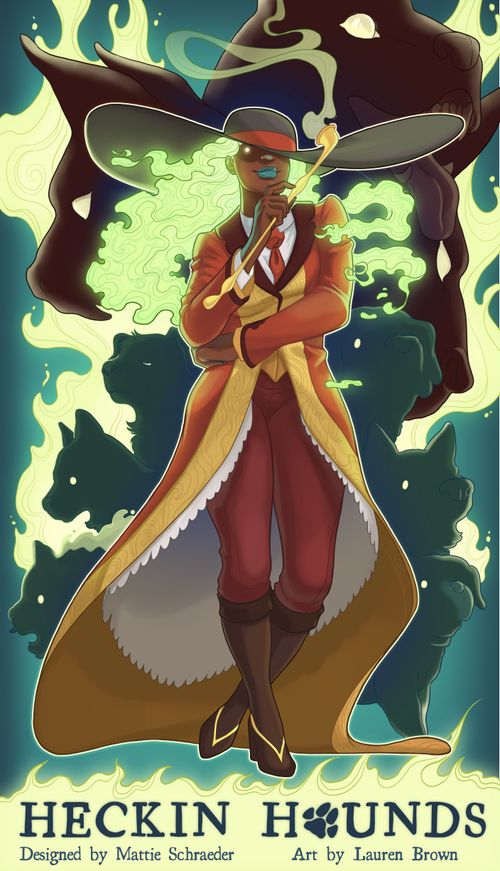
Heckin Hounds
Heckin Hounds Rulebook
Table of Contents
Table of Contents
Meet the Hounds
Mops was once the beloved pup of the Queen-Consort of France, Marie Antoinette. A life of silk bows, foie gras and tiny cakes spoiled her terribly, but even after losing her head in the revolution, she's a joy to walk.
Evil Molly's questionable taste in breakfast and love of heavy metal might make you think she's a real devil, but this sweet-faced darling is only a little evil. Just don't bring her into any pet stores...
Tom Dire ends walks on his own terms. You'll need to be even more stubborn than he is to get him through your route. Be sure to avoid the River Styx, because this obstinate pooch has a taste for its waters.
Sudachi's cousin, Kobasu, is quite the internet sensation! Poor Sudachi hates being left behind and has devoted his entire afterlife to going viral. Don't end up walking right into one of his flashmobs.
Paulgrave has published five novels, speaks three languages, and is a classically trained accordian player. She considers herself quite above going for a walk. Good luck getting a collar around her neck.
Deathpaw? Some of my previous employees have described him as evil incarnate, but I know my sweet baby is just lonely! Without any interested ladies to be found, he makes do with every toy and leg he sees.
Cerberus. Oh, Cerberus, my most darling and dangerous pup. He's the baddest boy I know, which is why he's tasked with guarding the gates of the underworld. No one escapes my realm -- my precious Cerberus sees to that.
Gameplay Overview
Heckin Hounds is a game that takes place over a series of rounds, each consisting of five shifts (tricks). Each round is overseen by a shift leader. The shift leader can see everyone's hand, including their own. Other players are unable to see their own hand nor can they see the shift leader's hand, but are able to see other players' hands. The shift leader gives three clues to each player about the dogs in their hands and how bad they are.
Players then take turns promising to work a number of shifts. Ideally they want to work as few shifts as possible. The round is scored based on how many shifts the player worked compared to how many shifts they promised to work. Working a shift that you didn't promise to work is unpaid overtime.
Finally, players take turns working a shift walking and taking care of dogs on behalf of Hades. Each shift consists of all players playing one card from their hand into the center of the table. The player that played the worst dog has to work that shift and collects the cards played into it.
Winning the Game
The game is won by the player who did the least amount of work without getting fired. If at the end of the game a player has done less work than they promised, they'll be fired. Unpaid overtime might get a player on Hades' good side, but ultimately is bad for their health. To win, each player needs to be as mediocre as possible.
Work too much one round? Slack off the next. Work too little? Better make it up. Otherwise, do exactly what is promised.
Components
- 95 Clue Tokens
- 45 Hound Cards
- Cerberus Card
- 7 Card Stands
- 21 Brown Promise Cubes
- Shift Leader Card
- Reference / Scoring Sheet
- 1 Black Bad Dog Cube
- 14 Meeples in 7 colors
Setup
- Place the reference/scoring sheet in the center of the table.
- Each player is assigned a color and receives the two meeples of that color. One meeple is placed on the center bar of the Employee of the Month tracker of the reference/scoring sheet and the other below the 0 at the badness tracker at the bottom of the reference/scoring sheet.
- Place the black bad dog cube on the reference sheet.
- Make a supply consisting of all of the clue tokens and a supply of all of the brown promise cubes near the reference/scoring sheet.
- Separate the five Mops hound cards numbered 1-5 from the deck and put them in a pile near the reference/scoring sheet face down. Note: These will be shuffled into the dead hand during the shift leader duties.
- Place the Cerberus card next to the pile of Mops cards.
- Give each player a card stand.
- Construct the kennel, a deck of hound cards that will be used to distribute work during the game. For each different hound, take cards numbered 1 to the number of players plus one and return the rest of the hounds to the box. Place the kennel near the reference/scoring sheet. For example: For 2 players, the kennel consists of cards numbered 1 through 3, and cards numbered 4-8 are removed, for 3 players the kennel consists of cards numbered 1-4 and cards numbered 5-8 are removed, etc.
- Whoever last walked a dog becomes the shift leader and takes the shift leader reference card. The shift leader then proceeds to follow each step on the shift leader card.
Shift Leader Duties
Each of the apprentice hound walkers will take a turn as shift leader. The shift leader is responsible for each duty on the shift leader card:
Shuffle and Deal
Shuffle the kennel, and deal five cards face down to each hound walker. Shuffle the remaining 5 cards with the stack of 5 mops cards and put them face down in the center of the table. This is the dead hand.
Reveal Cards
The shift leader is the only player able to see all the hounds that need to be walked. Their hand of five cards is placed in the card stand so that the cards are facing themself, and so no other player can see them. Each other player picks up their hand, careful not to reveal the cards in it, and places them in the card stand facing outwards so that every other player can see them.
Choose the Bad Dog
The shift leader chooses one hound to be extra bad and informs the rest of the players, optionally telling a story as to why that dog is being particularly bad. The black bad dog cube is placed on the reference sheet on the bar for that dog as a reminder. Players who walk this dog during a shift go up on the badness tracker, and this tracker is used to break ties at the end of the game.
Give Clues to Players
Since only the shift leader can see all players' cards, it is their responsibility to provide each player with as unhelpful, but still truthful, clues as they deem necessary. Each player is given 3 sets of clues, using the clue tokens. Each set of clues must be one of the following:
- Hound name/type (at least two cards, and all of that hound must be pointed out)
- Hound badness value (at least two cards, and all of that value must be pointed out)
- Both pieces of information about a single card.
Each set of clues must provide new information, but a single clue can lead to duplicate information having been given. If a player is told that they have two Tom Dires, the shift leader may also point out which one of them is a three and which is a four.
Assign Cerberus
Cerberus is the worst dog in the underworld to walk, but he must be walked nonetheless. The shift leader assigns one player, which can be themself, to be in charge of walking Cerberus. The chosen player discards one card of their choice from their card stand, face down out of the way without revealing it, replacing it with Cerberus. Do not put this card in the dead hand.
Trade with the Dead Hand
Each player, starting with the shift leader and proceeding clockwise, may optionally trade one card (but not Cerberus) with the dead hand. This card is set aside face down, a new card is drawn from the dead hand, and finally the set aside card is shuffled into the dead hand before the next player chooses to trade. Any player that chose to trade should then take one Mops token to help remind them which card they traded in, that now may or may not be Mops.
Players should not look at or reveal the card they are drawing from the dead hand. After all players have chosen whether to trade with the dead hand, players simultaneously reveal their traded cards by placing them in the card stands facing the same way as the rest of their cards.
Players Promise to Work Shifts
Each player, starting with the shift leader and proceeding clockwise, promises to work a number of shifts. They take a number of brown promise cubes equal to their promise, from 0 to a maximum of 5.
Players Work Shifts
Starting with the shift leader and proceeding clockwise, each player plays any card in their card stand face up into a shift. The player who played the hardest to walk hound must work that shift. The reference sheet provides a reminder from hardest to easiest to walk. Cerberus is harder to walk than Deathpaw, who is harder to walk than Paulgrave, and so forth. In the case of two of the same hound being played, the one with the higher badness value is the harder to walk.
The cards are collected and if any of those cards were the extra bad dog, the player moves up one space on the badness tracker for each extra bad dog that they had to walk. The cards are then placed face down in a pile in front of the player. If they have a promise cube available it is placed on the pile.
The player that worked the shift starts the next shift by playing the a card first, and this continues until all 5 shifts have been walked.
The Round is Scored
The shift leader tallies points on the Employee of the Month Tracker on the reference/scoring sheet based on how much work each player did. Starting with the shift leader and proceeding clockwise, each player announces their score, and the shift leader moves them either up or down on the Employee of the Month tracker.
Each extra shift that a player worked, meaning they had more piles of cards than promise cubes, moves the player up one space. If a player has more promise cubes than piles of cards, they instead go down one space for each leftover promise cube. Players who did exactly as much work as they promised do not change their position.
Shift Leader Changes
Pass the shift leader card clockwise. The new shift leader sets up a new round, following the setup rules. They then proceed to follow the steps on the shift leader card.
End of the Game
After each player has had a turn being shift leader, the game ends and final scores are tallied. For a two player game, each player should be shift leader twice.
The player with the lowest score, without being on probation, is the winner. In the case of a tie, the player who walked the least badness on the badness tracker is the winner. This player may go home early.
The player with the highest positive score is promoted to Houndmaster. In the case of a tie, the player who walked the most badness on the badness tracker is promoted. Congratulations on your dead end job! Hopefully you'll last longer than the previous one.
The player(s) who end the game on probation are fired, and are no longer allowed to walk Hades' hounds.
Everyone else? I admire your initiative ... and have much, much more work for you to do.
Short Single Round Game
There is no shift leader. One player is randomly selected to shuffle and deal. All players play with their hands facing outwards. Rather than having one player provide clues, each player takes turns giving a clue to a player of their choice until each player has been given three total sets of clues. You cannot bid zero. There is no extra bad dog to break ties, instead ties are broken by the total value of the dogs that were walked.
Memory Mode
Leave the clue tokens in the box. Players must now memorize the clues that they are given, and what cards they were given for.
Meet the Team
The game is created by Mattie Schraeder, an amazingly talented new designer who submitted her idea to us. When she isn't busy working on dog walking or hacker-themed games she is working in IT and serving on the board of directors for Geekway to the West. We look forward to seeing the other awesome games she conjurs up in the future!
The game is illustrated by Lauren A. Brown, a phenomenal artist with a specialty for the whimsical and the fantastical. Her credits range from various tabletop games to Emmy Award winning animated show Archer. Additional information and instances of her beautiful art can be viewed at www.labillustration.com
James Parsons is the awesome dude who feels awkward writing this description of himself. He owns Sapphire City Board Game Parlor, a board game cafe located in Northeast Ohio that added publishing to its bag of tricks out of boredom during the lockdown downtime of 2020.
Special thanks to our primary playtesters: Dannielle Pence, Kate Pence, Jenessa Farnsworth, Cody Bozarth.