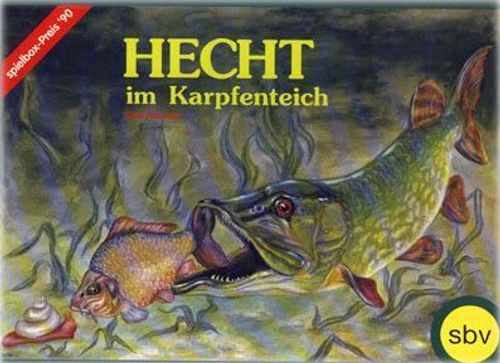
Hecht im Karpfenteich
Hecht im Karpfenteich Rulebook
Table of Contents
Table of Contents
Material
- Game board
- Rulebook
- 12 snail stones in light natural tone
- 14 carp stones in dark natural tone
- 36 pike stones: 6 each in red, yellow, blue, green, orange and white
- 36 chips for covering the action spaces on the edge of the game board
- 1 die
Object of the Game
Each player begins the game with two pikes. Their only purpose during the whole game is to eat carp and to reproduce. Love goes through the stomach, as is well known, and with fish it is no different. That is why the pikes hunt the carp on the game board. If a pike is full, it swims on to its nest and hopes to find a satisfied partner there, with whom it can then provide offspring together. Pikes of different players bring children of different colors into the world; as we know from the theory of heredity. Whoever has put the most pikes into the world at the end of the game wins.
Summary
Lay out the game board.
Distribute the material:
- In the shared supply: all snails and carp.
- Each player: 6 pikes of one color.
The Game Board
The game board shows a blue pond with hexagonal spaces. In its center lies an island, which the fish naturally never enter. The six arrow spaces at the edge of the pond are connected to one another by channels. There are 6 nests on the water surface: 3 green ones for the pikes and 3 brown ones for the carp. In addition, there are 12 snail spaces in the pond.
Setup
The game board is laid out. Snails and carp belong to all players jointly. They are placed as a supply next to the game board, within easy reach. One carp is placed in each of the 3 carp nests. The snails do not come into play until later.
Each player chooses a starting position (2 adjacent spaces) and takes the pikes of one color. Two of them are placed on the starting spaces; the rest are kept in front of the player as a supply. In addition, each player receives 6 chips for covering the action spaces.
The players may try to distribute the starting positions as evenly as possible; this is not strictly necessary. If two players are playing, they must start in adjacent pond sections.
Starting layout:
- Each player: 2 pikes on the starting spaces (use the starting spaces).
- In each carp nest: 1 carp.
Turn order passes clockwise.
Each turn:
- 7 movement points for carp and your own pikes, plus 1 action.
Turn Sequence
The starting player is determined by lot; the others follow clockwise around the table.
On his turn, the player has 7 movement points available, which he may distribute as he likes among his own pikes and the carp. It is not necessary to use all movement points. Snails do not move.
Before, during, or at the end of his turn, the player must carry out one action.
Movement of the Fish
Fish move from space to space; each step costs one movement point. From one of the arrow spaces a fish may jump directly to the next arrow space, which costs only one movement point. The channels thus represent fast connecting routes between the pond segments.
A fish may move across occupied spaces, but may not stop on them, except in order to eat.
Hungry and Sated Fish
A single pike or carp stone is always a hungry fish.
A hungry carp eats a snail by standing on a snail stone.
A hungry pike eats a carp by standing on the carp stone. (If the carp still has a snail stone beneath it, that snail stone returns to the supply.)
A sated fish carries the food stone it has eaten underneath itself. Both stones are moved together (without additional movement points) until the fish reaches a suitable nest. There it becomes hungry again only through a reproduction action, and the eaten stone returns to the supply.
Example: how to move with sated fish. = 2 movement points
Diagrams: a hungry pike eats a carp; a carp eats a snail.
Nests
Fish swim into nests to reproduce. Special rules apply to entering nests:
- Pikes never swim into carp nests, and carp never swim into pike nests (except in the eaten state).
- Only sated fish may be moved into a nest.
- As long as there are still hungry fish in a nest, no other (sated) fish may swim into that nest.
- If a nest is occupied by a breeding pair (= two sated fish), no further fish may be moved into that nest.
- Nests are not thoroughfare spaces. A (sated) fish that has swum into a nest may not leave it again in the same turn.
- As long as only three carp are in the pond at the start, not all 3 carp nests may be occupied by a sated carp each. The third (sated) carp must then be moved to one of the two other carp in its nest.
- If no more than 4 carp are on the game board, they may not be eaten by the pikes.
Imagine that the pikes cannot track down the remaining carp when only such a small stock is left.
Diagrams: "Only carp swim into carp nests! Only pikes swim into pike nests! Only sated animals!!" – "A breeding pair must not be disturbed." – "Nests are not thoroughfare spaces. 4 carp must always remain!"
Performing Actions
Before, during, or at the end of his turn, the player must carry out an action (no more and no less). Each player has six different options to choose from. When he has finished one of them, he covers the corresponding symbol of his color on the game board with a black chip.
Covered actions may no longer be carried out. Only when all symbols are covered are the chips removed again, and all actions become available again.
The player decides for himself which of his remaining open actions he wants to use. If carrying out an action is not possible at that moment, the action has no effect, but the corresponding symbol space must nevertheless be covered.
Actions: each turn, you must carry out one action that is still open. Cover the action symbol!
Meaning of the Action Spaces
Snail: The player takes a snail stone from the supply and places it on any free snail space.
Star: skip once. Whoever chooses this action must skip. This action is only possible at the start of the turn. Skip (must be played once per round!).
Wave: turn extension. The player receives 7 further movement points for this turn, so 14 in total. 14 movement points.
Reproduction of Pikes and Carp
Largely the same rules apply to both kinds of fish. The following conditions must be met before the reproduction action is possible at all:
- A nest must contain exactly two sated fish (pikes or carp, respectively). They form a breeding pair.
- Apart from the breeding pair, no other fish may be in the nest.
A reproduction action leads to reproduction in all nests of the respective fish type in which the conditions are met.
The parent animals become hungry again through reproduction. The eaten carp or snails return to the supply.
Reproduction: only in this way.
Pike reproduction: Two new pike stones are placed in the nest from the supply of the player who owns the parent animals. If the breeding pair consists of two differently colored pikes, each of the participating players places one new pike of his own color in the nest.
After a pike reproduction, each of the participating players must first use his next movement points to clear the pike nest. The action "skip once" can block a pike nest for one turn.
2 sated pikes + pike reproduction action = 4 hungry pikes (2 old and two new pikes). On the next turn: clear the pike nest!
Carp reproduction: The number of new carp is determined by rolling the die. They are taken from the supply and placed in the nest. If reproduction takes place in several nests at once, the die is rolled separately for each nest. Before rolling, the player announces for which nest he is rolling.
Carp reproduction: roll the die for the number of new carp.
Emigration
A pike may be drawn out of the game board over the arrow spaces – it emigrates. The single step out of the game board counts as one movement point. Each emigrated pike is credited to its player and counts in the final scoring. From the next turn on, the emigrated pike may be brought back into the game by a reproduction action.
Emigration: a pike emigrating over the arrow spaces is drawn out to the outside. Important: note every emigrated pike! Emigrated pikes can be brought back into the game as new pikes through pike reproduction.
Imagine the pike had emigrated via a waterway into another lake.
Shortage of Material
If there is not enough material in the supply to carry out a turn in full, the part that cannot be carried out is forfeited. When several possibilities exist, the player whose turn it is decides how the scarce material is distributed.
Example: In two nests the carp reproduce at the same time. The player rolls a "5" and a "4", but there are only eight carp left in the supply. The player may now decide for himself in which nest fewer carp are placed.
It becomes especially embarrassing for a player when he could actually carry out a pike reproduction, but does not have enough pike stones in the supply because he did not provide in time for emigration! He can then only place as many new pikes as his supply allows. The rest is forfeited.
Game Rounds
As soon as each player has carried out all 6 actions (that is, all 6 symbol spaces are covered with chips), a game round has ended. All action spaces are uncovered again. This begins a new game round, in which all players again have all 6 action options available.
End of the Game
The game ends:
- with 2 players after 4 rounds;
- with 3 players after 3 rounds;
- with 4–6 players after 2 rounds.
The last round is over as soon as no player has a pike reproduction action left open. The player who carries out the last pike reproduction may still finish his turn; then the scoring takes place.
End of the game after 2–4 rounds.
Scoring
Each player counts his pikes on the board and his emigrated pikes. Pikes in the supply are not counted.
The player with the most pikes wins.
In a tie, the sated pikes decide (emigrated pikes are hungry!). If the tie remains, the players share the victory.