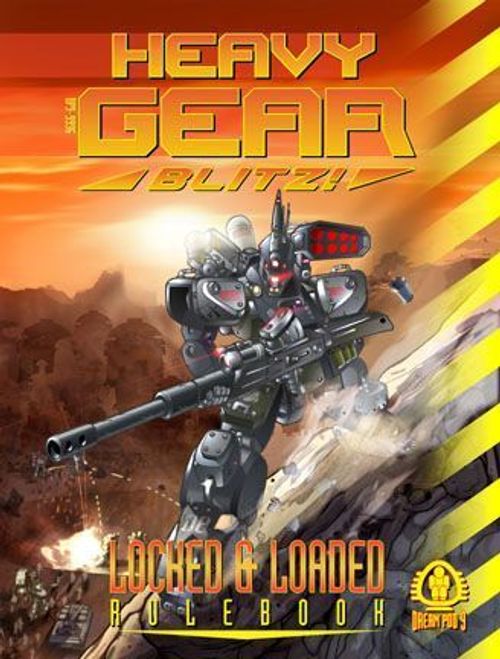
Heavy Gear Blitz! Locked & Loaded
Heavy Gear Blitz! Locked & Loaded Rulebook
Table of Contents
Table of Contents
Dice and Rolling
Dice rolls are made with regular six-sided dice. When a roll is called for, the number of dice to roll will be specified as a Skill. Roll a number of dice equal to the specified Skill and the result of the roll is the highest result on any single die. If multiple 6s are rolled, add 1 to the result for each extra 6. If all dice come up 1, the result is a Fumble, and counts as a result of 0. No modifiers ever apply to a Fumble.
Example: You roll two dice, which come up with 3 and 5. The result of the roll is 5.
Example: You roll three dice, which come up 6, 6, and 1. The result of the roll is 7.
Dice rolls will be made against either Thresholds or other dice rolls.
If rolling against a specified Threshold, the roll is a success if the result is higher than the Threshold, and a failure if the result is less than or equal to the Threshold.
When rolling against another dice roll (when shooting, for example), one player will be designated the attacker and the other the defender. If the attacker's result is higher than the defender's, the attacker has succeeded. If the attacker's result is less than or equal to the defender's, the attack has failed.
If a dice roll succeeds, the Margin of Success (MoS) is the dice roll minus the Threshold or the defender's roll. If it fails, the Margin of Failure (MoF) is the Threshold or the defender's roll minus the attacker's roll.
Unless otherwise stated in the starter army lists, Skill values for Attack and Defense are Level 2 and Electronic Warfare is Level 1.
Game Setup
In order to play a game of Heavy Gear Blitz, you'll want a tabletop or other flat playing area about 4 feet by 4 feet. While it's not necessary, having some terrain will make your battles much more interesting. Practically anything can be pressed into service as terrain. Food containers can serve as buildings, upturned bowls as hills, office supplies as rocks or small walls. Terrain from other miniature wargames works fine too. Heavy Gear uses 1/144th scale terrain, which is close to N scale terrain and models.
Once you've got the terrain arranged to the satisfaction of both players, you can start setting up your Gears. Each player should pick opposite edges of the table and place their Gears within 1 foot of this edge. Placing them facing your opponent is strongly recommended.
Rounds
Once you've both finished deploying your Gears, gameplay proceeds in a series of rounds. The length of a round isn't fixed.
When acting, your Models will move and act one at a time.
To decide who goes first, both players roll one dice at the start of each round. Whoever rolls higher gets to decide who goes first that round. If the results are the same, re-roll.
All of a player's Gears are organized into Combat Groups of up to six Gears. Starting with the player going first this round, the two players alternate activating Combat Groups. When a Combat Group is activated, the Gears in that Combat Group move and act one at a time.
When a model has completed its activation, it is 'Used' and cannot move again until the next round. Each Gear must finish moving and any actions (or holding their Action) before another Gear can start. If another Gear in the group moves or acts, any prior Gear is Used, and may not complete any unfinished actions or movement.
Movement
Gears and other vehicles move using Movement Points (MPs). The number of MPs available to a Gear is determined by its current speed (Stationary, Combat Speed, or Top Speed) and its movement mode (Walker or Ground), and is listed on its card.
Vehicles may change their speed and their movement mode one per turn before moving. Speed may only be changed by one level up or down, so a vehicle must spend a turn at Combat Speed between Top Speed and Stationary. Vehicles at Top Speed must spend at least their Combat Speed MP allowance or shift to Combat Speed. If a vehicle changes movement modes, its MP limit for the turn is always equal to the model's current speed.
Additionally, moving at Top Speed requires the model to use an action. (See Actions.)
Use the following terrain table to determine how many MPs it costs for a Gear to move 1 inch in the given type of terrain using its current movement type.
| Terrain | Walker | Ground |
|---|---|---|
| Clear | 1 MP | 2 MP |
| Rough | 3 MP | 3 MP |
| Sand | 1 MP | 3 MP |
| Woods | 2 MP | 3 MP |
Source note: the text layer flattened this table, so the Walker and Ground pairings above are read from the order of the printed values.
Hills are divided into 1 inch high increments called elevation levels. Moving up one level costs 2 MP. Moving downhill costs 1 MP. This only pays for the cost of moving up the hill, not into the terrain on it.
Vehicles also have a facing. Clearly designate one side of the miniature's base as its front. Facing determines how the vehicle can move and how it takes damage.
- Ground Mode at Combat Speed can only move forward, and can make one free turn of 60 degrees for every 2 inches moved.
- Ground Mode at Top Speed can only move forward, and can make one free turn of up to 60 degrees for every 3 inches moved.
- Walker Mode at Combat Speed can move in any direction and can turn freely at no MP cost.
- Walker Mode at Top Speed moves like Ground Vehicles at Combat Speed.
- Stationary Gears may move 1 inch in any direction (adjusting their position) and can turn freely.
Actions and Attacking
The main Action your Gears will be taking is attacking their enemies. Each Gear can attack once per round at any point during its movement. Gears may not attack once they are Used, with the exception of Reaction Fire. A Gear that spent its only action to move at Top Speed may also not attack.
When attacking, the attacker rolls a number of dice equal to its Attack Skill and the defender rolls a number of dice equal to its Defense Skill. If the attacker wins, the attack hits and will deal damage. If the defender wins, the attack misses.
A number of modifiers can apply to the attacker's or defender's rolls. Add these to the final result before comparing the two rolls.
Weapon Arcs
In order to attack a target, it must be inside the weapon's arc, which determines the direction it can fire in.
- FRONT ARC (F) is the front 180 degrees (3 faces) of the Gear's Hex base.
- FIXED FRONT (Ff) is the front center 90 degrees (middle front face).
- REAR (Rr) is the back 180 degrees (3 faces) of the Gear's Hex base.
- FIXED REAR (FRr) is the back center 90 degrees (middle back face).
The printed quickstart includes diagrams of the 90 degree and 180 degree arcs of attack, which are not reproduced here.
Attack Modifiers
These modifiers apply to the attacker's roll.
Range. Each weapon has five range bands, expressed in inches: Point-Blank, Short, Medium, Long and Extreme. Measure the distance to the target, and use this to find the appropriate range band.
| Range band | Modifier |
|---|---|
| Point-Blank | +1 |
| Short | +0 |
| Medium | -1 |
| Long | -2 |
| Extreme | -3 |
Attacker's Movement Modifier and Weapon Accuracy. Both are listed on the Model's card. The Attacker's Movement Modifier depends on the Model's speed, while Weapon Accuracy depends on the weapon chosen.
Example: Joe Gear opens fire with his LAC on the scum that murdered his brother. Joe rolls a 5, his opponent rolls a 2. They're at Medium Range and both are Hunters at Walker Combat Speed. Joe's modified roll is a 4 and his opponent's is a 1, giving Joe an MoS of 3.
Cover
Cover is measured from a Model's-eye view from the attacker. There are four levels:
- Open Target. If the target is not blocked at all, the attacker gains a +1 to the attack roll.
- Some Cover. If the target Model is up to half covered, but can still be seen easily, there is no Cover Modifier (+0).
- Partial Cover. If the Model is more than half hidden but you can see the main body, there is a -1 modifier to all attacks against the target Model.
- Full Cover. If the target Model is fully hidden, there is a -2 to attack the target Model. A Model with only a weapon or part of a limb showing is considered fully hidden.
| Cover | Modifier |
|---|---|
| Some Cover | +0 |
| Partial Cover | -1 |
| Full Cover | -2 |
Defense Modifiers
These modifiers apply to the defender's roll.
- Defender's Movement Modifier. These are listed on the Model's card, and vary based on movement mode and speed.
- Angle of Attack. -1 against attacks from attackers in the Rear arc (back half of the miniature).
Rate of Fire
Some weapons can fire much faster than others. These weapons have a Rate of Fire (RoF) noted along with a rating. When attacking with such a weapon, you can choose to use any amount of RoF from 0 (single shots, resolved just like a normal attack) all the way up to the weapon's RoF rating.
RoF points may be used on two things:
- Spray Fire. RoF used on Spray Fire makes the attack cover a larger area. Each RoF point used here increases the Spray Fire Area by one, starting from zero. All targets, friendly and enemy, within the Spray Fire Area must roll to defend against the attack and take damage if hit. All Attacker and Defender modifiers are determined individually for each target.
- Concentrated Fire. Points used on Concentrated Fire increase the attack's damage. Each RoF point used here increases the weapon's DM by one.
RoF may only be used on attacks against targets in the weapon's long range band or closer.
Indirect Fire
Weapons with Indirect Fire (IF) can be launched over obstructions to strike at an enemy without fear of retaliation. This requires a spotter, or forward observer.
To act as a spotter, a friendly Model must spend an action on forward observation to mark a specific enemy Model for friendly IF attacks for the remainder of the round (or until the target moves). The observer must be able to see the Model. Once a Model is marked, any friendly Model acting at a later point in the round may perform Indirect Fire against it as their action.
The attacking Model rolls a number of dice equal to its Attack Skill versus a Threshold of 4, modified for Range, Attack Modifier, and Weapon Accuracy for the Model performing the IF Attack, and Cover between the spotter and the target point. A success means that it has struck the target point; a failure indicates a scatter.
If the attack scatters, roll 1 dice and count clockwise in 60 degree increments from a line between attacker and target point. The landing point is moved a number of inches equal to the MoF in the indicated direction. Any target under the landing point must defend (as in Ranged Attacks) against the unmodified attack roll. Area Effect modifies this normally.
Area Effect
Area Effect (AE) weapons attack using a large blast that covers a wide area. The AE weapon has a listed rating, which is the radius of the area effect in inches. Every target, friendly and enemy, within the area effect must defend against the attack and take damage if hit. The attack always comes from the direction of the attacking Model.
Hand Grenades
Hand Grenades use the IF rules, but do not require a spotter. They can be thrown at any target the throwing Model can see. Treat the Model as its own spotter for the purpose of modifiers.
Grenades have only two ranges:
- Short (+0 modifier) = Attacker's Size in inches.
- Medium (-1 modifier) = Size x 2.
Other Weapons and Traits
There are other weapons, like Melee weapons (such as Vibro Blades) as well as other traits and ratings on weapons, like Anti-Infantry (AI), that are not used in the Quickstart rules.
Damage
When an attack strikes a target, that target may take damage. Multiply the attack's MoS by the Damage Multiplier (DM) of the weapon used. The result is the attack's damage.
Compare the damage to the target's Armor, and use the following table to determine the effects.
| Damage vs. Armor | Effect |
|---|---|
| Dam < Armor | No effect |
| Dam >= Armor | 1 box of damage |
| Dam >= 2x Armor | 2 boxes of damage |
| Dam >= 3x Armor | Overkill |
Cross off the appropriate number of boxes from the target's damage track. If the target is overkilled, it is instantly and explosively destroyed and removed from the table. Otherwise, the effects of the damage depend on the last box crossed off.
The damage track has four boxes, in order: Sturdy, Light, Heavy, Critical.
- Sturdy: No additional effects.
- Light: No effect in these Quickstart rules.
- Heavy: The target has a -1 penalty to all rolls, and cannot travel at Top Speed.
- Critical: The target has a -2 penalty to all rolls, and cannot travel at Top Speed. If the Gear takes any damage beyond its Critical box, it is destroyed. Tip it over and treat it as Rough Terrain.
Example: Joe Gear has hit an enemy Hunter with a LAC for an MoS of 3. The LAC has a DM of x8, so Joe Gear does 24 points of damage. Against a Hunter's 15 points of armor, that's enough to do one box of damage. If Joe Gear had been very lucky on his roll, he might have managed an MoS of 6 instead of 3. This would've done 48 points of damage, instantly destroying the enemy Hunter!
Other Actions
The following Actions show a limited number of the many options available in the full rules. Many of these require the Models to have saved an Action.
Reaction Fire
If a Model has saved its Action, it may respond to any currently Moving Model by spending the Action to make a Ranged Attack. A Model may be acted against at most once per inch moved on the table or per Action performed. For an inactive Model to do so, the inactive Model must declare it will spend an Action to React.
The Reaction Fire occurs after the next inch of Movement (when movement ends if the Model keeps moving but stops at less than a full inch) or the next Action performed by the Active Model.
ECM
A Model with the ECM Perk may attempt to block a Forward Observation by spending an Action. This can be attempted by a Model that can see the enemy attempting the Forward Observation. This turns it into an opposed roll. Both sides roll a number of dice equal to their EW Skill and add their Comm rating as a modifier. The Model with ECM adds in the ECM Rating. If the blocking Model rolls higher, the Observation does not take place. Any Actions used will still be spent.
Perks and Flaws
Many Models have special qualities or equipment. These are their Perks and Flaws. Examples include:
- Autopilot. The Model has a more sophisticated autopilot, capable of basic piloting even under combat conditions. It may turn on its Autopilot at the start of the round. It only rolls 1 dice for defense that turn, but may make a second attack.
- Reinforced Arc. The Model has one arc that is Reinforced. Add the value of this Perk to the Armor of the vehicle against attacks made from that Arc.
- Weak Facing. One of the Model's facings has inadequate protection, camera coverage or is otherwise poorly defended. Add 2 to the MoS of any successful attack (including MoF 0) coming from that facing.
Starter Forces
Each starter force is built to a Threat Value (TV) of 610 or less at Priority Level 1. Stats are listed per model in the order printed on the force card (Attack, Defense, Electronic Warfare, Leadership). An asterisk (*) marks the Squad Leader, who is also the Army Commander.
Peace River Starter Force (610 TV)
Combat Group 1: General Purpose Squad (245 TV)
- 4x Warrior: ATT 2, DEF 2, EW 1, LD 0
- 1x Warrior Chieftain*: ATT 2, DEF 2, EW 2, LD 2
Any model in Combat Group 1 may upgrade its Light Autocannon (LAC) to a Medium Autocannon (MAC, Forward arc, Reloads) for +5 TV. Up to two Models may upgrade their LAC to a Frag Cannon (FGC, Forward arc, Reloads) or a Rapid Fire Bazooka (RFB, Forward arc, Reloads) for +5 TV each. If a Model upgrades to a FGC, its Hand Grenades are upgraded to Heavy Hand Grenades.
Combat Group 2: Fire Support Squad (335 TV, +30 TV Leader Upgrade = 365 TV)
- 2x Warrior: ATT 2, DEF 2, EW 1, LD 0
- 2x Crusader IV: ATT 2, DEF 2, EW 1, LD 0
- 1x Warrior IV*: ATT 2, DEF 3, EW 3, LD 3
One or both Crusaders may upgrade their Heavy Autocannon (HAC) to a Medium Bazooka (MBZK, Forward arc, Reloads) for +10 TV each. Any Model with a LAC may upgrade it to a MAC from the GP Squad (MAC, Forward arc, Reloads) for +5 TV each. Up to two Models with a LAC may upgrade it to a Rapid Fire Bazooka (RFB, Forward arc, Reloads) from the GP Squad for +5 TV each.
Tactics. Paxton's largest strength is the near complete dominance of the airwaves with every Model having some form of ECM. This means their Squads are more expensive, but well skilled, with high Leadership throughout and they do well at denial-styled missions when they must prevent others from doing something. However, due to the higher Threat Value of their squads, their abilities start to shine best in larger games, even though they will be outnumbered.
Notes. While three Warriors have Armored Jackets (extra Sturdy Box each), it is recommended you count them as not having them when first playing. These Models may be used in the Fire Support Squad instead of the normal Warriors. The Armored Jackets cost +10 TV each. It is recommended that you play a few games with the defaults listed before deciding on what weapon options you wish to affix to your Models.
Northern Starter Force (610 TV)
Combat Group 1: General Purpose Squad (225 TV: 205 TV +20 TV of weapons)
- 4x Hunter: ATT 2, DEF 2, EW 1, LD 0
- 1x HeadHunter*: ATT 2, DEF 2, EW 1, LD 1
Two models have upgraded their Light Autocannon (LAC) to a Medium Autocannon (MAC, Forward arc, Reloads), Frag Cannon (FGC, Forward arc, Reloads) or a Snub Cannon (SC, Forward arc, Limited Ammo 3, remove Light Rocket Pack). Both of the models who upgraded their weapons have Heavy Panzerfausts (HPZF, Forward arc, Limited Ammo 2).
Combat Group 2: Fire Support Squad (305 TV: 295 TV +10 TV of weapons)
- 2x Hunter: ATT 2, DEF 2, EW 1, LD 0
- 2x Grizzly: ATT 2, DEF 2, EW 1, LD 0
- 1x Jaguar*: ATT 2, DEF 3, EW 1, LD 1
One Grizzly has upgraded its Heavy Autocannon (HAC) to a Medium Bazooka (MBZK, Forward arc, Reloads). One additional Grizzly may upgrade its HAC to a MBZK as above for +10 TV.
Tactics. While the starter force is built mostly from generalists, the North tends to specialize their loadout or use specialist vehicles in squads to create Combat Groups that form a whole greater than the sum of their parts. This can be demanding from a player's perspective, but a well planned attack with synergized squads will complete objectives easily. As a Northern player you must remain focused and plan well ahead. In larger games, you can easily bring a squad or two for each role.
Notes. Choose one Squad to be the command squad and gain Veteran upgrades. Their Attack and Defense become 3. The Squad Leader becomes the Army Commander and gains Attack 3, Defense 4, Electronic Warfare 1, Leadership 3. This costs 80 TV. It is recommended that you play a few games before deciding on what weapon options you wish to affix to your Models.
Southern Starter Force (595 TV)
Combat Group 1: Veteran General Purpose Cadre (305 TV: 160 TV +100 TV for skill upgrades +30 TV for vehicle upgrades +15 TV for weapons)
- 3x Jäger: ATT 3, DEF 3, EW 1, LD 0
- 1x Stripped-Down Jäger: ATT 3, DEF 3, EW 1, LD 0
- 1x Command Jäger*: ATT 4, DEF 4, EW 2, LD 3
One Model other than the Stripped-Down Jäger has replaced its Light Autocannon (LAC) with a Paratroop Rifle (LAC + LGL, Forward arc, reloads on LAC only) and one has replaced its LAC with a Medium Autocannon (MAC, Forward arc, reloads).
Combat Group 2: Fire Support Cadre (290 TV: 280 TV +5 TV for Command Upgrade +5 TV for weapons)
- 3x Spitting Cobra: ATT 2, DEF 2, EW 1, LD 0
- 1x Command Jäger*: ATT 2, DEF 2, EW 1, LD 1
The Command Jäger has replaced its Anti-personnel Grenade Launcher (APGL) with an Anti-personnel Mortar (APM, F, no Reloads). Any Spitting Cobras may swap its Heavy Autocannon (HAC) and Light Guided Mortar (LGM) for a Medium Bazooka (Forward arc, no reloads) for -5 TV, swap its Heavy Rocket Pack (HRP) and LGM for a Very Light Field Gun (VLFG, Fixed Forward arc, no reloads), or swap its HAC and Medium Rocket Pack (MRP) for a Very Heavy Autocannon (VHAC, Forward arc, no reloads).
Tactics. The Southern MILICIA army is made up of generalists for the most part. Every model is in some way shape or form a commando-style unit capable of doing a multitude of roles, but not necessarily all at once. Your heavy gears are often good for laying down vast quantities of area attacks, but you must be careful to avoid tight quarters where these attacks will hurt your own people.
Notes. Most Southern options involve a lot of swapping of weapons. Play a few games and try out the weapon options before affixing the weaponry to your models.
QuickStart Armory
The quickstart armory lists the weapons used by the starter forces. The text layer of the source scrambles its table: the numeric columns (Accuracy, the Point-Blank to Extreme range bands, and the Damage Multiplier) and the per-weapon ability tags cannot be reliably matched to their rows, so they are not transcribed here. The weapons named in the armory, by code, are:
LAC (Light Autocannon), MAC (Medium Autocannon), HAC (Heavy Autocannon), VHAC (Very Heavy Autocannon), LMG (Light Machine Gun), HMG (Heavy Machine Gun), MBZK (Medium Bazooka), RFB (Rapid-Fire Bazooka), DPG (Deployable Pack Gun), SC (Snub Cannon), FGC (Fragmentation Cannon), VLFG (Very Light Field Gun), HPZF (Heavy Panzerfaust), LRP (Light Rocket Pack), MRP (Medium Rocket Pack), HRP (Heavy Rocket Pack), APGL (Anti-Personnel Grenade Launcher), APM (Anti-Personnel Mortar), LFM (Light Field Mortar), LGM (Light Guided Mortar), HGM (Heavy Guided Mortar), VA (Vibroaxe), VB (Vibroblade), CR (Combat Reinforcement), HG (Hand Grenade), HHG (Heavy Hand Grenade), PZF (Panzerfausts), and LAC + LGL (Paratroop Rifle).
The armory's ability tags, such as IF, AI, AE and MR, are used by the full rules; the armory entries in this source are not reliable enough to assign them, so refer to the printed armory for the complete weapon profiles.
Transcription Notes
The following changes were made to the source text. Each is a correction of an obvious typographical error or a text-layer artifact, not a rules change.
- Apostrophes dropped by the text layer (for example "youre", "attackers", "Gears" possessives) were restored.
- "Defense Skil" was read as "Defense Skill", and the Margin of Failure sentence's "attackers role" as "attacker's roll".
- The contested-roll sentence reads "If the attacker's result is less than or equal to the attacker". It has been transcribed as "less than or equal to the defender's", since the sentence describes the defender winning; the source's wording is an error.
- The damage track diagram is garbled in the source. The track is transcribed from the labels printed beside it (Sturdy, Light, Heavy, Critical).
- The umlaut in "Jäger" was dropped by the text layer and has been restored; the source prints "Jger".
- The terrain table's Walker and Ground pairings are inferred from column order (see Movement).
- The sales blurb at the end of the quickstart and the arc diagram captions are not reproduced.