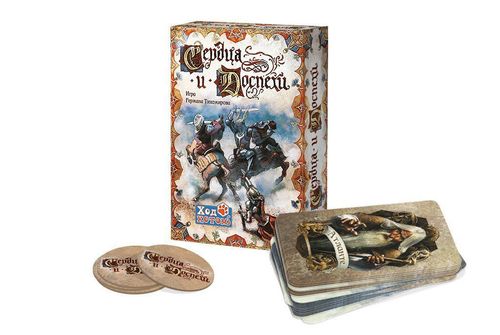
Hearts and Armour
Hearts and Armour Rulebook
Table of Contents
Table of Contents
Components
- Knights of one side — 4
- Knights of the other side — 4
- Wizard — 1
- Personal goal cards — 10
- Action cards — 29
- Victory tokens — 12
Rules for an Even Number of Players (recommended for the first game)
Setup
- Set aside all cards with the wizard. They will not be used in this game.
- Choose the heroes who will take part in the game. Each side must have the same number of heroes in the game. All hero cards that are not taking part in the game, and the goal cards with them, are removed from the game.
- Each player receives a hero card. These cards are laid out in front of the players, coloured side up, so that everyone can see them well. Knights of different sides must sit alternating (one of each side in turn around the table).
- From the personal goal cards showing the heroes taking part in the game, form the goal decks. Each knight receives one goal card with a back matching the pattern on the opponent's cards. It signifies sympathy for one of the opposing knights (what this means — friendship, love, a vow for saving a life — the player may decide for themselves). The goal card is kept secret from the other players. A player cannot win if this hero dies.
- Each player receives 3 action cards.
Turn Order
Players take turns clockwise, so that the sides alternate.
The first player is the one who last watched a film or read a book about knights.
Playing a Turn
On their turn a player must do one of three things:
- Play a card face down on any hero (an opponent's or their own, including on themselves).
- Play a card face up on any other hero (an opponent's or their own, but not on themselves) and carry out that card's extra action.
- Declare the start of a clash. This may only be done after every player has played at least one card, that is, after at least one full round of the game has been completed.
An extra action applies only at the moment the card is played, and only if the card is played face up.
If a hero has no cards, he is obliged to declare the start of a clash.
Card Extra Actions
- Move: Move an action card previously played on this hero to any other hero, including oneself. The card is moved in the same state in which it was played: if it was played face down, it stays face down.
- Discard: Discard an action card previously played on this hero. If the card was face down, it is not revealed when discarded.
- Take: Take a card previously played on this hero into your own hand, or pass it into the hand of any other hero.
Played cards remain lying in front of the player on whom they were played, so that everyone can see them.
The Clash
When a clash occurs, all face-down action cards are revealed, and the outcome is determined for each hero. From the number of swords played on a hero, subtract the number of shields played on him. All remaining swords inflict wounds, one for each sword. One or two wounds — the knight is wounded. A third wound — the knight is killed.
Outcome of the Clash
If after the clash no hero has been killed, a new round begins. Goal cards are not revealed and remain with those to whom they were dealt at the start of the game.
Wounded heroes remain wounded in the new round, and these wounds can no longer be cancelled by shield cards. Mark each wound with one action card showing the corresponding number of swords, tucked under the hero card.
Return all played cards and the cards left in players' hands to the action deck, shuffle, and deal action cards anew. Wounded heroes receive one card fewer for each wound.
The first player is the one sitting next in clockwise order after the player who declared the last clash.
If at least one hero has died, the game ends and a winner is determined.
Determining the Winners
For convenience, turn the cards of killed heroes over to their black-and-white side.
The winners are determined in two stages:
- Determining the winning side.
- Determining the winners among the winning side.
The winning side is determined by the number of opponents killed. The side that suffered fewer losses from death wins. If the numbers are equal, the number of wounds on the surviving heroes is compared, and the side that inflicted more wounds on its opponents wins.
All heroes of the losing side lose the game, regardless of any other conditions. In the case of a draw, everyone wins except those whose "sympathies" were killed.
Within the winning side, the players reveal their goal cards. Players who did not fulfil the conditions of their goal card also lose.
In other words, to win, a player must fulfil both conditions: be on the winning side, and keep alive the opponent whose card they received at the start of the game.
Note: the death of the hero himself does not mean his loss. If his side won, and the opponent whose card he received survived, the hero wins. For a noble knight, duty and honour matter more than his own life!
Rules for an Odd Number of Players
In this variant all the rules for an even number of players apply, but a new character now appears in the game: the wizard. Add three wizard cards (the wizard's hero card and two goal cards).
The wizard receives two personal goal cards, each with one of two knights from opposite sides.
The wizard plays by the same rules as the other knights, except that he receives 5 action cards and dies only after 5 wounds.
To win, the wizard must ensure that both heroes whose goal cards he received survive. Unlike the knights, he must also survive himself.
Note: if after a round only the wizard dies, the game ends, and only those heroes whose goal was to kill him win.
Setup
- Deal the hero cards. One of the players receives the wizard card. He must sit between knights of different sides.
- Shuffle the goal decks as usual, without the wizard cards. The wizard draws one card from each deck.
- Shuffle one wizard card into each deck. Now all the remaining heroes receive one card each.
- All knights receive 3 action cards each. The wizard receives 5 action cards.
Knights who received a goal card showing the wizard seek to destroy this hero. Each of them wins if both of the following conditions are met: their side won, and the wizard was killed.
Game on Points
Play several games in a row under the general rules. All the winners of each game receive a victory token. The players who first collect three victories win.
If you are playing with the wizard, in each following game the role of the wizard passes around the circle clockwise.
In each new game, the first player is the one sitting to the left of the player who declared the last clash.
The idea for this game was inspired by the poem "Orlando Furioso" by Ludovico Ariosto, written in the first half of the 16th century.