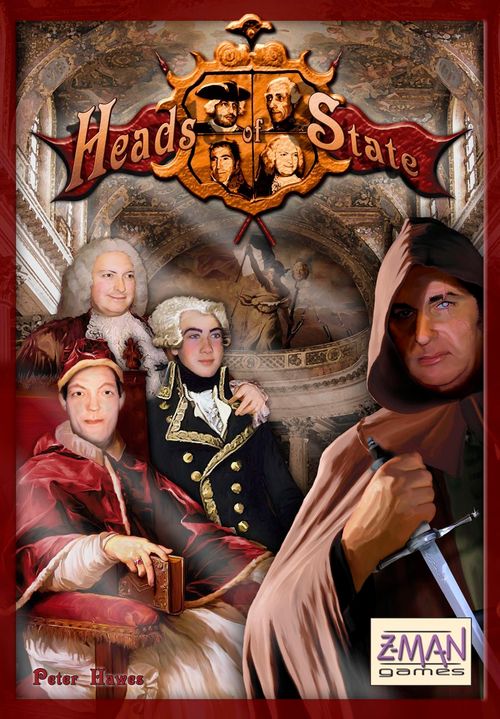
Heads of State
Heads of State Rulebook
Table of Contents
Table of Contents
Contents
- 1 Rule Book
- 1 Black Bag
- 1 Game-Board
- 1 Turn Marker
- 1 Revolution Card
- 1 Revolution Disc
- 70 Noble Cards
- 100 Attribute Cards
- 29 Treachery Cards
- 5 Noble Attribute Charts
- 16 Initial Scoring Markers
- 8 Country Scoring Markers
- 3 Noble House Scoring Markers
- 24 End of Turn Scoring Markers
- 160 Noble Counters (32 in each of the 5 player colours)
- 20 Player Cubes (4 in each of the 5 player colours - 3 smaller player cubes and 1 larger player scoring cube)
Idea of Play
Each player, as head of an influential family, attempts to establish as many nobles as possible across the 4 countries on the board. No player owns any particular country at the start of the game and players are free to create nobles in any empty boxes on the board. Each box has an icon that shows which noble may be created there. Players collect Attribute Cards and consult their Noble Attribute Charts to see what sets of cards are needed to create each of the 7 types of nobles. When the player has the necessary cards, he plays them and creates a particular noble (eg. a King) and places a Noble Counter for this type of noble on the board. In recognition of this, the player receives a corresponding Noble Card, which remains in front of him for the rest of the game.
As more nobles are created and the empty boxes run out, players will start to choose Treachery Cards instead of Attribute Cards in order to remove existing nobles from play and then replace them with nobles of their own. Assassins, the Guillotine, the Axeman, the Gallows and the Spanish Inquisition will be employed to remove existing nobles.
Ultimately the players are trying to get as many Victory Points (VPs) as possible. VPs are earned for creating the first noble in each area, for creating one noble in every area in a country and for having created one of each of the 7 types of nobles in the game - a Noble House. The game is played over 3 Turns. At the end of each Turn VPs are given to the 1st and 2nd most influential players in each of the 4 countries. Finally, after the 1789 Turn scoring, VPs are awarded to the players with the most nobles of each type. The player with the most VPs is the winner.
Game Components
70 Noble Cards: 7 types, 10 of each type. Ranked in this order from Baron to King: Baron, Count, Earl, Marquis, Duke, Prince, King.
100 Attribute Cards: 9 types - Back, Gold (15), Bishop (12), Title (11), Troops (11), Skills (11), Castle (9), Science (9), Palace (9), Courtesan (13).
29 Treachery Cards: Assassin, plus 4 Country Specific Cards - Back, Assassin (7), Axeman (4), Guillotine (4), Inquisition (4), Gallows (4) - plus 6 Special Country Specific Cards (Gallows, Guillotine, Inquisition and Axeman, each tied to a specific country such as Britain, France, Spain or the German States).
160 Noble Counters: 5 coloured sets of 32. 4 of each type of noble, except Barons and Counts, of which there are 6.
Initial Scoring Markers (16), Country Scoring Markers (8), Noble House Scoring Markers (3), End of Turn Scoring Markers (24), Turn marker.
5 Noble Attribute Charts in 5 colours, showing the cards needed to create each noble type: Baron, Count, Earl, Marquis, Duke, Prince, King.
Revolution Disc and Revolution Card.
5 Players' Scoring Markers and 15 Players' Cubes, 3 in each colour.
The Game-Board
The board shows the part of Europe containing the four countries in which the game is played. Each country is divided into areas. Each area is represented by a hexagon and one or two adjacent boxes. An area may be a province, which has a light outlined box, or a capital, which has a heavy outlined box eg. Britain has 3 areas: a province with 2 boxes in Ireland, a province with 2 boxes in Scotland and a capital with one box in England.
In each box there is an icon of the type of noble that can be created there.
Each hexagon has a number in it and at the start of the game the Initial Scoring Marker for each area will be placed on its hexagon. The number on the marker matches the number in the hexagon. This number may be needed to break ties in the end of Turn scoring phases, if 2 players have the same amount of influence in a country. The player whose noble is in the area with the highest numbered hexagon wins.
Adjacent to each country (in the water) are 2 square boxes, colour coded the same as the country. These square boxes will contain the Country's Scoring Markers (2 per country). Each country also has a rectangular box enclosing 6 circles, which will contain the End of Turn Scoring Markers (6 per country).
In the lower right corner is the Noble House scoring area, which will contain the 3 Noble House Scoring Markers.
In the upper right corner is the Turn Chart (3 flags) showing that the game lasts 3 Turns each representing 100 years.
Around the outside of the board is the Score Track.
Preparation
Before the first game put the coloured stickers onto their matching coloured wooden blocks of the same shape.
-
Place the Noble cards in 7 piles down the right side of the board, with each pile containing only the same type of noble. Place in the following order: King, Prince, Duke, Marquis, Earl, Count, Baron.
-
The number of Attribute Cards used depends on the number of players:
- 5 PLAYERS - use all the Attribute cards,
- 4 PLAYERS - remove the cards with a '5' on them,
- 3 PLAYERS - remove the cards with a '4' or '5' on them,
- 2 PLAYERS - remove the cards with a '3', '4' or '5' on them.
-
Shuffle the Attribute Cards and place them next to the left side of the board forming the Attribute draw deck. Remove the top 10 cards and shuffle the Revolution Card in, then place these 11 cards in a separate pile above the draw deck and place the Revolution Disc on top of them. Turn up the next 6 cards and place them below the draw deck forming the Attribute open display.
-
Shuffle the Treachery Cards and place this deck next to the left side of the board forming the Treachery draw deck. Turn over the top 2 cards and place them below the draw deck forming the Treachery open display.
-
Place the Initial Scoring Markers (hex-shaped) on the hexagon icons of each area in the 4 countries. Each country's markers are coloured the same as the country and the number printed on the marker should match the number in the hexagon. Britain's markers are red, France's are blue, the German States' are green and Spain's are yellow.
-
Place the Country Scoring Markers (square-shaped) on the matching coloured boxes adjacent to each country. Britain's markers go in the red boxes, France's in the blue boxes, the German States' in the green boxes and Spain's in the yellow boxes. eg. France has 2 markers 7 and 6.
-
Place the End of Turn Scoring Markers (round-shaped) on the matching coloured rectangular box adjacent to each country. There are 6 markers per country, 3 high numbers and 3 lower numbers eg. France has three 10s and three 2s. Place them on their matching circles.
-
Place the '16', '12' and '8' Noble House Scoring Markers on their matching circles in the Noble house Scoring Area. NOTE: In a 2 player game, remove the 12 point Noble House Marker.
-
Each player takes in his colour: a set of Noble Counters, his Noble Attribute Chart and his 3 Player Cubes.
-
Each player places his Scoring Cube on the zero space at the start of the Score Track.
-
Put the Turn Marker on the 1589 Flag (Turn 1).
Course Of Play
The game has 3 Turns, with each Turn having a variable number of player turns and finishing with a scoring phase. Randomly choose a start player who will begin play. This player draws cards and performs his actions. Once his turn is over, turn up Attribute and Treachery Cards from the draw decks to replace any cards this player drew from the open displays.
Now the player to the left of the start player takes his turn. Players continue to take their turns in clockwise order until the Attribute draw deck runs out, then they draw from the 11 cards under the Revolution Disc. When the Revolution Card appears the game is halted for the 1589 Turn scoring phase. End of Turn VPs are then allocated.
When scoring is finished, move the Turn Marker onto the 1689 Flag. At the start of each new Turn, players can only hold a maximum of 6 Attribute Cards (including Courtesans) and 2 Treachery Cards. Players must discard Attribute and Treachery Cards from their hands if they exceed these limits.
Gather up all the remaining Attribute Cards (including the open display), shuffle them and form a new deck. Place 11 cards (with the Revolution Card shuffled in) under the Revolution Disc and turn up 6 new Attribute Cards, just like at game start. Do not shuffle the Treachery deck, but put the 2 cards from the open display into the discard pile and turn up 2 new cards.
The player, whose turn it was when the Revolution Card appeared, now finishes his turn from the exact point at which his turn was halted. Play continues in this manner with the Revolution Card ending the 1689 and then the 1789 Turns. Game-play finishes with the 1789 Turn scoring phase. Victory Points for the most nobles of each type are scored, after which the game ends.
Playing The Game
On each turn the player whose turn it is (the Active Player) must choose one of the following two options.
Option 1: Attribute Card Option
A. TAKE ATTRIBUTE CARDS, then he B. MAY CREATE ONE OR MORE NOBLES.
Take Attribute Cards - In one of two ways:
i). Take 3 cards.
ii). "Flush" the open display. Remove the 6 face-up Attribute Cards and replace them with 6 new ones from the deck. Now choose 1 card. The 6 "flushed" Attribute Cards are shuffled back into the deck after the player has finished his turn. "Flushing" is not allowed if it would mean drawing cards from the stack of 11 cards containing the Revolution Card.
Each of the cards chosen can come from either the open display area or the top of the Attribute deck. They are taken up to form the player's hand.
At the end of each turn a player may only have 10 Attribute Cards in his hand. Any excess cards must be discarded.
OR
Option 2: Treachery Card Option
A. TAKE 1 TREACHERY CARD, and B. TAKE 1 ATTRIBUTE CARD, then he may C. PLAY 1 OR MORE TREACHERY CARDS, and D. CREATE NOBLES TO REPLACE ANY KILLED NOBLES.
The cards chosen can come from the respective open displays or the tops of the closed decks. The Treachery Card may be kept in the hand or played immediately. If saved it can be used in any future turn when Option 2 is chosen and any number of Treachery Cards may be played on that turn. Playing Treachery Cards is not allowed on turns when Option 1 is chosen.
For each Treachery Card played, nominate a targeted noble. Each noble may only be targeted once per turn, so if several Treachery Cards are used, a different noble must be targeted with each subsequent card.
The attempted treachery is resolved and if the noble is killed, the player may then play the required Attribute Cards and create one of his own nobles in its place.
At the end of his turn a player may only have 4 Treachery Cards in his hand. Any excess cards must be discarded.
Replace Any Drawn Cards
In both Option 1 and Option 2, any cards drawn by the Active Player from the open displays are replaced after the turn is over and not during the turn.
Draw For First Turn Only
Only Attribute Cards may be chosen on the players very first turn of the game and the number of cards drawn depends on the number of players and turn order.
- 2 players: 2,3 (1st player gets 2 cards, 2nd player 3 cards).
- 3 players: 1,2,3 respectively.
- 4 players: 1,1,2,3 respectively.
- 5 players: 1,1,2,2,3 respectively.
Creating A Noble
Each box on the board has the icon of the noble that can be created in it. No other nobles are allowed in that box.
Example: In this province a Count and an Earl can be created in either order.
Each player has a Noble Attribute Chart, that shows for each type of noble, which set of Attribute Cards is needed in order to create that noble.
Example: A set containing Title, Troops and Castle are needed to create an Earl.
Players collect Attribute Cards and when ready can choose to create a noble.
During Option 1, nobles can be created in any empty box on the board. Any number of nobles may be created in one turn, so long as the player has the required sets of cards to create each noble.
During option 2, nobles can only be created in boxes where nobles were killed on that Treachery Card turn.
In both cases the required cards are discarded to the discard pile and a matching Noble Counter is placed into an appropriate box on the board. Then the matching Noble Card, from the Noble Card piles on the right side of the board, is placed face up in front of the player.
Example: Blue creates an Earl and places one of his Earls on the Earl icon. He then takes an Earl Noble Card and places it in front of himself.
A single player may own both nobles in the same area. In the above example, Blue could now create a Count and place it in the other box in this area.
The Courtesan
When nobles are created, Courtesans can be used as "wild" cards to take the place of one card that is missing from a set. Only 1 Courtesan is allowed per set and no Courtesans are allowed when creating a King (pure blood only!) or a Baron. A player may hold several Courtesans in his hand if he chooses.
Example: The Courtesan is used instead of a Castle card to create an Earl.
Removing An Existing Noble
Once a box contains a noble it can only be removed through the use of Treachery Cards. If an attempt is successful the killed noble is flipped over and placed face down on the hexagon icon for that area. This is important to show that a particular player has created a noble in that area. If a player has created a noble in every area in a country he will earn VPs from the Country Scoring Marker. If a noble has been killed, the Active Player may leave the box empty or he may play the necessary Attribute Cards and create his own noble in that box (and take a Noble Card as usual). He may not create nobles to place in other empty boxes; only in boxes made empty by that Treachery turn.
A player may never remove one of his own nobles using a Treachery Card.
Playing A Treachery Card
There are 3 types of cards found in the Treachery deck: Assassin cards, Country Specific Cards (one for Britain, France, Spain and the German States) and Special Country Specific Cards. When a player takes Option 2, choose a Treachery Card etc, he may play the Treachery Card he just picked up and/or any others that he already had in his hand and try to remove nobles of his choice from the board.
On a player's turn he may play as many Treachery Cards as he wishes. For each card played one noble is targeted, but any one opposing noble may only be targeted once per turn. If an attempt fails the targeted noble stays on the board and if the active player has more Treachery Cards to play, he must nominate a new noble for each subsequent card.
If successful, the Active Player must create nobles to replace nobles he killed that turn. Only 1 noble may be left not replaced eg. if 1 noble is killed he may choose to replace it or leave the box empty. If 2 nobles are killed he must replace at least 1, but he could replace both and so on.
A. Assassin
This card allows an assassination attempt on another player's noble. ONE Assassin card allows a noble in any province to be targeted. TWO Assassin cards allows a noble in any capital to be targeted. The Active Player puts his 3 coloured cubes in the bag and the owner of the targeted noble puts 1 of his cubes in the bag. The Active Player then draws out 1 cube and if he draws his coloured cube the assassination attempt is successful and the targeted noble is flipped over on that area's hexagon icon. He may then create his own noble (if he has the required Attribute Cards) and place it in the targeted box. If he draws the targeted player's coloured cube, the attempt has failed. Either way, the Assassin Card is put in the Treachery discard pile and all cubes are emptied from the bag.
B. Country Specific Cards
There are four Country Specific Cards, colour coded to match the relevant country.
- Axeman: used in Britain only
- Guillotine: used in France only
- Spanish Inquisition: used in Spain only
- Gallows: used in the German States only
A. If a player plays ONE of these cards, he removes any one provincial noble (not in the capital) in that specific country eg. a Guillotine is played and a provincial noble in France is removed.
B. If the player plays TWO of the same Country Specific Cards, he may remove any one noble in that country's capital eg. 2 Guillotine cards could be used to remove either the Prince or the King in the French capital boxes. The active player may then create his own noble and place it in the targeted box.
C. Special Country Specific Cards
These 6 cards are used in exactly the same way as the above Country Specific Cards, except that each card can be used in either of the two countries on the card.
Example: This card could be used in either Britain (Axeman) or the German States (Gallows).
Once played, all Treachery Cards are put into the Treachery discard pile, which is reshuffled if the deck runs out.
Example: the blue player attempts to assassinate the yellow player's Duke and succeeds.
The deceased yellow Duke is placed face down on the hexagon icon for that area. The box is free again for the creation of a Duke.
On this same turn the blue player plays Attribute Cards and creates a Duke of his own in this box. He also takes a Duke Noble Card.
When a player loses a noble on the board, he still keeps the large Noble Card (in front of him), that he received when he originally created that noble. These cards are a record of how many nobles the player has created during the game, not how many are alive on the board. The yellow player in the above example keeps his Duke Noble Card.
Scoring During The Game
Scoring occurs:
- When the first noble is created in each area.
- When a player has created a noble in every area of a country.
- When a player has 1 noble of each type: A Noble House.
- At the end of each Turn, all 4 countries are scored.
- At the end of the game, VPs are awarded to the players with the most nobles of each type.
Except when scoring the most nobles, there are VP markers for all forms of scoring. When awarded they are taken and placed in front of the respective player and their scores are advanced on the score track. These markers can be used to verify a player's score.
1. Initial Scoring Markers
At the start of the game there are Initial Scoring Markers on each hexagon icon. The first player to create a noble in an area, takes the marker and places it in front of himself. He immediately scores those points on the score track.
Example: Blue creates a Prince and takes the 7 VP marker. Now, when a player creates a King in this area he will not get VPs for doing so. Only the first player in an area can claim the Initial Scoring Marker.
2. Country Scoring Markers
The first player to have created a noble in every area of a country, takes the higher marker from the Country Scoring Marker boxes for that country. These square boxes are located in the ocean adjacent to each country. There are 2 markers for each country. The second player to achieve this takes the remaining marker. Where there are two noble boxes in an area, only one of the two possible nobles has to be created by this player. Also, the nobles do not have to still be alive (remember dead noble counters are flipped and placed on the nearby hexagon icon to show that the player has created a noble in that area). After a player scores in this manner he removes any of his flipped counters back to his supply. Each player may only score once per country in this manner.
Example: Yellow has created a noble in all 3 areas in Britain. Note, the yellow King has been killed and flipped over and placed on its nearby hexagon icon but it still counts for scoring these points. Yellow removes his flipped counter and takes the Country Scoring Marker worth 4 VPs.
3. Noble House Scoring Markers
The first player to create at least one of each of the 7 different noble types takes the 16 VP scoring marker from the Noble House scoring area. The Noble Cards in front of each player are used to keep track of this. Subsequent players to achieve this take the next highest maker. There are 3 Noble House scoring markers in this area. (Only 2 in a 2 player game.)
4. End of Turn Scoring Markers
At the end of each Turn, Victory Points are awarded for the 1st and 2nd most influential players in each of the 4 countries. Each live noble scores "Influence" dependent upon its rank and location.
In a Province, if one noble is present it gets 2 Influence and if 2 nobles are present, the higher noble gets 2 Influence and the lower noble 1 Influence.
In a Capital, if one noble is present it gets 4 Influence and if 2 nobles are present, the higher noble gets 4 Influence and the lower noble 2 Influence.
Calculate each player's Influence in each country and then award VPs to the players with 1st and 2nd most Influence in each country as per the table below. Take the markers from each country's rectangular box. If only 1 player is present put the 2nd place marker back in the box.
| 1st | 2nd | |
|---|---|---|
| FRANCE | 10 | 2 |
| BRITAIN | 8 | 3 |
| SPAIN | 7 | 4 |
| GERMAN STATES | 6 | 5 |
Ties are broken in favour of: 1) the player with the highest ranked noble in the country then 2) the player with a noble in the area with the highest numbered hexagon.
Example: Scoring the German States. The red player has 4 points (Prince), the yellow player 3 points (Duke 2, Earl 1) and the blue player 4 points (Marquis 2, Baron 2). The red player wins the tie because he has the highest noble (a Prince). Victory Points (VPs) are awarded as follows: red 6 VPs, blue 5 VPs. Yellow is third and receives zero VPs.
Example: Scoring France. The red player has 5 points (Prince-2, Baron-2, Earl-1), the yellow player has 5 points (Duke-2, Marquis-2, Count-1), the blue player has 4 points (King). The red player wins the tie because he has the higher ranked Noble (red's Prince is higher ranked than yellow's Duke). Victory Points are awarded as follows: red 10 VPs, yellow 2 VPs, blue zero VPs.
Note: The noble boxes are arranged in a way that helps to identify the higher noble in each area. The boxes are arranged vertically and the higher noble is on top and the lower noble beneath it.
Example: The Duke is higher ranked than the Earl which sits under it.
5. Noble Card Scoring
After the 1789 turn scoring phase, play stops and Victory Points are awarded to the player who has the most Noble Cards of each type in front of him. Points are awarded as follows:
- Most Barons: 4
- Most Counts: 6
- Most Earls: 8
- Most Marquis: 10
- Most Dukes: 12
- Most Princes: 14
- Most Kings: 16
If two players tie, each player receives half. If more than two players tie no points are awarded.
Example: This player has these Noble Cards in front of him. He has the most Barons and scores 4 VPs. He has the most Marquis and scores 10 VPs. He has 2 Kings and one other player also has 2 Kings so he scores 8 VPs. He has 2 Counts but two other players also have 2 Counts so 0 VPs. Other players have more Earls, Dukes, Princes, so 0 VPs.
Note: The number of each type of Noble Card is limited to 10, so if, for example an 11th Duke were created, the player would still place his Duke Counter on the board, but he would not receive a Duke Noble Card. This is important when competing for the most nobles in each category.
Game End
The games ends when the Revolution Card appears in the 1789 Turn. The player who draws the Revolution Card will not get to finish his turn. Do the 1789 Turn scoring phase, then score for most nobles of each type. The player with the most Victory Points wins the game. In case of a tie, the winner is the player with the most Kings, then if still tied the most Princes, then most Dukes etc.
Important Rules
- In an Option 1 turn (take Attribute Cards), you may not play Treachery Cards (only in option 2).
- In an Option 2 turn (Treachery Card option) you may only create nobles to replace nobles that you killed ON THAT TURN. You may not fill other empty noble boxes.
- In an Option 2 turn, if you killed several nobles then you must replace a minimum of all killed nobles, less one eg. if you killed 3 nobles you must replace at least 2 of them. You may replace all 3 if you wish.
- If only 1 player has nobles in a country, that player only gets the VPs for 1st place; not 1st and 2nd.
- Before "flushing" the Attribute Cards, ensure there are 6 cards remaining in the draw deck, so that when turning up the 6 new cards, the cards under the Revolution Disc are not used. The "flushed" cards are shuffled back into draw deck when the Active Player's turn is finished.
- The Attribute and Treachery decks are replenished when the Active Player's turn is over and not during the turn.
- Only 1 Courtesan allowed per set and none for the King and the Baron.
Summary Of Play
- Set up the board as per page 4-5. Draw 10 cards from the Attribute deck, shuffle in the Revolution Card, place the Revolution Disc on top and place above the draw deck. Turn 6 cards face-up below the draw deck.
- Turn 2 Treachery Cards face-up below the Treachery draw deck.
- Randomly choose a start player and play in clockwise order.
- First turn only - Attribute Cards only drawn: 2-player: (2,3), 3-player: (1,2,3), 4-player: (1,1,2,3), 5-player: (1,1,2,2,3)
- Game has 3 Turns. Each Turn lasts until the Revolution Card appears.
Options on a Player turn
- Choose 3 Attribute Cards (only 1 card if display is flushed). May create one or more nobles. OR
- Choose 1 Treachery Card, 1 Attribute Card. May play one or more Treachery Cards. Create nobles to replace any dead nobles. Only 1 dead noble may be left not replaced per turn.
Creating a Noble
- Each box has an icon showing which noble may be created there.
- Players are free to create nobles in any empty box on the board.
- The required Attribute Cards for that noble are played and the corresponding Noble Counter is placed in the box. The corresponding Noble Card is placed in front of the Active Player.
- Only 1 Courtesan allowed per set. No Courtesans for the King or the Baron.
Removing a Noble
-
Nobles can only be removed using Treachery Cards.
-
Assassin: (a) Playing 1 Assassin allows an attempt in any province. (b) Playing 2 Assassins allows an attempt in any capital. In both cases the Active Player puts 3 cubes in the bag and the Targeted Player puts in 1. The Active Player randomly draws out one cube and if it is his own, the noble is killed.
-
Axeman (Britain), Guillotine (France), Spanish Inquisition (Spain), Gallows (German States): (a) Playing a single card allows automatic removal of a noble in a PROVINCE eg. 1 Guillotine removes a provincial noble from France. (b) Playing two matching cards allows automatic removal of a noble in the CAPITAL eg. 2 Guillotine cards removes the Prince or the King of France.
Scoring: Victory Points (VPs) are awarded for
- Creating the first noble in each area - take the Initial Scoring Marker (hex-shaped) from the hexagon icon.
- Creating one noble in each area in a specific country - take the higher Country Scoring Marker (square-shaped).
- Creating one of each of the 7 noble types - take the highest Noble House Scoring Marker.
- Having the most Influence in each country at the end of each Turn - 1st and 2nd get VPs as per table below:
- To calculate Influence each noble gets: 4 in a capital, 2 in a province. If a higher noble is present, lower ranked nobles get 2 in a capital and 1 in a province. Ties decided in favour of highest ranking noble, then the area with highest numbered hexagon.
- Having the most nobles of each type at game end - see table below. If tied share the VPs. If more than 2 players tie 0 VPs.
Card Limitations
- At the end of a turn a player can not have more than 10 Attribute Cards or 4 Treachery Cards. Discard any excess cards.
- At the end of a Game turn discard down to 6 Attribute and 2 Treachery Cards. (end of 1589 and 1689 Turns).
End Of Turn Scoring Chart
| 1st | 2nd | |
|---|---|---|
| FRANCE | 10 | 2 |
| BRITAIN | 8 | 3 |
| SPAIN | 7 | 4 |
| GERMAN STATES | 6 | 5 |
Most Nobles Scoring Chart
| Type | VPs |
|---|---|
| Most Barons | 4 |
| Most Counts | 6 |
| Most Earls | 8 |
| Most Marquis | 10 |
| Most Dukes | 12 |
| Most Princes | 14 |
| Most Kings | 16 |
Nobles' Ranking
Baron, Count, Earl, Marquis, Duke, Prince, King (highest).