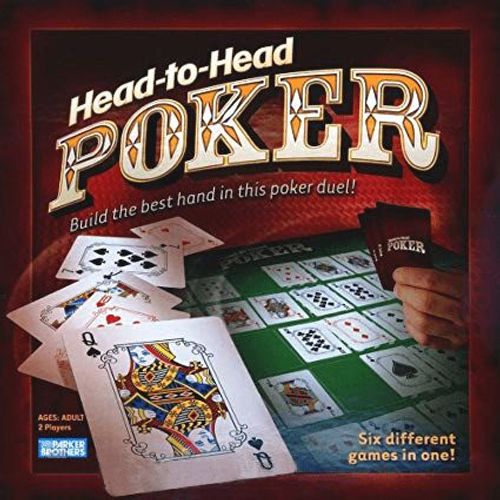
Head-to-Head Poker
Head-to-Head Poker Rulebook
Table of Contents
Table of Contents
Object
Win poker chips by building the best five-card combination on the board.
The player with the higher total value of chips after three rounds wins the game.
Contents
Gameboard, deck of 52 cards, 90 poker chips (forty $10 chips, thirty $50 chips, twenty $100 chips), one red die.
Set Up
- Place the gameboard on a table. You and your opponent sit on opposite sides as shown in Figure 1. Remove the two "scoring chart" cards from the card deck and give one to each player. Place the poker chips and card deck next to the gameboard within easy reach.
(Figure 1 labels: Common spaces; Card rows.)
- Each player rolls the die. The player with the higher roll is the dealer for the [text cut off in the source scan]
Three Rounds - Six Ways to Play Them
Each game consists of three rounds. These rounds may be played six different ways as described below. At the beginning of each round, the dealer places cards on the gameboard, and rolls the die to determine which type of round will be played. This is explained in detail below.
Dealership alternates between the two players. The dealer shuffles the cards and places them facedown next to the gameboard. The dealer then does the following for each round:
Round 1 - Turn over three cards from the top of the deck and place them faceup on the first three Common spaces, as shown in Figure 2. The dealer then places two $100 chips on each card.
Round 2 - Turn over four cards from the top of the deck, and place them faceup on the first four Common spaces. The dealer then places two $100 chips on each card.
Round 3 - Turn over five cards from the top of the deck, and place them faceup on all five Common spaces. The dealer then places two $100 chips on each card.
Important: Be sure to shuffle the card deck between rounds.
Card Hand
A "card hand" includes any cards you are holding, as well as cards you have placed on the gameboard.
Types of Rounds
First-time players should choose "Draw 1" (described below) to become familiar with the overall gameplay. For experienced players, the dealer rolls the red die to decide which of the six types of rounds (described below) will be played on a round. Or, instead of rolling the die, let the dealer pick one of the six versions described below.
- If the dealer rolls a 1, play "Draw 1": On your turn, draw one card from the deck and play it. Players alternate turns.
- If the dealer rolls a 2, play "Split 2": On your turn, draw two cards from the deck. Play one of the cards and give the other card to your opponent. Your opponent then plays the card given to him/her. Your opponent then draws two cards, and play continues as described above with players alternating turns.
- If the dealer rolls a 3, play "Hold 3": At the start of the round, each player is dealt three cards into his/her hand. On your turn, play one card and refresh your hand by drawing from the deck. Players alternate turns.
- If the dealer rolls a 4, play "Play 4": At the start of the round, each player is dealt four cards into his/her hand. On your turn, play one card from your hand. Players alternate turns. When both hands are used up, each player is dealt four new cards. Players alternate playing first after receiving four new cards.
- If the dealer rolls a 5, play "Share 5": At the start of the round, reveal five cards from the deck and display them face up next to the gameboard. On your turn, choose one of the cards and play it. When all five cards are used up, reveal five new cards. Players alternate going first after each set of five new cards is revealed.
- If the dealer rolls a 6, play "Crazy": Roll the die again until a number other than "6" comes up. You will play a "Crazy" version of that game number by placing your cards on either (or both) sides of the board if you wish. This will allow you to block your opponent's good hand(s).
No-Bet Gameplay
Playing a Round: The dealer's opponent starts a round. Each player, in turn, builds hands by playing cards onto the spaces (rows) on his/her side of the gameboard. The Common cards count for both players' hands. When both players have played four cards into one row (for total of eight cards plus the Common card), the row is complete. The player with the higher five-card combination wins the two $100 chips from the Common card. When all rows have been completed, the chips are removed and placed in front of the player(s) who won them. This ends the round.
Winning: The game ends after three rounds. Both players total their chip values. The player with the higher total wins.
Up-the-Ante Gameplay
This version generally follows the same rules as above, except that you can bet with poker chips. At the beginning of the game, the dealer gives each player $800 in chips (ten $10 chips, eight $50 chips and three $100 chips). At the beginning of each round, the dealer places two $100 chips on each Common card.
On your turn, you may choose to place a bet on top of a Common card's chips. However, you must do this before you play a card. When playing "Draw 1" or "Split 2", you may look at your new card(s) before betting.
Important: You may not raise more than $100 at a time, nor more than your opponent has in total chip value. There is a maximum bet of $200 per card per round ($600 maximum in round 1, $800 in round 2, and $1,000 in round 3).
If you decide to place a bet, announce this to your opponent. Then place the chips you want to bet on top of the Common card chip. (You do not actually play your card until the betting stops.) Your opponent must then accept or decline your bet by doing one of the following three things:
-
Decline: Your opponent declines to bet and immediately hands you one of the two $100 chips, as well as your betting chip(s) from the Common card. The other $100 chip remains on the Common card for now.
-
Accept and Raise: Your opponent immediately matches your bet, then adds more to it. You must then do one of the following:
- Accept and raise by matching the total bet and raising it even higher. Play continues.
- Accept and call -- see below.
- Decline.
-
Accept and Call: Your opponent matches your bet, and "calls" for you to immediately play a card. Play then continues as you finish your turn by playing the card.
Important: Players may not place bets on rows with only one $100 chip remaining on the Common card. However, players continue to play cards on empty spaces in these rows.
Winning a Row: If a row is completed (all 9 cards in place), betting stops in this row and the player with the higher combination in the row wins all of the chip(s) on the Common card.
Winning: At the end of three rounds, both players total their chip values. The player with the highest total value of chips wins the game. If there is a tie, each player draws a card from the top of the remaining deck. Highest card wins.
Scoring Chart
Following are the possible five-card combinations from the highest rank to the lowest:
- Straight Flush: Sequence of five cards in the same suit. (Aces may be high or low.)
- Four of a Kind: Four cards of the same number.
- Full House: Three cards of the same number and two cards of another number.
- Flush: Five cards of the same suit.
- Straight: Sequence of five cards in different suits. (Aces may be high or low.)
- Three of a Kind: Three cards of the same number.
- Two Pairs: Two cards of the same number and two of another number.
- One Pair: Two cards of the same number.
- High Card: Any other combination.
Note: Cards of the same number do not have to be placed adjacently. Consecutive numbers may occur in any order.
Ties Breakers
Straight Flush, Flush, Straight and High Card ties are decided in favor of the player with the highest card. If both players' highest card is the same, the second highest card decides, and so on.
Two Pairs and One Pair ties are decided in favor of the player with the highest remaining card. If both players' highest card is the same, the second highest card decides, and so on.