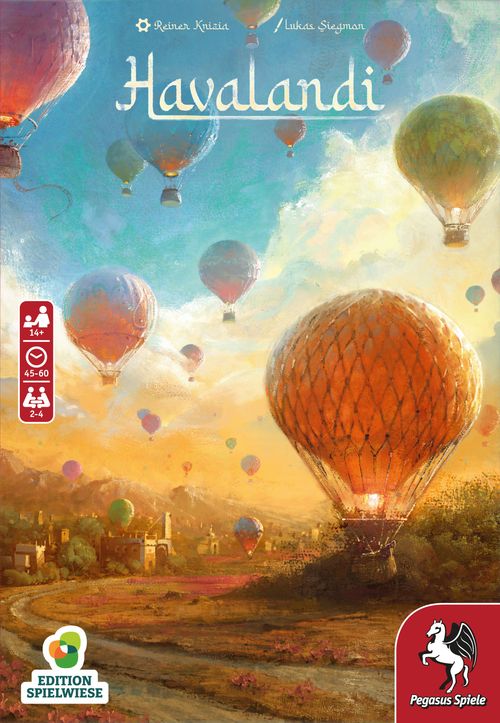
Havalandi
Havalandi Rulebook
Table of Contents
Table of Contents
Contents
- 1 rulebook
- 1 double-sided game board
- 1 six-sided die
- 1 airship with base
- 7 end-game score cards
- 4 × 20 balloons, in the 4 game colours
- 4 × 3 special balloons (Neighbourhood, Wind, Sharing), each in the 4 game colours
- 4 × 1 points token, each in the 4 game colours (please stick the matching colour stickers on the tokens)
- 4 × 1 sandbag
Each balloon has a front side showing a lying balloon and a back side showing a launched balloon.
How do I assemble the airship?
Follow the illustrated steps in the rulebook to assemble the airship from its base and body pieces.
Note: Airships are gas-filled dirigibles. Our airship here is actually a hot air balloon. However, we decided to use this name to help avoid any confusion or misunderstandings when it comes to game components.
Aim of the Game
In Havalandi, you are trying to score as many points as possible with clever placement of your balloons. Points are earned by launching the balloons of your fleets and forming the largest possible groups of your own balloons within the different regions. The launch sites at the pavilions are also highly coveted and offer you further opportunities to earn points. Choose the right launch site at the right time and score lots of points for your fleet!
The player with the most points at the end of the game wins.
The Game Board / Setup
The game board is double-sided with each side showing different landscapes. The 2 sides differ in their arrangement of regions as well as pavilions.
The airship moves on a track around the edge of the board. Certain spaces on the board are pavilions: during the course of the game, you will score points if you place one of your own balloons next to them.
The remaining spaces are launch sites where you place your balloons during the game. They are located in 4 different regions: sand dune, tulip field, meadow, and gravel path.
-
Select the front or back side of the game board and place the board in the centre of the table.
Note: For the first few games, we recommend the A-side of the board. It is a good way to get to know the game.
-
Place the airship on the marked starting space in the upper part of the track and place the die nearby.
-
Everyone chooses a game colour and takes the corresponding game materials.
Note: In a 4 player game, everyone returns 3 balloons of their own colour back to the box.
Any reference to "balloon" in these rules always refers to a lying balloon. Rules regarding special balloons will always be explicitly stated.
-
Place your points token on the 0 space of the score ladder. This is where you will keep track of your score during the game. Place your sandbag on the hot air balloon basket (space 40 of the score ladder).
-
Shuffle the end-game score cards. Draw 2 at random and place them face up on the spaces provided on the board.
-
2 player game only: Cover the launch sites on the board marked with a flag with balloons of an unused game colour. These launch sites are considered occupied by another player. The flags have no meaning in a game with more than 2 players.
Return any unused game material to the box as it will not be needed for this game.
Gameplay
The player who last launched something starts the game.
On your turn, perform the following steps:
- Roll the die and move the airship the corresponding number of spaces clockwise along its track.
- Place one of your balloons on an available launch site within one of the 2 lines of sight of the airship. This can also be a special balloon. If possible, you may now also launch the balloons of a fleet.
- Record any points scored from placing your balloon by moving your points token along the score ladder.
Then the next player in clockwise order will take their turn.
Moving the Airship
The airship is not assigned to any one player, but is steered by everyone. It is always moved clockwise forward along its track according to the die roll.
Each space on the track grants 2 different lines of sight in which you can place one of your balloons on an available launch site.
If the airship ends its movement on one of the corner spaces, the 2 long sight lines along the edge of the board will be available to you. The white area in each corner of the track is considered a single space.
Placing a Balloon
You always place a balloon with the lying balloon face up.
There are 2 ways you can choose the launch site for your balloon.
-
Place your balloon on a free launch site within line of sight. Place one of your balloons on any free launch site that is within one of the 2 lines of sight of the airship. There must be no other balloon on the launch site. You may never place a balloon on pavilions or on the airship track.
OR
-
Place your balloon, starting from the line of sight, adjacent to one of your own balloons in the same region, or form or extend the group of this balloon in the same region. Choose a launch site within the 2 lines of sight of the airship that already contains one of your balloons. It does not matter if this balloon is lying or has already launched. Starting from this balloon, you may place your balloon on an adjacent launch site within the same region. Alternatively you may form or extend a group within the same region. This launch site does not have to be in the line of sight.
During the course of the game, it can happen that there are no available launch sites for you. In this case, move the airship 1 space at a time on the track until you are able to place one of your balloons. You are not forced to use one of your special balloons in this situation.
Note: The 3 special balloons have individual rules which can be found in the "Special Balloons" section.
How Do I Score Points?
You can score points in several ways:
- Launch the balloons of a fleet
- Form and extend groups
- Place balloons next to pavilions
- End-game score cards
If you reach the top of the score ladder during the game, take the sandbag in your colour and place it in front of you with the "40" facing up. Then start again at the bottom of the ladder. If you reach the top again, turn the sandbag over so that it shows "80" and start counting your points again from the bottom of the ladder.
Note: In these rules we distinguish between a "fleet" and a "group".
A fleet consists of several of your balloons that are connected over several regions. Initially, the balloons in your fleet are all lying balloons. You can let them launch once.
You form a group with at least 3 of your balloons that are connected within a single region. This can include balloons that have already launched, but also balloons that are still lying.
1. Launch the Balloons of a Fleet
Immediately after placing your balloon, you can launch the balloons of a fleet. You have to keep the following in mind:
- The balloon you just placed must be part of the fleet. Previously launched balloons may not form part of the fleet.
- At least one of the balloons of this fleet must be on the gravel path. This may be a balloon placed in a previous turn.
- The balloons of the fleet must be connected.
Example: Through the balloon you just placed (highlighted in yellow), you may launch the balloons of the fleet because you have made a connection with the gravel path. The balloon marked in red on the sand dune cannot be launched because it does not belong to the fleet.
You will score different amounts of points depending on how many different regions you launch your fleet from. Turn over the balloons in your fleet so that they are now showing the launched side. You do not have to turn over all the balloons in your fleet, only those that are absolutely necessary to get the respective points. This must include the balloon you have just placed to trigger the launch of the fleet. The size of your fleet is not related to the number of points you score for launching. However, it can have an influence on one of the end-game score cards.
- Gravel path + Meadow: 4 points
- Gravel path + Meadow + Tulip Field: 8 points
- Gravel path + Meadow + Tulip Field + Sand Dune: 12 points
Note: In these examples, the launch site of the balloon just placed is highlighted in yellow. You must launch, i.e. turn over, the balloons marked in white to launch the fleet and trigger scoring. You may also turn over the balloons marked with dashed white lines. However, they do not score any additional points for this fleet.
A fleet can extend beyond several sides of the gravel path. You have the possibility to launch all balloons of this fleet at the same time. For each side of the gravel path, separately consider how many regions the fleet launches from and add up the respective points. Note, however, that each side only scores points once.
On the A-side of the game board you can launch the balloons from up to 2 sides at the same time, one to the right and one to the left of the gravel path. On the B-side, you can even launch balloons from up to 3 sides at the same time.
Example: You have just placed your balloon (launch site highlighted in yellow). You may now launch all marked balloons at once. For the launch of the fleet you would receive 8+12+8=28 points.
2. Form and Extend Groups
If you place a balloon adjacent to other balloons within a region, you can form a group. A group consists of at least 3 of your own balloons that are connected within the same region. You will score points equal to the size of the group: 3 points for a group of 3. If you later extend the group to a group of 4, you will score points again, this time 4 points. Then if you later extend the group of 4 to a group of 5, you will score 5 points, and so on. It doesn't matter whether the balloons in the group have already launched or not.
Example: For the balloon you just placed (1., highlighted in yellow) you will score 4 points because it forms a group of 4. If you later add another balloon to the group (2., semi-transparent), you increase it to a group of 5 and score another 5 points.
3. Place Balloons Next to Pavilions
Each pavilion immediately scores you 3 points the first time you place one of your balloons adjacent to it. You can only score these points for each pavilion one time.
Then check whether you receive a bonus:
- On the A-side of the game board, you immediately score 7 bonus points if you have placed at least 1 of your own balloons next to all the pavilions.
- On the B-side there are 3 pavilions in 3 different colours. You immediately score 3 bonus points if you have placed at least 1 of your own balloons next to each pavilion of a single colour. You can therefore get a maximum of 9 bonus points in this way.
4. End-Game Score Cards
At the end of the game, check whether and how well you have fulfilled the conditions on the 2 end-game score cards on the board. Record your points on the score ladder. A detailed list of the individual end-game score cards can be found in the "End-game score cards" section.
Special Balloons
You have 3 special balloons. You can use each of them exactly once a game during your turn. They also have a side that shows the lying balloon and a side showing the launched balloon. You can use them regularly as part of a fleet, but they also offer you some special possibilities. You may only use one special balloon per turn.
Sharing
You may use the sharing balloon instead of your regular balloon on your turn. Place it on a launch site that is within one of the 2 lines of sight but is already occupied by an opponent's balloon. Place your sharing balloon on the opponent's balloon in that space. You may now treat this launch site like any other of your launch sites. If the other balloon launches on this launch site, it has no effect on your sharing balloon. The reverse is also true.
Important: Each launch site can have a maximum of one sharing balloon placed on it. You may not place your sharing balloon on an unoccupied launch site.
Neighbourhood
After you have placed your balloon on a launch site, you may additionally place the neighbourhood balloon on an available launch site adjacent to it. The additional launch site may belong to another region.
Wind
You may use the wind balloon instead of a regular balloon on your turn. Place it on any available launch site. The launch site does not have to be within line of sight of the airship.
End of the Game
If you have no more balloons available, the game ends for you and it is the next player's turn. Your special balloons do not count. If you still have special balloons remaining, they will be forfeited unused.
If everyone has no more balloons available, the game is over and it is time to evaluate the 2 end-game score cards. Evaluate and score both cards for everyone and record the points on the score ladder.
The player with the most points wins the game. If there is a tie, the player with the most special balloons remaining wins. If there is still a tie, everyone involved wins.
End-Game Score Cards
Each card can only be scored once per player at the end of the game.
For illustrative purposes, we have chosen to use turquoise or red balloons for the balloons on the cards, which are also available as player colours. However, each end-game score card is valid for every colour of the game and the colours of balloons shown on the cards are to be understood only as an example.
The image on the cards show whether scoring refers to lying balloons, launched balloons, or whether it does not matter.
The 7 end-game score cards are:
-
2 edges of the board are linked: 1 point per balloon. Everyone scores points for linking 2 edges of the board with only their own balloons. Check if you have linked 2 edges of the board. Choose exactly one of the links and score it: count the minimum number of balloons needed to link the edges. This will be the number of points you score. Detours and branches do not count.
Example: There are 2 possibilities for scoring here, of which only one may be chosen. The 4 red, lying balloons (in the example at the top) would score 4 points. The balloons marked in white, on the other hand, would score 8 points because the link extends over 8 balloons. However, it is not permitted to make a detour via the balloons marked in red to score more points.
-
A minimum of 4 pavilions linked with each other: 8 points. Everyone scores points if they have linked at least 4 pavilions with their own balloons.
Example: The 4 pavilions are linked with each other and therefore score 8 points.
-
Launched balloons on launch sites at the edge: 1 point per balloon. Everyone scores 1 point for each of their own launched balloons that are on launch sites at the edge of the board, i.e. adjacent to the airship track.
Example: The launched balloons marked in white score 1 point each for a total of 3 points. The balloons marked in red do not score any points because they are either at the edge but have not been launched or they are not at the edge, despite being launched.
-
The largest connected fleet: 1 point per launched balloon within the fleet. Everyone scores points for each launched balloon in their largest connected fleet. The balloons in this fleet need not have launched together during the course of the game, but they must all be connected.
Example: The balloons marked in white score 7 points as the largest fleet. The lying balloons marked in red do not link the launched fleet above with the one below.
Brief Overview
On your turn:
- Roll the die and move the airship the corresponding number of spaces clockwise along its track.
- Place your balloon either on a free launch site within one of the 2 lines of sight of the airship, adjacent to one of your own balloons in the same region, or extend its group. Your special balloons are also at your disposal, if you have not yet used them.
- Use your points token to record any points you have scored by moving up the score ladder.
You can earn points in the following ways:
Launching the balloons of a fleet
- Gravel path + Meadow: 4 points
- Gravel path + Meadow + Tulip Field: 8 points
- Gravel path + Meadow + Tulip Field + Sand Dune: 12 points
Form and extend groups
At least 3 of your own balloons form a group within a single region. You immediately get 3 points for a group of 3. If you later increase it to a group of 4, you immediately score 4 points, etc.
Place balloons next to pavilions
You score 3 points whenever you place a balloon next to a pavilion for the first time. Bonus points are awarded if you place your balloons adjacent to all pavilions of one colour:
- 7 points (A-side of the game board, 1 time only), or
- 3 points (B-side of the game board, up to 3 times possible)
The special balloons
- Sharing: Place the sharing balloon instead of your regular balloon on a launch site that is already occupied. You may use the launch site as well.
- Neighbourhood: You may additionally place this balloon adjacent to the balloon you have just placed.
- Wind: Instead of placing a regular balloon, you may place this special balloon on any empty launch site on the board.
End of the game
The game ends after everyone has placed their final regular balloon on the board. Unused special balloons are forfeited. The player with the most points after checking the end-game score cards wins the game. In the event of a tie, the player amongst those tied who has more unused special balloons wins.