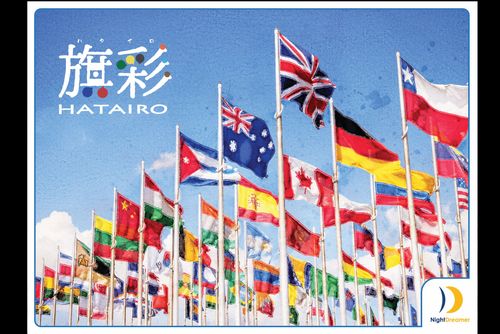
Hatairo
Hatairo Rulebook
Table of Contents
Table of Contents
Components
- 208 Flag cards (each shows: Topography, Name, Bonus pigment on the front; Required pigments, Victory points, Features; Back = Sketch side with Name, Topography, Bonus pigment)
- 16 Topography tiles
- 4 Gallery boards (player boards): Gallery, Palette, Atelier, Motif Area, Topography Area. Standard game side: 4-column gallery. Back side: 3-column gallery for beginner's game.
- 40 Pigment cards
- 36 Motif cards: 19 type-I motifs and 17 type-II motifs (see Appendix for details)
- 4 Player Aid cards. Front: each number depicts the total number of flags which matches the topography, continent, feature and required pigments. Back: a pivot table showing the distribution of bonus pigments on flags with respect to continents.
- 1 Starting Player card
Game Setup
- Each player chooses a player color. She receives the player board of that color and places it in front of her. (Use beginner's side for beginner's game and first play.)
- The player who travelled to the most countries is the starting player. She gets the starting player card.
- She shuffles all the flag cards to a pile, called the Flag Supply. The box insert can be used as a card rack. According to the Market Distribution Table below, she draws flag cards from the Flag Supply and places them sketch side up to the center of the table in 4 rows. These rows are known as the Market.
Market Distribution Table
| 2-player game | 3-player game | 4-player game | |
|---|---|---|---|
| 1st row | 4 | 5 | 6 |
| 2nd row | 3 | 4 | 6 |
| 3rd row | 2 | 4 | 5 |
| 4th row | 2 | 3 | 4 |
- Then she deals 9 flag cards to each player from the Flag Supply.
- Each player simultaneously performs the following actions. Choose 3 flag cards and place them in her Palette and/or Atelier on her player board; receive 4 topography tiles of her color and place them onto the 4 topography spaces of her player board. (3 spaces for beginner's game.) After all players finish their actions, discard the unchosen flag cards to the Flag Supply. Reshuffle the Flag Supply. (Discard the unchosen topography tile to the game box.) [Tips: Advanced players are suggested to take the flag distribution in the Market and your player order into consideration.]
- Next to the Market, sort the motif cards into Type I and Type II and place them face-down as the motif piles. Turn over 2 motif cards each from Type I motif pile and Type II motif pile. Place them in a column next to the Market. This column is called the Motif Supply.
- Place the pigment cards within the reach of all players as a general supply. This supply is called the Pigment Supply.
Object of the Game
On your turn, you choose and perform an action that leads you to earn victory points by completing a flag sketch in your Gallery. You earn extra VPs when the arrangement of flags in your Gallery resonates with your motifs and your topographic styles. Card in the Market provides you a flag sketch to the Atelier, or a pigment to the Palette. You also complete a flag sketch from the Market or the Atelier to your Gallery and may earn bonus pigments.
The game ends when a player completes all flags in her Gallery. Then, you add up VPs from completed flags in your gallery, type-I motifs, topography styles and remaining pigments. The player with the highest VPs wins the game.
Gameplay
Beginning with the starting player, players consecutively take turns in clockwise direction. A turn is composed of three phases in this order:
A. Motif phase B. Action phase C. Clean phase
If you learn the rules for the first time, you may first skip reading Motif Phase and come back after reading Action Phase and Clean Phase.
A. Motif phase
This phase is optional and available only when at least one row of Market is empty. If this is the case, you have the option to do the following actions:
- You choose a motif card from the Motif Supply and place it to an empty space in the Motif Area on your player board. Then the player to your left must do the same. Continue until all players choose and place a motif card.
- You discard any remaining flag cards in the Market and unchosen motif tiles to the game box.
- Similar to game setup, you draw flag cards from the Flag Supply and place them in rows according to Market Distribution Table. You also replenish the Motif Supply by drawing 4 new motif cards from the motif piles (2 cards from type-I motif pile and 2 cards from type-II motif pile). Then, you continue with Action phase.
Note: You can only place one motif tile in each space. Note: You cannot move or discard motif tile once it is placed in your Gallery.
B. Action phase
On your turn, you must carry out an action from the following 3 actions.
- Reserve a flag sketch
- Gain a pigment
- Complete a flag sketch
1. Reserve a flag sketch to your Atelier
You choose a row from the Market and take the rightmost flag card of that row to your Atelier. Later in the game, this card in Atelier is treated as a flag sketch only but never as a pigment.
Note: If you already have 3 sketches in her Atelier, you cannot perform this action.
Example: Red chooses the third row of the Market and takes the rightmost flag card. He places it on one of the empty slots in his Atelier. He may only use this card as a flag sketch but not as a red pigment.
2. Gain a pigment
You choose a row from the Market and take the rightmost flag card of that row to your Palette, showing the pigment only. Later in the game, this card in Palette is treated as a pigment only.
Example: Yellow chooses the second row of the Market and takes the rightmost flag card. He stacks it under his Palette. He may only use this card as a blue pigment but not as a flag sketch.
3. Complete a flag sketch
You take a flag sketch from your Atelier or from the Market. You pay all the required pigments as stated on the left of the flag sketch. You can pay by any pigment cards and/or flag cards in your Palette. Then, you turn over the card (showing a colored Flag) and place it to an empty space in your Gallery. Then, you check all the adjacent (orthogonally and diagonally) flags in your Gallery. For each completed flag in these spaces, you gain a bonus pigment as indicated by the bonus pigment icon on the flag card. For each bonus pigment, you take a pigment card from the Pigment Supply and stack it to the Palette appropriately to show the bonus pigment.
Note: You cannot move your flag once it is placed in your Gallery. Note: Pigment card is discarded back to the Pigment Supply. Pigment on Flag card is discarded to the game box.
Important Note: You may use two pigments of the same color as one pigment of any color you choose.
Example: Blue completes the rightmost flag sketch on the third row of the Market. He first pays the required 3 pigments. Then, he turns over the flag and places it in his Gallery. He gets new 5 bonus pigments.
C. Clean phase
After that, if you have more than 10 pigments in your Palette, you discard to 10 pigments.
End of the Game
The game end is triggered when a player completes all 12 flags (9 flags for beginner's game) in her Gallery. Play continues in clockwise order until the starting player is reached. (i.e. All players play equal number of turns.) Then, players proceed to scoring.
Scoring
Each player sums her victory points as follows:
- Completed flags in Gallery: Sum the VPs shown on the top-right hand corner of all completed flags in your Gallery.
- Type-I Motifs: Sum the VPs awarded by Type-I Motifs in Motif area of your player board. Each motif on the top of the board is applied to all completed flags in that column in your Gallery; each motif on the left of the board is applied to all completed flags in that row in your Gallery.
- Topography: Sum the VPs awarded by Topography tiles in Topography Area of your player board. Each tile is applied to all completed flags in that column in your Gallery.
- Pigments: Each pigment left in your Palette scores you 1 VP.
The player with the most VPs wins the game. In case of a tie, the tied players share the victory.
General note and special cases
- You are allowed to look through the game box anytime to check which cards are discarded.
- In the rare case where there are no flags in the Market (i.e. you cannot perform any 1 of the action in Action Phase), then you have to trigger Motif phase and choose a motif tile and so on.
Example: Scoring
- Completed flags in Gallery: 4+4+3+7+10+6+4+6+2+28+6+4=84
- Type-I Motifs: 12+6+6+10+8=42
- Topography: 3+6+0+8=17
- Pigments: 3x1=3
Total: 84+42+17+3=146
Variants
- Motif variant: Shuffle all Motif cards into one Motif pile instead of two. In Motif phase, draw 4 cards from this pile to form the Motif Supply.
- Drafting variant: In game setup, instead of directly choose 3 flags out of 9, players choose 1 flag then pass the remaining flags to the left. Repeat this twice. Unchosen card are discarded back to the Flag Supply. Then, reshuffle the Flag Supply.
Solo Mode
- The game is set up as in 2-player game. (i.e. Place 4 flag cards on the first row, then 3, 2 and 2)
- Motif variant is also applied. (see above)
- You are the only player of the game, so you only get yourself a player board.
- At the end of each of your turn, do the following depending on whether any rows of the Market is empty.
- (A) If any row of the Market is empty, the Motif phase is triggered by the game. Remove the upper 2 motif tiles. Then you choose a motif and place it to your motif Area.
- (B) If none of the rows of the Market is empty, remove a flag card from the Market as below. In the market, locate the rightmost flags in rows which have more than 1 flag. Among these flags, remove the flag with the least VPs. If there is more than 1 flag with the same least VPs, remove the uppermost one. If only one flag is left on each row, remove the flag with the least VPs.
- Repeat your turns until you complete all flags in your Gallery.
- Check your final score with rankings below. Are you a Vexillologist?
| Score | Rank |
|---|---|
| 120+ | Vexillologist |
| 100-120 | Master |
| 80-100 | Fellow |
| 60-80 | Apprentice |
| 0-60 | Novice |
Appendix
Type-I Motifs
The player who adds this tile to his gallery receives VPs as shown for each matching flag feature on the flags in that column/row of the motif tile.
Features: Vertical Stripes, Horizontal Stripes, Diagonal Stripes, Cross, Sun, Star, Crescent, Triangle, Artifact, Fauna, Flora, Inscription.
The player who adds this tile to his gallery receives VPs as shown for each matching continent on the flags in that column/row of the motif tile.
The player who adds this tile to his gallery receives 1 VP at the end of the game for each pigment left in your Palette.
Type-II Motifs
- Pigment-color tiles (Red, Orange, Yellow, Green, Cyan, Blue, Black, Others): The player who adds this tile to his gallery may use the pigment of the color shown on the motif tile as any pigment he chooses when completing a flag sketch. This conversion can be performed any number of times in a row as long as you have the appropriate pigments available.
- Any-to-color tiles: The player who adds this tile to his gallery may use any pigment in his Palette as pigment of the color shown on the motif tile when completing a flag sketch. This conversion can be performed any number of times in a row as long as you have pigments available.
- 3-for-2 tiles: The player who adds this tile to his gallery may use 3 pigments of the same color as 2 pigments of any combination of colors when completing a flag sketch. This conversion can be performed any number of times in a row as long as you have the appropriate pigments available. Converted but unspent pigments are discarded immediately after the action.
Topography Tiles
Players receive VPs as shown accordingly for the total number of matching topography icons on the flags in that column of the topography tile. Topographies: Coastal, Island, Landlocked.
Flags of Countries / Regions
Afghanistan, Albania, Algeria, American Samoa, Andorra, Angola, Antigua and Barbuda, Argentina, Armenia, Aruba, Australia, Austria, Azerbaijan, Bahrain, Bangladesh, Barbados, Belarus, Belgium, Belize, Benin, Bermuda, Bhutan, Bolivia, Bosnia and Herzegovina, Botswana, Brazil, British Virgin Islands, Brunei, Bulgaria, Burkina Faso, Burundi, Cambodia, Cameroon, Canada, Cape Verde, Cayman Islands, Central African Republic, Chad, Chile, China, Chinese Taipei, Colombia, Comoros, Cook Islands, Costa Rica, Côte d'Ivoire, Croatia, Cuba, Cyprus, Czech Republic, Democratic Republic of the Congo, Denmark, Djibouti, Dominica, Dominican Republic, East Timor, Ecuador, Egypt, El Salvador, Equatorial Guinea, Eritrea, Estonia, Eswatini, Ethiopia, Faroe Islands, Fiji, Finland, France, Gabon, Georgia, Germany, Ghana, Greece, Grenada, Guam, Guatemala, Guinea, Guinea-Bissau, Guyana, Haiti, Honduras, Hong Kong, Hungary, Iceland, India, Indonesia, Iran, Iraq, Ireland, Israel, Italy, Jamaica, Japan, Jordan, Kazakhstan, Kenya, Kiribati, Kosovo, Kuwait, Kyrgyzstan, Laos, Latvia, Lebanon, Lesotho, Liberia, Libya, Liechtenstein, Lithuania, Luxembourg, Macau, Madagascar, Malawi, Malaysia, Maldives, Mali, Malta, Marshall Islands, Mauritania, Mauritius, Mexico, Micronesia, Moldova, Monaco, Mongolia, Montenegro, Morocco, Mozambique, Myanmar, Namibia, Nauru, Nepal, Netherlands, New Zealand, Nicaragua, Niger, Nigeria, North Korea, North Macedonia, Norway, Oman, Pakistan, Palau, Palestine, Panama, Papua New Guinea, Paraguay, Peru, Philippines, Poland, Portugal, Puerto Rico, Qatar, Republic of the Congo, Romania, Russia, Rwanda, Saint Kitts and Nevis, Saint Lucia, Saint Vincent and the Grenadines, Samoa, San Marino, São Tomé and Príncipe, Saudi Arabia, Senegal, Serbia, Seychelles, Sierra Leone, Singapore, Slovakia, Slovenia, Solomon Islands, Somalia, South Africa, South Korea, South Sudan, Spain, Sri Lanka, Sudan, Suriname, Sweden, Switzerland, Syria, Tajikistan, Tanzania, Thailand, The Bahamas, The Gambia, Togo, Tonga, Trinidad and Tobago, Tunisia, Turkey, Turkmenistan, Tuvalu, Uganda, Ukraine, United Arab Emirates, United Kingdom, United States, Uruguay, Uzbekistan, Vanuatu, Venezuela, Vietnam, Virgin Islands, Yemen, Zambia, Zimbabwe.
Flags of countries/regions are chosen with reference to the Olympic Games. But for gameplay and balance purposes, some of the details have been altered.