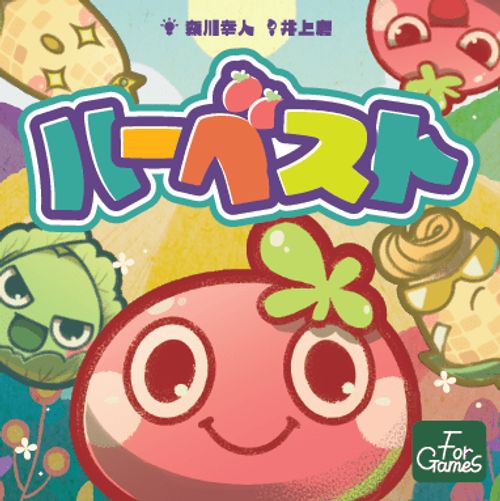
Harvest
Harvest Rulebook
Table of Contents
Table of Contents
Game Summary
Harvest is a game where you will harvest a lot of large vegetables. When you place a vegetable card from your hand into a field, if three or more of the same type are in a line, they're harvested. Each player harvests the vegetables from their own field. At the end of the game, compare the total points of each player's harvested vegetables, and the person with the highest score wins!
1-6 players, ages 8+, 20 minutes.
Components
- 56 vegetable cards
- front: 19 tomato
- front: 19 cabbage
- front: 18 corn
- 4 special cards
- front: 1 harvest
- front: 3 tornado
- back: (shared card back)
- 2 rule books
- 6 field boards
- 6 quick reference cards
Game Preparation
Each player takes the quick reference card of their favorite color and places it in front of themselves. Then, each player takes the corresponding field card, and they arrange them randomly face down in the configurations shown for their player count (for 3 players, for 4 players, for 5 players, for 6 players, for 2 players). Next, turn the field boards face up. The field which matches a player's quick reference card's color is their field.
When playing with two people, add a neutral field and use three field boards. Please arrange the field boards as shown for 2 players.
Shuffle the cards well and set them face down as a deck in a place where all players can easily reach. Each player takes 4 cards from the deck as their hand. The players can look at the front of their cards, but should not show them to the other players. The players can discuss the cards in their hand, but it is forbidden to intentionally show the front of the cards.
Preparation example for 4 players: a deck and discard area are placed centrally, with a harvest area for each player near their field board, and each player's hand kept private.
When playing with two people, remove 20 cards from the deck without looking at them and place them in the box.
Please place any field boards which were not selected back in the box.
Game Flow
The person who has most recently harvested something will take the first turn; otherwise, decide on a start player in any appropriate way.
Each turn consists of the following three steps, in order from top to bottom:
- Card placement
- Harvest check
- Hand replenishment
Turns proceed clockwise.
Play continues in this way, and if any of the following conditions are met, the game will end and scores will be calculated:
- The deck is exhausted, and everyones' hands are empty
- Everyone passes consecutively
Turn Details
Card Placement
On their turn, a player selects one card from their hand and places it face up on a field board.
Placement Rules
Each field board is divided into 4 squares. A player places their card into one of the empty squares of the field board they choose. However, there are certain priorities for which field board the player must place their card in.
First, a player checks if there are any cards on their field board. If a player's field board is empty, they must place a card on their field board. If a player has at least 1 card on their field board, they can place on their field board or another player's field board which has at least 1 card.
For example, if a player's own field is empty, they must place a card in their own field (because there are no cards in their field). If a player's own field already has a card, they can play a card in their own field, in a second player's field, or in a third player's field — but they cannot play in a fourth player's field if there are no cards there.
Neutral field: A neutral field board is used when playing with 1 or 2 players. If there is a card on a player's field, they can place on the neutral field (there does not need to be a card on the neutral field first).
Pass: If a player cannot place any cards, they pass their turn without playing a card. A player cannot pass if they can play a card. If a player has no cards in their hand, they must pass; this may happen at the end of the game.
Harvest Check
After a card is played, if at least 3 of the same type of vegetable are lined up in a straight line (including diagonal), they must be harvested. A harvest will always involve multiple fields. Each player takes their harvested vegetables and places them face down in their harvest area.
Please place any harvest from a neutral field in the discard area.
Hint: A harvest cannot occur in a single field. In order to successfully cooperate with other players, it is a good idea to actively plan, saying things like "I want you to put tomatoes here" or "if you put corn here, I'll place cabbage here next turn."
Special Cards
Harvest Card: When playing this card, a player declares it to be tomato, cabbage, or corn. Once placed, immediately harvest; it cannot be placed in a position where a harvest would not trigger. Once harvested, this card is placed in the discard area rather than a player's harvest area. If a player has this card in their hand at the end of the game, it is worth -50 points.
Tornado Card: When playing this card, a player declares it to be tomato, cabbage, or corn. It must be placed in a space which would trigger a harvest for the declared vegetable. However, a normal harvest does not occur. Instead, place the tornado card and the vegetables which would be harvested in the discard pile. If a player has this card in their hand at the end of the game, it is worth -50 points.
When playing with 2 players, the special cards are not worth -50 at the end of the game.
Hand Replenishment
A player draws cards from the deck until they have 4 cards in their hand. If a player forgets to draw, they should take cards when they notice it. After the deck is depleted, there is no further drawing, so please skip this step.
Then, the person to the left takes their turn.
Game End
The players take turns until one of the following game end conditions is met. Then, the game ends and the score calculation is performed.
- The deck is exhausted, and everyones' hands are empty
- Everyone passes consecutively
Score Calculation
Each player reveals the cards in their harvest area. The black numbers indicate positive points scored, and the red numbers indicate points lost. If a player has any special cards left in their hand, they are worth -50 points each.
If a player's field is empty, they get a 50 points bonus.
The winner is the person with the highest total score. In the case of a tie, the person with the most cards harvested is the winner. If this is still a tie, the person with the most points remaining on their field board is the winner. If this is still a tie, the tied players each prepare a mixed salad, and the player with the best tasting one wins.
Scoring Example
Player A's field and harvest area: Harvest: 40-20+20+10-10 = 40 pts. Empty field: 50 pts. Total score: 40+50 = 90 pts.
Player B's field and harvest area: Harvest: 20+20+10+40+20-10 = 100 pts. Special card in hand: -50 pts. Total score: 100-50 = 50 pts.
Solo Rules
In the solo rules, the high-performance agricultural robot, Morikawa-kun No. 3, will plant seeds at a tremendous speed. The player aims to harvest a lot of vegetables while keeping pace.
Game Preparation (Solo)
Arrange 3 field boards: a neutral field, the player's field, and a second neutral field.
Shuffle the 20, 10, -10, and -20 point vegetable cards to form a face down deck. The 40 point vegetables and the special cards are not used. The player draws 4 cards from the deck to use as their hand. Morikawa does not use a hand of cards.
Game Flow (Solo)
The game progresses with Morikawa and the player alternating turns; Morikawa takes the first turn. The game ends when either Morikawa or the player can no longer place cards or the deck runs out.
Morikawa's Turn: Draw two cards and place them next to the deck. The first card should be placed in the first empty space in the upper left; the space with the lowest number has the highest priority for placement, numbered 1-12 across the neutral fields and the player's field (space 1 in the upper left of the first neutral field, proceeding through space 12 in the player's field).
Then, after a harvest check (refer to the multiplayer rules), place the second card in the same way and perform another harvest check.
Morikawa doesn't follow the usual placement rules. If they cannot place a card, the player loses and the game ends.
The Player's Turn: On the player's turn, they perform the following three steps in order from top to bottom:
- Card placement
- Harvest check
- Hand replenishment
Card placement: If a player has no cards on their field board, they must place a card on any empty space of their field. Otherwise, they may play on any empty space of any field. If a card cannot be placed, the player loses and the game ends.
Harvest check: A harvest check is performed (refer to the multiplayer rules).
Hand replenishment: The player draws cards from the deck until they have 4 cards in their hand. If the player forgets to draw, they should take cards when they notice it. After the deck is depleted, the game ends; move on to score calculation.
Score Calculation (Solo)
The player sums the points of the cards in their harvest area. The black numbers indicate positive points scored, and the red numbers indicate points lost. If the player's field is empty, they get a 50 point bonus. Morikawa isn't competing to win or lose, so their score is not calculated.
- ≤100 points: This was a bad year. Good luck next year, [insert your name here]!
- 110 - 150 points: You are a fledgling farmer - jumping to the next step!
- 160 - 200 points: Excellent! UGO-UGO-LHUGA!!
- ≥ 210 points: You are the best farmer in the universe! You are sure to win the all-universe vegetable contest!
From the Designer
When I was a child, video games were not yet common, but it was the era of analog games: Epoch's Yakyu Ban, TOMY's The Game of Life, and Hanayama's Bankers (a Japanese game similar to Monopoly). I was addicted to Epoch's Torpedo Game.
Then, I had no connection to analog games for a while, but I encountered Ravensburger's Hare and Tortoise and my board game love was reignited.
Around that time, Mr. Ishihara, a fellow board game player, my senior at the university, and the current president of Pokémon Inc. asked me if I would like to make a game, and Harvest is the game I created. I remember how happy I was to think that the day had come when a game I had conceived would become a product!
And now, I can't believe that the day has come when it will be reprinted! It's like a dream. I would like to thank Mr. Okano and Mr. Koriyama for asking me to do this.
I hope you enjoy it.
From the Editor
When I was in elementary school, I bought a card game at a train station on a family vacation. I was so excited that I opened it on the spot and played it on a small table on the bullet train. That game was Harvest. When I opened the box for Harvest for the first time in a long time in order to create this new edition, I found the tickets from those days still in it.
It is a game that does not fade away even after 30 years, and it is a game that must be played with other people. I hope that this work will become a precious memory for you as well.