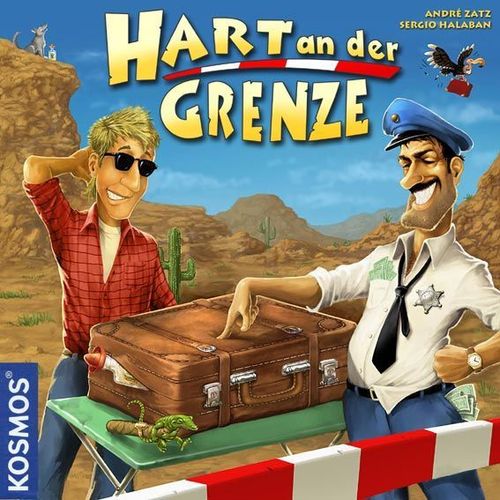
Hart an der Grenze
Hart an der Grenze Rulebook
Table of Contents
Table of Contents
Game Goal
Whoever has earned the most money by the end of the game wins.
Game Material
- 100 money bills: 13 x 100-bill, 13 x 50-bill, 23 x 10-bill, 17 x 5-bill, 17 x 2-bill, 17 x 1-bill
- 6 different travel suitcases
- 6 "seizure" playing pieces (red)
- 6 "extra control" playing pieces (white)
- 1 overview card
- 1 sheriff star, to pin on
- 139 goods cards
Setup
- Each player receives one travel suitcase, which they place in front of themselves.
- The goods cards are shuffled thoroughly and each player is dealt 5 of them face down, which they take into their hand. The remaining goods cards are set out face down in the middle of the table as a draw pile.
- The overview card is laid out next to the pile where all players can see it.
- Each player receives 30 dollars (2 x 10-bill, 1 x 5-bill, 5 x 1-bill). The remaining money is sorted by value and set out face up in the middle of the table as the "bank."
- Each player receives 1 red "seizure" playing piece.
- Only in a game with five or six players does each player also receive 1 white "extra control" playing piece. With fewer than five players, these pieces stay out of the game.
- The most honest player receives the sheriff star and begins.
The Goods Cards
The goods cards show six different kinds of goods, which vary in value. There are three legal goods (jug, maracas, sombrero) and three illegal goods (cigar, tequila, statue). How often a good occurs can be seen from the overview in the suitcase lids. Printed at the bottom of each goods card is the penalty you must pay if you are caught smuggling it. For the legal goods, if you are falsely accused, you receive a compensation that is just as high as the possible penalty.
- Jug (39 in the deck): value 2, penalty/compensation 1
- Maracas (30 in the deck): value 3, penalty/compensation 2
- Sombrero (23 in the deck): value 4, penalty/compensation 3
- Cigar (18 in the deck): value 7, penalty 5
- Tequila (16 in the deck): value 9, penalty 6
- Statue (13 in the deck): value 12, penalty 8
The Overview Card
The overview card shows the six kinds of goods, their value, and the possible penalties or compensations.
| Jug | Maracas | Sombrero | Cigar | Tequila | Statue | |
|---|---|---|---|---|---|---|
| Value | 2 | 3 | 4 | 7 | 9 | 12 |
| Penalty | 1 | 2 | 3 | 5 | 6 | 8 |
| Compensation | 1 | 2 | 3 | – | – | – |
The Notes in the Suitcase Lid
At the very end of the game, players can sell goods at double their printed value. However, only a certain number of cards of each kind of good can be sold. How many that is depends on the number of players. Above the individual goods it also states how many cards of that kind are in the game altogether (i.e. 39 jugs, 30 maracas, and so on).
The number of cards that can be sold, by number of players:
| Players | Jug (39) | Maracas (30) | Sombrero (23) | Cigar (18) | Tequila (16) | Statue (13) |
|---|---|---|---|---|---|---|
| 6 | 12 | 10 | 8 | 6 | 5 | 4 |
| 5 | 10 | 8 | 6 | 5 | 4 | 3 |
| 4 | 8 | 6 | 5 | 4 | 3 | 2 |
| 3 | 6 | 5 |
For example, if you play with five players, only the values in the row next to the "5" apply. The other three rows play no part in this game.
Overview of the Course of Play
- The game runs over three rounds.
- A round consists of as many turns as there are players, so that every player takes on the role of sheriff exactly once per round (exception: with 3 players, each player is sheriff twice).
- In each turn, a different player is the sheriff.
- At the end of a round, the players sell the goods they have brought across the border at the value printed on the card.
- After each round, each player may keep back up to three goods cards for the end of the game and possibly sell them at double the value.
Sequence of a Turn
- The player holding the sheriff star pins it on. They set their hand cards down face down in front of their suitcase, since they do not need them during this turn.
- Each of their fellow players must select 1-5 cards from their goods cards and place them secretly in their suitcase. Note: it is not necessary to close the suitcase all the way; it is enough for the lid to be pushed down.
- Starting with the player to the left of the sheriff, each player in turn must announce aloud how many goods cards they have in their suitcase. In addition, they must name exactly one kind of good, regardless of whether they actually put that good in their suitcase or have several different goods in their suitcase.
- Only legal goods may be declared, i.e. jugs, maracas, or sombreros.
Example 1: A player puts 2 jugs and 1 tequila in their suitcase and declares "3 jugs."
Example 2: A player puts 2 cigars in their suitcase and declares "2 sombreros."
Example 3: A player puts 4 maracas in their suitcase and declares "4 maracas."
- Once all fellow players have made their declaration, the sheriff may choose one of them to inspect. The sheriff points at the suitcase and orders "Open up!" — but they may also decline to inspect.
- The player being checked must remove all cards from their suitcase and lay them out openly — unless they can bribe the sheriff (see below).
- If all the goods match their declaration, they were accused unfairly and receive from the bank a compensation of 1, 2, or 3 dollars, as stated on the goods card. The player then places their inspected goods cards face down behind their suitcase.
- If the declaration does not match, the player does not have to open the suitcase yet. They can try to bribe the sheriff by offering any amount of money. The sheriff and the player being inspected may then negotiate over the size of the bribe. If they can agree, the player gives the sheriff the money and does not have to show the contents of their suitcase.
Example: The player declared "3 sombreros." In fact, their suitcase contains only 1 sombrero and 2 cigars. Because the player would rather not have to empty the suitcase in front of the sheriff, they offer 3 dollars. The sheriff finds this too little and demands 8 dollars. Since the two cigars have a combined sale value of 14 dollars and the combined penalty for revealing them would be 10 dollars, the player counters with 6 dollars. The sheriff finally accepts this amount, so the player gets off with a black eye once again.
- If there is no agreement, the player must open their suitcase and lay out all the cards inside. The goods cards that match their declaration may be kept and are placed face down behind their suitcase. For every card that does not match the declaration, the player must pay the penalty printed on the card to the bank. These cards are placed face up next to the draw pile and form a discard pile.
Example: If the sheriff and the player in the example above had not come to an agreement, the player would have had to discard the two smuggled cigar cards and additionally pay the 10-dollar penalty to the bank. The correctly declared sombrero could be kept by the player and placed face down behind their suitcase.
Hint: Should a player have more cards in their suitcase than they previously declared, they must give up the excess cards and pay the penalty for them — even if they are of the declared kind of good.
- All players who were not inspected also now take their goods cards out of their suitcase, without the others being able to see the kinds of goods, and place them face down behind their suitcase.
- This ends a turn, and the player to the sheriff's left, going clockwise, becomes the new sheriff. They pin on the sheriff star and deal out as many cards to each player as needed so that everyone again has 5 cards in hand.
- The new turn proceeds as described.
Tip for the sheriff: If the sheriff accuses a player unfairly, the compensation is paid out of the bank. If they catch a player smuggling, that player must likewise pay the penalty into the bank. The sheriff should therefore be willing to be bribed, since that is the only way they can earn money during their turn — but of course only if they are not offered too little.
Extra Control (only in a game with five or six players!)
- When a player is sheriff, after their normal inspection they may use their "extra control" playing piece once during the game.
- The sheriff returns the playing piece to the box and may now inspect a second player, possibly letting themselves be bribed by this player as well.
Seizure
- When a player is sheriff, after their normal inspection and any extra control, they may use their "seizure" playing piece once during the game.
- The sheriff returns the playing piece to the box and names any player who must hand over their suitcase, with its contents, to them. This may not, however, be a player they have already inspected during this turn.
- The sheriff looks at the cards in the suitcase secretly. The player gets the suitcase back, along with any cards that match their declaration, and places these face down behind their suitcase. There is, however, no compensation.
- Cards that do not match the declaration are seized by the sheriff. They keep the cards and place them face down behind their own suitcase.
- Bribery is not possible during a seizure.
End of Round
- A round ends when every player has been sheriff once (with 3 players, twice).
- Each player sets their hand cards down in front of themselves for the moment and looks in secret at the cards they have collected behind their suitcase.
- Each player may place up to 3 cards from these face down under their suitcase, to sell at the end of the game at double value. Starting with the sheriff, each player in turn announces aloud how many goods cards they are keeping for the end of the game and placing face down under their suitcase. Players may look at their own kept cards at any time during the game.
- All remaining goods cards that they collected behind their suitcase during the round are now sold at the value printed on the card. The players receive the money from the bank. The goods cards are placed on the discard pile.
- Everyone counts their money. The poorest player decides who will be the first sheriff in the next round. Play then continues clockwise. In case of a tie, the poorest player who sits next (clockwise) to the last sheriff decides.
- The new sheriff pins on the star and deals out as many cards to each fellow player as needed so that everyone again has 5 cards in hand.
End of Game and Selling Goods at Double Value
- After the third round, the goods cards collected under the suitcases can be sold at double the value.
- Starting with the jugs, the different kinds of goods are called out one after another by the player who was sheriff last, then the maracas, the sombreros, and so on.
- Each player lays out openly all their cards of the called kind of good.
- Only a certain number of goods cards of each kind may be sold. How many that is can be seen from the overview in the suitcase lid. Different upper limits apply depending on the number of players. In a game with four players, for example, only the values in the row next to the "4" apply. All other rows have no bearing on this game.
- If there are no more goods of a kind than the stated upper limit, every player may sell all their goods of this kind at double the value.
Example: In a game with four players, 8 jugs can be sold. Player A has collected 3, B has 2, and C has 1 jug. Since this comes to only 6 jugs in total, each of the three players may sell their jugs for 4 dollars per card instead of 2.
- If there are more goods cards than the permitted upper limit, the player with the most goods cards of that kind may sell all of theirs first, as long as the upper limit is not exceeded. Then the player with the second-most goods cards of that kind may sell, and so on, until the upper limit is reached. In case of a tie, the sale is divided equally until the upper limit is reached. If an odd number remains, the proceeds are then split.
- All unsold goods cards are worthless, as are any goods cards still in hand.
Example 1: In a game with six players, only 5 tequila can be sold. Player A has 6, B has 4, and C and D each have 2 tequila. Only player A may sell 5 tequila at 18 dollars each. Their sixth tequila is worthless, as is the tequila held by the other players.
Example 2: In a game with four players, only 4 cigars can be sold. Player A has 2 cigars, and B, C, and D each have 1 cigar. A sells their 2 cigars for 14 dollars each. B, C, and D share the proceeds for 2 cigars (= 28 dollars), so each of them receives 9 dollars, with the remaining 1 dollar lost.
- Whoever has the most money wins. In case of a tie, there are multiple winners.
Example of a Turn
Played with four players. The sheriff asks his fellow players to make their declarations. The player to his left says: "I have nothing more than 3 jugs, bought cheaply from a local." The next player states: "I was at the same dealer and even bought 4 jugs." The last player states: "I only have 1 sombrero in my suitcase."
Now the sheriff must decide. Which player should he inspect? Who is telling the truth and who isn't? "1 sombrero" already sounds very suspicious. But 4 jugs! What if there are actually 4 tequila in the suitcase instead? He can't let the player get away with it that easily. The sheriff looks the players deep in the eyes. Then he decides. "Open up!" he orders the player with the "4 jugs." The player smiles innocently at the sheriff. "Tell me, what does one earn here at the border, anyway?" He generously offers 10 dollars if the sheriff would turn a blind eye and forgo the inspection. This naturally makes the sheriff suspicious. If the player is already voluntarily offering 10 dollars, he must have quite valuable goods in his suitcase. The sheriff demands 15 dollars, which the player willingly pays. In return, the sheriff forgoes the inspection. But before the other players can breathe a sigh of relief, he picks out another player. The sheriff is quite certain that "1 sombrero" is not on the level. So he uses his red seizure playing piece, well aware that he can only use it once in the whole game. The sheriff has the suspicious suitcase handed over, checks the contents, and discovers a statue instead of a sombrero. The sheriff now keeps this and places it face down behind his own suitcase. — That was a rewarding turn for him.
The Authors
The journalist André Zatz, born 1974, and his brother-in-law, the product designer Sergio Halaban, born 1963, live in São Paulo, Brazil, and have already published numerous games there. Their nerve-racking bluffing game "Hart an der Grenze" is the first of their games to be released outside their home country.
Editorial work: TM-Spiele Illustration: Michael Menzel Design: Pohl & Rick
© 2006 KOSMOS Verlag