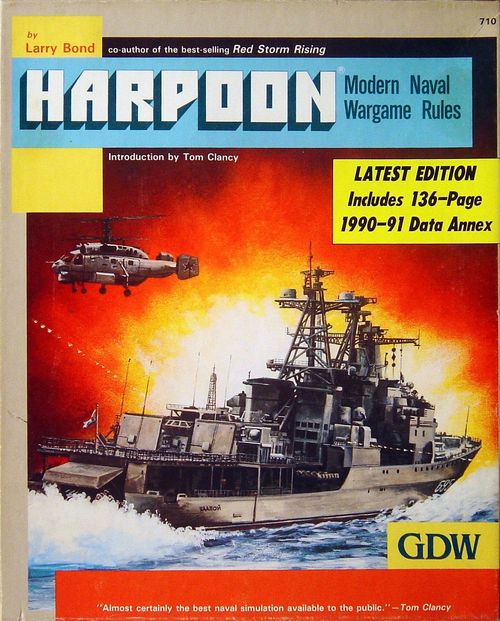
Harpoon (Third Edition)
Harpoon (Third Edition) Rulebook
Table of Contents
Table of Contents
1.0 Introduction
Harpoon is a modern naval wargame. With it, it is possible to simulate virtually every modern naval operation, achieving reliably accurate, consistent results that depend as much on the strategy and planning of the players as on the vessels and equipment of the adversaries.
1.1 Background
Harpoon simulates modern naval warfare. It covers air, surface, and subsurface engagements at the tactical (i.e., individual unit) level. Its coverage of how naval forces are used allows a player with little or no experience in naval combat to understand the basic principles of modern naval warfare, and to use those principles to expand his knowledge.
Modern naval warfare differs radically from the classic naval warfare of World War II. In 1939, at the start of that war, there were few types of naval units, and few things they could do to each other. Surface units fired guns or torpedoes at other surface units, fired guns at aircraft, and dropped depth charges on submarines. Aircraft dropped bombs or torpedoes on ships, and dropped depth charges on submarines. Submarines torpedoed merchant ships, taking on warships only if they were in the right place at the right time. The only sensors available were sonar (brand new and overrated), radar (still secret), and the lookout's eyes.
Naval warfare fifty years later is totally different. New classes of weapons and sensors have given entirely new types of capabilities to naval vessels, aircraft, and submarines. The helicopter, nuclear propulsion, nuclear weapons, FLIR (Forward Looking Infra-Red), guided missiles, and many other systems have spread across the naval spectrum and multiplied the possibilities for detection and destruction of an opponent.
Where before armored dreadnoughts or hundreds of carrier aircraft slugged it out, now one aircraft, one missile, or even just one decision may decide the victor. The rare accounts of modern naval combat reveal it to be much more intense than World War II, compressing the same violence into a fraction of the time. In World War II, ships steamed in column and then deployed into battle formation; reaction times were measured in hours. Naval units today must always be in combat formation; attacks may be launched within seconds of detection.
As might be expected, the capabilities of naval weapons have been improved since 1939. Naval guns, their basic nature unchanged, have increased in range and accuracy. Torpedoes run farther, faster, and truer than their World War II counterparts. Radars have greater range, greater resolution, and greater reliability. Everything that the belligerents used in World War II is still used, but with greater power and greater effectiveness.
As also might be expected, totally new naval capabilities have been developed since World War II. Technology has produced new naval weapons and equipment to meet the needs of modern naval operations. Helicopters give even small ships an ability to increase their range and ability to project attacks. Satellites allow naval commanders to detect and target surface ships that have not been seen by any friendly naval unit. Missiles make the smallest ship an adversary for the largest. Counter-measures make ships invisible to sonar or radar. And as new naval capabilities are added to the inventory, the options (and the problems) facing the naval commander increase.
Technology is the driving force behind these new capabilities, and naval warfare is much more subject to technology than land warfare. On land, the dominant force remains the individual infantryman; technology has not (yet) changed this fact. At sea, however, the development of a new weapon or even a new sensor can have a dramatic effect, unobstructed by terrain or human limitations. Sea warfare is machines fighting other machines, with men directing them and serving as parts of the machine to do things it cannot. Ever since war at sea became mechanized, the goal has been to remove men from the loop, to maximize speed and efficiency. Automatic gun mounts remove men from dangerous and nasty jobs, but response time improves and a ship's manpower support overhead is reduced. The ultimate example to date is the Aegis system: it detects, classifies, and engages hostile air targets without human intervention (although under human direction). Advanced technology makes this system possible, but it also increases the burden on the man ultimately responsible, the naval commander.
What does this mean for the naval wargamer? Technology is complex and expensive, with lots of little details and limitations that can overwhelm a player. A game must show the players the significant details, and ignore the rest. Some details are just not important to the player at his level of control. A ship or formation commander is not interested in the maintenance record of the aircraft, or the exact frequency settings of his sonars; his junior officers take care of that and let him handle the big picture.
Harpoon keeps detail at a level appropriate to the player's role as a naval commander. The game assumes that his guns are firing the correct ammunition, and that the target is in range. If it is not, the guns won't fire. The player concentrates on strategic decisions: should he order two ships out as pickets to scout for the enemy? Should he retain them to increase the warfare to make the game both manually playable and easy to learn. Harpoon has a modular design which allows new sections of the rules to be added or changed with a minimum of fuss. New weapons systems can also be added easily. Units are expressed in real-world terms: knots, meters, kilograms, degrees. I was forced to use damage points to quantify a ship's ability to resist damage, but the formulas to convert any ship to this system are included in Annex Q (contained in the Scenario Book). It also has other useful values for metric conversion and converting the game to different scales.
The Harpoon Missile. Harpoon is the jack-of-all-trades in the American missile arsenal. Designed as a private venture air-launched missile by McDonnell Douglas, a variety of launchers and support equipment made it equally at home as a surface-launched and even subsurface-launched cruise missile.
Harpoon is launched by a three-second burn from its solid fuel booster, after which it is at cruising speed and its air-breathing turbojet sustainer motor takes over. At launch, the missile is programmed to fly toward a target up to 60 nautical miles away. A radio altimeter keeps the missile just above the wavetops until it nears the target. In the last seconds of flight, the missile closes in on the target using an active radar homer, and its 500 pound warhead explodes within the ship.
Air-launched versions dispense with the solid fuel boosters. Submarine-launched versions are expelled in a water-tight cannister from torpedo tubes, to be fired as they broach the surface.
Harpoon keeps detail at a level appropriate to the player's role as a naval commander. The game assumes that his guns are firing the correct ammunition, and that the target is in range. If it is not, the guns won't fire. The player concentrates on strategic decisions. Should he order two ships out as pickets to scout for the enemy? Should he retain them to increase the defensive strength of his formation? The player, as a ship or formation commander, gives orders such as: Engage that target with guns, or Send a two-ship group to see if the enemy force is in that direction. A task force commander's role is to resolve tradeoffs, and decide, sometimes on the basis of faulty and incomplete information, on the best course of action.
Harpoon shows the player what kind of decisions must be made by a ship or battle group commander when he fights a modern sea battle. It shows what information the commander has, and how he uses it to make those decisions. Most importantly, it allows the player to make those decisions, and to see their results in a simulated combat setting.
All this makes Harpoon sound like a very serious simulation, but any wargame attempts to do this. I just want Harpoon players to understand that they can use the game not just to bash away at each other in a structured way, but to understand what is happening out on the oceans of the world. It can be used to recreate recent naval engagements such as the Falklands or the Persian Gulf, or to look at current issues, such as the convoys going to the Central Front in Europe, or the role of the reactivated battleships.
While I call Harpoon a game, there is no built-in play balance; it is more accurately a simulation. The data are a reflection of real-world weapons and equipment, used with a game system that allows them to interact. Tactics useful in the real world work in this simulation. Whether one player or the other will win 50 percent of the time, I can't say; that depends on the initial setup and the skill of the players, which is, after all, what it's all about.
Every player will learn some naval tactics while playing Harpoon. He will learn the relative value of naval units, and how they work together. He can reenact recent naval combats and see what forces were at work, or try out hypothetical units on his own, only on the drawing board now, and see if they are worthwhile. In the long run, he will be able to appreciate how this country's naval forces serve our national interests.
But no player has to understand modern naval warfare in order to play Harpoon. The rules and the game stand by themselves. With each game and with experience, an understanding of naval warfare will come naturally. These rules assume a basic understanding of elementary terms (which have readily available dictionary definitions) like cruiser, destroyer, sonar, or radar. Anything beyond a basic knowledge of naval terms is explained in the appropriate rules section. Annex P (in the Scenario Book) is a list of abbreviations used in the rules.
As a player gets more experienced with Harpoon, and does some reading, he may discover that a rule is too simple. Change the rule. I had to ruthlessly simplify many aspects of naval warfare to make the game both manually playable and easy to learn. Harpoon has a modular design which allows new sections of the rules to be added or changed with a minimum of fuss.
New weapons systems can also be added easily. Units are expressed in real-world terms: knots, meters, kilograms, degrees. I was forced to use damage points to quantify a ship's ability to resist damage, but the formulas to convert any ship to this system are included in Annex Q (contained in the Scenario Book). It also has other useful values for metric conversion and converting the game to different scales.
In the design of Harpoon, I had to make some basic assumptions about the way that units interact to produce what I considered a realistic result. These assumptions underlie the game, and strongly influence the way it should be played.
-
The hardest part of naval warfare is finding and fixing your opponent. This was so in WW II, and it is more so now. The proliferation of sensors has not greatly helped the initial detection process.
-
A ship is relatively easy to kill. In WW II, ships could suffer many shell or bomb hits without its fighting efficiency being destroyed (sunk). A modern ship has many fragile systems to be damaged, and far less armor. Consequently, a single solid hit will often cause enough critical hits to make it ineffective (a mission kill).
-
Reactions today must be much faster than in WW II. Most WW II naval wargames use turns of five or six minutes. This represented the amount of time it took commanders to determine trends and then give orders based on the information they had gained (the decision cycle). Because of the speed of current threats, ships must react much faster. This makes the high-speed tactical maneuverability of a ship much less important than in WW II. When a missile moves at 600 knots and a ship moves at 30 knots, the relative motion of the ship is irrelevant, except for turning to unmask its batteries.
Finally, all information used in this game has been drawn from unclassified Navy or civilian sources listed in Annex O. What I have done is amass information from many different sources, compare it and try to resolve differences, and use the best, most current, most commonly available values. I have also noted books or publications that I recommend as providing good summaries and background in various topics, or as being the most accurate and useful publications for a modern naval gamer to add to his library.
The information in this game is as accurate and up-to-date as possible, but data like weapon kill probabilities and exact ranges can vary widely from source to source. Even prestigious books like Jane's Fighting Ships and Combat Fleets of the World must sometimes publish best guesses on a weapon's or a sensor's performance. Data on the physical features of a ship or aircraft are easier to come by. Performance information is suspect in any case because it is based for the most part on test firings made under ideal conditions. There is only a small body of combat data by which to judge effectiveness. Modern game designers must accept that when the systems they describe are actually used for the first time, some will do very well, most will perform a little below advertised performance, and a few will prove to be utter failures. There is no way to predict which will be which.
1.2 Scope
Harpoon's rules simulate surface, submarine, and air attacks on naval units and aircraft. They cover surface gunnery, cruise missiles, surface-to-air missiles, and electronic and antisubmarine warfare. The annexes provide characteristics for ships of Argentina, Canada, China (the People's Republic of China), France, Germany (the Federal Republic of Germany), Italy, Libya, the Soviet Union, and the United States. The ships of other nations can be added to the game by using Annex Q.
The rules do not cover amphibious assaults, ballistic missile submarines, or towing, due to the time required for these evolutions or to tactical doctrine that would tend to involve them in a sea fight.
1.3 Players
Harpoon requires at least two players — one for each side in a scenario. Harpoon prefers at least three players, one of whom is the referee.
A player is a participant in a Harpoon scenario who has charge of the activities of the vessels and aircraft of one side. Players decide what forces will do: when they attack or how they maneuver. Victory comes to the player with superior strategy and tactics.
A referee in Harpoon is in charge of the entire game; he determines the situation and conveys important information to the players before and during the game. The referee observes everything that happens in a Harpoon scenario. He enforces the rules and makes sure that they are correctly interpreted. He determines what each side can detect and reveals it when it is detected. When the scenario is over, he can recount the action to both sides, telling them the close calls they had, the near misses, and the brilliant moves they managed to pull off.
Game Scale
One Intermediate Turn equals 10 minutes. One Tactical Turn equals 30 seconds. Distance is represented by 1:36,000.
1.4 Scale
Harpoon uses a variety of scales to compress distance and time in order to be a manageable game.
1.4.1 Turns. Two types of game turns are used. The Intermediate Turn represents ten minutes. The Tactical Turn represents thirty seconds.
1.4.2 Distance. 1:36,000. One inch equals 1,000 yards. Two inches represents one nautical mile (nm).
1.4.3 Speed. Speeds are given in knots (kts; nautical miles per hour). One knot of speed allows a ship to move 1/3 inch per Intermediate Turn.
In some cases, speed is given in the distance covered in one 30-second Tactical Turn or 15-second Tactical Phase.
1.4.4 Ships. Miniature ship models in 1/2400 scale are ideal for Harpoon. Printed cardboard counters can be substituted for ship models with no ill effect (except possibly an aesthetic loss).
1.4.5 Other Scales. Other ship scales are possible. Annex Q provides information on converting Harpoon for use with 1/1200 scale ships. It is also possible to play Harpoon directly on paper or a map, dispensing with ship models altogether. In that case, markings on the map identify the ship's tracks.
1.5 Materials
This Harpoon game consists of the following components:
one Harpoon Rules Book. one Harpoon Data Annex Book. one Harpoon Scenario Book. two (identical) Harpoon Player Reference Cards. one sheet of die-cut ship and aircraft counters. one ten-sided die. two six-sided dice.
In addition, the following materials are necessary:
Blank copies of the Harpoon Form 1 Ship Reference Sheet, Harpoon Form 2 Air Data Card, Harpoon Form 3 Player Log Sheet, and Harpoon Form 4 Aircraft Operations Sheet.
A flat playing area approximately four by eight feet. A larger area can be useful.
A tape measure. Distances are measured from bridge to bridge of the ships in question.
A protractor.
Graph paper. Submarine movement is plotted on graph paper.
A pocket calculator is useful, but not essential.
Pens and Pencils.
Dice. The minimum requirement is one ten-sided die (D10) and two six-sided dice (D6) — they are provided with the game. More dice may be useful, and they speed up play.
Miniature ships (or counters) representing those chosen for the game. If the ships for the scenario being played are not included on the counter sheet, miniature ships or counters must be made for them.
1.6 Organization
Harpoon is organized into three books. The Rules Book contains the game concepts and rules. The Data Annex Book contains detailed data about specific naval vessels, weapons, and aircraft. The Scenario Book contains a variety of situations suitable for Harpoon games.
The Rules Book is the heart of the Harpoon game system. It details how the game works, and how the ship data is used.
The Data Annex Book provides detailed information, usable with these game rules, on most of the naval vessels currently in service. Because it contains information which changes, it is less permanent than the Rules Book. From time to time, the publisher revises and updates the Data Annex Book by including new information. The latest edition of the Data Annex Book is available from the publisher.
The Scenario Book is a collection of situations which allow players to play Harpoon. By presenting examples of ships, aircraft, and weapons which may meet in naval combat, the scenarios give an indication of what typical naval battles may be like. Working from the scenarios, players can learn how to create their own naval battles using Harpoon. Additional Harpoon scenarios are also available from the publisher as separate products.
The Scenario Book also contains master copies of the Harpoon forms. These master copies are suitable for photocopying; they should be kept unmarked so they will always serve as a source of additional copies.
1.7 Game Counters
Traditional naval wargaming has always used miniature ships to represent the ships involved in a scenario. This Harpoon game includes a set of die-cut ship counters as an alternative to metal or plastic miniatures. Each counter represents a single ship, aircraft, helicopter, or missile. Counters, in addition to carrying a basic representation of the vessel or aircraft, present information which helps players identify specific ships and understand their basic capabilities.
Game Counter Format. Each counter has a front and a back. The front of an aircraft counter shows an identification number and an aircraft symbol; the back shows the "unidentified target" symbol used before the type of contact is known. Missile counters follow the same front/back pattern, showing an identification number and a missile symbol on the front, and an "unidentified target" symbol on the back. Ship counters show an identification number, the ship's name and symbol (e.g., a Leander-class frigate, "FF") on the front, and the "unidentified target" symbol on the back.
1.8 The Basic Game
To simplify learning the rules, read the following sections first, ignoring the rest for now.
Chapter 2. Game Mechanics. Chapter 3. Plotting. Chapter 4. Movement. Chapter 6. Combat. Chapter 7. Combat Results.
In effect, ignore Chapter 5 Detection and begin a battle with ships at the limits of detection range.
Once you have played through a scenario with these rules, add in the rest as they are called for. Quite quickly, you will find you are using the entire rules set.
2.0 Game Mechanics
Harpoon simulates reality. Its rules should express, within limits, how naval warfare works in the real world. As it is with reality, common sense is a valuable asset with Harpoon. Rules or rules interpretations that seem silly should be changed or ignored. Harpoon is based on reality, and the game should feel real to its players.
2.1 Overview
Harpoon is played in scenarios, or situations, which pit specified ships, aircraft, and submarines from opposing nations against each other. Scenarios may be administered by a referee (an independent person who objectively applies the rules and presents information), or by the players themselves. Using the information from the scenario, players prepare Ship Reference Sheets and Air Data Cards by copying data from the Data Annex Book to blank forms; these forms then hold the information necessary for each player to understand his ships' and aircrafts' capabilities.
Harpoon is played in a series of turns. Until enemy vessels are contacted, the players use Intermediate Turns (which represent ten minutes each); once the enemy has been detected or battle begins, the scenario is played in Tactical Turns (which represent 30 seconds each). During each turn, players plot their actions for the turn by writing down brief instructions for each vessel and aircraft. At specified points in the turn, these instructions (called orders) are executed.
Vessels and aircraft move scaled distances on the game playing surface. Players then check their sensors (radar, sonar, and others) and determine if those sensors detect enemy vessels or aircraft. Weapons (guns, missiles, torpedoes, and others) may be fired at detected enemy units. Gunfire strikes immediately. Torpedoes and missiles travel to the enemy (possibly over the course of several turns) and explode when it (if) they hit. Weapons which do impact (hit) cause damage which will destroy weapons, sensors, machinery, or even sink a vessel.
The scenario continues in a series of turns until one side has achieved the goals (called victory conditions) stated in the scenario notes.
2.2 Preparation for Play
After a scenario has been selected, the players need one completed Ship Reference Sheet for each of their ships and one completed Air Data Card for each aircraft or group of aircraft. The ships and aircraft to be used are specified in the scenario. The master copies of the Ship Reference Sheet and the Air Data Card should be photocopied in order to always have usable masters for future games.
2.2.1 Filling Out the Ship Reference Sheet. Make one copy of the Ship Reference Sheet for each ship or submarine being used in the scenario being played. Using the information for the ship in Annex A, fill the sheet out. By entering this data on the sheet, it will speed up play and reduce page flipping once the game begins.
2.2.1.1 Annex A. Consult Annex A (in the Data Annex Book) and find the data for a ship in the scenario under its nationality and name. The listing provides information general to all ships of the class. Exceptions for individual ships of the class are listed in the remarks.
2.2.1.2 Basic Data. The initial portion of the ship listing provides basic data about statistics and performance. Enter on the Ship Reference Sheet (in items 1 to 9) the ship's name, class, type, displacement (in tons), speed (in knots), propulsion system, crew, total mounts, and number of aircraft carried.
2.2.1.3 Damage and Speed Breakdown. Transfer the damage and speed breakdown figures from the Annex A entry to the appropriate section of the Ship Reference Sheet. If the vessel is a surface ship, line out the submerged speed section on the sheet.
2.2.1.4 Sensors. Sensors may be Radars (Annex J) or Sonars (Annex M).
2.2.1.4.1 Radars. Find the Sensors section of the ship listing and enter the name of every sensor marked J (in the right margin) in the Radar section of the Ship Reference Sheet. Then turn to Annex J, find each radar type, and transfer its statistics to the proper line of the Ship Reference Sheet.
2.2.1.4.2 Sonars. Return to the Sensors section of the ship listing and enter the name of every sensor marked M (in the right margin) in the Sonar section of the Ship Reference Sheet. Then turn to Annex M, find each sonar type, and transfer its statistics to the proper line of the Ship Reference Sheet.
2.2.1.5 Weapons. Find the Weapons section of the ship listing and read each weapon listing, noting its annex letter (in the right margin). Enter the name of the weapon in the appropriate section of the Ship Reference Sheet. Then turn to Annex C (for guns), D (for missiles), E (for ASW systems), and F (for torpedoes), find each specific weapon type, and transfer its statistics to the proper lines of the Ship Reference Sheet. Helicopters and aircraft are copied down in the Aircraft and Helicopters portion of the Ship Reference Sheet.
Weapons are presented in the ship listing in a specific format which clearly shows the weapon's firing arc, number of barrels/rails/tubes per mount, the number of mounts on the ship, the weapon name, the ammunition available per mount, and any weapon director present. The Weapon Data Diagram shows this format and helps decipher this information.
Weapon Data Diagram. A weapon entry such as
A(8)1 NATO Sea Sparrow w/8 RIM-7M //1 Mk91 Dreads as: firing arc A; (8) number of rails/barrels/launchers/etc. (R = rotary barrels); 1 number of mounts; NATO Sea Sparrow weapon name; w/8 RIM-7M number of missiles or torpedoes carried per mount; //1 Mk91 director linked to mount and weapon annex for more information; D weapon annex for more information. Some weapons have no firing arc.Deck Plan Symbols Chart. Symbols used on the ship deck plan: a cross (+) is a Surface to Surface Missile Launcher; an up-arrow (↑) is a Surface to Air Missile Launcher; an inverted-T (⊥) is an ASW Standoff Missile Launcher; a bracket (∩) is a Torpedo Tube; overlapping circles are a Gun Turret; a single circle is a Point Defense Gun System; a bracketed rectangle is a Depth Charge Rail; the letter K is a Depth Charge Projector; slashes (////) represent an ASW Mortar; a "D" in a circle is a Weapon Director; "A" in a circle is an Air Search Radar; "S" in a circle is a Surface Search Radar; a plain circle is a Hull Mounted Sonar; a circle on a line is a Dipping Sonar; a circle on a longer line is a Towed Sonar; a crossed square is a Helipad. The number of rails/launchers on a mount (if more than one) is shown by a number to the side of the symbol.
2.2.1.5.1 Weapons Directors. Examine the weapons entered on the Ship Reference Sheet, and find each one which has a weapons director. For each one, assign a number (D1, D2, D3, etc.) and write that number to the left of the weapon listing on the sheet. Consult Annex K and write next to the identifier A (for air mode), S (for surface mode), or A/S (for air/surface mode). This number is later used to identify weapons directors and their current modes.
2.2.1.6 Remarks. Find the Remarks section of the ship listing and read the data presented carefully. Note any information which applies to the specific ship being written up, and transfer it to the Ship Reference Sheet.
2.2.1.7 Ship Deck Plan. Weapons and sensors must be diagrammed on the ship deck plan. Although purists can consult a naval reference work to determine the exact placement of ship's weapons and sensors, the firing arc and mount data contained in the weapons listings is sufficient for game purposes.
2.2.1.7.1 Deck Plan Symbols. The Weapons Symbols Chart shows a set of standardized, easily-drawn symbols that can be used on the ship deck plan. One weapon symbol is drawn for each mount. For launchers, one symbol is drawn, and the number of tubes is written to the side of the symbol.
Radars should be drawn in the central superstructure area of the ship deck plan. Draw one radar symbol for each listed radar. Label each with its name.
Hull mounted sonars should be drawn in the bow of the ship.
Towed sonars and dipping sonars should be drawn on the tail of the ship. Label each with its name.
Weapon and Sensor Placement Diagram. Weapons are drawn within the hull outline; their location is determined by the firing arc of the weapon. The weapon and sensor placement diagram shows the preferred placement locations for symbols on the deck plan. If a weapon director is listed for the weapon, the director symbol is drawn in the radar section of the deck plan; it is connected by a line to the weapon or weapons it controls.
2.2.1.7.2 Weapon Firing Arcs. Each weapon mount has an arc of fire. A weapon mounted forward may not be able to fire aft because part of the ship's structure blocks its fire. Some weapons, such as large missile launchers, may not be able to pivot, and the arc is limited by the weapon's ability to turn after launch. The arc which can be used by each weapon mount is designated on the Ship Reference Sheet in the weapons listing.
A stroke (/) splits the arcs of multiple mounts: P/S(1)2 indicates that there are two mounts, one firing into the Port Arc and one into the Starboard Arc.
An ampersand (&) combines arcs: P&PQ(1)1 indicates that there is one mount firing into both the Port Arc and the Port Quarter. P&PQ/S&SQ(2)2 indicates that there are two mounts, one firing into both the Port Arc and the Port Quarter, and one firing into both the Starboard Arc and the Starboard Quarter. The parentheses refer to the number of tubes the mount has.
2.2.1.8 Examples. Examples of completed Ship Reference Sheets for a US Spruance-class destroyer and a Libyan Osa II-class missile boat are provided. These vessels are used in the extended game example (rule 2.4; page 14).
2.2.2 Filling Out the Air Data Card. Make one copy of the Air Data Card for each group of four or fewer aircraft of the same type. Generally, each aircraft or helicopter that will operate alone should have its own card; aircraft that operate together can be consolidated on a single card.
2.2.2.1 Annex B. Consult Annex B (in the Data Annex Book) and find the aircraft listing for an aircraft in the scenario under its nationality and name. The listing provides general information about the aircraft; exceptions for variant types of the aircraft are listed in the remarks.
2.2.2.2 Basic Data. The initial portion of the aircraft listing provides basic data about statistics and performance.
Enter on the Air Data Card (in items 1 to 5) the aircraft type, mission, ceiling, ATA (air-to-air rating), and D-ATA (defensive air to air rating).
2.2.2.3 Speed and Altitude. Transfer the speed and altitude figures from the Annex B entry to the appropriate section of the Air Data Card.
2.2.2.4 Sensors. Sensors may be radar, sonar, or other types.
2.2.2.4.1 Radar. Find the Sensors section of the aircraft listing and enter the name of every radar in the Radar section of the Air Data Card. Then turn to Annex L, find each radar type, and transfer its statistics to the proper line of the Air Data Card.
2.2.2.4.2 Sonar. Return to the Sensors section of the aircraft listing and enter the name of every sonar or sonobuoy in the appropriate section of the Air Data Card. Then turn to Annex M, find each sonar type, and transfer its statistics to the proper line of the Air Data Card.
2.2.2.4.3 Other Sensors. Return to the Sensors section of the aircraft listing again and enter the name of every other sensor in the Sensor section of the Air Data Card. Then turn to the Data Annex Book, find each one, and transfer its statistics to the proper line of the Air Data Card. For data on FLIR see rule 5.5.2; for data on MAD see rule 5.6.
Some weapons can fire into more than one arc: a missile launcher may be able to fire into both the Port Quarter and the Port Arc; its firing arc is expressed by combining the appropriate abbreviations with an ampersand (in this case, P&PQ).
2.2.2.5 Ordnance Loads. Find the Weapons section of the aircraft listing and select one ordnance load from that section. Note the name of each weapon in the load and transfer the data to the appropriate section of the Air Data Card. Then turn to Annex G or H, find the weapon, and transfer its statistics to the proper line of the Air Data Card.
2.2.2.6 Remarks. Find the Remarks section of the aircraft listing and read the data presented carefully. Note any information presented which applies to the specific aircraft being written up, and transfer it to the Air Data Card.
2.2.2.7 Units. The Air Data Card may refer to up to four aircraft of the same type and which will be used together. In the Remarks section of the Air Data Card, write distinct identifying numbers for up to four units to indicate the aircraft the card represents. These numbers are used to identify the individual aircraft when orders are given, or targets identified. As aircraft are destroyed, these numbers will be crossed out.
2.2.1.8 Examples (worked samples). The Rules Book shows fully completed Ship Reference Sheets for a US Spruance-class destroyer and a Libyan Osa II-class missile boat, filled out exactly as described above from their Annex A listings (ship name, class, displacement, damage points, speed, propulsion, crew, mounts, weapons with firing arcs and directors, sensors, and deck plan). These two ships are the ones used in the extended game example that follows (rule 2.4).
2.3 Turn Sequence
Harpoon is played in turns which divide time into discrete, manageable periods. Harpoon uses two different turn lengths. The first is the Intermediate Turn. Ten minutes in length, it allows aircraft and ships to move long distances and close on opposing forces. The Tactical Turn is used once one of the sides has detected the other, and must react to that threat. It is thirty seconds long. Obviously, moving long distances in Tactical Turns will mean a lot of wasted time. The sequence of events in both cases is similar. The difference is in the distance moved, and is the reason for the Intermediate Turn. It simply allows units to move quickly into contact, when there are no reactions or decisions to be made.
2.3.1 Turn Concept. Harpoon turns are simultaneous within each phase. All players conduct the same activity (as allowed by a phase) at the same time. Players plot their actions at the same time; they reveal their orders and move their vessels at the same time; they fire their weapons at the same time. The rules allow only those actions which could reasonably take place in the turn length given.
2.3.1.1 Internal Phases. Each Turn (Tactical or Intermediate) is divided into a succession of phases. These divide the turn into specific periods when specific actions may be taken.
2.3.1.2 Time Representation. Turns should be recorded in units of real time. For example, the first Intermediate Turn might be at time 0110 (zero-one-ten hours on the twenty-four hour clock). The next would be ten minutes later, at time 0120, the one after at 0130, and so on. If two units moved into detection range during the 0120 Intermediate Turn, the first Tactical Turn would be 0120.0. The next would be 0120.5 (halfway through the minute), then 0121.0, and so on.
2.3.1.3 Transition Between Intermediate and Tactical Turns. Unless the units start the game directly in contact (i.e., within 10 minutes' movement of each other) they start out moving in Intermediate Turns. If, at the end of any Intermediate Turns' Detection Check Phase, one unit has moved within the detection range of another, the action is stopped. The units' movement is backed up to the maximum range of the sensor that made the detection. The action then continues in Tactical Turns. A player can invoke Tactical Turns any time during the Intermediate Turn. This reflects the fact that although time is passing in 10-minute chunks, the player can react within 30 seconds, the length of a Tactical Turn, to a threat. Game play may alternate between Intermediate and Tactical Turns. For example, if the submarine in the example below moves into detection range, it switches to Tactical Turns. It successfully detects the opposing force, and performs a few actions, changing depth and speed for instance. The other side has not detected the sub
Mixing Intermediate and Tactical Turns (example). Picket ship detects and engages unit R1 from 0122 to 0127, then moves three minutes to finish the 0120 turn.
...and cannot [detect the target] until it gets much closer. The sub should then go back to Intermediate Turns, with the order (see the turn sequence below) that if it loses contact, it can invoke a Tactical Turn to react. This feature is especially useful in refereed actions, where the other side may never know it has been detected. If there are many groups of units all moving independently, only those in contact need go to Tactical Turns, while the rest continue moving in 10-minute segments. If an action between two units was over at 0127, and there were other units still present in the game, there are three minutes until the next 10-minute break. The best way to get all the units moving together is to move the two units involved a distance equal to three minutes (six Tactical Turns), then resume the action.
2.3.1.4 Rationale. A modern naval battle happens quickly. The attack on HMS Sheffield, from missile launch to impact, was over in less than three minutes. The attacker's process of locating the ship and dispatching the Super Entendards to fly out to the missile launch point took many hours. In a fast-moving naval battle, many decisions have to be made quickly. If a commander lets the situation flow by, even for a few moments, he can get "behind the power curve," and never catch up. But the events that create a battle require few decisions and are stretched out over a long time. A typical naval engagement might consist of a naval force approaching a hostile shore. The commander defending the shore does not know the precise location of the force, or their direction of approach. He sets up a plan, using coastal radars, submarines, and reconnaissance aircraft, to search for the enemy ships. He assigns sectors for each unit to watch, then he waits. After several hours, one of his patrol aircraft gets a radar contact and reports it. It takes some time to evaluate the contact, decide it is hostile, and scramble a strike force. It might take the strike aircraft another fifteen minutes to prepare for their mission, and then two hours to fly out. Their attack, however, and the attack of the sub, will be over in a few minutes.
2.3.2 Intermediate Turns. The following sequence of phases is executed by the players each Intermediate Turn.
2.3.2.1 Plotting Phase. Players write down (log) movement, firing, and other orders for their forces. Orders can be phrased as a simple movement order, as an order to move until some specific time, or until some condition is met. These are the kind of orders a task force commander gives: For example, he might order unit B1 in the diagram (page 13) to move towards unit R1 at 30 knots until it is 60 nm away. If it takes less than a full 10-minute turn to reach the spot, it will not keep going, but will stop at the appropriate range. The player might want to invoke Tactical Turns at that point.
2.3.2.2 Movement Phase. Units move a distance equal to 10 minutes of travel. Aircraft launches and landings take place. Some units may not move for exactly ten minutes. For example, if a helicopter is on five-minute alert and is ordered to take off at the beginning of an Intermediate Turn, then it will take off halfway through the turn, and will move a distance equal to 5 minute's flight. Alternately, the player may order it to take off 5 minutes through the turn, so that it starts flying at the beginning of the next Intermediate Turn.
2.3.2.3 Detection Check Phase. Players examine their unit's sensors to see which one are relevant, and see if they are within detection range of a hostile unit. If they are, all units are backed up enough so that the potential contact is at the outer limits of the detection range. Players should then start using Tactical Turns.
2.3.3 Tactical Turns. The following sequence of phases is executed by the players each Tactical Turn.
2.3.3.1 Plotting Phase. Players write down (log) movement, firing, and other orders for their forces. Orders can be phrased as a simple movement order, as an order to move until some specific time, or until some condition is met. Players may plan fire for the coming Planned Fire Phase only against targets detected in the previous turn's Detection Check Phase.
2.3.3.2 Movement Phase. Surface ships and submarines move a distance equal to 30 seconds of travel. Aircraft launches and landings take place. Missiles may be moved a distance equal to 30 seconds of flight, or if they are interacting with aircraft, 15 seconds. All aircraft move a distance equal to 15 seconds of flight (they will move another 15 seconds of flight in the Second Air Movement Phase). Missiles and torpedoes that reach their target in this phase impact and inflict damage in the Resolution Phase.
2.3.3.3 Planned Fire Phase. All weapons ordered to fire in the Plotting Phase are fired simultaneously. Gunfire and unguided weapons attacks by aircraft are resolved immediately. ASW mortar and depth charge attacks made in this phase are resolved immediately.
2.3.3.4 Detection Check Phase. Players exchange visual, radar, sonar and ESM information. Units attempt to detect ships, missiles and aircraft. A unit can react only to detected threats, even though the controlling player may be aware of others.
2.3.3.5 Second Air Movement Phase. All aircraft and missiles interacting with aircraft move a distance equal to another 15 seconds of flight. Missiles which reach their target in this phase impact and inflict damage in the Resolution Phase.
2.3.3.6 Reaction Fire Phase. All shipboard weapons which have not been used so far this turn may now fire at either newly detected threats or against previously known targets. The target must still be consistent with the director mode logged in the plotting phase. Aircraft fire as before. Gunfire and unguided weapons attacks by aircraft are resolved immediately. ASW mortar and depth charge attacks made in this phase are resolved immediately. Firing a missile launcher in the Reaction Fire Phase halves the number of missiles that can be launched. For instance, a launcher that could normally fire four missiles per turn can only fire two. Missiles and torpedoes fired in this phase move only half their normal movement in this phase.
2.3.3.7 Resolution Phase. Weapons (missiles, torpedoes) which reached their surface or submerged targets in either movement phase in the turn impact and inflict damage in this phase.
2.3.4 Variations to This Procedure. Although phases are expressed as a rigid sequence, they have some flexibility. When weapons reach a target with no weapons (point defenses, missiles, etc) which can fire in self defense, the impact and damage of the weapon can be resolved and implemented immediately (in other words, in the movement phase of that turn). Otherwise, the attack must be delayed until the resolution phase. Immediate resolution keeps the playing surface free of clutter.
2.4 Extended Example
This is a concrete demonstration of a typical Harpoon scenario. It deals with the ambush of a picket destroyer by two Libyan Osas in an attempt to "teach the Americans a lesson" after a US task group enters the Gulf of Sidra. The Libyan vessels are under orders to attack the US destroyer; the US ship has standing orders not to fire except in self-defense.
Environment is specified randomly with the rules in Annex N. A variety of die rolls produce sea state 3 (15 knot winds, 4 foot seas), a wind blowing from 80 degrees (approximately ENE: East by Northeast), and 80% of normal visibility. Another random roll produces a beginning time of 0910 hours. Environment rolling is done ahead of time and noted on the players' log sheets.
Situation: The USS Kinkaid (a Spruance-class destroyer) is stationed 100 nm (200 inches) south of a US task force (off the playing surface), and is acting as an early warning picket. Her radars are on and her fire control radars are in the transition mode. The Kinkaid has no information about the location of enemy ships. The Osas have been given general information that the US destroyer is northeast of their position (roughly course 045). The ships are 26 nm (52 inches) apart.
Intermediate Turn (0910): There can be no action until one ship sights another. The captains of the vessels are steering their ships blindly in the general direction of the enemy. In this fog of war, they plot their orders.
Plotting: Kinkaid, being a destroyer (DD) on picket duty, leisurely cruises at 15 knots on a course of 270; it will take no action until it detects something (that's what pickets do).
Its commander writes orders of 15 knots (5 inches per Intermediate Turn) on course 270. The Osas, knowing generally where the DD is, plot their courses full speed toward their target. Their commander writes orders of 36 knots (12 inches per Intermediate Turn) at course 045.
Movement: The movement orders are executed. The ships move from their initial separation of 26 nm to 21.2 nm (52 inches to 42.4 inches), although neither side as yet knows the location of the other.
Detection Check Phase: Both sides check their sensors and determine if they are in detection range.
Kinkaid's SPS-55 radar has a range of 27 nm (54 inches) against a Small target. Line of sight (5.8) is also checked; it shows that the two sides will not see each other until it is 22 nm (44 inches) apart (radar horizon between a Medium ship and a Small ship). Because the Intermediate Turn has brought the ships within detection range, play automatically transfers to Tactical Turns.
In transferring to Tactical Turns, the ships are placed on the playing surface at the limits of detection range. That range, in this case, is 22 nm. The Osas are backed up a distance equal to one Tactical Turn (600 yards; 0.6 inches); the Kinkaid is backed up one Tactical Turn (250 yards; 0.25 inches). The ships are now separated by approximately 22 nm (44 inches) and are at the limits of detection range. Time has been backed up one 30-second Tactical Turn, and the current time is now 0919.5.
Kinkaid rolls to detect the Osas with her SPS-55 surface search radar (its SPS-40 is an air search radar, not effective in detecting surface ships; its SPQ-9A has a shorter range than the SPS-55). It rolls once to detect each ship, with a 80% chance of detection. One roll is successful; the other is not. Kinkaid knows there is one small surface craft out there.
The Osas each attempt to detect targets using their Square Tie surface search radars (with a 70% chance for each to detect) and each successfully detects the DD.
Second Aircraft Movement Phase: Aircraft would normally move the second portion of their movement at this time. Because no aircraft are present in this scenario, this phase will be ignored for the rest of the scenario.
Reaction Fire Phase: The Osas, with the Kinkaid successfully detected, may react by firing their weapons. Kinkaid cannot shoot back since she doesn't know she's being shot at (the Detection Phase for Turn 0919.5 is over; the first chance she will have to take any action is in the Reaction Fire Phase of Turn 0920.0, but only if she successfully detects the soon-to-be-launched missiles).
The Osas' commander checks his Surface to Surface Missile section on his Ship Reference Sheet: it says he has a SS-N-2B which is in range (25 nm; 50 inches) with a speed of 4.3 nm (8.6 inches) per Tactical Turn. The SS-N-2B can be fired at the rate of two per turn. Because this is the Reaction Fire Phase, the number of missiles that may be launched is halved; each Osa II may launch one SS-N-2B. In later Planned Fire Phases, each Osa II will be able to fire two missiles. The data for the SS-N-2B includes Note L: the missile needs no director after launch; this means that the Osa II's Square Tie director can direct the fire of another missile next turn. The missiles are being launched during the Reaction Fire Phase, so they will move half of their normal distance. One missile counter is placed 2.1 nm (4.3 inches) in front of each Osa, in the direction of Kinkaid. Kinkaid cannot see the launch, or the ships, visually, since they are over the visual horizon (14 nm).
Resolution Phase: There is no Resolution Phase, since no units have been hit, yet.
Tactical Turn (0919.5): At a separation of 22 nm (44 inches), the ships begin plotting Tactical Turns as they close on each other.
Plotting Phase: Detection has not yet occurred. Both ships continue on their previously plotted courses. The Osas continue on course 045 at 36 knots. The DD continues on course 270 at 15 knots.
Movement Phase: The Movement Phase is executed, with both ships continuing on their current courses. The Osas move 0.6 inches, and Kinkaid moves 0.25 inches.
Planned Fire Phase: No fires were planned, so no planned fires may be made.
Detection Check Phase: The ships are separated by 22 nm (44 inches), the limit of sighting range. Kinkaid attempts to detect targets using its SPS-55 surface search radar.
Tactical Turn (0920.0): At a separation of slightly less than 22 nm (44 inches), the ships are on passing courses and the Osas have fired at Kinkaid.
Plotting Phase: All ships must operate on the basis of the information they have from the previous Detection Check Phase. Kinkaid's captain knows that the potentially hostile units are present, but he cannot shoot because he has not detected any hostile action. He can change his gun and missile directors from /T (Transition) to /A (Air Target) mode. This applies to the SPG-60 and Mk91 directors; Harpoon has no director. He also plots a course of 270 at 15 knots. The Osas plot a turn toward Kinkaid on course 340 at 36 knots, and the launch of one Styx missile each.
Movement Phase: The Movement Phase is executed. Kinkaid moves 0.25 inches. The Osas move 0.6 inches on course 340. Osas are allowed turns of up to 180 degrees in a Tactical Turn; this turn is only 65 degrees. The two Styx missiles in the air each move a full 4.3 nm (8.6 inches).
Planned Fire Phase: During the Planned Fire Phase the Osas launch another SS-N-2B Styx each. They are placed a full 4.3 nm (8.6 inches) out from the firing ships. There are now four missiles in the air, headed for the DD.
Detection Phase: Kinkaid must roll again to try to detect the other missile boat. If successful, she can fire Harpoon missiles at both boats in the Reaction Fire Phase; otherwise, only the detected unit can be fired on, while the destroyer must continue to roll in an attempt to detect the other Osa II in subsequent turns. Kinkaid rolls to detect using her SPS-55 surface search radar: the roll is 4 and is successful.
Kinkaid also attempts to detect the missiles headed towards it. The range is measured, and the first two missiles are at 9 nm (18 inches), and the second pair, just launched, are at 13 nm (26 inches). The missiles are flying at low altitude.
Kinkaid has three radars: SPS-40, SPQ-9A, SPS-55, and Mk23 TAS. SPS-40 is an air search radar normally detecting at Medium and higher altitudes; its range for an aircraft (of Small size) at Medium or higher altitude is 120 nm (240 inches) but only 6 nm (12 inches) at Low altitude (5% of 120 nm). It detects nothing. SPQ-9A is a surface search radar, but its range against a Small-sized target is only 13 nm (26 inches); it detects nothing. The SPS-55 is a surface search radar with a range of 27 nm (54 inches) against Small-sized targets.
The missiles are within the radar's detection range, and it has an 80% chance of detecting them. The DD player has an 80% chance of detecting each missile and (after rolling the D10) at an incoming Styx. The range to the target is measured, and is 6.8 nm. The 127mm guns are not in range, but the NATO Sea Sparrow is. The missiles are fired and travel 22 nm (44 inches) during this phase. Each has a 40% chance to hit. The chance to hit is rolled on D100 for each mount. The rolls are 90, and 12, so one missile hit, which is all that is needed to destroy that missile.
Detection Phase: Both ships roll to see if their radars pick up the new missiles in the air. The Osas have two chances for each ship, and successfully detect both missiles. Kinkaid, likewise, can see all five of the missiles headed towards it.
Reaction Phase: The Reaction Phase is short, since there are no weapons left to use.
Resolution Phase: The Resolution Phase is skipped, since no hits have been made.
Tactical Turn (0920.5): The battle continues toward its climax.
Plotting Phase: The players plot as before, each electing to continue on the same course and speed. The Osas also plot to launch a final salvo. Kinkaid plots to engage the nearest Styx with NATO Sea Sparrow and the other missile with 127mm guns.
Movement Phase: The ships continue to close, but the missiles move much faster. The Styx missiles are at 6.8 nm (1 missile), 8.6 nm (2), and 12.6 nm (2). The Harpoon missiles are 9.2 and 11.5 nm from their targets.
Planned Fire Phase: The Osas fire their missiles. Kinkaid's Sea Sparrows still do not have the range to engage a Styx, so they do not fire. The nearest missile continues to close. The 127mm guns are fired, and roll a 57 (miss) and a 23 (hit), destroying a missile.
Detection Phase: The only thing to be resolved is whether Kinkaid detects the two new missiles, and it does, rolling 25 and 11.
The Reaction Fire Phase and the Resolution Phase are not applicable during this turn.
Tactical Turn (0921.0): Missiles on both sides draw near their targets.
Plotting Phase: The Libyan player decides to turn 90 degrees (315 at 36 knots) so that all of the PTM's 30mm mounts will bear. The Drum Tilt director is in air mode and the guns are plotted to fire at the incoming Harpoons. Kinkaid continues as before, picking targets for its guns, missiles, and Phalanx, which will have a target this turn.
Movement Phase: The ships maintain their range while the missiles home in. The Styx are now at 2.5 (1 missile), 4.3 (1), 8.3 (2) and 12.3 (2) nm. The Harpoons have closed to 4.2 and 6.5 nm.
Planned Fire Phase: The Osas cannot shoot during the Planned Fire Phase, since the Harpoons are not in range of the 30mms yet (1.6 nm). The Styx, however, are definitely in range. Sea Sparrow now fires, and since it can move 22 nm (44 inches) in a Tactical Turn, it travels to one Styx during this phase.
With a 40% chance of a hit, it rolls 20 and destroys the incoming missile. The 127mm guns fire, roll a 10, and also destroy an incoming missile. There are two left at 8.3 nm and two at 12.3 nm.
As before, the Reaction Fire Phase and the Resolution Phase are not applicable during this turn.
Tactical Turn (0921.5): The moment of truth approaches.
Plotting Phase: Both sides plot to move as before. The Osas plan fire with their 30mm guns in defense against the incoming Harpoons. Kinkaid plans fire against the incoming Styx missiles.
Movement Phase: The Styx are at 4.0 nm (2 missiles) and 8.0 nm (2 missiles). The Harpoons are at 0 nm and 1.5 nm. The Harpoon at 0 nm cannot impact, however, until the Resolution Phase; the Osas can fire their guns once before the missiles hit.
Planned Fire Phase: Kinkaid fires two Sea Sparrow at one of the nearer missiles, and one hits, making the other superfluous, but it is expended anyway, since all fire in each phase is considered simultaneous. The 127mm guns fire at another and get an 82 and a 70, both missing. The Osas fire at their targets, each boat firing two 30mm mounts. The base chance of a hit is 30%, but several factors reduce this probability: Harpoon is a very small target, reducing hit chance by 10%; Harpoon is a terminal popup missile (treated as a crossing target at low altitude), quartering the chance to hit. The final percent chance of a hit is (30%-10%)/4 = 5%. The first Osa fires at the impacting Harpoon; it rolls for each mount, getting 61 (miss) and 15 (miss). The second Osa fires at its target, rolling 67 (miss) and 04 (hit), which destroys the Harpoon.
Detection Phase: There are no new contacts to roll for during the Detection Pase.
Resolution Phase: One of the Harpoons has reached its intended target. The US player resolves the impact by throwing the percent chance to hit (75%) or less on D100. He rolls 44 and the missile hits, automatically inflicting 46 points of damage on the Osa. The ships characteristics chart says that the Osa can take 10 damage points before sinking, so the boat will sink automatically. Using the sinking procedure, the Osa's player rolls 2D6 and gets a 7. The wreck will sink in 70 turns or 35 minutes.
Tactical Turn (0922.0): The battle is nearly over.
Plotting Phase: The remaining Osa and Kinkaid plot to continue on their present courses and to fire at the incoming missiles. They pick their targets.
Movement Phase: The ships maintain their course and speed as the missiles close. After movement, one Harpoon is at 0 nm from the remaining Osa. The other Harpoon, with no target, flies harmlessly by. One Styx has reached its target, the others are 3.7 nm away.
Planned Fire Phase: The Osa fires its two 30mm, rolling a 75 (miss) and an 02 (hit); there is definitely some good gunnery on that boat. Kinkaid now fires. She has plotted to fire Phalanx at the near one, and her 127mm and Sea Sparrow at the others. The player rolls D100 for the Phalanx, and gets a 79, destroying the missile. The two gun and two missile rolls are made; 01, 85, 35, and 32. The missiles are shot down.
There is no Detection or Resolution Phase.
The Aftermath: To this point, the battle has taken three minutes. Luckily, the Styx is an old missile, and the destroyer used the time between radar sighting and attack to prepare for possible trouble. If there had been three instead of two Osas, the results could have been quite different. The tactic used against Kinkaid is one of the most common in missile warfare, that of rolling back the ship's defenses, even though they shot down some of the missiles headed for them. One thing the US player could have done to increase the effectiveness of his attack was to delay firing his Harpoon missiles until the Planned Fire Phase of Turn two. Instead of having two pairs of missiles coming in separately, four missiles would have arrived at the same time.
I have emphasized the various phases in each turn because it is important to know what is done in each phase. During the Plotting Phase, movement orders are written, and targets are picked. During the Movement Phase, everybody moves simultaneously. Fire orders are executed during the Planned Fire Phase, but no new targets can be picked, nor can fire be changed from what is plotted. The Detection Phase is the only time that units can see if there is anything out there. The Reaction Fire Phase is used to fire unassigned weapons at newly detected or previously known targets. The Resolution Phase is when SSM and torpedo attacks against surface ships are rolled, and the results of their impacts determined.
By the way, on Tactical Turn 0922.5, Kinkaid turned around so her other Harpoon launcher bore on the departing Osa, and lobbed a four-round salvo at it that blew it away.
3.0 Plotting
Players move and act simultaneously during the phases of a turn; many of their actions must be secretly planned before that phase occurs. Plotting is the process of planning out and writing down the actions that vessels and aircraft will take during a turn.
In Harpoon, players plot out the intended movement of their surface ships, submarines, and aircraft during the Plotting Phase of each turn (Intermediate or Tactical). At the same time, they plan any weapons fire, order aircraft to launch or land, and perform other ship control activities. Plotting is required for the movement of submarines, ships, aircraft, and any other platform under direct human control. It is not required for inflight missiles and running torpedoes. They move automatically, as described in the rules. Plotting is also required for the planned fire of any weapon. All plots are recorded on the Log Sheet.
3.1 The Concept. The commanders of ships plan their actions before they are executed. Many of the required actions take a period of time before they can take place. Plotting is the method by which the player indicates what actions are to take place for units under his control. It also allows him to keep track of actions that take place over a period of time. Plotting also allows simultaneous movement and actions by players within a turn.
3.1.1 Plotted Actions. Plotted actions are deliberate decisions regarding movement and direction and about firing weapons. Orders are written down during the Plotting Phase and executed during the course of the turn. For example, the course and speed of a ship is written down as a plotted action.
Setting weapons modes, enable points for torpedoes, or seeker enable points for missiles takes place in the plotting phase.
3.1.2 Unplotted Actions. Unplotted actions are activities which do not require orders; they take place in the appropriate phases of a turn. For example, the use of sensors is an unplotted action; turning on a sensor, though, is a plotted action.
3.2 Plotting Movement. Movement is plotted for every ship, submarine, and aircraft (there are some exceptions for aircraft).
3.2.1 Elements. A surface ship movement plot has two required elements: speed and direction. Aircraft movement plots may also include altitude changes; submarine movement plots may include depth changes. The speed of the unit for the turn is stated in knots or a distance per turn. The direction of the unit for the turn is stated as a bearing expressed in degrees. In standard naval terminology, North is 000 degrees, East is 090 degrees, South is 180 degrees, and West is 270 degrees. North is always "true" North (to the North Pole) as opposed to Magnetic North; the two are not the same. The course can be abbreviated as 090°T, for example, meaning zero-nine-zero degrees true. The compass rose shows directions and their degree equivalents. A protractor is useful in plotting precise degree bearings. The playing surface should have North clearly designated so all players are aware of local directions. The amount of climb or dive for an aircraft is stated in meters. If its climb or dive carries it into a new altitude level, arrival in the new level is noted. Depth change for the submarine is stated as an order to move into a new level, and the arrival in that level.
3.2.2 Secret Submarine Movement. Submarines move secretly. Their counters are not placed on the playing surface unless they have been detected. In order to better record their movement, each submarine's initial position should be noted with respect to some standard reference point on the playing surface. For example, a submarine might record its initial position as 26 inches on bearing 300 from the compass rose, or a specific piece of tape on the playing surface. Submarine movement can be plotted on graph paper (at any convenient scale). On the same sheet, positions of opposing player's ship can also be maintained. The submarine player observes sonar detection rolls and notifies the opponent when his submarine is detected.
3.2.3 Missiles and Torpedoes. Missiles and torpedoes move toward a target assigned at the instant of launch. Each moves at top speed toward its target. Variations in its course or altitude may occur because of the weapon's guidance system, and they are performed by the player as the weapon moves. Changes in targeting may occur if the weapon guidance system allows, and the change in target is noted on the weapon movement plot.
Compass Rose. North is 000°, East is 090°, South is 180°, and West is 270°, with the intermediate ordinals NE 045°, SE 135°, SW 225°, and NW 315°.
3.3 Plotting Weapons Fire. Weapons are fired in the Planned Fire Phase or the Reaction Fire Phase. Fire for the Planned Fire Phase must be plotted on the Log Sheet; fire for the Reaction Fire Phase does not require plotting, but that weapon cannot have fired in the previous Planned Fire Phase of the turn.
Secret Submarine Movement Example. This is a sample plot only, showing the type of information that needs to be recorded. Players should use whatever scale for game and distance they choose. They may wish to change the scale they use during the game. This plot is based on 1/10th inch graph paper. The plot should be used, together with the Log Sheet, to keep track of weapons and sensors, target information, and damage status.
Situation: A US Permit class sub has detected a group of Soviet ships, all pinging with their active sonars. The player has opted to close range at Intermediate depth at 15 kts. The Soviet formation is also at 15 kts. Initial unit placement is just outside of maximum sensor range, or just before they have a chance to detect each other. The longest range sensor is the Permit's BQQ-2, which is being used in the passive role. Since it is at Intermediate depth, the range to the ships is halved, but since the Soviet ships are active (pinging), the range is doubled (and thus returned to normal).
Plotting: Represent starting positions with an X, and later positions with a dot. Not every position need be plotted, since units may move slowly and range will not change much. At the starting speed of 15 kts, the ships move 250 yards (0.125 nm) per turn. Players agree to plot positions every four Tactical Turns (two minutes). On the graph paper, this shows a change every 1000 yards or one square of graph paper.
ASW operations normally take a long time (in the real world) and ships move very slowly. Players may prefer to set up standing orders such as steam at 15 kts on this course with sonar active until I detect something or until 1030. The Soviet player is assumed to have issued such an order here. The US player can now simply say he is closing and plot to fire at a range of 10 nm (not all ASW scenarios are this one-sided).
Sensors, Directors, and Mounts (diagram, Kynda-class CG (USSR)). Sensors: Detect targets. Directors: Control fire of weapons. Mounts: Are weapons that fire shells or missiles. The diagram labels the Kynda's Head Net A sensor, Owl Screech and Scoop Pair directors, SS-N-3 mount, Peel Group director, SA-N-1 mount, 533mm torpedo tubes, RBU 6000 mount, and 76mm/60 mount.
3.3.1 Required Conditions. For a weapon to fire, it must meet certain conditions. The target must have been detected. If the weapon has a director, it must be in the correct mode.
3.3.1.1 Weapons Directors. Director is the generic term for fire control equipment for guns, SAMs, or SSMs. Directors are required for the operation of many weapons. They are usually radars (in combination with visual, infrared, or laser backups), which measure the range to the target, and compute an aim point for their associated weapon. For some guided missiles, they track the target and provide guidance commands to the weapon after launch. Some gunfire control radars track the outbound shells and use the information to correct the aim point.
Directors for weapons are noted in the weapons statements in ship listings in Annex A. If a director is listed for a weapon, the weapon requires it to function; if no director is listed, then the weapon may be fired without it. Weapon directors are listed in Annex K.
Directors which control weapons capable only of engaging surface targets, or only engaging air targets are always ready to engage that type of target. However, directors which control more than one weapon, or dual-purpose weapons (capable of engaging both air or surface targets) must be set to the proper mode. Director modes are described in Annex K as A for air targets only, S for surface targets only, or A/S for air or surface targets.
Dual-mode directors must be placed in one of three settings: /A (Air), /T (Transition), or /S (Surface). It is placed in one of those modes during the Plotting Phase. A director may be changed to Transition mode from either setting, but may only be changed to Air mode or Surface mode from Transition mode. It takes one full Tactical Turn to change modes.
Weapons controlled by a director in Transition mode cannot be fired. Weapons controlled by a director in Air mode can only engage airborne targets. Weapons controlled by a director in Surface mode can only engage surface targets. Hovering helicopters are surface or air targets, whatever the firer chooses. A missile director cannot switch targets or modes or guide another missile to the same target until the first missile has hit, been aborted, or has been shot down. A missile director that is busy at the beginning of a turn is considered busy for the entire turn.
3.3.1.2 Fire Control Solutions. Firing weapons against submerged targets requires a fire control solution. Active sonars produce fire control solutions automatically; passive sonars produce fire control solutions after a period of time.
3.4 Plotting Other Actions. Activity other than movement or firing may be plotted. These actions include aircraft operations, changing sensor modes, dropping sonobuoys, and turning on aircraft jammers. Each action is described in its own section of the rules, along with required information that must be plotted.
3.5 Recording Plots. Plots (orders) are written down during the Plotting Phase as an accurate record of each players intentions during the turn.
3.5.1 The Log Sheet. Plots are recorded on the Log Sheet (Harpoon Form 3). Actually, any lined paper fills the need equally well. The Log Sheet provided in this book should serve as an example of an acceptable format. Any Log Sheet can be used in either of two ways: one sheet for all orders, or one sheet for each unit.
When one sheet is used for all orders, the player notes each unit and its orders in succession on one sheet. Additional sheets are usually required as the scenario continues.
When one sheet is used for each unit, the player prepares one Log Sheet for each ship, aircraft, helicopter, and submarine, and records the orders for each on its own sheet.
3.5.1.1 Required Information. It is essential that Log Sheets be identifiable by player and by the unit or units to which they refer.
3.5.1.2 The Columns. The Log Sheet has six basic columns: Turn, Unit, Movement, Targetting, Firing, and Remarks.
The Turn column records the current turn for which orders are being written.
The Unit column records the specific vessel or aircraft which is performing an action.
The Movement column records the details of unit movement: speed and direction.
The Targetting column records the moves of weapons directors, the status of fire control solutions, and the presence of radar contacts.
The Firing column records orders to fire weapons at targets.
The Remarks column records miscellaneous activity not otherwise covered by the other columns.
4.0 Movement
Ships, submarines, aircraft, missiles and torpedoes move in the Movement Phase of the Intermediate and Tactical Turns. Aircraft (including helicopters) also move in the Second Air Movement Phase of the Tactical Turn. Missiles may (if involved with aircraft) move in the Second Air Movement Phase as well.
4.1 Ship Movement. Ships (including submarines) have a maximum speed stated in Annex A and transferred to the Ship Reference Sheet. This maximum speed is reduced by damage received in combat. Ships may move at any speed up to the maximum speed available to them.
When a ship is damaged, consult the Damage and Speed Breakdown Chart on the Ship Reference Sheet. As it accumulates damage, its speed is automatically reduced. Each 25% of its maximum damage reduces its speed by 25%, until it reaches 90% damage, when its speed is zero (it is dead in the water). The ship sinks if it reaches 100% damage.
Ships are subject to restrictions on their changes in speed and course based on their size. The Speed and Course Change Table shows the limits on changes to ship speeds and courses.
Speed and Course Change Table
Ship Size Description (Damage Points) Course Change Per Turn Accel/Decel (Knots/TAC Turn) Large 450+ 20° 2 / 4 Medium 140-449 30° 3 / 6 Medium 50-139 45° 3 / 6 Small 49 or less 180° 5 / 10 — gas turbine see note 5 / 10 — submerged
The minimum speed for a submerged submarine is 5 knots. Submarines may not move astern. A ship moving astern has a 50% chance of losing a deployed towed sonar (in each turn of astern movement); it also has a 10% chance of its propellor(s) being fouled by the sonar cable (implemented as an engineering critical hit).
4.1.2 Course Changes and Turning. Ships may turn subject to the limits given in the Speed and Course Change Table. All course changes are made at the beginning of the Tactical Turn. The ship is pivoted around the centerpoint of its counter or around its bridge and then continues in a straight line for the distance its speed allows. The Turning Diagram shows an example of turns made by a destroyer and an aircraft carrier.
4.1.3 Special Maneuvers. Ships must maneuver in specific ways in order to support air operations.
4.1.3.1 Aircraft Carriers. Aircraft carriers add their own speed to that of the wind to give fixed wing aircraft the greatest relative wind on takeoff. This allows the aircraft to carry a larger load, or have a safer launch envelope. Most aircraft carriers have angled and fore-and-aft flight decks, and can launch and land fixed-wing aircraft by either steaming into the wind, or with the wind 10 degrees off the port bow. The ship's speed plus the wind speed must be at least 30 knots (see Annex N, Environment). Ships with only a fore-and-aft deck (e.g. Invincible) must steam directly into the wind. Ships with large landing areas (LPH, LHA, CV, CVH) can launch helicopters and VTOL-fixed wing aircraft with the wind coming from any direction.
4.1.3.2 Ships With Helicopter Pads. Ships with helicopter pads must steam with the wind 30 degrees off the starboard bow, ship plus wind speed equaling 30 knots. The wind cannot be directly fore-and-aft due to turbulence from the ship's superstructure and stack gases. Putting it off the starboard bow gives the helicopter pilot the best view of the landing area.
4.1.1 Speed Change. Vessels have limitations on how fast they can change their speed. The Speed and Course Change Table divides surface vessels into classes for this purpose. No vessel can change its speed by more than the stated amount (exception: 4.1.1.1 Crash Back).
4.1.1.1 Crash Back. Ships may slow much faster than the normal limits by performing a crash back. The engines are reversed and the deceleration rate is doubled. There is a 5% chance that this maneuver will cause an engineering critical hit.
4.1.1.2 Astern. Maximum speed astern for any surface ship is 5 knots.
Turning Diagram. The diagram shows the Kitty Hawk (CVA) making a 20° turn at 15 kts (course 000 at 0910.0, to course 020 at 0910.5, to course 040 at 0911.0, to course 060 at 0911.5), and the USS Barry (DD) making a 45° turn at 30 kts (course 000 at 0910.0, to course 045 at 0910.5, to course 090 at 0911.0).
4.2 Submarine Movement. Submarines maneuver on the surface in the same manner as surface ships. When submerged, they are subject to the restrictions on submerged submarines on the Course and Speed Change Table. Submarines are also capable of changing depth.
4.2.1 Speed Change. The Speed and Course Change Table indicates the limitations on speed change for submarines. No submarine can change its speed by more than the stated amount (exception: 4.2.1.1 Submarine Crash Back). Submarines which are Running Silent are limited to 2 kts acceleration and 5 kts deceleration while submerged.
4.2.1.1 Submarine Crash Back. Submarines may slow much faster than the normal limits by performing a crash back. The engines are reversed and the deceleration rate is doubled. There is a 5% chance that this maneuver will cause an engineering critical hit. Submarines performing crash backs from any speed are subject to the cavitation sonar performance modifier.
4.2.1.2 Submarine Astern Movement. Submarines may not move astern.
4.2.2 Submarine Course Changes and Turning. Submarines may turn subject to the limits given in the Speed and Course Change Table. All course changes are made at the beginning of the Tactical Turn. The sub is pivoted around the centerpoint of its counter or around its bridge and then continues in a straight line for the distance its speed allows.
4.2.3 Depths and Depth Changes. Submarines may change depth, moving between specific depth levels. These depths are Surface, Periscope depth, Shallow depth, Intermediate depth, Deep depth, and (for some subs) Very Deep depth. A submarine may change depth by plotting the desired depth as an order on the Log Sheet. It takes one turn to go between Periscope and Shallow depth, one turn between Shallow and Intermediate depth, one turn between Intermediate and Deep, and one turn between Deep and Very Deep depth. Surfacing is possible only from Periscope depth, and takes one turn for all submarines. Submerging is possible only from the Surface, and takes one turns for diesel submarines (SS or SSG) and three turns for nuclear submarines (SSN or SSGN). A submarine is at its new depth only after all turns of transition have passed.
Modern nuclear submarines surface and submerge much more slowly than the boats of WW II. The submarine of WW II was a surface ship that had to be able to dive quickly to attack a target or escape air attack. It had special ballast tanks that would automatically pull its nose down and give it a strong negative buoyancy. Modern nuclear submarines do not need to surface or submerge as often, so there is no need to take up space and weight (and money) with the special tanks. There is no need for the modern attack submarine to surface to carry out its mission.
Depths Table
Depths Short Name Move Up Move Down Surface Surf — 1/3 Periscope Depth Peri 1 1 Shallow Depth Shal 1 1 Intermediate Depth Inter 1 1 Deep Depth Deep 1 1 Very Deep Depth VDeep 1
For example, in the Plotting Phase of turn 0900.0, a player orders a diesel submarine at Periscope depth to surface. It surfaces in the Movement Phase of turn 0905.0. In the Plotting Phase of turn 0905.5 the submarine is ordered to submerge. It is completely submerged at the end of the Movement Phase of turn 0910.5.
4.2.3.1 Surfaced. A surfaced submarine is treated as a small surface ship. It may submerge by ordering it in the Plotting Phase. It completely submerges in the Movement Phase of the sixth (for diesel subs) or next (for nuclear subs) turn after beginning the dive, and is then at Periscope depth. It can use no more than its maximum submerged speed beginning with the second turn after plotting submerge.
4.2.3.2 Periscope Depth. The submarine is submerged, but is close enough to the surface to use its periscope, snorkel, periscope radar, or periscope sensors. It may fire submerged launch missiles. A submarine may not extend a snorkel, periscope, or any other mast if its speed is greater than 5 kts. If all masts are retracted, it may move at its maximum submerged speed.
A submarine at Periscope depth is visible (during the daytime) as a dark shadow in the water; this shadow is visible to aircraft at Low altitude only, at a distance of up to 5 nm during the Detection Check Phase. If a submarine moves at 2/3 or more of its original maximum submerged speed, it leaves a visible wake on the surface. This Kelvin wake is visible to aircraft at Medium or Low altitude at a distance of up to 5 nm (and only in sea states 0-3) during the Detection Check Phase. A Kelvin wake is not visible for submarines below Periscope depth.
A submarine must be at this depth before it can surface. The sub is surfaced in the Movement Phase of the tenth turn (for diesel subs) or next turn (for nuclear subs) after the order to surface is plotted. It may use its maximum surface speed the turn it surfaces.
4.2.3.3 Shallow Depth. The submarine is above the thermocline, but less detectable than at Periscope depth. It may fire submerged-launch missiles. It may not use its periscope or other mast-mounted sensors.
4.2.3.4 Intermediate Depth. The submarine is below the thermocline (the layer) and has a reduced chance of detection by surface vessels. The thermocline is a sharp change in water temperature that can deflect sound. The submarine's sonar range to surface vessels is reduced, and other sensors cannot be used at all to detect surface vessels.
4.2.3.5 Deep Depth. This is the maximum safe depth for most submarines. This level is used to evade detection or weapons launched against it.
4.2.3.6 Very Deep Depth. The submarine is at a depth greater than Deep. Only submarines specifically allowed this depth in the remarks of their ship listings in Annex A may move to Very Deep depth. It can be used to move at faster speeds without cavitating.
4.2.4 Submerged Submarine Movement. Undetected submarines move in reference to an arbitrary fixed point on the playing surface. The submerged submarine is plotted on a piece of graph paper (recommended is approximately 10 squares/inch), with each square representing 500 yards). A sub's starting point may be randomly determined or mutually agreed upon. The submarine player will keep track of the other's ships and will notify his opponent when the sub is detected. Detected but submerged submarines are represented by a counter, and moved normally. Upon loss of contact, remove the counter.
Altitude and Depth Diagram. A full-page illustration showing the vertical bands used by the game, from top to bottom: Very High Altitude, High Altitude, Medium Altitude, Low Altitude, and Very Low Altitude (with silhouettes of a jet, an airliner-sized aircraft, an attack jet, and a helicopter at their respective bands, and a surface ship at the waterline), then below the waterline: Periscope Depth, Shallow Depth (crossing the Thermocline), Intermediate Depth, Deep Depth, and Very Deep Depth (with submarine silhouettes at each level, down to the sea floor).
4.3 Aircraft Movement. Aircraft move at greater speed than ships and submarines. They move twice during each Tactical Turn: each aircraft moves half of its plotted movement during the Movement Phase, and the other half of its plotted movement during the Second Aircraft Movement Phase. They may make course and altitude changes in either or both phases. Plotted aircraft movement should include speed and direction, altitude, altitude changes, and turns. Aircraft may arrive in, or move out of, the battle area and still be in the game. Record the positions of off-board air units on paper.
4.3.1 Dogfights. Aircraft may be plotted as participating in close-in air combat; the plotted order is dogfight. Aircraft that are involved in a dogfight may be exempt from the requirement to plot movement. If an air unit is plotted as dogfighting, and the other aircraft is not dogfighting as well, then the dogfighting aircraft unit is allowed to know what the second aircraft's movement orders are for the next phase. Possible candidates for this are cruise missiles being engaged by aircraft, hovering helicopters, and any air unit, which for any reason, does not dogfight back.
4.3.2 Speed. Each aircraft has a speed which depends on its altitude. Most aircraft can move faster at higher altitude than at sea level. Their engines work more efficiently, and supersonic aircraft do not have to worry about airframe heating from friction. The aircraft data in Annex B shows the maximum speed allowed a specific aircraft type at a given altitude. An aircraft may not exceed the speed given for a given altitude level.
When changing between altitude levels, an aircraft must use the slower of the two speeds.
Aircraft must move at least 20% of their maximum speed for the altitude band, except for VTOL-fixed wing aircraft and helicopters transitioning into (or out of) hover. Hovering helicopters and VTOL-fixed wing aircraft must remain stationary.
Aircraft Altitudes
Altitude Short Name Meters Characteristics Very High VHi 20,001 and up no helicopters High Hi 3,501 to 20,000 no helicopters Medium Med 601 to 3,500 Low Low 31 to 600 Very Low Vlow 0 to 30 no fixed wing Altitude Changes
Ship Conduct of Air Operations (diagram). Straight Deck ships turn 10° off the wind to launch/recover in a straight line. Angled Deck and Dual Deck ships turn similarly, launching off the bow while recovering aircraft down the angled deck (marked "OR" between the two deck arrangements). A Helipad Ship holds a course roughly 30° off the wind, with helipads shown at Forward, Midships, and Aft positions.
4.3.2.1 Speed Change. An aircraft can accelerate up to 10% of its maximum speed (for that altitude) in a phase. It may decelerate by 20% of its maximum speed at the start of a phase. If an aircraft is in the process of changing altitude bands in a phase, it must use the slower of the two maximum speeds in computing acceleration or deceleration.
4.3.2.2 Hover. A helicopter can hover at Very Low altitude at zero speed. To hover, the helicopter must be at Very Low altitude, and travelling into the wind; its player then plots hover for the turn. Both Movement Phases in the current turn are spent in transition to hover. In the Movement Phase of the next turn, the helicopter is hovering.
While hovering the helicopter is perfectly stationary and runs the risk of a collision as if it were a ship. It is treated as a seaskimming air target or a surface target (whichever the firer chooses) including while in transition into (and out of) hover.
A helicopter must move into the wind when leaving hover mode.
4.3.3 Course Changes and Turning. Each aircraft has a Defensive Air-to-Air (D-ATA) rating stated in the aircraft listing in Annex B. An aircraft can turn 20 degrees times its ATA Rating in one phase. A plane with an ATA rating of 2.5 can turn 50 degrees in one phase. The plane is pivoted at the start of the phase and moves in a straight line afterwards.
A helicopter can turn up to 180 degrees in one phase, regardless of its ATA Rating.
4.3.4 Altitudes and Altitude Changes. Aircraft and missiles can be at one of five general altitude levels: Very Low, Low, Medium, High, and Very High. The Altitude Table shows the basic characteristics of the various altitude levels. Manned aircraft should record their exact altitude (normally in hundreds of meters); different rates of climb will carry aircraft through the different altitude bands in different amounts of time. Aircraft may change altitude by climbing or descending. The Altitude Change Table shows the rate of climb allowed for various types of aircraft. Missiles in the Very Low altitude band are often referred to as seaskimmers.
4.3.5 Aircraft Launching and Landing. Some aircraft may be launched from ships and may land on ships. Launching or landing is a plotted activity for both aircraft and ships; it is the only activity aircraft can do in a turn. Aircraft launch and land times are expressed as a quantity of phases. A ready aircraft may launch or land in either movement phase; another aircraft may not perform the same function (launch or land) until the appropriate delay has passed.
4.3.5.1 Launching/Landing Locations. Three types of air launching/landing locations are available: carrier flight decks, helipads, and the sea surface.
4.3.5.1.1 Carriers and Flight Decks. An aircraft carrier is any ship with a flight deck. A flight deck may be straight (UK Invincible), angled (USSR Kiev), or dual (USA Nimitz). Flight decks may have catapults to assist in the launch of fixed wing aircraft. A carrier can have arresting gear to capture, stop, and hold aircraft which land on the deck. Flight decks are noted in the ship listing in Annex A, and identified as straight, angled, or dual. For example, the USS Midway has a dual flight deck.
4.3.5.1.2 Pads. Ships with helicopter pads allow helicopters and VTOL-fixed wing aircraft to launch and land on them. Helicopter pads may be listed in the weapons or remarks section of the ship listing in Annex A. They are identified by location (aft, midships, or forward). The number of mounts is the number of helicopters which can be carried; the number of tubes is the number of helicopters which can be launched or landed at one time. Additional information is given in the remarks section. For example, the Spruance-class destroyer is equipped with aft-pad(1)2; it can carry two helicopters, but can launch or land only one at a time. Helicopter pads may be fitted with recovery systems (typical types are Bear Trap or RAST) which assist in
4.3.5.2.4 Sea Surface Launch. Seaplanes can take off from the sea surface. Take off requires six phases. The aircraft is prepared for four phases, and then travels at 25% of its maximum velocity into the wind for two phases. The aircraft is airborne at 100 meters altitude at 25% of its maximum velocity at the end of the second launch phase. There is a 20% chance every ten turns. The aircraft is prepared for nine turns, and is launched in the Movement Phase of the tenth turn. At the end of the Second Air Movement Phase, the helicopter or VTOL fixed-wing aircraft is moving into the wind at 25% of its maximum speed at 100 meters altitude.
Safe Sea State Table
Ships: Carrier aircraft and helicopters may launch from or land on a ship safely in sea state 3 or less.
Sea Surface: Seaplanes, amphibians, and float-equipped helicopters may launch from or land on the sea surface in sea state 2 or less.
Modifications: Safe sea state is modified by the following conditions (modifications are cumulative):
Condition Modifier If ship has stabilizers (not dual stabilizers) +1 If ship has dual stabilizers (not stabilizers) +2 If ship is Medium size +1 If ship is Large size +2 If ship has helo recovery (Bear Trap, RAST, etc) +1
Landing for seaplanes on the sea surface: of straight flight, the seaplane touches the water and continues for two additional phases. At the end of the second phase on the water, the seaplane has landed. The safe sea state for landing on the sea surface is 2.
A flotation-equipped helicopter may land on the sea surface in the Movement Phase or the Second Air Movement Phase if it was hovering in the previous phase.
4.3.5.4 Ready Times. Aircraft must be prepared for flight before launch. The Ready Times Table shows the times required for certain preparations for an aircraft before it can be launched.
An armed aircraft has bombs or ordnance loads mounted on it. Aircraft which have no weaponry need not be armed. A fueled aircraft has its fuel tanks filled. An alerted aircraft has its basic pre-flight checks performed and its crew briefed. A crewed aircraft has its flight crew physically on board and prepared to operate the aircraft. Aircraft are normally in an uncrewed, unalerted, unfuelled, unarmed condition. A ready aircraft is armed (if necessary), fuelled, alerted, and crewed; considered on +5 status (ready for launch in 5 minutes).
4.4 Missile Movement. Once fired, missiles travel toward their targets in accordance with the details of their guidance systems and their maximum range, as described for individual surface-to-surface, surface-to-air, and air-to-air surface missiles in Annex G.
Missile counters should be used to show the location of missiles in flight.
4.4.1 Speed. Missiles fly at their stated maximum speed during their entire flight.
4.4.2 Course Changes. Missiles have an unlimited ability to change course as they are guided to their targets. The guidance system of a missile determines how it will maneuver in pursuit of its target. The Missile Guidance Table (Page 28) shows each of the basic missile guidance types and the effects that guidance system has on the missile's maneuvers.
4.4.3 Altitude Changes. Missiles change altitude in pursuit of targets. They may change altitude by any number of levels in a Tactical Turn in order to pursue or impact a target.
Air-to-air missiles (AAMs) without snap up/down capability can only engage a target within one altitude level of the launching aircraft. Those with snap up/down capability can engage any target within range regardless of altitude.
Surface-to-surface missiles (SSMs) rise to their maximum altitude at the rate of one altitude level per Tactical Turn, cruise at their maximum altitude, and descend to their minimum altitude for the last phase of travel before striking their target.
Surface-to-air missiles (SAMs) may not exceed their maximum
4.5 Torpedo Movement. Once fired, torpedoes travel toward their targets in accordance with the details of their guidance systems. Missile counters should be used to show the location of torpedoes on the way to their targets. Torpedoes are described in Annex F.
4.5.1 Speed. Torpedoes move at their stated speed during their travel to their target. Some torpedoes have two speeds indicated in Annex F; the slower speed gives the torpedo a longer range. Either speed may be selected at the time of launch. If the torpedo is wire-guided, the speed may be changed to the higher value on command by the firing platform. It is then limited to the shorter range.
When launched during the Planned Fire Phase, torpedoes move the full distance allowed by their speed. When launched during the Reaction Fire Phase, they move half that distance that turn and their full distance on subsequent moves.
4.5.2 Course Changes. There is no limit to turns made by torpedoes being guided toward their target.
4.5.3 Depth Changes. Torpedoes may be launched at any depth against a target at any depth.
4.5.4 Range. Torpedoes have a maximum range indicated in Annex F. When the torpedo reaches that distance from its launcher, it runs out of fuel and stops (it does not explode). Some torpedoes have two ranges indicated in Annex F; the longer range gives the torpedo a slower speed. Either range/speed combination may be selected.
Missile Guidance Systems. Missiles may be guided by the following systems.
Command (Cmd): The launcher controls the missile's path by tracking both the target and the missile and sending it guidance commands. The missile travels at maximum speed on a course directly toward the target, changing course each phase to correct for target movement. The launcher must be within radar line of sight of the target at launch, and at all times until missile impact; if radar line of sight is lost (or if the weapon director for the missile is destroyed), the missile self-destructs. The weapon director may control only one missile at a time; another may not be launched and controlled until the first has been aborted, destroyed, or impacts the target.
Beam Rider (BR): The launcher controls the missile's path by pointing a radar at the target, which the missile follows to the target. The missile travels at maximum speed on a course directly toward the target, changing course each phase to correct for target movement. The launcher must be within radar line of sight of the target at launch, and at all times until missile impact; if radar line of sight is lost (or if the weapon director for the missile is destroyed), the missile self-destructs. The weapon director may control only one missile at a time; another may not be launched and controlled until the first has been aborted, destroyed, or impacts the target.
Track Via Missile (TVM): The launching vessel controls the missile's path by tracking the target and the missile and sending it guidance commands. The missile travels at maximum speed on a course directly toward the target, changing course each phase to correct for target movement. The launcher must be within radar line of sight of the target at launch, and at all times until missile impact; if radar line of sight is lost (or if the weapon director for the missile is destroyed), the missile self-destructs. The weapon director may control several missiles at a time.
SemiActive Radar Homing (SARH): The missile seeks a target designated by the launching vessel. The guidance radar, called an illuminator, is pointed at the target. The missile then homes in on the radar reflections. The missile travels at maximum speed on a course directly toward the target, changing course each phase to correct for target movement. The launcher must be within radar line of sight of the target at launch, and at all times until missile impact; if radar line of sight is lost (or if the weapon director for the missile is destroyed), the missile self-destructs. Any number of missiles can be fired at the same target.
Torpedo Guidance Systems. Torpedoes may be guided by the following systems.
Straight-Running (SR): The torpedo is launched with a preset course and speed. It travels on that course until it intersects the target or runs out of fuel.
Acoustic Homing (AH): The torpedo is launched toward a target and moves toward it at maximum speed, changing course each phase to move toward the target.
Wire-Guided (WG): The torpedo trails a fine wire out behind it, connecting it to the launching ship's fire control system. If the target changes course or speed, corrections can be sent to the torpedo.
Inertial With Terminal SemiActive Radar Homing (I/TSARH): The missile is given a bearing and a distance before (or at) launch by the guidance system. When launched, it travels in that direction at maximum speed until the stated distance is reached, whereupon the radar receiver set in its guidance package turns on. The launcher must be within radar line of sight of the target at launch, and at all times until impact of missile; if radar line of sight is lost (or if the weapon director for the missile is destroyed), the missile self-destructs. Any number of missiles can be fired at the same target.
Inertial With Terminal Infrared Homing (I/TIRH): The missile is given a bearing and a distance before (or at) launch. When launched, it travels in that direction at maximum speed until the stated distance is reached, whereupon the infrared seeker in its guidance package activates and homes on the heat source.
4.6 Collisions and Ramming. Whenever two ships not engaged in towing, or underway replenishment, pass within 500 yards (0.25 nm) of one another, there is a risk of collision. Any time a submarine is Surfaced, or at Periscope depth (whether the periscope or snorkel is in use or not), there is a risk of collision with a surface vessel. Two submerged submarines are not at risk of collision unless a deliberate attempt to ram is made.
4.6.1 Determination. Whenever there is a risk of collision, the Collision Table is consulted. If a collision occurs, both ships are dead in the water.
4.6.2 Damage. When a collision occurs, the damage to each ship is determined using the following computation.
Label the ships A and B. Subtract the original damage points of ship B from the original damage points of ship A, consult the Damage Column of the Collision Table, and inflict the damage shown on ship A.
Subtract the original damage points of ship A from the original damage points of ship B, consult the Damage Section of the Collision Table, and inflict the damage shown on ship B. Disregard a minus sign on the difference, if present.
A ship ramming with its bow reduces the damage to itself by half. Critical hits are rolled for normally. Damage results are applied immediately (that is, during the Movement Phase). A glancing blow (an angle 30 degrees or less between the ships' courses) halves the damage for both ships.
For example, USS Virginia successfully rams a Foxtrot class submarine in the side. Virginia's damage point rating is 186; the Foxtrot's is 44. It is a bow-on ram for Virginia. Virginia's damage is 186 minus 44 or 142; 10% of which is 14 points; halved for bow-on ram is a total of 7 points of damage to Virginia. The Foxtrot's result is 44 minus 186 or -142 points which (according to the table) is an automatic sink. Virginia's speed is now zero.
Collision Table
Die Roll Effect Ship Difference Damage 1 No Effect 70+ 10% of difference 2 No Effect 69 to 30 70% of difference 3 No Effect 29 to -29 100% of difference 4 No Effect -30 to -69 150% of difference 5 No Effect -70 or less automatic sinking 6 Collision. Both ships are now speed zero.
4.7 Arrival of Units in the Battle Area. Units may exist which are outside the battle area, and which arrive during a battle or scenario. In general, such units become part of the battle when they reach maximum possible detection range from any unit currently in the battle area.
Because of distances involved, the range at which a unit arrives may not allow its placement on the playing surface. Players must be aware of the unit's existence, however, and once sensors detect the unit, it is placed on the playing surface.
Units which are too far away to be placed, but which have been detected may be reported to players in terms of position, altitude, bearing, and speed.
For example, an SS-N-3 Shaddock is fired at maximum range (250 nm; 500 inches) against the USS Decatur (DDG). Decatur's SPS-29 air search radar has a range of 167 nm (334 inches) against a small-sized target. The missile is placed on the playing surface 334 inches from Decatur. Actually, the missile would be noted as appearing at that range, and then moved the proper distance (on paper) each turn until it reaches a manageable distance.
5.0 Detection
Sensors have expanded in capability and diversity since World War II.
5.1 Sensor Basics. A typical modern destroyer receives information from its lookouts (visual), two or three kinds of search radars, at least one sonar, and from electronic intercept (ESM) equipment. The ship's helicopter may also provide information by using sonobuoy, MAD (Magnetic Anomaly Detection), and radar. Some helicopters are even equipped with sonar. Due to modern communication capabilities, sensor information gained by one unit is known to all units which are in communication with each other on that same turn.
5.1.1 Sensor Media. Sensors use the electromagnetic spectrum, magnetic, and acoustic means to gather information. Without going too deeply into information science, energy must pass from the potential contact to the sensing platform for information to be exchanged. This can be heat (infrared in the electromagnetic spectrum) given off by a jet engine, or noise from the ship's screws (kinetic energy passed through the water as sound waves). Even a visual sighting is the result of light energy (also in the electromagnetic spectrum) being reflected from the contact to the observer.
The important criteria for a sensor medium is that the energy easily passes through the environment and can be easily detected. As an example, sound travels much faster through water than air, so it makes a good underwater sensor. Also, neutrinos are given off by atomic reactions, and pass through great distances with no resistance. They would be useful for detecting nuclear-powered ships, except that the detector requires a tank with 30,000 gallons of cleaning fluid!
Sensors Table
Media Type Mode Information Provided Radio Waves Radar Active Bearing, Range ESM Passive Bearing Visible Light Lookouts Passive Bearing, Range, ID Heat FLIR Passive Bearing Magnetic Force MAD Passive Bearing, Range Sound Waves Sonar Passive
5.1.2 Active and Passive Sensors. A passive sensor is one that detects energy (such as heat or sound) given off by the potential contact. It will give direction, but not distance (for example, try to guess the distance of something you are looking at). An active sensor radiates energy, which is then reflected from the target back to the sensor. Radar is an example, as is a searchlight at night. Active sensors give direction and range to any contacts, but at a price. Since the sensor is giving off energy, it can be detected itself, which may reveal the ship's location and something about its nature. For example, merchant ships probably do not use active sonar.
5.2 Radars. Radars use radio energy to detect and track objects.
5.2.1 Radar Specifications. Radars are listed in Annex J (for ships and subs) and Annex L (for aircraft). They all have a range, a percent chance of detection, and a type. Some cannot see surface targets. Some can tell the height of an air target. The type describes what targets they can see.
5.2.2 Detection by Radar. All radars have a percentage chance of detection inside their effective range. This roll is made during the Detection Phase. If unsuccessful, a roll may be made on subsequent turns so long as the potential contact is within detection range. Once detected, the contact cannot be lost unless the radar is put out of action, turned off, or the contact moves out of detection range.
5.2.2.1 Size of Contacts. The larger the contact, the farther away a radar can detect it. The size of a potential radar contact is measured in square meters, or area. The Radar Contact Size Table indicates the criteria for determining radar contact size for ships and aircraft. The chance for detection given in Annex J or L is for a Large, Small, or Very Small (0.1 m²) contact. A Large contact is a bomber-size aircraft, or a cruiser or larger ship (140 or more damage points); all approximately 10 square meters in detectable surface area. A Small contact is a fighter-size aircraft or a destroyer-size ship (139 or fewer damage points); all approximately 2 square meters in detectable surface area. Periscopes, submarine masts, and some missiles are Very Small contacts; they have a detectable surface area of approximately 0.1 square meter. Missiles that are Very Small contacts are listed as such in the Annexes. Periscopes and submarine masts cannot be detected by radar at all over sea state 4.
5.2.2.2 Automatic Detection (Optional). Upon agreement of both sides, any group of three or more units carrying a given type of operating search radar (e.g. surface search) automatically detects all eligible contacts for that radar type. The contact is detected at the range of the shortest-ranged radar. The detecting player may choose the three radars to be used (if more than three are energized). This rule may not be used when attempting to detect submarine periscopes or radar masts.
For example, three ships have a total of three energized air search radars between them, with maximum detection ranges of 270, 200, and 180 miles. All eligible air contacts are automatically detected at 180 miles, subject to line of sight limitations. This rule speeds play by removing the Detection Phase for some sensors. If several ships all operate their radars and maintain communication, the chance of a contact going undetected is very low.
5.2.3 Tracking. Once detected by radar, players do not have to roll to detect a unit each turn. A contact is detected until it drops below the radar horizon, moves out of range, or all the radars capable of maintaining track are turned off.
5.2.4 Shipboard Radars. Characteristics of shipboard radars are listed in Annex J. There are four main types of radars:
5.2.4.1 Shipboard Surface Search Radar. Surface search radars are medium-range radars which will pick up ships, land, and air contacts at Low and Very Low altitude. They are also called navigation radars.
5.2.4.2 Shipboard Air Search Radar. Air search radars locate aircraft and missiles at Medium altitude and above and have ranges measured in hundreds of miles. They can detect air targets at Low and Very Low altitudes as well as surface contacts at 5% of their maximum range. If a radar is labeled surface search as well as air search, it can detect targets as a surface search radar out to the radar horizon.
5.2.4.3 Height-Finding Radars. Height-finding radars (also called 3D radars) are a variety of air search radars that can be used to determine a target's altitude. A missile ship's height-finding radar (if it has one) must be operational for it to fire medium- or long-range SAMs at any airborne target. A height-finding radar can detect a target at full range (horizon-limited) at any altitude, and also functions as an air search radar. It detects surface targets at the radar horizon.
5.2.4.4 Periscope Radar. A specialized type of surface search radar is the periscope radar built into the periscope of modern submarines. It assists the submarine in gathering information for targeting its antiship weapons. It requires that the submarine using it be at periscope depth and have its periscope/radar mast extended.
5.2.5 Airborne Radars. Most aircraft carry a combined search and fire-control radar in their nose. A few aircraft carry a specialized search radar with no fire control capabilities (e.g. E-2C Hawkeye with the APS-125), and a few carry a range-only radar that has no search capability. The characteristics of airborne radars are listed in Annex L. There are three main types of radars carried on aircraft:
Radar Contact Size Table
Contact Size Approx Area Typical Aircraft Typical Ship (DP) Large 10 m² Bomber 140 or more Small 2 m² Fighter, Large Missile less than 140 Very Small 0.1 m² Missile, Stealth Aircraft Periscope Ship size is shown in damage points. Operating Blip Enhancers (6.7.2) are detected by radar as one size larger.
5.2.5.1 High and Low Altitude contacts. Contacts at the shorter of either line of sight or maximum radar range. Other than the effect of line of sight, their detection capability is not affected by altitude. They have a 360 degree field of view.
5.2.5.2 Airborne Air Search Radar. These radars detect air contacts. They operate at full stated range against contacts in their current altitude level, or in the next higher level. They operate at half stated range against contacts two levels above, and in all levels below.
5.2.5.3 Look Down/Shoot Down Radars. Some air search radars are not subject to the range restrictions in section 5.2.5.2. They use the full range and can detect and track targets two altitude bands up and four altitude bands down from the band the aircraft is in. They are identified as LD/SD in Annex L.
5.2.5.4 Range Only Radar. Some aircraft have very simple range only radars that show the range to a known target directly in front of the aircraft's nose. They have no search capability; they only provide data for the radar computing gunsight. Range only radars are identified with the abbreviation RO in Annex L.
5.2.5.5 Radar Arc. An airborne search radar searches for and tracks contacts forward of the aircraft and within specified range. The radar can search within a 120 degree arc centered on the aircraft's line of flight. Aircraft search for contacts every Tactical Turn. Specified effective range is the shorter of either radar range or line of sight.
Some aircraft have a full 360 degree radar search and track coverage (for example, E-2C, E-3, Tu-126 Moss, Il-76 Mainstay); they are identified in Annex B.
5.3 Sonars. Sonars use sound energy to detect and track objects.
5.3.1 Sonar Specifications. There are two methods of sonar detection: active and passive. A passive sonar listens to noise made by other vessels while an active sonar sends out pings into the water and listens for their echoes. A passive sonar will range, just like a radar. It also broadcasts sound energy into the water, making the pinging vessel easier to detect.
5.3.2 Maintaining Contact. Sound travels quickly through water, but is somewhat unpredictable in the path it will take. Players check each turn to see if each sonar detects the contact. This is done by the player controlling the contact, or by the referee, so that the detecting platform's player does not get too much information about the contact's position and status.
5.3.3 Detection Acoustics. The Detection Acoustics Diagram shows sonar types and methods of detection.
5.3.3.1 Direct Path and The Layer. The thermocline (also called The Layer) is the dominant factor in sonar detection. It is a sudden change in the temperature of the water, which normally decreases as depth increases. This boundary between two different layers of sea water is an excellent sound reflector, located between Shallow and Intermediate depth levels. A sonar beam that hits it at too shallow an angle will bounce off. A ship on the surface might therefore not detect a distant submarine below the layer, since its sonar hits at too shallow an angle and cannot penetrate to the submarine's depth. As the sub gets closer, however, the angle becomes more and more acute, until the sound does penetrate, and detection is made. This process is the same for a sonar below the layer (on a sub, or being towed by a ship) trying to detect a contact above the layer. For this reason if the layer is between any kind of sonar and its potential contact, the sonar's base detection range, active or passive, is halved.
This method of detection (where the sound waves travel in a relatively straight line from the contact to the sonar or from the sonar to the contact and back again) is called Direct Path.
5.3.3.2 Convergence Zones. A second, more exotic method of sound detection is called Convergence Zone (abbreviated CZ). When a sonar beam is directed into very deep water (on the order of 1,000 - 1,500 fathoms), a combination of water pressure and temperature changes refract the beam back up to the surface, forming an annulus (the area between two concentric rings) at extreme range, 30+ nautical miles being common. A better sonar may be able to go out more than one convergence zone. For instance, a sonar with a CZ capability of 3 (as specified in Annex L) would have detection annuli at approximately 30, 60, and 90 nm. The Layer has no effect on this method; the sound rays pass through it at steep angles.
Convergence zones can be used at any depth by any sonar with convergence zone capability.
CZ detection chance varies with the distance from the platform attempting detection. Annex M gives the CZ capability of each sonar, expressed as the number of CZs that the sonar can use. The detection chance in the first (innermost) CZ is the full active or passive detection chance listed for that sonar. The other convergence zones have a reduced chance as range increases. To calculate this chance, divide the normal detection chance by the maximum number of CZs and reduce each successive CZ out by that amount until the probability is zero.
Sonar Detection by Speed (example table). Sub 2: Is a potential contact for active sonar (80%). Sub 3: Cannot be detected. Sub 4: Is a potential contact for passive sonar (60%) or active sonar (80%). Sub 5: Cannot be detected. Sub 6: Is a potential contact for passive sonar (30%) or active sonar (40%). Sub 7: Cannot be detected. (As the speed of the ship carrying the sonar can go up, so does the noise generated (a combination of machinery noise and the flow of the water past the hull).)
The Baffles (diagram). The Baffles prevents detection of tube-launched torpedoes approaching the ship inside this arc. The torpedo must be fired from a torpedo tube, either on a ship or a sub. An air-dropped or standoff-launched torpedo circles, and would quickly move out of the arc.
5.3.4.2 Towed Sonar. Towed sonars (Variable Depth Sonar (VDS) or towed arrays) are streamed behind the vessel as it moves through the water. They may be towed by surface ships or submarines. Deploying a towed sonar takes 20 minutes (2 Intermediate Turns; 40 Tactical Turns), and the platform cannot exceed 15 knots during deployment. Once deployed, the ship is restricted to a maximum speed of 25 knots, and cannot move astern. If these restrictions are exceeded, there is a 50% chance each turn of losing the towed sonar. If moving astern, there is a 10% chance each turn that the ship's propellor(s) will be fouled by the sonar cable (an engineering critical hit).
A surface ship's towed sonar lies at Intermediate depth, and thus removes the half-range effect caused by the Layer when it tries to detect a submarine at Intermediate depth. Note, though, that if the towed sonar tries to detect a sub at Shallow or Periscope depth (with the Layer between), the range is halved. Towed sonar does not have a blind zone.
There is a risk that a sub at Periscope, Shallow, or Intermediate depth will collide with a towed sonar streamed by a surface ship or by a submarine at Periscope or Shallow depth. Normal collision distances and rules apply. However, if the collision occurs, the towed sonar is destroyed, and the submarine colliding with it suffers 2D6 points of damage. The submarine also has a 10% chance that its propellor(s) will be fouled by the sonar cable (producing an engineering critical hit). There is no damage to the towing vessel other than losing its towed sonar.
A sub at Intermediate depth tows its sonar at Intermediate depth, and is a hazard only to another sub at Intermediate depth. A sub at Deep depth tows its sonar at Deep depth. If a ship towing a passive sonar array turns at all, the sonar is inoperative for five minutes (the sonar is bent in the middle, and there is no way to sort out which direction the sounds are really coming from).
5.3.4.3 Dipping Sonar. Dipping sonars do not move in location, but can change depth. They are deployed from hovering helicopters, flying boats that have landed on the water, or ships stopped dead in the water. They have all-round facing, no blind zones. They take one turn to lower to Shallow depth, one further turn to lower to Intermediate depth, and so on. Dipping sonars can be raised or lowered one depth level per turn.
5.3.4.4 Sonobuoys. Sonobuoys are small sonar transmitters dropped by aircraft to search for submarines. They are deployed singly or in patterns, and float on the surface with a hydrophone hanging below on a cable. A sonobuoy remains active for a stated endurance, and then stops transmitting. Sonobuoys can be dropped in the Movement Phase or the Second Air Movement Phase of the Tactical Turn after dropping. Sonobuoys have no blind zone, and are too small to be a collision hazard. Passive sonobuoys will not detect a submarine at Deep depth if the submarine does not exceed 5 knots, does not use active sonar, does not fire a weapon, and does not perform a crash back.
5.3.4.4.1 Sonobuoy Types (Optional Rule): This rule gives a more detailed explanation of sonobuoy types and the information they yield. If the players don't want this level of detail, assume that any passive sonobuoy gives a bearing to the detected unit, and an active sonobuoy gives the bearing and range, just as any other sonar does.
There are several types of sonobuoy in use.
The most common sonobuoys are called LOFAR buoys and are passive (see 5.3.1 for descriptions of active and passive modes). Unlike most passive sonars, LOFAR buoys do not provide a bearing; the operator simply hears what the buoy detects. This makes them very cheap, and they are usually laid in large barriers to make an initial detection of a sub. Successful detection of a sub by a LOFAR buoy means that the contact is somewhere within a circle described by the buoy's detection range.
The next most common sonobuoy is the DIFAR, which is passive, but does provide a bearing. Detection of a submarine by a DIFAR buoy gives a bearing from that buoy. If two buoys detect the same sub, a cross-bearing will provide its position. In any case, the range of the buoy is limited enough so that a single bearing will still narrow down the area to be searched.
The most common active buoy is called the CASS; it sends out an omnidirectional ping (it has no baffles). When it makes a successful detection, it provides a range, but no bearing data. This makes it very cheap, and it is used to detect slow, quiet submarines. It can be dropped ahead of time and turned on by command from a controlling aircraft. A detection of the same sub by two CASS buoys will provide the sub's position at the intersection of two range circles.
There is also the DICASS buoy, which will give a bearing and a range (on command) to a detected submarine. DICASS buoys are very expensive, and few are carried.
Most aircraft carry a standard sonobuoy load of 50% LOFAR, 20% DIFAR, 20% CASS, and 10% DICASS.
5.3.5 Sonar Information. Active sonar gives the detecting player exact information on the contact's bearing and range, just like radar. Passive sonar gives a bearing only, plus whatever information can be deduced from the sounds heard. Extended analysis of these sounds will give information on the nature of
Passive Sonar Produced Information. Information chance equals number of times a detection has been made (consecutive or not) times 5%. If active sonar is used, add 20%. If correlated with an ESM signal, add 20%.
Throw D100 immediately during the Detection Phase and compare with the information chance.
If throw is equal to or less than This information is received information chance exact ship class information chance +20 general ship/sub type, propulsion type, nationality information chance +40 propulsion type information chance +41+ no information
the contact. Most sonar does not provide depth information on the contact (exception: USA BQQ-2 and BQQ-5), although shifting sensor depths or changing modes may enable a player to deduce it. Surface ships can detect other ships, actively or passively, just as ships can detect subs or subs can detect subs.
5.3.5.1 Active Fire Control Solution. Ships using active sonar can fire at any number of detected targets during the Reaction Fire Phase of the same turn, or either Fire Phase of following turns, within the limitations of their weapons.
5.3.5.2 Passive Fire Control Solutions. Ships using passive methods may launch bearing-only weapons on the basis of a single passive detection.
For example, a Los Angeles-class submarine passively detects a surface contact. The information roll (section 5.3.5.3) says it is a Soviet gas turbine cruiser, type unknown (first turn information chance is 5%, the sub rolls a 23). On the basis of that bearing, the sub can launch Harpoon missiles (a BOL weapon) at the target. If the target is out of range, the missiles will miss. The sub launches two Harpoons in the Reaction Fire Phase, and during the Plotting Phase of the following turn decides to turn on its active sonar. In the next turn its now active sonar detects the ship on that bearing at a range of 20 nm. It decides to fire two Mk48 torpedoes (which must have range information) during the Reaction Fire Phase of that turn.
One way around the bearing-only limitation of passive sonars is to take successive bearings, which will change as the two ships move on their respective courses. By using certain techniques, a solution good enough to fire on can be achieved. A ship can carry two passive solutions at the same time. Any vessel equipped with a passive sonar may attempt a passive fire control solution.
The base chance for a passive fire control solution is 60%, and requires six turns of contact in consecutive turns. Modifiers are shown in the Passive Fire Control Solutions Table. This number is secretly rolled during the Plotting Phase and if successfully rolled the unit may fire during the Planned Fire Phase of that turn. After a successful fire control solution is made 35 nm. For example, a ship moving at 32 knots would be detected visually at 30 nm, other factors permitting. A ship moving at 18 knots is detected visually at 20 nm. Just round the value to the nearest 5 nm.
Aircraft can be detected at ranges farther than possible for the naked eye by using a magnified TV camera, called a TCS (Television Camera Sensor), which displays a TV image in the cockpit. Small aircraft can be seen at 15 nm, and large aircraft
Two successful consecutive passive detections tell the detecting vessel the contact's speed. If the contact changes speed by 5 kts or more on the second turn, no speed data is obtained; the detecting ship must start again, using the second turn as its new starting point.
The detecting vessel has a chance of deducing the contact's class based on the number of successful detections (consecutive or not). The chance is equal to the number of turns detected times 5%. If the contact can be correlated with an ESM signal, add 20% to the chance. If the contact is using an active sonar, add 20% to the chance. This information roll is made with D100 in the Detection Phase immediately after sonar detections rolls are made. A passive sonar automatically indicates whether a contact is a surface ship or submarine.
For example, a Kara class CG is passively detected by an Oberon class sub for the third time. The sub (after making its successful detection roll) has a 15% chance (3 times 5%) of learning something about the contact. If the sub rolls 01-15, it knows it is a Kara. If the sub rolls a 16-35, it knows that it is a CG-type warship. If the sub rolls a 36-55, it knows it is a gas turbine-powered ship. If it rolls over 55, it all it knows is that it is a surface ship. On the next turn (if the sub makes a successful detection roll), it will have a 20% chance of determining the ship's class; if it fails the detection roll, an information roll cannot be made.
5.4 Visible Light Sensors. Visual light sensors use light to detect and track objects.
5.4.1 Visual Sighting. The naked eye is still an important source of information. It cannot be jammed (yet), it is passive, and it is cheap. Visual sighting range depends on meteorological conditions and is limited to the visual line of sight. If the visibility arrived at is different from that stated in Annex N, Environment, use the shorter of the two. Visibility at night is one-third of this figure.
5.4.2 Sighting From Aircraft. Aircraft can sight other aircraft or missiles at High or Very High altitudes at 50 nm (due to contrails). Aircraft at Medium altitude or below are sighted at 3 nm (small aircraft) and 6 nm (large aircraft). Sighting ranges to ships and subs are equal to the ship's speed in knots rounded to the nearest 5 nm. Sighting range is at least 10 nm and maxi-
5.4.4 Sighting From Submarines. Surfaced subs function as surface ships. Submerged submarines must use periscopes to get visual information. The periscope is a purely visual sensor. Using one requires that it be extended, and thus visible to others. It can be extended, used, and retracted in one turn, during the Detection Phase. Periscope visual ranges and detection chances are not reduced by darkness (they carry infrared and low-light level vision aids). A periscope is also equipped with a rangefinding device, independent of the radar (usually a stadimeter or a laser rangefinder). The submarine player may measure the range to one contact per turn using these devices.
The chance of sighting a periscope or submarine radio aerial is 30% - the square of the range in nm - the sea state x 5% computed each turn it is extended (divide by three at night). The sub's player makes the roll and the opposing side is told if the roll is successful. Rolls should be made when subs put anything above the water: periscope, radar, or radio aerial. There is always a 1% chance of the scope or aerial being seen within 6 nm (and within 2 nm at night).
For example, an SSN is cruising at Periscope depth with its radio aerial extended. In sea state 4, a DD located 2 nm away has a 6% chance of spotting it (30% - 4% - 20% = 6%).
5.5 Infrared Sensors. IR sensors are passive, designed to detect the heat generated by a ship, aircraft, or a missile. They can be used without risk of detection, and unlike radars or IR missile seekers, cannot be jammed. They are limited to visual line of sight, and are degraded by fog, snow, or rain.
5.5.1 Infrared Search and Track (IRST). This IR sensor is mounted on fighter aircraft and supplements their air-intercept radars. It detects airborne targets (but not ships, they are too cool) at 20 nm, subject to visual line of sight. Air units can be detected one altitude level away and within a 60 degrees arc centered on the aircraft's line of flight. Very Low altitude is considered part of the Low altitude level for IRST purposes.
5.5.2 Forward-Looking Infrared (FLIR). FLIR is an airborne search sensor which displays a magnified thermal image on a TV screen. It operates in any weather, day or night. An aircraft equipped with FLIR (visual line of sight allowing) can detect surface ships at 20 nm; if the contact's bearing is already known, it can detect at 35 nm. The TV image allows identification of the contact's class. Snorkeling submarines (because of the heated water from their diesel exhaust) can be detected at 10 nm. FLIR is a sensor shown in the aircraft listings of Annex B.
5.5.3 Shipborne Passive IR Sensors. Passive IR scanners (for example, the French DIBV 10 Vampir and US AN/SAR-8) are similar to FLIR, but set on a rotating base to scan for surface and air contacts at Low and Very Low altitude. They are limited by visual line of sight. SPIR have enough imaging capability to provide a picture of any surface units detected, but not of air units. All shipboard passive IR sensors have a range of 20 nm against surface and air targets. They are listed in Annex J.
5.6 Magnetic Anomaly Detectors (MAD). MAD is used by ASW aircraft to detect submerged submarines at Periscope, Shallow, and Intermediate depths. MAD detects the bending of the Earth's magnetic field caused by the metal hull of the submarine. The searching aircraft must be at Low or Very Low altitude and will automatically detect a submarine within 1 nm at Periscope or Shallow depth, and 0.5 nm at Intermediate depths. MAD range against a submarine with a titanium hull is halved.
Line of Sight Diagram / Radar Line of Sight. A diagram shows an aircraft's MAD detection swath: 8 nm on approach and 12 nm past the point of closest approach to a submarine's position.
5.7 Electromagnetic Intercept (ESM). All electronic emitters (radar, radio) radiate electromagnetic energy into space. This radiation can be detected by sensitive receivers designed to detect these emissions. The chance of intercepting an active weapon's radar or missile seeker's emissions is 80%. The range of this intercept is 110% of the radar horizon for the two units involved. A missile's active radar homer (if it has one) can be detected at 5 nm as soon as it turns on. A successful detection will reveal the type of emitter (e.g. Top Bow, SPS-10), and its bearing from the detecting unit. As with passive sonar, section 5.3.5.2, Electromagnetic Intercept can be used to generate a passive fire control solution. The solution is accurate enough for SSM launch or nuclear depth charge attack, but not for torpedo or conventional ASW weapon attacks. This sensor is also called ESM (Electronic Support Measures). All combatant ships of frigate size and larger (including subs) are assumed to have ESM unless stated otherwise in Annex A. Aircraft have ESM if it is listed as a sensor in Annex B. All aircraft have a simple form of ESM called a Radar Warning Receiver (RWR) that will tell them when they are being attacked by radar-guided weapons. It will not detect search radars. For simplicity, only detection of radars is allowed.
A director does not emit radiation except when it is guiding a weapon or controlling weapon's fire. Otherwise, regardless of mode, it cannot be detected.
5.8 Line of Sight. The distance at which units can detect each other is limited by the range to the horizon. This is a function of the height of the two units attempting to detect each other, and whether the sensor uses light or infrared (visual) or the electromagnetic spectrum (radar). To determine the maximum line of sight, consult the Line of Sight Table for the media of the sensor being used. Use the Visual Line of Sight Table for visual and infrared sightings; use the Radar Line of Sight Table for radar contacts. The radar line of sight is also used for determining possible ESM intercepts (110% of radar horizon, see section 5.7). The visual and infrared ranges may be affected by weather (see Annex N).
For example, a Large ship with an air search radar attempts to detect a bomber at Medium altitude. The radar has a range vs. Large target of 120 nm. Referring to the Radar Line of Sight Table, find the searching ship in the left hand column (as Large Ship), and the target column (as Medium Altitude); at the junction of the row and column, find the value 109. This is the maximum distance at which a target can be detected, regardless of the stated range of the radar.
Radar Line of Sight Table (nm). Rows are the searching unit's altitude/type (Vhi, Hi, Med, Low, Vlow, Large Ship, Medium Ship, Small Ship, Periscope); columns are the target's altitude/type. Selected entries: a Large ship vs. a Medium-altitude target is 109 nm; a Low-altitude searcher vs. a Small ship is 40 nm; a Periscope vs. Very-High-altitude target is 263 nm. Height equivalents for radar spotting are: Vhi 24,700 m (81,036 ft), Hi 10,800 m (35,433 ft), Med 1850 m (6069 ft), Low 310 m (1017 ft), Vlow 30 m (98 ft), Large Ship Radar Antenna 40 m (131 ft), Medium Ship Radar Antenna 29 m (95 ft), Small Ship Radar Antenna 19 m (62 ft), Periscope Radar Antenna .15 m (0.5 ft).
Visual Line of Sight Table (nm). Rows and columns are the same altitude/type categories as the radar table, using eye height instead of antenna height. Selected entries: Vhi vs. Vhi is 525 nm; a Large Ship's bridge vs. a Small Ship's bridge is 16 nm; a Periscope vs. a Periscope is 1 nm. Height equivalents for visual spotting are: Vhi 24,700 m (81,036 ft), Hi 10,800 m (35,433 ft), Med 1850 m (6069 ft), Low 310 m (1017 ft), Vlow 30 m (98 ft), Large Ship Bridge 25 m (82 ft), Medium Ship Bridge 14 m (45 ft), Small Ship Bridge 8 m (26 ft), Periscope 0.15 m (0.5 ft).
6.0 Combat
Combat between the many types of combatants in naval warfare follows specific procedures. This chapter is organized into sections, first by the type of platform attacking, then by the type of platform being attacked. For example, under Aircraft Attacks, there are subsections for attacks on other aircraft (Air-to-Air Combat), surface ships, and submerged submarines (Air ASW).
6.1 General Procedure. The general procedure for all combat (except for air-to-air) is as follows: Refer to the annexes for each type of weapon (or the completed Harpoon form). The annex provides the percentage chance of a hit for each specific weapon, as well as its range and speed. The percentage chance is sometimes modified by rules pertaining to the kind of combat described in the following section. The modified chance is then rolled for with 2D10, as percentile dice (D100). The number rolled must be equal to or less than the required modified percent chance in order to obtain a hit.
Air to Air Attack Resolution Table
Rating Differential Kill Percentage Air Combat Modifiers -4.0 01% If attacker is one level or more below the target aircraft and is not using a snap up/snap down missile — -10% -3.0 05% If target is moving faster than 10.8 nm per turn (1300 kts) — -30% -2.0 10% If target aircraft is Very Small — -10% -1.5 15% Unmanned target (e.g. a drone aircraft or cruise missile) — Cannon = 0.5 -1.0 20% Target is engaged in launching, landing, or hovering — Cannon = 0.5 -0.5 25% 0.0 30%
As long as the aircraft's external armament is made up of only air-to-air ordnance (e.g. missiles, gun pods), it uses the lightly loaded/unloaded rating. A cannon's rating is unaffected by an aircraft's loading. A weapon's rating might vary from one type of aircraft to another, but it is not affected by the load status. Some aircraft, usually single mission types, have the same rating whether loaded or unloaded. A common example is a pure interceptor, such as the MiG-25 Foxbat, which can only carry air-to-air weapons. The other extreme is the B-52, whose Cannon rating is so bad that jettisoning its external ordnance wouldn't help. There are also aircraft that carry no external loads.
Unless otherwise stated in the remarks section for a ship class, each weapon (except guns) may only fire one round (missile, torpedo) per tube. Some rotary cannon fire many rounds (called bursts) each turn. Other multiple-barreled weapons (such as ASW mortars) may fire all of their tubes at once in a pattern called a salvo. Unless otherwise stated, weapons automatically reload from belowdecks magazines. If the weapon is manually reloaded, one mount takes five minutes to reload.
6.2 Aircraft Attacks. Aircraft carry a variety of weapons loads which allow them to attack other aircraft, ships, and submarines.
6.2.1 Aircraft Weapons. Aircraft fight using cannon, missiles, and other ordnance loads.
6.2.1.1 Aircraft Ratings. Aircraft and their air-to-air weapons are given a Cannon (air-to-air) rating. The defensive ratings for aircraft are based on factors such as relative age, standard electronic equipment loads, wing loading, and thrust-to-weight ratio. An air-to-air weapon's offensive rating is based mostly on its probability of hit and its lethality, given a hit. It is influenced, however, by other things such as relative age.
6.2.1.2 Aircraft Ordnance Loads. Typical ordnance loads for each aircraft type are provided in Annex B. These are not exclusive. Almost any ordnance can be hung on a pylon. Most aircraft can carry bombs or rocket pods. If players want to have an aircraft carry another load, different from the ones listed in Annex B, they should find a photograph or other reference to show it. Be careful that the load is appropriate to the country using that type. Russian MiG-23s carry AA-7s and AA-8s, but Libyan MiG-23s only carry AA-2 Atolls.
6.2.1.2.1 Cannon Ammunition. Since any airplane carries a limited number of missiles, players must keep careful track of the number of weapons expended as the combat continues. For game purposes, assume that aircraft cannons, internally mounted or in pods, have four shots. The internal cannons and pods may be fired together, as two separate attacks, or separately, in different phases, to conserve ammunition.
6.2.2 Air-to-Air Combat. Air combat occurs twice in a 30-second Tactical Turn, once in the Planned Fire Phase and once in the Reaction Fire Phase. The two air combat phases are identical. Aircraft movement is divided into 15-second segments, and they move as described in Section 4.3.
In the phase it is fired, a missile fired by an aircraft moves the distance listed in Annex H (speed in kts/240). Each aircraft movement phase thereafter the missile will move towards its intended target. Missile range is measured from the geographic point of firing to the present position of the missile. Aircraft cannon range is measured at the moment of firing. Once a missile reaches its target (in the Movement Phase), or aircraft guns are fired, the attack is resolved using the Air To Air Attack Resolution Table. Subtract the defender's Cannon rating from the rating of the attacking weapon. The resulting number determines the percent chance of a hit (and kill). The percentage may be altered by modifiers to the table, or by jamming pods carried by the target aircraft. The effects of attacks take place simultaneously after all attacks for that phase have been conducted.
For example, a MiG-23 fires an AA-7 Apex (rating of 2) against a Tornado GR.1 (unloaded rating of 3). The differential is 4-3 = -1. The Air-To-Air Combat Table shows a -1 differential has a 40% chance of the Apex destroying the Tornado.
6.2.2.1 Air Combat Restrictions. There are some conditions under which air combat cannot take place, or an aircraft will be at a disadvantage.
more missiles are in flight to other targets.
Unless otherwise stated in the remarks section for a ship class, each weapon (except guns) may only fire one round (missile, torpedo) per tube. Some rotary cannon fire many rounds (called bursts) each turn. Other multiple-barrelled weapons (such as ASW mortars) may fire all of their tubes at once in a pattern called a salvo. Unless otherwise stated, weapons automatically reload from belowdecks magazines. If the weapon is manually reloaded, one mount takes five minutes to reload.
it reaches the target. Some can launch and control more than one missile in the same phase at different targets as indicated in Annex B remarks). Missile attacks are resolved in accordance with 6.2.2. Missiles identified as all-aspect may be fired at a target from any angle. Non all-aspect missiles must be fired from behind the target aircraft in an arc 60° wide centered on the line of flight. An aircraft may launch two missiles at the same target in one Air Combat Phase. If the aircraft has multi-launch capability (such as the F-14), it may launch at different targets.
6.2.2.3 Dogfight. The classic dogfight involves maneuvering aircraft using close-range missiles and cannon to attack each other. Any aircraft ending its movement within three nautical miles of another plane on the same altitude level may declare that it is in a dogfight with that aircraft. The other aircraft may elect to engage or to break off and run.
Special conditions apply to all air units involved in a dogfight. All radar homing air-to-air missiles not rated as dogfight capable in Annex H have their Cannon ratings halved when firing at an aircraft that has declared itself to be dogfighting with the firing aircraft. Cannons, carried internally or in external pods, may be used against air targets only in a dogfight. Aircraft involved in the dogfight do not move normally. If just one aircraft declares a dogfight (and the other tries to run, or is a missile, which cannot maneuver), then the dogfight goes wherever the running aircraft goes, and the attacking aircraft must start within three nm (measured at the end of the Movement Phase) to maintain the dogfight. If both aircraft elect to dogfight, then the two aircraft move randomly over the playing surface. The dogfight moves D10 nm each turn in a direction of D6 times 60°. The dogfight ends with the two aircraft on the same altitude level they started on. An aircraft may engage only one target at a time in a dogfight, although it may switch targets each turn if there is more than one, for example, an aircraft at Low altitude could only attack a target at Very Low or Medium altitude.
Missiles cannot engage a target over their ceiling, as indicated on the Air Data Card (taken from Annex H).
6.2.2.2 Missile Combat. Aircraft engage each other with medium and long-range missiles outside of dogfight range. An aircraft participating in this type of combat must meet the necessary range and altitude restrictions for the type of missile that is being fired, and the player declares that he is firing a missile at a given target. Most aircraft can engage only one target at a time by launching the missile, then guiding it until aircraft in a dogfight are violently maneuvering, trying to get in a firing position while avoiding the other's weapons. Aircraft compete for firing position using the Dogfight Position Formulae. Compute the chance of achieving position and throw D100.
Dogfight Position Formulae
Gun Shot: (3 + Atk - Def) x 0.1. Use this formula for shots by aircraft cannon and tail chasing missiles (identified as non all-aspect in Annex H).
Missile Shot: (5 + Atk - Def) x 0.1. Use this formula for shots by all-aspect missiles.
For example, a fighter with an Cannon rating of 3 attacks a bomber with an Cannon rating of 0.5. Its chance of getting in position for a gunshot is (3+3-0.5)x0.1 = .55 or 55%. The chance of getting off a missile shot is 20 percent better, or 75 percent. The player rolls D100 and gets a 62; he cannot fire his cannon, but he can fire his all-aspect missile if he so chooses. Remember that non-dogfight missiles have their Cannon rating halved in a dogfight.
A missile or cannon fired rom an aircraft which is not in position automatically misses. An aircraft in position can fire with guns or missiles according to 6.2.2.
6.2.2.3.2 Limitations on Dogfight. Dogfights are limited by the Air Combat Modifiers on the Air to Attack Resolution Table.
6.2.2.3.3 Ending a Dogfight. Combat is broken off when one player's planes are destroyed, both sides agree to break off, or the faster planes decide to run. In the last case, the slower planes get as many parting shots as their speed and range allow.
6.2.3 Aircraft Attacks on Surface Ships. Aircraft may attack surface ships with guided or unguided ordnance. Guided missiles are launched in the Planned Fire Phase or Reaction Fire Phase, and move toward their intended target. Aircraft may maneuver after firing, if the missile's guidance system permits it. Aircraft attacking with unguided ordnance (rockets, bombs) must fly directly over the platform at Low altitude. When the ordnance reaches its target, compute any modifiers and then roll percentile dice to see if the ordnance hits or misses.
6.2.3.1 Restrictions. An aircraft cannot make an unguided weapon attack or launch guided weapons on the same phase that a surface-to-air missile is due to hit it (the pilot is too busy trying to stay alive).
6.2.3.2 Guided Weapons. To fire a guided weapon against a surface target, an aircraft must have line of sight (LOS) to the target and be flying directly towards it, in order to guide cannon, unguided rockets, or bombs an aircraft must fly directly over the target at Low altitude. Unguided bombs may be dropped at Medium altitude, subject to a modifier equal to the target's speed in knots (e.g. 27 kts = -27%) or a minimum of -10%. Attacks are made in the Movement Phase. Any amount of unguided ordnance may be fired or dropped on a pass.
Unguided rockets fired from pods are fired as other unguided ordnance. If they hit, throw 2D6 - 2 x 10% (reroll a 2) for the percentage of the pod's rockets which actually hit. Multiply this percentage by the damage point value for the pod.
For example, a rocket pod that does 30 points of damage according to Annex G, hits. The 2D6 roll is 7 (7 - 2 x 10% = 50%), so 50% of the rockets hit. The pod did 15 points of damage.
6.2.4 Attacking Submerged Submarines. Aircraft may attack a submerged target with torpedoes, conventional depth charges, or nuclear depth bombs. Torpedoes will have to search for a target over several turns, then attack. Depth charges and depth bombs will attack on the turn they are dropped. When the ordnance reaches its target and attacks, determine any modifiers and then roll percentile dice to see if it succeeds.
6.2.4.1 Restrictions. Aircraft may attack only known submarine targets with torpedoes and conventional depth charges. They may use nuclear depth bombs to make area attacks or to attack lost contacts.
6.2.4.2 Air-Dropped Torpedoes. Air-dropped torpedoes must be dropped from Low or Medium altitude at 25% of the aircraft's maximum speed. The aircraft must be heading into the wind and must know the location of the sub, either from its own sensors or through communications with a friendly unit. One torpedo may be dropped each turn. Helicopters may drop torpedoes from in flight or in hover.
6.2.4.3 Depth Charges. Aircraft may drop either conventional depth charges or nuclear depth bombs against submarines.
The modifiers in section 6.3.4.1 also apply to aircraft depth charge attacks. Note that the modifiers for submarine speed mentioned in 6.3.4.5 always apply. The modifier above for submarine speed is an additional minus for attacks from Medium altitude.
6.2.4.3.2 Nuclear Depth Bombs. These bombs must be dropped from Medium altitude with the aircraft moving at maximum speed. The location of the submarine must be known within 1 nm in order to conduct the attack. See section 6.5.3 for effects of a nuclear depth bomb attack.
6.3 Surface Ship Attacks. Surface ships can carry the greatest variety of weaponry of any naval platform.
6.3.1 Ship Weapons. Ships can engage aircraft or surface ships with guns or missiles and attack submarines with torpedoes, standoff missiles, depth charges, or ASW mortars. They can launch aircraft, equipped with their own weaponry. Surface ships have the unique ability to attack different types of platforms simultaneously. Any ship can attack air, surface and submarine targets (with different mounts) at the same time.
6.3.1.1 Gunnery. Gunfire may attack air or surface targets. Annex C shows the percent chance of a hit for gun attacks on air and surface targets. The gun director must be in the correct mode or there can be no attack. Guns can engage only one target per director per turn. Since gunfire cannot be intercepted, hits are resolved immediately. Gunfire against surface targets is modified by 6.3.3.2.
6.3.1.2 Missiles. Surface-to-air and surface-to-surface missiles are fired in either the Planned Fire Phase or the Reaction Fire Phase and are moved as aircraft. Missile attacks on ships are not resolved until after the Reaction Fire Phase is completed. Surface-to-air attacks will spoil certain air-to-surface attacks by aircraft. Annex D covers surface and subsurface-launched missiles and their effects.
6.3.2 Surface Ships Attacking Air Targets. Anti-Air Warfare (AAW) involves surface ships attacking aircraft and cruise missiles with missiles and guns.
6.3.2.1 Procedure. The hit percent chance given in Annexes C and D represents the chance of destroying a jet aircraft or forcing it to abort. A missile or very fast-moving aircraft is a much harder target to hit, and a missile cannot be forced to abort its mission. The hit chance is modified by the Air Target Hit Modifiers Chart.
Air Target Hit Modifiers
Condition Modifier Target moving faster than 10.8 nm/turn (1300 kts) -30% Target is Very Small -10% Target at High alt (guns only) -10% Target is helicopter in flight +15% Target is helicopter transitioning to/from/in hover +35% Target is at VLow alt (seaskimmer) (but see 6.3.2.2.4) -15%
6.3.2.2 Restrictions. For simplicity, the range to an air target is its range at the end of the Movement Phase. The range to an unmanned, non-maneuvering target (missile) is extended by 50% for SARH guided missiles.
6.3.2.2.1 Crossing Targets. If the aircraft or missile crosses an arc of 30 degrees or more from the viewpoint of the firing ship on one turn, the aircraft or missile is a crossing target. A crossing target is harder to hit because it does not present a steady bearing to the firing ship. The percentage chance of a hit on a crossing target is one quarter of the chance to hit for that system after modifiers are applied. Round all fractions to the nearest whole percent.
For example, a missile system with a 70% hit chance firing at a Walleye II (Vsmall) crossing target has a (70% - 20%) /4 = 13% chance to hit.
6.3.2.2.2 Point Defense Ranges. Antiaircraft weapons with a range less than the distance covered by an air target in one turn can only fire at that target once. Because time is divided into 30-second Tactical Turns, an air target only appears at 30-second intervals along its flight path. It may happen that the target stops its movement inside the range of a point defense weapon, and then would move next turn and find itself under fire again. In Harpoon, each shot with a weapon represents 30 seconds of fire; if the weapon's speed is high enough, it will only be in the defending weapon's engagement envelope for 30 seconds or less, thus it only gets its one shot.
For example, a Soviet AS-1 Kennel moves 4.3 nm per turn. The US Mk 15 Phalanx has a range of 0.8 nm. The Phalanx will be able to fire at the AS-1 only once as it closes on the target ship, even if the AS-1 were to end its movement within .8 nm of the ship. The ship's Mk42 127mm/54 gun will be able to fire at the AS-1 more than once as the missile must take more than one move inside the gun's range.
6.3.2.2.3 Sea-Skimming Targets. Air units (helicopters, and missiles at 30 m altitude or less) are at Very Low altitude and are very difficult to hit. Only specific SAM systems can shoot at targets at this altitude, due to problems with the radar locking onto the target amid the sea clutter. Any surface-to-air missile system with a Very Low minimum altitude listed in Annex D can engage sea-skimmers. Any surface-to-surface missile with sea-skimming capability is identified in Annex D or G.
Additionally, specific gun systems are designed to engage sea-skimming targets and do not suffer the -15% penalty when engaging them. They are listed as being capable vs. seaskimmers in the remarks column in Annex C. Seaskimming missiles fly at Very Low altitude and use this line on the Line of Sight Chart.
6.3.2.2.4 Terminal Pop-Up Missiles. Some seaskimming surface-to-surface missiles execute a pop-up maneuver just before they hit (noted in the remarks of Annexes D or G). The missile climbs sharply to a few hundred feet, then dives down onto the ship from above. During this period, which is considered to be the turn the missile will hit the ship, the defending ship can fire at the missile as a crossing target at low altitude, rather than as a very low altitude target. Players should ensure that when they fire at such a target, it is not inside the minimum range of the defending weapon.
6.3.3 Attacking Surface Ships (ASuW). Antisurface Warfare (ASuW) includes missile and gun attacks on hostile surface ships. Surface gun duels are rare; usually the issue is decided by long-range missile fire targeted by ship-launched helicopters. Survivors usually break off, rather than risk a chancy shot. mounts and radars, but probably will not sink the ship. Impact rounds put holes in the ship that let water in.
Players are not required to keep track of ammunition expenditure for most gun systems. It is extremely rare for a surface gun mount to run out of ammunition.
6.3.3.2 Surface Gunnery. Surface gunnery hit chance modifiers: Target speed is 36 kts or more, -10%. Target speed is 10 kts or less, +10%. Surface gunfire damage is halved at targets over 50% range.
6.3.3.3 Surface to Surface Missiles. Surface-to-surface missiles are fired in the Planned Fire Phase or the Reaction Fire Phase. Missile attacks on ships are not resolved until the Resolution Phase.
6.3.4 Surface Ship Attacks on Submarines. Antisubmarine Warfare (ASW) is the classic duel between surface and subsurface vessels. It is not always an equal contest, with the submarine being the hunter in many cases. The towed sonar array and the helicopter are a ship's best way of finding a sub, with the ship then firing torpedoes, standoff weapons, or ordering the helicopter to attack with its own ordnance.
There are several types of ASW weapons fired from ships: mortars, conventional depth charges, nuclear depth bombs, homing torpedoes, and standoff weapons (depth bombs and homing torpedoes carried by a missile to the vicinity of the target and lowered into the water by parachute).
6.3.4.1 Procedure. The chance of a hit for mortars, homing torpedoes, and depth charges is increased by 5% for the second and 5% for the third consecutive turn after detection in which the contact is held by active sonar, as long as the submarine does not change its course by more than 20 degrees or its speed by more than 5 knots.
6.3.4.2 Surface-Launched Torpedoes. Torpedoes must be fired against a detected target, or a successfully achieved fire control solution. All the torpedoes listed in Annex F are homing torpedoes (either wire-guided or acoustic homing) unless otherwise specified. Homing torpedoes today are the rule rather than the exception. They can be used to attack surface ships as well as submarines, and can be launched from both types of platforms. These rules apply to those attacks as well. Range for torpedoes is measured from the geographic point of firing to the torpedoes current position. If the distance traveled by the torpedo since its launch is greater than the listed range, the torpedo automatically misses. A ship may reveal its bearing when it fires a torpedo against any ship with effective sonar. Modern torpedoes will not leave a wake, but the propeller noise can be heard by a sonar. Torpedoes cannot hit hovercraft, or hydrofoils when they are air-borne or foil-borne.
6.3.4.2.1 Straight-Running Torpedoes. Torpedoes with no guidance systems are straight-running; they are preset to a particular course, which will hopefully intersect that of their targets. They are normally fired in spreads. A straight-running torpedo will never hit a submerged target below Periscope depth.
Straight running torpedoes' hit chance is given in Annex H. That chance is modified by the following: For every torpedo over kts or more, -20%. If target changes course 20 degrees or more, or changes speed 5 knots or more (on the firing turn or any turn thereafter), -40%.
A spread will normally only produce one hit. If the target is Medium or larger, or if there is another potential target within the weapons danger space (6.6.3), a second attack is made using the number of torpedoes which missed the original target, divided by two and rounded down, as the new spread.
6.3.4.2.2 Guided Torpedoes. Torpedoes can be guided toward their targets.
6.3.4.2.2.1 Acoustic Homing Torpedoes. These torpedoes use a built-in sonar to search for and attack their targets. After launch, the sonar may listen passively for the noise of a target, or send out pings of its own to detect one, or use a combination of the two methods. As soon as it detects something, it will home in and attack. Homing torpedoes are always fired at subs singly. Another one cannot attack the same target until the first one stops running, due to possible mutual interference. Minimum separation is 1 nm.
The base chance of a hit for an acoustic torpedo is given in Annex F, and is modified by the following: If target turns at least 45 degrees and goes to maximum speed, -15%. If target changes depth level, -15%. If target is Large, +20%. If target has anechoic coating, -10%. Torpedoes cannot hit hovercraft or hydrofoils when they are air-borne or foil-borne.
6.3.4.2.2.1.1 Homing Torpedo Attacks. After launch during the Planned Fire Phase or the Reaction Fire Phase, torpedoes move at their rated speed toward the target's position to begin its search and attack. The torpedo must get within 1 nm of the target to begin its search and attack. The attacking player must move the torpedo and check the range after each turn. Since the torpedo must move some distance, it is possible that a fast sub or surface ship, if far enough away, might outrun a torpedo. If a ship with a top speed of 32 kts is attacked by a 35 kt torpedo, and it turns away and runs, the relative closure speed is 3 kts, and the torpedo may run out of fuel before it is close enough to attack. If the distance traveled by the torpedo since its launch, plus 1 nm, is greater than the maximum range of torpedo, it automatically misses.
Once the torpedo is close enough to attack, it will maneuver to get the best angle. Additionally, if it misses on the first pass, it will circle and re-attack. It takes the torpedo D10 (1 to 10) turns to make its attack. This period of time while the torpedo is attacking, plus any movement to the target, is called Running Time. Target vessel will not know how long it lasts, i.e. when the torpedo will make its attack. The player will only be told when the torpedo stops running, if it fails to hit.
6.3.4.2.2.2 Wire-Guided Torpedoes. The torpedo trails a fine wire connecting it to the launching ship. If the target changes course or speed, corrections can be sent to the torpedo. A launching platform may control two wire-guided torpedoes at the same time.
6.3.4.3 Standoff Weapons. Standoff weapons are carried through the air by a rocket to the vicinity of the target's position, and are fired and projector is rolled individually.
Multiple-barrelled DC projectors (Annex E) fire a salvo of one charge from each tube. They must then be reloaded, either manually in 10 Tactical Turns, or automatically in 4. The chance to hit for these weapons is rolled once, as a salvo.
Ships dropping depth charges must move at least 15 kts or automatically take damage from the depth charges' blast equal to 0.25 x Damage Points x number of DCs dropped. If the pattern is set for the correct depth and dropped within 0.25 nm of the sub's actual position, resolve in accordance with 6.2.4.3.
6.3.4.5 ASW Mortar. Mortars fire a salvo of charges in a pattern over a sub's position; a charge detonates if it strikes a submarine. The hit chance is rolled for each salvo (not each charge); no more than one charge in a salvo will ever strike a submarine. The damage value in Annex E is for one charge. The hit chance is modified as follows: If sub speed 5 kts or less, +10%. If sub speed 15 kts or more, -10%. If sub speed 30 kts or more, -30%. If at Periscope depth, +10%. If at Deep depth, -20%. If second unit holds active sonar contact with the sub, +10%.
6.4 Submarine Attacks. Submarines can attack from the relative security of their underwater position.
6.4.1 Submarine Weapons. Modern submarines can fire not only torpedoes, but submerged-launch antiship missiles and standoff weapons. Many countries' subs also must carry more than one type of torpedo, having special types for antisubmarine or antiship use, or simply older models that are still in inventory. Submarines may soon be able to engage aircraft while submerged. US Navy spokesmen have stated that the Soviet Union is developing a submerged-launch Surface-to-Air missile.
6.4.2 Submarine Attacks Against Aircraft. Several countries are working on missile systems which will allow submerged submarines to shoot down aircraft. The typical target is a low-altitude helicopter, or a lumbering turboprop aircraft — not a difficult target. To use a submerged-launch SAM, the submarine must be at Periscope depth, moving at a maximum speed of 5 knots.
6.4.3 Submarine Attacks Against Surface Ships. Submarines may fire torpedoes or cruise missiles at surface ships.
6.4.3.1 Procedure. After a target is detected, the submarine player may fire weapons in either the Planned Fire or the Reaction Fire Phase. The torpedo or missile moves directly towards its target. When it reaches its target, its controlling player adjusts the hit chance for any modifiers, then rolls D100 to see if each torpedo attacking hit or missed. Action by surface search radar. The missile should not be placed on the playing surface until it is detected to prevent revealing the submarine's location.
6.4.3.4 Submarine Torpedo Fire. Submarines fire torpedoes as surface ships (6.3.4.2). Submarines may fire all their tubes in one turn, subject to guidance restrictions. They may fire any number of straight running or acoustic homing torpedoes in one turn, and up to two wire-guided torpedoes in the same turn. The first set of reloads for the torpedo tubes can be loaded at the rate of one minute per tube. The second and subsequent sets take five minutes per tube. The player should write down before the game what each tube is loaded with, as it takes five minutes to change either a tube or an initial reload. The torpedo room crew can either reload one tube or change one tube at a time (it's crowded). Typical choices for a US player include Harpoon, Mk48, Mk37, Mk14, and SUBROC, and the choice should be made with some care, since a limited number of tubes are available.
6.4.4 Submarine Attacks Against Submarines. Submarines may attack other submarines using torpedoes or standoff weapons. The procedure for such attacks is the same as for ship-launched torpedo or standoff weapon launches.
6.5 Nuclear Weapons Attacks and Effects. Nuclear weapons may be used against air, surface, and subsurface targets.
6.5.1 Air Targets. Some surface-to-air weapons can be armed with nuclear warheads. Additionally, the detonations of nuclear weapons aimed at ships may also destroy or damage aircraft in the immediate area. In general, any aircraft within the ship damage radius listed in Annex I for a given weapon is destroyed, for game purposes. Nuclear-tipped SAMs always detonate, and must be aimed at a specific aircraft.
6.5.2 Surface Targets. Any surface vessel caught within the ship kill radius listed in Annex I for a given weapon is destroyed, for game purposes. Depending on the exact size of the ship and its distance, it may still be afloat, but it will be so badly damaged it will take no further part in the action. It should be treated as dead in the water, on fire, with no power and all of its weapons and sensors damaged, often severely.
If the ship is within the ship damage radius, it takes D6 + 2 x 10% of its original damage points. Any exposed aircraft and any air units in flight within the radius are destroyed for game purposes.
These distances apply to surface bursts only. Subsurface bursts have their effectiveness halved against surface ships, and have no effect against aircraft.
6.5.3 Subsurface Targets. Nuclear depth bombs may be used against submarines. Any submarine within the sub kill radius listed in Annex I for a given weapon is destroyed, for game purposes.
6.6 Special Weapons Effects. Certain weapons and situations have special effects on combat resolution.
6.6.1 Weapon Malfunctions. For every ten missiles or torpedoes an annex lists as fired at a target, roll 1D10 for a possible failure to complete its mission (the equivalent of a weapon mount critical hit); do not make the D10 roll for magazine fire/explosion. This simulates occasional mishaps that occur during prolonged weapons use.
6.6.3 Weapons Danger Space. If a gunfire attack or a missile misses a targeted surface ship, it is possible that other surface units in the immediate vicinity may be hit instead. Enemy and friendly units are equally vulnerable. If a unit is within 10 degrees of the line of fire, and within 10% of the firing range, and the gunfire or missile misses its intended target, roll for a hit on the other unit or units. Determine the number of surface units within the limits described above, and determine randomly which one is the potential new target. Minimum or maximum ranges may alter the size of the danger zone. Halve the percentage chance to hit after all modifiers have been applied, and roll to see if the weapon hits. Random allocation should be on a weapon-by-weapon basis. Only one re-attack is allowed per weapon. This procedure may result in a missile actually attacking a second target in front of its intended victim. These missiles should be interpreted as actually attacking the other target (at reduced effectiveness) first. Since the first target was missed anyway, it is a minor point. This rule may require some common sense concerning missile movement and ships defending themselves. In general, a ship should get at least one turn of fire at the missile, i.e. the turn it is to hit.
6.6.4 Antiair Firing Restriction. No unit may fire any weapon at a crossing air target the turn it is due to reach another friendly vessel. Imagine an antiaircraft gun tracking and firing at a missile headed toward another friendly ship. Most of the rounds aimed at the missile will miss, and many will hit the other ship, even if the missile is shot down. The same effect would result with a SAM fired at the missile. A ship presents a much larger radar image than a missile, so there is a good chance that the ship would be hit by the friendly as well as the enemy missile.
6.6.5 Bearing Only Launch (BOL). Any surface-to-surface missile with inertial guidance and terminal homing may be fired destroyers would be resolved on D10, with a result of 1-3 hitting the carrier, 4-5 hitting the cruiser, 6 hitting the first destroyer, and 7 hitting the second destroyer; a result of 8-10 must be rolled again.
Since the firing unit does not have exact information on the target's position when a bearing only launch is made, this mode reduces the chance of a missile's hit by -15% for Soviet-built missiles and by -5% for all other missiles.
6.6.6 Passive Radar Homing Missiles and Anti Radiation Missiles. Passive radar homing (PRH) missiles and antiradiation missiles (ARM) do not require directors; they home in on the energy given off by the target's radar. As long as the radar is on, the missile will home toward it. If the radar turns off, the missile will "go ballistic" and automatically miss the target.
Exception: Missiles with ARM guidance and may have a remark that the emitter's location is stored; they have a one-half chance to hit if the radar is off at the time of impact. As long as the missile is in flight, if the radar turns on again, the missile will reacquire the target and home in as before.
The term ARM (AntiRadiation Missile) is used to describe ASMs and SSMs with this specific type of guidance; the term PRH (Passive Radiation Homing) is applied to SAMs, but the guidance method is the same.
6.7 Electronic Warfare. Because of the complex and highly classified nature of Electronic Countermeasures (ECM), Harpoon uses a simplified approach, building in the effects of ECM into weapon kill probabilities and radar detection capabilities. Although some information is available for many of the systems in use, knowledge of their combined use is limited, and the effect of both sides using chaff, jammers, deception repeaters, and flares all at the same time can only be guessed at. The accent in Harpoon is on simplicity, and given the accuracy of the unclassified information available, this approach is as accurate as a detailed treatment. ECM actions (turning on jammers or blip enhancers, or dropping chaff) must be ordered in the Plotting Phase.
6.7.1 Airborne ECM. One form of ECM not built into the hit and detection values are ECM aircraft and the defensive ECM pods carried by aircraft. This is because the player must trade offensive weapons for ECM capability if he uses pods on an aircraft. He must also position and employ ECM aircraft based on their capabilities.
ECM pods may affect radar-guided weapons only, infrared weapons, or have combined effects. An aircraft may carry one radar pod, or one IR pod, or one combined radar/IR pod. It may secutive phases in the chaff cloud. If they do, their engines may fail. Chaff is not visible to the naked eye when deployed. Chaff does not block ESM detection of a radar signal. Chaff falls one altitude band every 10 minutes (20 Tactical Turns).
7.0 Combat Results
7.1 Introduction. the Plotting Phase. During the Detection Phase, the ship will be detected as if it was a Large target, at the increased detection range. Detailed target selection rules may be implemented using the procedure presented in 6.6.5 Bearing Only Launch. Helicopters with blip enhancers are treated as destroyers, with one chance of being targeted.
Missiles that attack helicopters using blip enhance automatically miss the helicopter and crash harmlessly into the sea.
6.7.3 Airborne Chaff. Some aircraft are specially designed to lay large amounts of chaff in chaff corridors. Others can be equipped with pods for sowing chaff corridors. The amounts involved are more than the small bursts used to decoy missiles. In some cases they are measured in tons of fine, coated mylar slivers that will stay in the air for up to 30 minutes.
A chaff-laying aircraft has its capacity described in nautical miles. The controlling player should order chaff laid in the Plotting Phase, and it is laid in the Movement Phase of that turn. The distance the aircraft flies is subtracted from its chaff capacity. The barrier blocks radar line of sight at whatever altitude the plane was flying. It is not necessary to lay chaff corridors at Very Low altitude; for game purposes, it is included in the Low altitude band.
The chaff barrier is one-quarter nautical mile wide and occupies the entire altitude band. Aircraft can move through a chaff barrier as long as they do not spend more than two consecutive phases in the chaff cloud. If they do, their engines may fail. Chaff is not visible to the naked eye when deployed. Chaff does not block ESM detection of a radar signal. Chaff falls one altitude band every 10 minutes (20 Tactical Turns).
warhead will do, and the amount of damage a ship can absorb before it sinks. The bigger a ship, the more damage it can take, but it is not a linear scale. Larger ships get fewer points for each ton of displacement than do smaller ships.
7.1.2 Critical Hits. A surface ship is a platform for the weapons and sensors that allow it to fight. A ship can be destroyed by sinking it, but it can also be rendered useless by destroying the equipment that makes it a warship. Destroying a ship's weapons or sensors while leaving it relatively undamaged is called a mission kill, meaning that the damage a ship has received prevents it from performing its mission.
Damage to a vital component of the ship that leaves the rest of the vessel relatively untouched is called a critical hit. These include not only weapons and sensors, but the engineering and flight decks. In Harpoon, whenever a ship is damaged, the severity of the hit will be used as a way of determining if there is a chance of one or more critical hits.
7.1.3 Armor. Armor functions in two ways. First, it reduces the amount of damage a ship takes. Second, it can provide special protection to critical areas of a ship. In the game, each function is represented by a distinct type of armor. Both types of armor use an armor rating, mentioned in the Remarks Section of the ship listing. Letters: L (light), M (medium), H (heavy), or S (special) indicate the quality of armor. The effectiveness of armor is also dependent on the size of the weapon used
Combat Resolution Procedure Chart
Plotting Phase. No combat resolution occurs.
Movement Phase. Missiles impacting aircraft targets in this phase are resolved in this phase.
Planned Fire Phase. Gunfire, unguided weapons attacks by aircraft, ASW mortar, and depth charge attacks made in this phase are resolved in this phase.
Detection Phase. No combat resolution occurs.
Second Air Movement Phase. Missiles impacting aircraft in this phase are resolved in this phase.
Reaction Fire Phase. Gunfire, unguided weapons attacks by aircraft, ASW mortar, and depth charge attacks made in this phase are resolved in this phase.
Resolution Phase. Missiles and torpedoes which impacted in either of the preceding Movement Phases of this Turn are resolved in this phase.
Note: Critical hits are computed after every phase, but before the next phase begins.
Gunfire is resolved in the same fire phase in which it occurs. Torpedo Attacks are resolved in the Resolution Phase. ASW Mortar and Depth Charge Attacks are resolved in the fire phase in which it is made. Missile Attacks Against Air Units are resolved in the Movement Phase in which the missile reaches its target. Missile Attacks Against Surface Ships are resolved in the Resolution Phase.
critical hits, are applied simultaneously to both sides at the end of the phase. Damage points applied during the resolution of a critical hit may produce another critical hit next turn.
7.2.2.1 Speed Loss. When a weapon successfully hits a ship, it causes a certain amount of damage points. As points accumulate, the ship slows its speed in increments (shown in the Damage and Speed Breakdown Section of each ship listing). The top line shows the condition of the ship in damage points. The second line is the maximum speed corresponding to each level of damage (a third line for submerged submarines may be present). For example, Spruance has a maximum speed of 33 kts with 0 damage points taken; at 36 damage points taken, its maximum possible speed is 25 kts. Another 36 points of damage will reduce its speed to 16 kts. At 108 total damage points taken, it is reduced to 8 kts, and it is dead in the water (speed 0) at 130 damage points taken. It sinks at 144 damage points taken. Each ship listing contains this information.
7.2.2.2 Submarine Surfacing. When a submarine is reduced to 25% or less of its original damage points, it must surface. It must remain surfaced until it has repaired half of its critical hits (7.3) and has more than 25% of its damage points against it; there are six classes of weapons, each of increasing size and penetration ability. The Armor Effects Chart on Page 46 shows the effects of armor on incoming weapons fire.
7.2 Damage. Damage is caused by impacting weapons and can slow and sink a ship.
7.2.1 Computing Hits. When a weapon hits, it inflicts its damage point value on its target. Subtract the damage points of the weapon from the current damage point total of the target. Some weapons may inflict special damage effects as well. Weapons hitting aircraft kill the aircraft.
7.2.2 Applying Damage. The effects of damage, including damage occurring during a turn.
7.3.1.1 Direct Impacts. All damage inflicted by direct impacts in a phase may cause critical hits. Direct impact damage is caused by weapons not specifically designated as airburst or torpedo impact. Total direct impact damage inflicted on a vessel in a phase is divided by the vessel's damage points remaining after that phase's damage has been deducted. This result is called the damage ratio. Always round damage ratios down to the nearest tenth. The higher the ratio, the greater the chance of critical hits. The Damage Ratio Table compares the damage ratio with the roll of D6, giving the number of critical hits inflicted.
For example, the undamaged Spruance has 144 damage points and receives 32 damage points as the result of a missile attack. The damage ratio is 32 divided by 112 (144 - 32), or 0.28. This rounds down to 0.2, which produces the possibility of 0 to 3 critical hits in this phase.
7.3.1.2 Airbursts. Airbursts create critical hits individually; each airburst weapon is considered by itself. For each airburst, divide the weapon's damage points by 10 (but a minimum of 1) and add 2D6 minus 2. This is the number of critical hits the target ship suffers. Airburst damage does not inflict damage points: The calculation is made solely to allow computation of critical hits. Engineering or flooding critical hits are wasted and ignored. Airburst weapons are SAMs used in an SSM role, ARMs, and cluster bombs. Gunfire may optionally be fuzed for either impact or airburst; aircraft cannon damage is always airburst damage. An ARM airburst automatically uses its first critical hit to destroy whatever radar it was homing on.
7.3.1.3 Torpedo Impacts. Torpedo impacts are distinct
Critical Hit Type Determination
Die Roll Surface Combatants Aviation Ships Merchants and Auxiliaries Submarines (all weapons) Torpedoes vs Surface Ships 1 Weapon Mount Weapon Mount Weapon Mount Weapon Mount Weapon Mount 2 Weapon Mount Flight Deck Cargo Pressure Hull Flooding 3 Weapon Mount Hangar Cargo Pressure Hull Flooding 4 Sensor
tion of destroyed aircraft. If the gun/launcher was hit, roll D10: 0 produces fire in the mount (7.3.2.1.4). If the mount has ammunition in a below-decks magazine (any gun mount, any other mount with unexpended missiles) or an unfired antiship missile in it, the fire is in the magazine or launcher and is one level more severe. If the fire is, or becomes, a conflagration, the magazine or missile detonates, damaging the ship as if it were hit by that many and type of rounds. A mount's magazine can be flooded during the Plotting Phase, which will prevent any fire from detonating it. If the mount has no magazines below decks, or does not fire antiship missiles, but has some sort of ammunition in it, there is a normal fire in accordance with 7.3.2.1.4. A ship with no weapons (to start with, or all have been destroyed) receives a Fire critical hit instead.
7.3.2.1.1 Weapons and Directors Effects (On-Mount). A weapon or director mount has been hit. If there is no director, the gun/launcher is destroyed. If a mount has more than four tubes/barrels/rails, they are not all destroyed. Roll D100 +20% to determine what percentage of the tubes/barrels/rails are knocked out. See 7.3.2.1.14 for resolution of destroyed aircraft. If the gun/launcher was hit, roll D10: 0 produces fire in the mount (7.3.2.1.4).
7.3.2.1.4 Fire. A fire has started. Determine the size of the fire with D10:
1-3 Minor Fire. The ship loses 5 damage points per turn until extinguished. Submarines must snorkel to ventilate the boat.
Armor Effects
Shells (Caliber) Missiles (Damage Points) Light Armor Medium Armor Heavy Armor Special Armor ≤57mm 1/2 (25%) 1/3 (10%) 1/10 (NE%) NE (NE%) 58-106mm Full (35%) 1/3 (25%) 1/3 (10) 1/20 (05%) 107-155mm 0-15 pts Full (50%) 1/2 (35%) 1/4 (20%) 1/10 (05%) 156-405mm 16-199 pts Full (50%)
4-8 Major Fire. Surface ships must cease offensive and flight operations, maneuver to put the wind 30 degrees on either bow and slow to 15 knots or less. Submarines must surface. The vessel loses 20 damage points per turn until the fire is reduced (see below).
9-10 Conflagration. The fire is out of control, inflicting 35 points of damage per turn. If the fire is not reduced on the next roll (see below) the order will be given to abandon ship and the ship will sink as in section 7.2.4.
Reducing Fires. If a fire is present, roll D10 before the Plotting Phase of each turn: 1-5 means that the fire has been reduced one class, and a minor fire has been extinguished; 6-8 means no change, and the fire continues as before; 9-0 means the fire increases one class in severity.
Missile Fuel Spill (Optional). Each successful impact on a ship by an air-to-surface or surface-to-surface missile with a warhead of 100 kg or more at 75% of its maximum range or less may cause a Fire critical hit (in addition to any other damage it normally produces). Roll D10 - 3: if the result is 0 or less, there is no fire; otherwise, the result is a Fire using the D10 - 3 result to determine its type (note that D10 - 3 produces a maximum of 7 and cannot start a Conflagration). This critical hit is caused by the unburnt missile propellant being spread over the impact site and ignited by the explosion.
7.3.2.1.5 Engineering. The ship's engines have been damaged. Reduce the vessel's maximum speed to the next lower chance of accidentally changing depth. Roll before each Plotting Phase, and if it does, roll D10 to determine which way: 1-5 up one depth level; 6-0 down one depth level. It will never go below its maximum depth and be crushed. If it goes up one level from Periscope depth, it will broach, that is, surface, but because it is still negatively buoyant it will submerge again next turn (unless the player loses depth control next turn as well).
7.3.2.1.8 Flight Deck. The ship has taken a hit on the flight deck which penetrates it and reaches the hangar. Roll D6 for location: 1-2 means the hit is forward; 3-4 means the hit is midships; 5-6 means the hit is aft. Roll D10 x 2% to determine how many aircraft on the flight deck have been destroyed; make the same roll if there are aircraft in the hangar (see 7.3.2.1.14 for aircraft damage).
7.3.2.1.9 Hangar. A hit has been made directly on the ship's hangar. Throw D10 x 5% + 25% for the number of aircraft in the hangar destroyed (see 7.3.2.1.14).
7.3.2.1.10 Cargo. The ship's cargo has been hit. The effects of this hit type will vary widely depending on the cargo type and weapon type. Players should draw up a mutually agreeable matrix before the game starts describing what will happen if a given cargo is hit.
7.3.2.2.11 Pressure Hull. The submarine's pressure hull has been breached, resulting in catastrophic flooding. If the sub is at Periscope or Shallow depth on the turn it is hit, it must perform an emergency blow and surface. The crew abandons add 2 to the die roll (a roll of 6 becomes 8). An aircraft fire cannot become a Conflagration.
7.3.3 Effects of Armor on Critical Hits. Armor can protect certain vital areas of the ship, which in Harpoon game terms means that there is a reduced chance of some critical hits occurring. Many ships are built with, or refitted with, armor over vulnerable areas such as magazines and electronics. The Remarks section of a ship listing states whether the ship has Critical Hit Armor, indicates the location of the armor and gives a letter showing its quality. For example, Spruance has Critical Hit Armor: Sensors and Mk143 ABL L. It has light critical hit armor on its sensors and its Mk143 ABL weapon mount.
If a ship takes damage and critical hits are inflicted on critical hit armored areas, there is a chance the critical hit will not occur. The Armor Effects Table shows the chance of avoiding a critical hit due to critical hit armor. Using the largest weapon producing the critical hit to determine the row, and the critical hit armor type to determine the column, find the percentage in parentheses for that weapons class and armor rating. The result is the percentage chance of the critical hit actually occurring.
For example, USS Enterprise has Critical Hit Armor: Flight Deck, Hangar, and Engineering L. The ship is hit by one 100 damage point missile and two 200 damage point missiles. Using the largest weapon to hit the ship, consult the Armor Effects Table. The percentage in parentheses at the intersection of the 200 damage point missile row and the Light armor column is 75%. When the missiles hit, they cause two critical hits: one on the flight deck and one on the hangar deck. For each critical hit, there is a 75% chance it will occur. Throw D100 for each hit: 01-75 and the hit is inflicted normally; 76-00 and the hit does not occur. It is the responsibility of the ship's controlling player to notify the attacker (when a critical hit is rolled) that there is armor there. If he forgets to look, someone left a hatch open and the critical is automatic, just as it is for an unarmored ships.
7.4 Repairs. Critical hits cannot be repaired during battle, except to stop fires and flooding. Some damage, especially to sensors and weapons, may be correctable after battle. Damage to the ship's structure (damage points) is generally not repairable, except in port. Some (connected with flotation damage from flooding) can be removed by pumping the water out, but ships do not carry structural repair supplies on board.
To determine which systems can be repaired, take the total remaining damage points, and divide by the ship's original
Breakdown Repair Table
Time Since Breakdown (hrs) 1 12 24 48 Western Systems 30% 35% 40% 45% Soviet Systems 20% 25% 25% 25% Failure to successfully roll the 48 hour repair roll means that the system cannot be repaired at sea.
7.4.1 Weapon Mount. Make repair rolls 1 hr, 12 hrs, 24 hrs, and 48 hrs after the battle is over. If a system is hit or damaged again before the roll is successful, compute the new roll and start over. Failure to successfully roll the 48 hour repair roll means that the system cannot be repaired at sea.
7.4.2 Sensor. Make repair rolls 1 hr, 12 hrs, 24 hrs, and 48 hrs after the battle is over. If a system is hit or damaged again before the roll is successful, compute the new roll and start over. Failure to successfully roll the 48 hour repair roll means that the system cannot be repaired at sea.
7.4.3 Flooding. Remove one half of the flooding damage points automatically (they pump the water out), but there is a chance of the patch popping. Submarines must stay at Periscope depth or the patch pops automatically. The chance for surface ships equals the (sea state x 5%) - (30 - maximum speed that day in kts)%. For example, assume a ship with a flooding patch maintains 15 knots cruising speed, but peaks for a short time at 20 knots in sea state 3. The chance of the patch popping is (3 x 5%) - (30 - 20)% = 15% - 10% = 5%, a low chance. If the sea state were 6, though, the chance would be (6 x 5%) - (30 - 20)% = 30% - 10%, or 20%. It pays to reduce speed in rough weather when you have holes in your ship.
7.4.4 Fire. A fire may restart at the 1- (10%), 12- (5%), 24- (1%), and 48-hour (1%) marks. Determine the size of the fire using D10 minus 2 applied to 7.3.2.1.4. Use this procedure for all fires (except aircraft). Aircraft fires cannot restart.
7.4.5 Engineering. Make repair rolls 1 hr, 12 hrs, 24 hrs, and 48 hours after the battle is over. If a system is hit or damaged again before the roll is successful, compute the new roll and start over. Failure to successfully roll the 48 hour repair roll means that the system cannot be repaired at sea.
7.4.6 Bridge/CIC. Repair rolls are made at the 12 hour, 24 hour, and 48 hour marks. A fire on the bridge is resolved according to 7.4.4. Degraded operations are allowed automatically 1 hour after the critical hit was taken. Two turns are needed to change course, and the aircraft land/launch rate is halved. Normal operations are allowed after the repair roll is successfully made.
7.4.7 Rudder. Make repair rolls 1 hour, 12 hours, 24 hours, and 48 hours after the battle is over. If a system is hit or damaged again before the roll is successful, compute the new roll and start over. Failure to successfully roll the 48 hour repair roll means that the system cannot be repaired at sea.
7.4.8 Flight Deck. Make the repair roll at the 12-hour, 24-hour and 48-hour mark after the battle.
7.4.9 Aircraft. Destroyed aircraft have a 50% chance of being only damaged and repairable under the rules in 8.0.
7.4.10 Cargo. Cargo cannot be repaired.
7.4.11 Sonar. Make repair rolls 1 hour, 12 hours, 24 hours, and 48 hours after the battle is over. If a system is hit or damaged again before the roll is successful, compute the new roll and start over. Failure to successfully roll the 48 hour repair roll means that the system cannot be repaired at sea.
Damage points are repaired in a tactical game. During non-battle periods it can be repaired as a critical hit of that type using the Breakdown Repair table. Systems not repaired within 48 hours cannot be repaired at sea.
Aircraft Maintenance Table
Event First-rate Country Second-rate Country Chance of undamaged aircraft developing gripe 8% 15% Chance of damaged aircraft being fully repaired 85% 70%
8.0 Aircraft Availability
Any hit on an aircraft is considered sufficient to destroy it or force it to abort its mission. The following rules can be used to keep track of aircraft status from battle to battle in a campaign scenario.
8.1 Aircraft Maintenance. Using the charts below, the players should keep track of aircraft availability. Even though a player will start with a given number of aircraft, this number will change as a result of combat operations, with aircraft being destroyed and damaged. Whenever aircraft are hit, note the fact so that after the battle the owning player can determine whether the planes were destroyed or damaged. There is a 50% chance that a plane which was hit was actually killed, otherwise it was only damaged and may be able to return to base. If the damaged plane must fly over 150 nm to reach a friendly landing spot, it must roll again, with a 50% chance that it fails to make it back, and crashes. At the referee's discretion, the enemy player may or may not know precisely how many hit planes were actually killed, or how many damaged planes survived to reach base. As always, common sense is the ref's best guide. Once home, the damaged aircraft must be repaired. There is also a chance that a safely returning, otherwise undamaged aircraft will develop some fault (gripe) that will prevent it from flying until it has been repaired. Roll D100 using the following table to see if aircraft have developed gripes, or if they have been repaired.
The Aircraft Operational Status Chart may be copied and placed inside a transparent report protector. The player can then record with a grease pencil losses and damaged aircraft on it, as well as where they are based. He can also easily change the figures as aircraft are repaired.
8.2 Aircraft Availability. Due to limitations on aircraft use, a plane may fly only so many missions a day. The limiting factors are pilot fatigue and the minimum maintenance required to keep the airplane flying, as well as the time taken to actually perform the mission. Guidelines on possible combinations of missions are: Three long-duration missions including Combat Air Patrol (with no combat), attack missions over 100 nm (considering transit time), and patrol/reconnaissance missions, or six short duration missions including Combat Air Patrol (with combat), intercept missions against hostile aircraft in the area, and attack missions under 100 nm.
For example, a British force has 20 Harriers available to it. Each Harrier has an endurance of 30 minutes. Each can fly 6 CAP missions a day, so that total CAP coverage of the formation is 60 flying hours. If two Harriers are to be kept up, 30 hours of CAP coverage can be provided each day. Short missions can be substituted for long-duration missions, on a two-for-one basis. The availability of aircraft will also depend on the maintenance rules, described above.