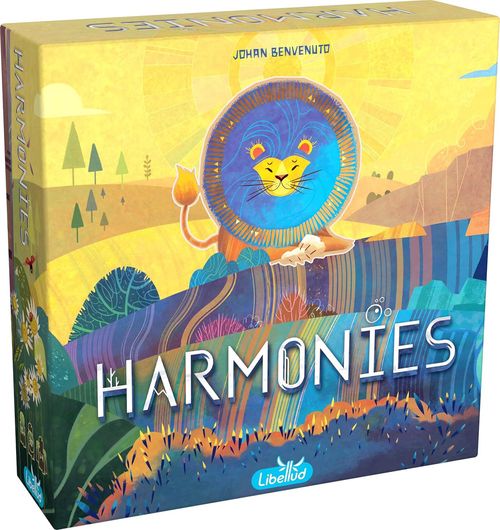
Harmonies
Harmonies Rulebook
Table of Contents
Table of Contents
Contents
- 1 Pouch
- 1 Central board
- 4 Personal boards
- 4 Reminder cards
- 120 Tokens (23 blue, 23 gray, 21 brown, 19 green, 19 yellow, 15 red)
- 66 Animal cubes
- 4 Nature's Spirit cubes
- 32 Animal cards
- 10 Nature's Spirit cards
- 1 Scoresheet pad
- 1 Rulebook
Setup
- Place the Central board with the 2–4 Players side faceup.
- Put all the tokens in the Pouch, then place the Pouch next to the Central board.
- Fill each of the 5 spaces of the Central board with 3 tokens you draw randomly from the Pouch.
- Shuffle the Animal cards and place 5 cards faceup next to the Central board. Place the rest nearby as the draw pile, and place the Animal cubes within reach of all players.
- Each player takes a Personal board; players collectively decide which side to use (all must play the same side faceup). Each player also takes a Reminder card matching that side. (For your first games, use Side A.)
- The player to have last seen a magnificent landscape is the first player. Point the Central board's arrow toward them.
Note: We recommend playing several games before using the Nature's Spirit cards; keep those cards and cubes in the box until then.
Game Turn
Starting with the first player and proceeding clockwise, each player takes a turn by performing the following actions in the order of their choosing:
- Mandatory: Take and place tokens.
- Optional: Take 1 Animal card; Place 1 Animal cube.
At the end of your turn, draw 3 tokens from the Pouch and refill the Central board, and refill the row of Animal cards if needed so there are 5 faceup cards.
Take and Place Tokens (Mandatory)
You must perform this action exactly once during your turn. Take 3 tokens from any one of the Central board spaces. You must place these 3 tokens on your Personal board however you see fit, following the rules below. After placing a token, you may perform optional actions before placing the next token.
How to place a token:
- It can always be placed on an empty space.
- It can be placed on top of 1 or 2 previously placed tokens to create Trees, Buildings, or Mountains. No other stacking is allowed.
- It cannot be placed underneath previously placed tokens.
- It cannot be placed on a space occupied by an Animal cube.
Take 1 Animal Card (Optional)
This action is optional and can be performed anytime during your turn, but only once per turn.
- Choose 1 Animal card from among the 5 faceup cards in the center. Place it above your Personal board. You may have up to 4 cards simultaneously above your Personal board.
- Take as many Animal cubes from the reserve as there are spaces to fill on the Animal card, and place 1 cube on each of those spaces.
These Animals can now be placed onto your Landscape.
Animal card description: A card shows the cubes to place until they can move onto your board, the points the card is worth, the Habitat pattern your tokens must form to create the Habitat, the space on which the Animal cube must be placed within the Habitat, and a reminder of the token color on which the cube must be placed.
Note: For your first games, avoid having multiple Animal cards whose cubes are placed on the same color (the colored stripe on the card's side reminds you of that color).
Place 1 Animal Cube (Optional)
This action is optional and may be performed multiple times on your turn, at any time. Animals settle in your Landscape once you have recreated their required Habitats.
Placement requirements:
- The Habitat pattern must be created exactly as depicted on the card, but it can be oriented in any direction.
- The height of the Trees and Mountains must exactly match what is shown on the card.
- The token on which the Animal cube is to be placed must be unoccupied.
- Buildings can be of any type (the bottom token can be red, brown, or gray).
If the requirements are met, take the bottom-most cube from the Animal card and place it on the corresponding token within the Habitat. Once the final cube on a card has been placed, put that card next to your Personal board—it is complete and no longer counts against your 4-card limit. At the end of the game, each Animal card earns you victory points.
Notes: A single token can be part of multiple Habitats. The placement of an Animal cube is final, even if the pattern initially forming the Habitat is no longer on your Personal board (e.g. if a red token is later placed on a gray one).
End of Game
The game ends in one of two ways:
- The Pouch is empty when you need to refill the Central board.
- At the end of your turn, there are 2 or fewer unoccupied spaces on your Personal board.
If necessary, end the current round so all players have played an equal number of turns. Then tally the points for your Landscapes and Animals. The player with the most points wins. Tie: the player who placed the most Animal cubes wins; if still tied, players share the victory.
Tallying Points — Landscapes
Trees: A Tree is formed by 1 green token placed on top of 0, 1, or 2 brown tokens, creating Trees of size 1, 2, or 3. The height of each Tree determines the points scored.
Mountains: A Mountain is a stack made of 1, 2, or 3 gray tokens. Its height determines the points. However, a Mountain is worth 0 points if it is not adjacent to another Mountain.
Fields: A Field is formed by at least 2 yellow tokens in a contiguous group. You score 5 points for each Field of 2 or more contiguous yellow tokens. To maximize scoring, create small groups separated from each other—a group of 4 or more contiguous yellow tokens still counts as a single Field worth only 5 points.
Buildings: A Building is made of 1 red token placed on top of 1 brown, gray, or red token. You score 5 points for each Building, but only if it is surrounded by at least 3 tokens of different colors (out of the 6 available, including red; consider only the top token on each adjacent space). Otherwise a Building is worth 0 points.
Water — Side A: The River: A River is a string of consecutive blue tokens. Count the number of tokens from one end to the other by the shortest path (ends included); the length determines the points. You only score your best river. If the path contains more than 6 consecutive tokens, score 4 points for each token beyond the 6th.
Water — Side B: The Islands: On Side B, blue tokens are scored differently. Each space or group of spaces separated from each other by blue tokens forms an Island. You score 5 points for each island. (You always have at least 1 island, even without separations.)
Tallying Points — Animal Cards
For each Animal card, whether completed or not, you score the number of points indicated in the topmost space without an Animal cube. A card with all cubes still on it is worth 0 points. There is no penalty for not removing all cubes other than scoring fewer points.
Nature's Spirit Cards
After several games, use Nature's Spirit cards for a richer experience.
Setup: Shuffle the Nature's Spirit cards and deal 2 to each player, facedown. On your first turn, look at them, choose 1 to place faceup above your Personal board (return the other to the box), then place a Nature's Spirit cube on the chosen card. These cubes follow the same placement rules as Animal cubes.
Game turn: Your Nature's Spirit card counts toward your 4-card limit until it is completed by placing its cube on your Personal board.
End of game: Nature's Spirit cards are treated like Animal cards—you score points if you placed the cube (no penalty if you don't). Their points are tallied only at the end of the game and are based on the Landscapes you created; refer to the rule on the card to determine its value. Points from a Nature's Spirit card are in addition to all other points. Some cards reward Landscape combinations you might not otherwise have looked for—for example, points per Mountain of a given height, points per number/groups of Landscapes, or points per group of yellow tokens.
Solo Mode
You can play solo to discover the game, practice, or beat your highest score.
Setup: Place the Central board with the Solo side faceup, which has only 3 spaces. Place only 3 Animal cards faceup near the Central board.
Game turn — at the end of each turn:
- Return the remaining 6 tokens to the box (they are discarded, not returned to the Pouch), then refill each of the 3 spaces with 3 tokens.
- If you did not take an Animal card this turn, you may discard 1 Animal card from the center and replace it with the top card of the draw pile.
All other rules remain unchanged.
End of game: Same triggers—no tokens left in the Pouch to refill, or at least one player has 2 or fewer empty spaces. Play until all players have had an equal number of turns.
Your goal is to earn as many suns as possible, representing your level of success. The number of suns depends primarily on your score, but is also influenced by the side of the Personal board used and the Nature's Spirit you chose. Try to beat your high score in each configuration.
Player Aid
Game turn — actions performed in any order; optional actions may be performed between the placement of 2 tokens:
- Take and place tokens (mandatory, once per turn): can be placed on an empty space; never underneath previously placed tokens; never underneath or on top of an Animal cube; can be stacked only per the stacking rules.
- Take 1 Animal card (optional, once per turn): immediately take enough cubes to cover each spot on the right side of the card; maximum 4 cards above your Personal board; avoid several cards of the same color at once.
- Place 1 Animal cube (optional, unlimited): Habitat pattern may be in any orientation; must comply with Tree and Mountain height requirements; no more than 1 cube per space; a token may be part of several Habitats; each cube placement is final.
End of game turn: refill the Central board; refill the row of Animal cards to 5 faceup if needed.
End of game: there are no tokens left in the Pouch to refill the Central board, or at least one player has 2 or fewer empty spaces on their Personal board. Play until all players have had an equal number of turns.