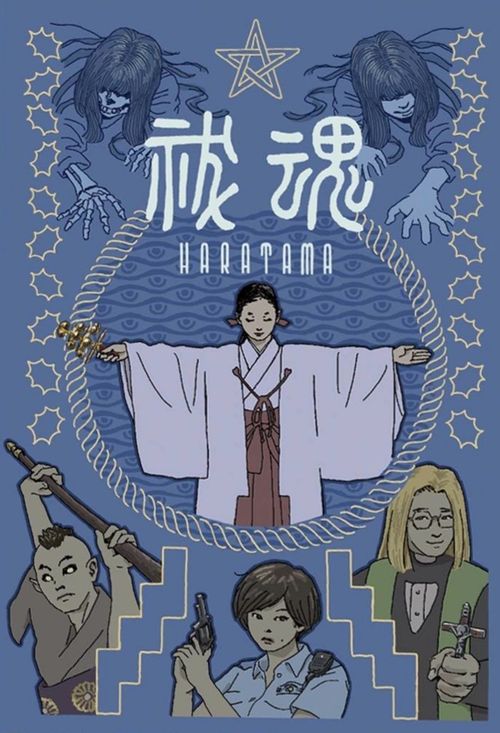
祓魂 (Haratama)
祓魂 (Haratama) Rulebook
Table of Contents
Table of Contents
1. Contents
- Play cards: 52. (Hereinafter simply "cards.") Four colours (red, blue, purple, green), with ranks 1 to 13, one card of each colour and rank. The colour is called the "suit" and the number is called the "rank."
- Divine Descent (神威降臨) cards: 10. One card each for ranks 1 to 10.
- Break marker card: 1.
Glossary
- Trick: Starting from the start player and proceeding in turn order, each player plays one card face up. The mini-game that decides the winner once every player's card is out is called a "trick."
- Round: Playing tricks until all players have used up their hands is called a "round." This game is played over 3 rounds.
2. Game Setup
Before the first round, adjust the number of cards to the number of players as follows:
| Players | Play cards used | Divine Descent cards used |
|---|---|---|
| 3 | 40 (4 suits, ranks 1–10) | 8 (ranks 1–8) |
| 4 | 52 (4 suits, ranks 1–13) | 10 (ranks 1–10) |
In a 3-player game, put the unused cards back in the box.
3. Round Flow
3.1 Preparing the Divine Descent Cards and the Break Marker
Turn all the Divine Descent cards face down and shuffle them well. Turn over 3 of them, saying "Divine Descent!" (神威降臨!) aloud, and place them in the middle of the table. Set the remaining Divine Descent cards aside.
All cards with the same rank as the numbers on the 3 revealed Divine Descent cards become, for this round, special cards called "Sacred Treasure cards" (神器カード).
Place the Break marker card face up next to the Divine Descent cards.
3.2 Dealing and Exchanging Cards, Determining the First Lead Player
Turn all the cards face down, shuffle them well, and deal 13 cards to each player. (In a 3-player game, the one leftover card is revealed and set aside.) Each player takes the cards dealt to them as their hand, and holds them so other players cannot see them.
Next, each player chooses 2 cards from their hand and passes them to the player on their left. Choose the 2 cards you want to pass from your hand and place them face down in front of the player on your left. After all players have placed their cards, each player adds the cards placed in front of them to their hand.
Make a fox with your free hand: If at least one of the cards passed to you by the player on your left has a rank of 6 or lower, make a fox shape with the hand that is not holding cards and show it to the other players. In this way, everyone can see that this player was passed a low-ranked card.
[Translator's note: the printed text says the cards are passed to the player on the left, but this paragraph says the cards come from the player on the left. As printed, the two statements seem to conflict; this translation keeps the printed wording. See the Translator's Notes at the end.]
Then the first lead player is determined. The first lead player is the player who holds the blue 5 (or the blue 6, if the blue 5 was set aside in a 3-player game).
3.3 Trick-Taking
Repeat tricks until the round-end condition is met. Each trick is carried out in the order of 3.3.1 to 3.3.3.
3.3.1 Playing Cards
The lead player plays 1 card from their hand face up. The suit of the card the lead player plays is called the "lead suit."
Break: At the start of the game, the activity of the evil spirits is limited to the hours from dusk to dawn. As battles accumulate, their power grows and they appear in broad daylight. Therefore, at the start of each round, blue, which represents daytime, cannot be used as the lead suit. Blue becomes usable as the lead suit once either of the following conditions is met:
- Someone (who could not follow the lead colour) played a blue card for the first time.
- When leading, all the cards in the player's hand are blue, so they are forced to lead blue.
When one of these conditions is met and a blue card is played for the first time, this is called a "Break." When a Break occurs, turn the Break marker card over to show that blue may now be used as the lead suit.
After that, the other players also each play 1 card in clockwise order, following the Must Follow rule.
Must Follow: If you have cards of the lead suit in your hand, you must play one of those cards in preference. You may play a card of any suit only when you have no card of the lead suit. In that case, you may also play a blue card to cause a Break.
3.3.2 Determining the Trick Winner
Once every player has played 1 card, determine the winner. The player who played the card with the highest rank among the cards of the lead suit wins the trick. The winner of the trick leads the next trick.
3.3.3 Acquiring Sacred Treasures
Each player is possessed by an evil spirit, so acquiring a Sacred Treasure damages them.
If there is a Sacred Treasure card among the cards played in the trick, the trick winner takes only the Sacred Treasure cards, and places them face up and sideways in front of themselves. This shows the damage they have taken.
If you have already acquired Sacred Treasure cards, place the new ones slightly overlapping the existing ones, so that everyone can see how many Sacred Treasure cards you have acquired.
All other cards are collected, turned face down, and discarded to the middle of the table.
When all the Sacred Treasure cards have been acquired: If all 12 Sacred Treasure cards have been acquired by some player, the round ends immediately, even if cards remain in hands, and the game proceeds to scoring. Discard all the remaining cards in hand to the middle of the table.
4. End of Round and Scoring
Repeat tricks. When all the hands are empty, the round ends.
4.1 Scoring
Damage from Sacred Treasures: The Sacred Treasures you have acquired damage you. For each Sacred Treasure card you have acquired, you lose 10 points.
Haratama (祓魂): When you have acquired the required number of Sacred Treasures, "Haratama," which clears away all defilement (穢れ), occurs and you regain your sanity (正気). To trigger Haratama, you must acquire 8 or more Sacred Treasures in a 4-player game, or 9 or more Sacred Treasures in a 3-player game.
When you trigger Haratama, you no longer take damage from Sacred Treasures. Your penalty points for this round are 0.
At this time, every other player loses 10 points for each Sacred Treasure you have acquired. In addition, when Haratama occurs, all the other players avoid the penalty from the Sacred Treasures they themselves have acquired.
4.2 Acquiring Sacred Treasures
[Translator's note: the printed heading for section 4.2 reads 神器の獲得 (Acquiring Sacred Treasures). The text beneath it concerns proceeding to the next round, and the heading is kept as printed.]
If this was not the 3rd round, proceed to the next round. Go to "3.1 Preparing the Divine Descent Cards and the Break Marker."
Game End
The game ends when the 3 rounds are over.
The player with the fewest total penalty points is the winner. If 2 or more players are tied for the fewest, keep playing additional rounds until a single player has the fewest.
Optional Rule: End Condition
You may change the game's end condition from "when the 3 rounds are over" to "when the total penalty points of at least one player reach 200 or more." (The 200 may also be changed to any value you like.)
In this case too, the player with the fewest penalty points wins. If 2 or more players are tied for the fewest, play additional rounds.
Translator's Notes
- Translation: This English text is a translation of the printed Japanese rulebook (the 説明書 published with the game). It was produced from the Japanese text only. Nothing has been added, and nothing has been filled in from other sources.
- Terms: 神威降臨 is rendered "Divine Descent," 神器 "Sacred Treasure," 祓魂 "Haratama" (kept as the game's name), 穢れ "defilement," 正気 "sanity," and 失点 "penalty points." The Japanese terms are shown in brackets at first use. The Break marker card is the printed ブレーク表示カード.
- Fox passing direction (section 3.2): The printed text says each player passes 2 cards to the player on their left, but the fox paragraph says the cards are received from the player on their left. Since a player who passes to their left receives from their right, this may be a printed error (possibly 右隣, "right neighbour"). The English keeps the printed wording and has not corrected it.
- Section 4.2 heading: The printed heading reads 神器の獲得 (Acquiring Sacred Treasures), although its text covers proceeding to the next round. The heading is kept as printed.