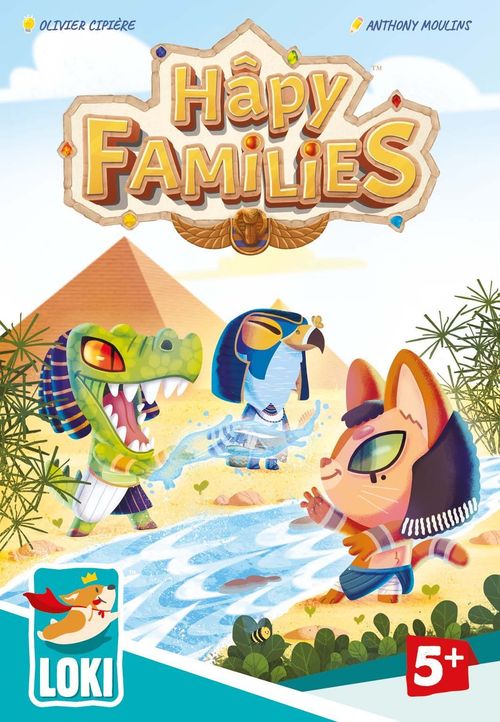
Hâpy Families
Hâpy Families Rulebook
Table of Contents
Table of Contents
Setup
- Shuffle all the cards with the Mummy side up.
- Lay out all the cards in the middle of the table to make a pyramid by following the instructions below:
- Start with the top of the pyramid. Place 1 card God side up, then place 2 more cards below it, Mummy side up, so that they partially cover the first card.
- Continue in this way for the rest of the cards, with rows of cards alternating between God side up and Mummy side up. When you're finished, your pyramid should look like the one in the example.
Goal of the Game
Be the first player to gather the most Gods of the same family.
Gameplay Overview
On your turn, you must take a God (1) from the pyramid and keep it with you: this is your hand. Then, you may request a God (2), and finally you must reveal Gods from the same family (3) if possible.
The youngest player starts, then play continues clockwise.
1. Taking a God
- If the pyramid is not empty, take 1 available God card and add it to your hand. A God card is available if it is not partially covered by another card. If the card is Mummy side up, do not show it to the other players. It's a secret! Only you can see which type of card it is.
- If the pyramid is empty, you can no longer take God cards from the middle of the table. Skip this step of your turn. But you can still ask for a God during the next step: requesting a God.
2. Requesting a God
This action is optional: choose another player and name 1 God card.
Example: "Adrien, do you have the number 1 Cat?"
If the player has that God in their hand, they must give it to you.
Note: You cannot request the same card that the previous player requested.
3. Revealing Gods
If you have a group of 3 God cards from the same family (of the same color) in your hand, you must place them God side up on the table in front of you. If you end up with two groups in the same turn, reveal them both. Other players cannot request these God cards from you for the rest of the game.
Then the player to your left takes their turn.
End of the Game
The game ends as soon as a player has revealed:
- an entire family, meaning 6 God cards of the same color;
OR
- 5 groups of 3 Gods in the same family (with 2 players);
- 4 groups of 3 Gods in the same family (with 3 players);
- 3 groups of 3 Gods in the same family (with 4 players).
That player immediately wins the game.
Exploration Variants
Spice up your games by changing the starting setup. Instead of putting the cards in a pyramid, you can copy the following examples:
- Mastaba: Start by placing all 6 number 1 Gods in a line, God side up. Then place the remaining cards in this design.
- Temple: Make two designs: one with all cards Mummy side up, and the other with all cards God side up.
- Tomb: Create this design by starting with 1 card in the middle, Mummy side up.
- Giza: Make three designs. You can also have fun by making one of them with all the cards Mummy side up!
The Gods of Ancient Egypt
We use the term god to designate supernatural beings endowed with powers. In ancient Egypt, gods were often represented by creatures with human bodies and animal heads!
- Hapy is the god of the Nile, the great Egyptian river. In ancient times, healthy crops relied heavily on the annual rising of the Nile. It provided all the necessary water to the farmlands by flooding them.
- Anubis is not the nicest god of the bunch, since he is the god of embalming and mummification. He is represented by a man with the head of a Jackal.
- Bastet is a protective goddess. Like cats, her sacred animal, she watched over houses and harvests by driving away animals that tried to snack on provisions and crops.
- Sobek is the god of water and fertility, represented by a crocodile. People worshipped him in the city of Crocodilopolis, where they raised sacred crocodiles.
- Horus is the protector god of the pharaohs, one of the oldest and most important gods of ancient Egypt. He is represented by a man with the head of a falcon.
- Taweret is a protective goddess of birth. Gentle and kind, she warded off evil spirits to keep them from newborn infants. She looks too cute as a hippo and loves cuddling babies!
- Apis is a super strong god represented by a bull with long horns and a solar disc. He is the symbol of fertility and physical strength.