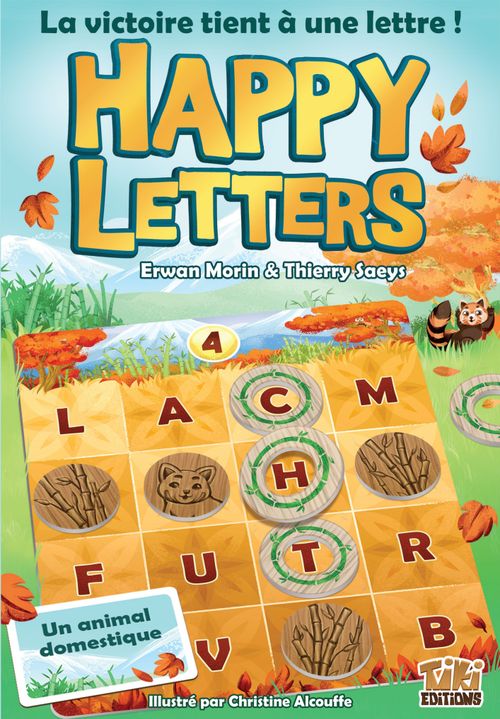
Happy Letters
Happy Letters Rulebook
Table of Contents
Table of Contents
Components
- 30 double-sided boards (5 per level, levels 1 to 6)
- 20 rings
- 80 tokens
- 5 "Master" tiles
- 5 "2nd grid" tokens
- 55 double-sided Theme cards
- 1 hourglass
The illustrations on the tokens have no effect on play.
Setup
- Each player takes at random a board matching their level (level 1 for a first game) and 4 rings.
- Place in the centre of the table the 80 tokens, the Theme cards and the hourglass.
- Leave the Master tiles and the "2nd grid" tokens in the box.
Before your first game, write your name in one of the frames of the Honour Board.
Playing a Round
1) Announcing the Theme
One player draws the first Theme card, turns it face up and announces the theme of the round.
2) Finding a Word
- All players play at the same time.
- Players look for a word that matches the theme and that contains as many letters as possible from a single row or a single column of their grid.
- The chosen word must contain every letter you cover with your rings, without necessarily following the same order (see the example below).
- If the same letter appears twice in a row or a column, your word must also contain that letter twice to cover both squares.
- As soon as a player is satisfied with their answer, they turn the hourglass over. From that moment on, they can no longer move their rings.
- The other players then have 20 seconds to find a word and place their rings.
Example: David has thought of the word "DOCTEUR" (DOCTOR). He has placed his rings on the E, the C and one of the two Rs of the 3rd column, because "Docteur" contains only one R.
3) Validating Words
- Each player announces their word in turn.
- A word is validated if it matches the theme.
- If there is a dispute, a word is validated if at least half of the other players approve it.
- If a word is refused, simply remove the rings.
- If a word is validated, replace the rings with tokens.
Spelling mistakes: if a word is misspelled, the player removes only the rings on the wrong letters. However, the rings covering correct letters are replaced with tokens.
Word Validation Rules
Allowed:
- One word or several words, if the group of words cannot be separated for the answer to be understood. It is forbidden to add useless words if the main word is clear enough.
- Examples: "Rouge à lèvres" (lipstick), "Le Seigneur des anneaux" (The Lord of the Rings) are allowed. "Faire de l'accrobranche" is not; it must be shortened to "Accrobranche" (tree-top adventure park).
- Plural words, unless the Theme card explicitly asks for a singular word.
- Example: for "Un animal" (an animal), "Chevaux" (horses) is not allowed; "Cheval" (horse) is.
- English words if they have no natural French equivalent for the theme.
- Examples: "Star Wars", "Cheesecake".
- Proper nouns.
- Conjugated verbs.
4 Letters or Fewer in Your Grid
When you have only 4 letters or fewer still visible in your grid, you are allowed to use them together, as if they were in the same row or column.
Ending a Round and the Game
End of a Grid
At the end of a round, if you have finished the first grid of your board, turn the board over and return the tokens to the supply. Then place a "2nd grid" token at the top of the new grid.
End of the Game
At the end of a round, the first player to have filled their second grid wins the game! If several players finish their second grid in the same round, they share the victory.
- The winner or winners tick their level on the Honour Board.
- In your next game, play at the next higher level, and progress up to level 6, then to the Master levels.
Example: Débora has just won her first game at level 1. She ticks "1" on the Honour Board and will begin her next game with a level 2 grid.
Within the same game, players may use grids of different levels.
The "Master" Level
When a player wins at level 6, they reach the title of Master! They tick the "Master" box on the Honour Board.
They then start again at level 1, following the Special "Master" Rule:
- At the start of a grid, draw a Master tile at random and place it on the first row of your grid.
- The letters on this tile are more complex.