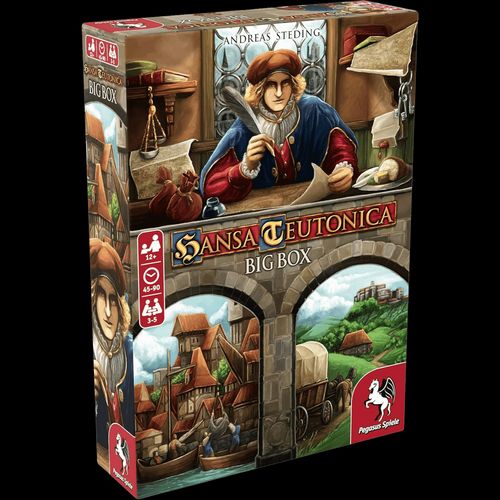
Hansa Teutonica
Hansa Teutonica Rulebook
Table of Contents
Table of Contents
Game Board
The two-sided board shows cities with one to four Office locations (spaces with square or round fields in white, orange, pink, and black). Trade routes between cities contain two to four field spaces for placing traders or merchants. Five cities (Groningen, Stade, Lübeck, Göttingen, and Halle) show pictograms of trading skills that can be enhanced by establishing a route there. In Coellen, prestige points may be gained. Three Bonus Markers are initially placed on the Taverns bordering the routes from (1) Osnabrück–Bremen, (2) Lüneburg–Perleberg, and (3) Hildesheim–Goslar. The board also shows a prestige-point track around the perimeter and a completed-city track in the top left.
Setup
- Flip the board to the appropriate side (2/3 players or 4/5 players).
- Shuffle face down the three starting Bonus Markers (1× Remove 3 Resources, 1× Swap Office, 1× Extra Office) and place them face up on the three Taverns, arrow pointing to the trade route. Shuffle the remaining Bonus Markers face down beside the board.
- Each player takes a player mat and covers the fields of the trading-skill tracks with traders (cubes) and merchants (disks) per the symbols, leaving only the first (leftmost, pale) field of each track open. The initial abilities are: 1 victory point per Office in Network, 2 activities per turn, basic (white) privileges, 2 resource moves, and 3 new resources from stock.
- Each player puts one trader on the "zero" field of the prestige-point track.
- Place the "completed cities" marker (black cube) on "zero."
- The randomly chosen start player puts 5 traders and 1 merchant into his personal supply (6 traders left in stock). Clockwise, each following player puts one additional trader in his supply (second player 6, third player 7, etc.). Resources must be moved from the stock to a player's personal supply before use—keep stock and personal supply separate.
Rule of thumb: merchants may be used instead of traders unless stated otherwise, but not vice versa. "Resource" means either may be chosen.
Player Boards
Each player board shows five activity pictograms (bottom), a tin plate (for unplaced bonus markers), and five trading-skill tracks (the fewer symbols covered, the more developed):
- Town Keys (1, 2, 2, 3, 4): At game end, your largest network of connected Offices scores this many prestige points per Office.
- Activities (2, 3, 3, 4, 4, 5): How many activities you may perform per turn (starts at 2, up to 5). Newly acquired activities may be used immediately.
- Privilege Level: Basic (white), Moderate (orange), Higher (pink), Maximum (black): Which colored city spaces you may place a resource on to establish an Office.
- Book of Lore (2, 3, 4, 5): How many of your own resources you may move (not insert) on the board within one activity.
- Money (3, 5, 7, C): How many resources you may take from the stock into your personal supply in one activity ("C" = all remaining).
Sequence of Play
Players take turns clockwise. Each player performs as many activities as his current "Activities" skill allows, in any order, repeating as often as desired (each completed before starting the next). Activities:
- Allocating Resources: Move resources from the stock into your personal supply, up to your "Money" track (3, 5, 7, or all).
- Placing a Resource: Put one resource from your personal supply on any free field on any trade route (not inside a city).
- Displacing a Resource: Replace an opposing resource with one from your personal supply, and move one additional resource to the stock as a penalty (two if you displaced a merchant). The opposing player puts the displaced resource plus one additional (two if a merchant) from the stock onto any empty field on an adjacent trade route (only one city between the origin and destination; if all adjacent fields are full, a farther field may be chosen). The displaced player may take from personal supply or the board if the stock is insufficient but may not move stock into personal supply, and may decline to place the extra resources but must re-place the displaced one.
- Moving Resources: Rearrange up to your "Book of Lore" number of your own resources on trade routes (swap positions), but not into cities.
- Establishing a Trade Route: If all fields of a route are occupied by only your resources, you may establish it (an activity, not automatic). When you do: (a) prestige points may be awarded, (b) a bonus marker may be obtained, and (c) an Office, skill level, or extra prestige points may be awarded.
- a. Prestige Points Awarded: If an Office already exists in a city adjacent to the new route, the player controlling that city gains 1 prestige point (2 if the same player controls both cities). No point for a city without an Office. The player controlling a city has the most Offices there; ties break to the higher-valued (rightmost) space.
- b. Bonus Markers: If a bonus marker sits on the established route, take it and place it face up in front of you. It may be used anytime later in the game (not the activity in which acquired) and does not count as an activity; each is used once, then kept face down for end-game scoring. For each bonus marker obtained, draw a new one face down onto your tin plate; before the next player's turn, place it beside any route(s) meeting three conditions: (i) no bonus marker already there, (ii) all fields empty, and (iii) at least one open Office space in an adjacent city.
End of the Game
The game ends immediately at the end of the activity (not necessarily the end of a turn) when one of these occurs:
- A player reaches 20 or more prestige points.
- No replacement bonus marker is available when a player draws a new one after establishing a route (the drawn marker cannot be used).
- The Completed City marker reaches "10."
Final Scoring
Sum the following prestige points:
- a. Points acquired during the game.
- b. 4 points per skill developed to the maximum (except Town Keys, scored in f).
- c. Bonus markers obtained: 1 BM = 1, 2–3 = 3, 4–5 = 6, 6–7 = 10, 8–9 = 15, 10+ = 21.
- d. Points for merchants in Coellen (per the table next to Coellen).
- e. 2 points per city you control (most Offices; ties to the higher-valued space).
- f. Your Town Key level × the number of Offices in your largest Office Network.
The player with the most prestige points wins; ties share the victory.
Bonus Marker Details
- Extra Office (5): When claiming a route, place an Office to the left of (not directly in) an adjacent city, using a trader or merchant from the claimed route, provided at least one Office already exists in that city. This Office is least valuable for control ties, and the Switch Offices marker cannot be used on it.
- Switch Offices (2): Switch the position of 2 adjacent Offices within the same city, ignoring the space colors and trader/merchant restrictions.
- +3/4 Actions (2/2): Take 3 or 4 extra actions this turn.
- +1 Ability (3): Improve any one ability by removing its leftmost resource to your personal supply; usable immediately.
- Remove 3 Resources (2): Remove up to 3 traders/merchants from trade-route fields (not cities), from any players/routes; removed pieces go to their owners' personal supplies.
2-Player Rules
Use the wooden figure and 4 border guards. The board is divided into 16 provinces by the trade routes and the border guards (placed between Osnabrück–Münster, Münster–Dortmund, Lüneburg–Bruinswiek, and Bruinswiek–Goslar). After the start player is chosen, the other player places the wooden figure in any province. On your turn you may move the figure 1 or 2 provinces free (before or after your activities), or to any province for the cost of one activity. The activities of placing a resource, displacing a resource, and establishing a trade route may only be taken on routes adjacent to the figure; allocating and moving resources are not restricted by the figure.