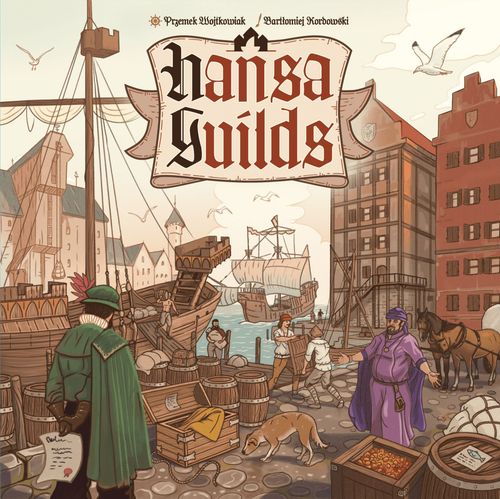
Hansa Guilds
Hansa Guilds Rulebook
Table of Contents
Table of Contents
- Components
- Board Description
- Setup
- Gameplay
- Actions
- Collect 1 Good and 1 Trade Contract
- Move Your Cart and/or Ship 1 Space and Collect Goods
- Move Your Cart 1 Space and Collect 2 Goods OR Move Your Cart 2 Spaces and Collect 1 Good
- Move Your Ship 1 Space and Collect 2 Goods OR Move Your Ship 2 Spaces and Collect 1 Good
- Finalise a Trade Contract OR Build a Kontor OR Buy a License
- End of the Game and Final Scoring
- Event Tokens
- Historical Background
- Kontors
- Representatives of the Families Appearing in the Game
Components
- 1 board
- 4 player boards
- 60 goods tokens (6 of each kind: grain, coal, wax, fish, timber, spices, cloth, wine, salt, amber)
- 16 trading houses (4 of each colour)
- 4 merchants (1 of each colour)
- 4 ships (1 of each colour)
- 4 carts (1 of each colour)
- 4 starting trade contract tokens
- 33 trade contract tokens
- 11 license tokens
- 12 event tokens (in Polish)
- 12 event tokens (in English)
- 4 flag tokens
- 1 first player token
- 1 bag
Board Description
- Sea routes, used by ships.
- Land routes, used by carts.
- Spaces for trade contracts.
- Spaces for goods.
- Space for event tokens.
- Space for final scoring rules.
- Action spaces.
Player Board Description
- Coat of arms of the family.
- Means of transport (a cart; a ship).
- Spaces for goods on the cart (4) and on the ship (4).
- Space for extra goods (available when the kontor is built).
- Trading houses and kontor benefits.
- Spaces for active trade contracts.
Trade Contract Description
- City of delivery.
- Goods required to finalise the contract.
- Contract type: sea (blue), land (brown), or sea/land (blue and brown).
- Starting trade contract.
- End game victory points.
License Description
- Coat of arms of the license city.
- Goods required to buy the license.
Setup
- Place the board in the middle of the table.
- Each player takes 1 player board and all pieces of the same colour: 4 trading houses, 1 ship, 1 cart and 1 merchant.
- Players place their 4 trading houses on their player boards.
- Each player is dealt a random starting trade contract token. Players place their ships and carts in the cities shown on the token. Then, they flip the token over and place it on a space for active trade contracts below their player boards.
- Depending on the number of players, put 4, 5 or 6 goods tokens into the bag and place it next to the board.
- Draw 20 goods tokens from the bag and place them randomly face up on the designated spaces on the board.
- Shuffle all trade contract tokens and place them face down above the board. Draw 4 tokens and place them face up on the designated spaces on the board. Place the remaining trade contract tokens in stacks face down.
- Place all license tokens on the designated spaces with coats of arms on the board.
- Choose the variant of the game: standard (45–60 minutes) or extended (60–75 minutes). Divide event tokens into 4 stacks according to the period number on their backs (I, II, III and IV) and place them face down on the table.
- In the extended variant, take 1 random event token from each stack. Place them in a face-down stack in ascending order with the period I token at the top. Then, place the event stack on the board in the designated space. Return the remaining event tokens to the box without looking at them. They will not be used during the game.
- In the standard variant, follow the description above with one exception: do not take a token from the period III event stack. The event stack should contain 3 tokens (from periods I, II and IV).
- Give the first player token to the person who last visited a museum. They keep it until the end of the game.
Now, you are ready for your Hanseatic adventure!
Gameplay
The game is played in turns in clockwise order, starting with the first player. At the end of the game, players count victory points gained from finalised trade contracts, built kontors and owned licenses and goods. The player with the most victory points wins!
Each turn, you must place your merchant on an action space on the board to perform that action. You can choose any action space on your first turn, but you must move your merchant to another action space in the following turns. Several merchants may occupy the same action space.
Important! You must move your merchant to another action space. In other words, you cannot perform the same 2 actions in a row.
When you place your merchant on the chosen action space, perform that action.
Actions
Collect 1 Good and 1 Trade Contract
Take the top-most goods token from 1 of the 2 columns corresponding to that action and place it on an empty space on your cart or ship.
In addition, choose 1 of the 4 face-up trade contract tokens and place it on an empty space for active contracts below your player board. Then, refill the empty space on the board with a new token (turned face up) from the top of the corresponding stack.
If your cart and ship are in the same port city before, during or after the movement, you may freely rearrange goods and trade contract tokens on your player board (but remember that contracts must match the means of transport).
Example: Eve takes the "Collect 1 good and 1 trade contract" action, placing her merchant on the corresponding space. She takes a timber token from the board and places it on an empty cart space. In addition, Eve chooses the contract to deliver goods to Visby. Since it is a sea contract, she places it on an empty space for active contracts on the right side of her player board.
Move Your Cart and/or Ship 1 Space and Collect Goods
You may move your cart and/or ship 1 space from the city to another city. You may move either your cart or ship, both your cart and ship or none of them.
In addition, take the top-most goods token from the column corresponding to that action and place it on an empty space on your cart or ship.
If your cart and ship are in the same port city before, during or after the movement, you may freely rearrange goods and trade contract tokens on your player board (but remember that contracts must match the means of transport).
Example: Eve takes the "Move your cart and/or ship 1 space and collect goods" action, placing her merchant on the corresponding space. She decides to move her cart from Toruń to Gdańsk. Since her ship is also in Gdańsk, Eve can swap her goods and trade contracts between her cart and ship. She also takes a wax token from the board and places it on an empty cart space.
Move Your Cart 1 Space and Collect 2 Goods OR Move Your Cart 2 Spaces and Collect 1 Good
Choose one of the two options:
- You must move your cart 1 space from one city to another and take 2 top-most goods tokens from the column corresponding to that action. Place them on empty spaces on your cart and/or ship.
- OR you must move your cart 2 spaces from one city to another and take 1 top-most goods token from the column corresponding to that action. Place it on an empty space on your cart or ship.
Example: Eve takes the "Move your cart 1 space and collect 2 goods OR move your cart 2 spaces and collect 1 good" action, placing her merchant on the designated space. She decides to move her cart 2 spaces from Gdańsk to Kaunas (via Toruń). She also takes a wax token from the board and places it on an empty cart space.
Move Your Ship 1 Space and Collect 2 Goods OR Move Your Ship 2 Spaces and Collect 1 Good
Choose one of the two options:
- You must move your ship 1 space from the port city to another port city and take 2 top-most goods tokens from the column corresponding to that action. Place them on empty spaces on your cart and/or ship.
- OR you must move your ship 2 spaces from the port city to another port city and take 1 top-most goods token from the column corresponding to that action. Place it on an empty space on your cart or ship.
Example: Eve takes the "Move your ship 1 space and collect 2 goods OR move your ship 2 spaces and collect 1 good" action, placing her merchant on the designated space. She decides to move her ship 1 space from Gdańsk to Visby and take 2 goods tokens from the board: fish and grain. She places the fish token on an empty cart space and the grain token on an empty ship space.
Important! Remember that carts move only along land routes, and ships move only along sea routes.
Important! If you take a goods token and there are no empty spaces on your cart or ship, you can choose and discard any goods token from your player board to the used goods pile and place the new token on the empty space.
Important! Whenever you take a goods token from the board, slide all remaining tokens to the top and immediately refill empty spaces with new tokens from the bag. If no goods tokens are in the bag, put all tokens from the used goods pile inside and refill empty spaces on the board. Then, resolve the event token.
Finalise a Trade Contract OR Build a Kontor OR Buy a License
You must choose 1 of the 3 available actions:
- finalise a trade contract;
- build a kontor;
- buy a license.
Finalise a Trade Contract
You can finalise 1 of your active trade contracts if you meet all of the following conditions:
- Your cart or ship is in the city indicated on the trade contract token.
- Your trade contract token is on the corresponding side of your player board, matching the means of transport.
- All goods indicated on the trade contract token are on the corresponding side of your player board, matching the means of transport.
To finalise a trade contract, discard all required goods tokens from your player board to the used goods pile. Then, flip the finalised trade contract token over and place it above your player board. Each of your finalised trade contracts provides victory points at the end of the game.
Example: Eve has an active trade contract that can be finalised in Visby, where her ship is now. It is loaded with grain and cloth tokens, which are required to finalise the contract. Eve discards them to the used goods pile next to the board, flips the trade contract token over and places it above her player board. At the end of the game, she will gain victory points for the finalised contract.
Build a Kontor
You can build a kontor in 1 of the 4 major Hanseatic cities if you meet all of the following conditions:
- Your cart or ship is in Bergen, Veliky Novgorod, Bruges or London.
- You do not have a kontor in that city.
- All goods indicated on the city are on the corresponding side of your player board, matching the means of transport.
To build a kontor, discard all required goods tokens from your player board to the used goods pile. Then, choose 1 of the trading houses on your player board and place it on the empty kontor space you choose in that city.
Example: Eve's cart is in Bruges. It is loaded with amber, fish and coal tokens, which are required to build a kontor in that city. Eve discards the goods tokens to the used goods pile next to the board, takes a trading house from her player board and places it on the second kontor space in Bruges. She immediately gains a bonus movement action, which she uses to move her cart from Bruges to Amsterdam. At the end of the game, she will gain victory points for the built kontor.
Kontor Bonus Actions on the Board
Kontors provide victory points at the end of the game, depending on which space your trading house is built. In addition, you immediately gain a bonus action corresponding to the kontor space on the board.
- A kontor built on this space provides you 4 victory points at the end of the game. Important! You do not gain a bonus action on this kontor space.
- A kontor built on this space provides you 3 victory points at the end of the game. After you build your kontor, you can immediately move your cart or ship 1 space.
- A kontor built on this space provides you 2 victory points at the end of the game. After you build your kontor, you can immediately move your cart and/or ship 3 spaces. You can distribute this movement among your cart and ship.
- A kontor built on this space provides you with 1 victory point at the end of the game. You can build this kontor for 1 goods token less than required. This means that you discard 1 token less to the used goods pile.
Example: You build a kontor and immediately move your ship 2 spaces and your cart 1 space.
Kontor Benefits on the Player Board
Each kontor you build on the board also provides an instant benefit displayed next to an empty space for a trading house on your player board:
- After this kontor is built, you can take goods tokens from any column space while collecting goods. You do not have to take the top-most goods token anymore.
- After this kontor is built, you can use the fifth space for goods on your cart and ship. This benefit allows you to store more goods tokens on your player board.
- After this kontor is built, you do not have to move your merchant to another action space in your turn. This means that you can perform the same action several times in a row.
- After this kontor is built, you can replace 1 good with any 2 goods while finalising a trade contract, building a kontor and buying a license. You can use this benefit more than once during a single action.
Example: Eve finalises the trade contract, which requires 3 goods on a cart: 1 amber, 1 salt, and 1 cloth. Not having a cloth token on her player board, she uses the benefit she gained after building a kontor. To finalise the contract, Eve discards the following tokens to the used goods pile: 1 amber token, 1 salt token and 2 other tokens (amber and timber) that replace the missing cloth.
Buy a License
You can buy a license in 1 of the 11 Hanseatic cities if you meet all of the following conditions:
- Your cart or ship is in a Hanseatic city.
- There is a license token on that city's space.
- The good indicated on the license token is on the corresponding side of your player board, matching the means of transport.
To buy a license, discard the required goods token from your player board to the used goods pile. Then, take the license token from the board and place it above your player board, next to the finalised trade contracts. Each license you buy provides you victory points at the end of the game.
Example: Eve's ship is in Stockholm. There is a license token in that city. The ship is loaded with grain, which is required to buy the license. Eve discards the grain token to the used goods pile next to the board and places the license token from Stockholm above her player board. At the end of the game, she will gain victory points for the bought license.
Events
When the goods bag is empty, take an event token from the top of the event stack and place it face up next to the board. Then, read and resolve its effect. Most events introduce some restrictions on specific places on the board. To remember that a given place is affected by the event, place a flag token on it.
The effect of an event is active until the goods bag is empty again. When this happens, return the active event token to the box and collect all flag tokens from the board. Then, take a new event token from the top of the event stack and place flag tokens on the board in appropriate places.
When you uncover the last event (i.e. the third or fourth event token, depending on the variant), the end of the game is triggered. The event token informs you how many turns players should take before the game ends. The first player takes 3 or 4 flag tokens (depending on the variant). At the beginning of their every turn, they place 1 flag token on the active event token to count turns. The players continue the game until they all perform the same number of turns. Then, proceed to final scoring.
(See the description of event tokens on pages 10–11.)
Example: The game ends, and Eve counts her victory points. She finalised 2 trade contracts (Visby and Toruń) for 3 and 5 victory points, respectively. She also built 2 kontors. For the kontor in Bruges, she receives 3 victory points, and for the kontor in Veliky Novgorod, she receives 1 victory point. Eve also has 3 licenses for 2 victory points each. There are 3 goods tokens left on her cart and ship, so she receives 1 victory point for them. Eve gathered 19 victory points in total.
End of the Game and Final Scoring
Add victory points gained from the following components:
- 3, 5 or 6 victory points for each trade contract that you finalised;
- from 1 to 4 victory points for each kontor that you built;
- 2 victory points for each license that you bought;
- 1 victory point for each set of 2 goods tokens on your player board (in any combination).
The player with the most victory points wins! In the event of a tie, the tied player who finalised more trade contracts wins. If there is still a tie, all tied players share the victory.
Event Tokens
Period I
- 1390–1401: The Victual Brothers' activity. To move via and to Bergen, Visby, Stockholm and the Skagerrak, players must pay 1 goods token from their ship. They do not have to pay if their ship is empty while moving.
- 1426–1435: The Dano–Hanseatic War. To move via and to the Skagerrak, players must pay 1 goods token from their ship. They cannot perform this movement if their ship is empty.
- 1438–1441: The Dutch–Hanseatic War. To finalise a trade contract or buy a license in Amsterdam, Hamburg, Dortmund and Lübeck, players must pay an extra 1 goods token. They cannot perform these actions if their cart and ship are empty.
Period II
- 1453–1454: Cold winter in the Baltic Sea region. Players cannot move their ships 2 spaces. Place a flag token on the action space on the board.
- 1454–1466: The war between Poland and the Teutonic Knights. To move via and to Gdańsk and Toruń, players must pay an extra 1 goods token. They cannot perform this action if their cart and ship are empty. Players cannot buy licenses in these cities.
- 1464: Epidemic in Gdańsk and Lübeck. To finalise a trade contract or buy a license in Gdańsk and Lübeck, players must pay an extra 1 goods token. They cannot perform these actions if their cart and ship are empty.
Period III
- 1470–1474: The Anglo–Hanseatic War. To move via and to London, players must pay an extra 1 goods token. They cannot perform this action if their cart and ship are empty. Players cannot build kontors in London.
- 1494: Tsar Ivan III of Russia closes the kontor in Veliky Novgorod. Players cannot build kontors in Veliky Novgorod.
- 17 September 1497: Great storm in the Baltic Sea. Each cart and ship in Gdańsk, Lübeck, Visby, Riga and Stockholm loses 1 goods token. Discard them to the used goods pile. If a player's cart or ship is empty, they do not lose goods from this means of transport. This event has a one-time effect and does not affect the following turns.
Period IV
In the case of each period IV event token, the active player completes their current turn. When the event is revealed, the first player takes 3 or 4 flag tokens according to the chosen variant. At the beginning of their every turn, they place 1 flag token on the active event token to count turns.
- 3 turns left: Each player can take 2 random goods tokens from the bag OR move their cart and/or ship 2 spaces (in any combination).
- 3 turns left: Each player can move their cart and ship 1 space AND take 1 random goods token from the bag.
- 4 turns left: (No effect text is printed on this token in the rulebook. None is transcribed here.)
Important! Make sure you place flag tokens on the board to remember the effect of the active event.
Historical Background
The facts presented in this section were prepared by Professor Beata Możejko (the Faculty of History at the University of Gdańsk) on the basis of her materials, materials by Marcin Grulkowski and entries published in Gedanopedia, the online version of Gdańsk Encyclopaedia.
What Was the Hanseatic League (Hansa)?
In the beginning, the word "Hansa" was used to describe a band, then a group, an agreement, a society of merchants and a commercial confederation (a merchant guild). It was an organisation of towns and cities in Central and Northern Europe founded to protect their mutual trading interests. Being aware of the importance of maritime trade, the Hanseatic League aimed to gain control over the Baltic and North Seas. Initially, it comprised several German towns (thirteenth century), with central positions of Lübeck and Hamburg. With time, however, it started to expand, admitting more towns and cities, such as Gdańsk, Toruń, Wrocław or Kraków, which had great commercial potential. It is estimated that during its heyday between the fourteenth and sixteenth centuries, the Hansa included 70 member cities and towns.
After years of glory, the organisation began to decline. Many factors contributed to this situation, including the lack of solidarity among the Hanseatic cities and towns, geographical discoveries, the growing role and importance of nation-states and colonial rivalry. In the second half of the sixteenth century, the Hansa focused mainly on protecting its privileges. In 1554, the league divided the organisation into four parts (quarters) led by Lübeck, Cologne, Brunswick and Gdańsk. In 1556, the post of syndic was created who was responsible for diplomatic activities on behalf of the Hansa. In 1612, a central treasury was set up. During the 1629 Hanseatic diet, it was agreed that the city councils of Lübeck, Hamburg and Bremen would be responsible for representing the interests of the Hansa. This, in practice, meant that the league was liquidated. In 1669, the last diet was organised; among delegates was the representative of Gdańsk.
The Hanseatic League did not form a coherent organisation. The representatives of member cities and towns met for Hanseatic diets, during which shared trade politics and political actions were discussed and formed. The cities and towns that did not follow Hansa's decisions were excluded from the league; in 1471, this was the fate of Cologne (its membership would later be restored).
The Goals of the Hanseatic League
- To secure protection against pirates who attacked ships loaded with food. They were called the Victual Brothers; its name was derived from the Latin word for provisions, victualia. The Hansa's way to deal with the pirates was joint convoys and combined fleets: ships gathered in Lübeck, set sail to collect goods and then returned together. From the late fourteenth century, ships were equipped with weapons, such as cannons, to be used in case of encountering pirates.
- To regulate shipping in winter. Due to weather conditions, sailing on the Baltic Sea was quite dangerous. The sea was especially threatening in late autumn, when dangerous storms raged, and in winter, when wooden ships were exposed to snow storms. Therefore, the Hansa imposed bans on sailing between 11 November and 22 February. Only small vessels carrying herring and mail were allowed to depart during that period.
- To regulate prices and take care of the quality of goods. The Hansards strived to trade in the products of the highest quality. Marks of property were used to stamp cloth; they were also scratched on barrels in which goods were transported.
- To prevent mercantile competition. The Hansa enjoyed numerous commercial privileges and freedoms granted by rulers and feudal lords. It tried to restrict non-Hansards' access to the markets on which it operated. Such restrictions, for example, were imposed on Englishmen in Gdańsk.
- To ban building ships for non-Hansards. In many towns and cities, the Hansa struggled to enforce this ban. For example, Gdańsk did not want to abandon building vessels for the Dutch, arguing that there was a functioning shipyard, shipwrights, and necessary materials in the city.
Kontors
The Hansards traded by land, yet for many of them, maritime trade was the basis of their existence. This inspired Polish historian Henryk Samsonowicz to entitle his book on the Hansa, The Hansa. Ruler of the seas (Hanza. Władczyni mórz). The most emblematic type of ships used within the Hansa were cogs (fitted with a single mast and the edges of hull planks overlapping each other) and bigger hulks, which could carry up to about 100 tons. Hanseatic skippers and merchants entered into commercial partnerships; their agreements included, for example, the transfer of goods to the ship or the sharing of profits from sales with the skipper. However, if the ship sank, the skipper and the merchant suffered loss. The merchants could also give the skippers money to purchase goods at the destination port.
The league's regular institutions that supervised trade were trading posts called kontors. Four major kontors were established in Veliky Novgorod, Bergen, Bruges and London. They were managed by the elected elders who coordinated activities to defend the interests of the Hansa. Kontor had its own court of justice, treasury, and seal. Each of the four major kontors operated in different conditions, controlling different parts of the trading network.
The easternmost post was the kontor in Veliky Novgorod, where the most challenging conditions prevailed due to the climate and the vicinity of neighbours who were not always friendly. Secured with a high palisade fence, the kontor's territory spread over the right bank of the Volkhov. St. Peter's Church was located in the kontor's centre, serving a religious purpose and functioning as a vault and shelter if needed. The kontor in Veliky Novgorod was closed in 1494 by the decision of Tsar Ivan III of Russia. The Hansards bought sable and squirrel furs, forest products, wax and linen here.
The territory of the Bergen kontor, which belonged mainly to the residents of Lübeck, was located on the coast of the North Sea. The only stone building in the area, St. Mary's Church, stood above timber houses. In the kontor, only merchants from the cities with the Lübeck law could be elected as the elders. The residents of Lübeck also had the right to choose the parish priest. The main exports were fish, animal fat and leather. The Hansards brought grain, cloth, salt and wine into the kontor.
Initially, Hanseatic merchants in Bruges, located at the Zwin channel, which connected the city with the North Sea, did not live in an enclosed area but in rented houses and inns. It was not until 1442 that they got their trading house; the kontor's headquarters was built in 1478. Before that, merchants met in the Carmelite monastery, which also served as the kontor's archive. In the fifteenth century, Bruges was one of the wealthiest cities in Europe. Italians had their banks here, and residents included, for example, the consul of the rulers of Spain and the representatives of London merchant guilds. In Bruges, the Hansards traded mainly in luxury goods, mixed dried fruit and nuts, silk, alum (a mineral used as a mordant in traditional textiles) and cloth. They brought grain, amber, leather, timber products and copper (brought by Kraków and Toruń merchants from a mine in Slovakia, which was then a part of the Hungarian state).
The kontor in London (called Stalhof and Steelyard) was established on the bank of the Thames, where the Cologne merchants' building used to be located. It was a separate walled community with residential quarters, trading premises, and a chapel. The Hansards bought here, above all, high-quality woollen cloths and imported, for example, wax, forest products and grain.
Apart from the four major kontors, the Hanseatic League also established smaller posts, such as the kontor in Kaunas, in the Grand Duchy of Lithuania, overseen by Gdańsk. The merchants from Gdańsk lived here in separate manor houses. They kept grain owned by traders, boyars and peasants in granaries. They imported salt, fish, iron, and spices from Gdańsk to Kaunas in spring and autumn. From Kaunas to Gdańsk, they exported timber, ash, wax, furs and hemp in spring.
Representatives of the Families Appearing in the Game
- Philip Bischof (born c. 1400, Lübeck–died 1483, Gdańsk) started his career as a tradesman and merchant. He exported wax and furs to Amsterdam and Bruges while bringing cloth into the country. Then, he engaged himself in politics, becoming a city board member, councillor and later a mayor of Gdańsk. Bischof amassed substantial wealth and was one of the richest townsmen of that period.
- Rudolf Feldstete (born c. 1420, Brunswick–died 1489, Gdańsk) was a sea merchant on a large scale. He traded with, for example, Lübeck, Copenhagen and London, where he exported grain, timber, ash, pitch, lead and copper. From these cities, he imported mainly cloth, herring and wax. Feldstete was also a town councillor and burgrave.
- Georg Giese (born 1497, Gdańsk–died 1562, Gdańsk) managed his family's office in the Hanseatic kontor in London. In 1532, he was portrayed by Hans Holbein the Younger. Giese represented Gdańsk during Hanseatic diets many times. He was also a city board member and councillor.
- Eberhard Ferber (born 1463, Gdańsk–died 1529, Tczew) was a Gdańsk diplomat and negotiated, for example, with Lübeck and Denmark. He was also a city board member, councillor, judge and mayor of Gdańsk. In 1515, Ferber was raised to the nobility by the king of Poland, Sigismund I the Old. Maximilian I, Holy Roman Emperor, granted him a similar honour, making him a member of the German nobility.