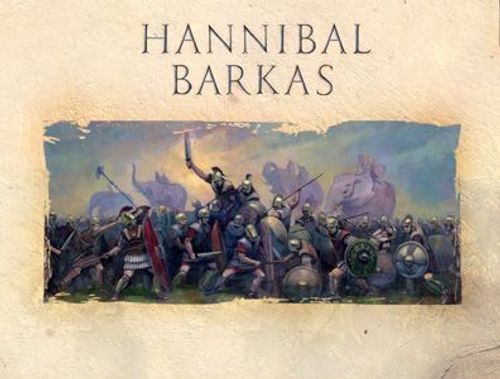
Hannibal Barkas
Hannibal Barkas Rulebook
Table of Contents
Table of Contents
- I. Game Components
- 1.1 General Information
- 1.2 Tokens
- 1.2.1 Light Infantry
- 1.2.2 Heavy Infantry
- 1.2.3 Cavalry
- 1.2.4 Gallic Infantry
- 1.2.5 Gallic Cavalry
- 1.2.6 Elephants
- 1.2.7 Ships
- 1.2.8 Leader Tokens
- 1.2.9 Control Tokens
- 1.2.10 Initiative Tokens
- 1.2.11 Currency Tokens: Talents
- 1.2.12 Victory Point Tokens
- 1.2.13 Political Tokens
- 1.2.14 Gallic Attitude Tokens
- 1.2.15 Order Tokens
- 1.3 Cards
- 1.4 Dice
- II. Game Setup
- III. Course of Play
- IV. Army Movement
- V. Battles
- VI. Capturing Cities
- VII. Politics
- VIII. The Gauls
- IX. Economy
- X. Multiplayer Game
- XI. Victory Conditions
- XII. Advanced Rules
- Historical Significance of Selected Events
- Scenarios
I. Game Components
1.1 General Information
Most of the components in the game belong to one of the nations taking part in the game. Each nation has an assigned emblem and colour. The nations are divided into:
Major nations, which can be directly controlled by players:
- Carthage - Colour: Blue. Symbol: Elephant
- Rome - Colour: Red. Symbol: She-wolf
- Syracuse - Colour: Yellow. Symbol: Lion
Neutral nations, whose attitude is controlled by the Players by means of the Political Track:
- Massilia - Colour: Green. Symbol: Horseman
- Numidia - Colour: Purple. Symbol: Horseman with a crescent
- Macedonia - Colour: Orange. Symbol: Sun
1.2 Tokens
There are 6 kinds of military units in the game, corresponding to the most common types of military formations in the period of the Second Punic War. Each has its own characteristics, representing its combat ability, mobility and recruitment cost.
Unit characteristics:
Attack strength - the minimum value that must be rolled on 1d10 during combat in order to inflict losses on the opponent. This roll is often called the to-hit roll.
Movement - a value representing the mobility of the unit (movement points). Movement 2, for example, means that the unit may move at most 2 regions on the board.
Cost - the cost of recruiting 1 unit of the given type.
1.2.1 Light Infantry
Lightly armoured light units fight mainly with slings, bows or javelins. Cheap to recruit, they are ideal for supplementing armies and city garrisons. In antiquity light infantry units opened battles, trying to inflict maximum losses on the enemy and gain a psychological advantage. Typical examples of this kind of formation were the Roman velites, Libyan javelin-men and mercenary Balearic slingers.
| Recruitment cost | 1 Talent |
| Attack strength | 9 or more (9+) |
| Movement | 2 Fields |
1.2.2 Heavy Infantry
Heavy infantry is the backbone of ancient armies. The most effective troops on the battlefield, whose task was to break the enemy. All other formations in the armies of antiquity of the Punic War period usually had the task of supporting the actions of the heavy infantry and securing its flanks. The most typical examples of this kind of formation are Roman legionary infantrymen, Macedonian phalangites and Carthaginian heavy infantry.
| Recruitment cost | 2 Talents |
| Attack strength | 7 or more (7+) |
| Movement | 2 Fields |
1.2.3 Cavalry
Units most useful for carrying out destructive raids on enemy territory, flanking manoeuvres and pursuing a fleeing enemy army. The most typical cavalry formations of the Punic War period are the Roman equites, Libyan light cavalry and Carthaginian heavy cavalry.
| Recruitment cost | 3 Talents |
| Attack strength | 8 or more (8+) |
| Movement | 4 Fields |
Special rule: Pursuit. After a won battle, if the enemy army has retreated, cavalry units may make a special attack. See the chapter on pursuit.
1.2.4 Gallic Infantry
Gallic warriors can reinforce the ranks of the armies of both sides of the conflict. They are particularly important for Carthage, which is waging war far from its home territories.
Gallic infantry units of the individual nations look identical and differ only in the colour of the border and the emblem on the reverse.
| Recruitment cost | 2 Talents |
| Attack strength | 8 or more (8+) |
| Movement | 2 Fields |
1.2.5 Gallic Cavalry
Gallic cavalry consists of the tribal nobility. A valuable reinforcement for both sides, but there are far fewer cavalry units than infantry.
Gallic cavalry units of the individual nations look identical and differ only in colour.
| Recruitment cost | 4 Talents |
| Attack strength | 8 or more (8+) |
| Movement | 4 Fields |
Special rule: Pursuit (see above).
1.2.6 Elephants
Elephants were a powerful instrument of war in antiquity - veritable "tanks of the ancient world". They were usually used as a force to break the enemy formation, but their very presence on the battlefield inspired terror in the enemy ranks. They proved extremely effective in combat against cavalry units, because horses feared these exotic animals. It often happened, however, that wounded elephants went berserk and attacked their own units, so that this dangerous weapon was sometimes double-edged.
Elephant units can be recruited only in the cities of Africa and Hispania that bear an elephant symbol on the city card.
| Recruitment cost | 4 Talents |
| Attack strength | Automatic |
| Movement | 2 Fields |
Special rule: Special attack - Elephant Charge. The destructive impetus of the elephant charge is represented by the rule that elephants inflict losses automatically (no to-hit roll is made).
Special rule: Fear of horses. Horses feared these terrifying creatures, therefore during a battle, in each combat round, cavalry units in a number equal to the number of elephant units do not take part in the fighting (they are set aside). They may take part in absorbing losses. In subsequent rounds, if the number of elephants decreases, these units return to the battle and fight normally (see the example of a battle with elephants further on).
1.2.7 Ships
Owning a fleet allowed armies to be transferred quickly. Superiority at sea also prevented the enemy from transporting units quickly and condemned him to slow movement by land routes. Unfortunately, because of their relatively primitive construction and lack of navigational instruments, the ships used in antiquity were extremely vulnerable to difficult weather conditions and often sank during storms.
| Recruitment cost | 5 Talents |
| Attack strength | 7 or more (7+) |
| Movement | 8 sea fields |
Special rule: Sea transport. Each ship unit can take on board 2 land units of any kind and/or any number of leaders/generals.
Special rule: Marine infantry. Each infantry unit (of any kind) simultaneously becomes marine infantry and increases the effectiveness of the ship unit in a naval battle by adding +1 to the to-hit roll. Thus, with 2 infantry units on a ship, it hits on 5+.
1.2.8 Leader Tokens
Leader tokens represent the most important leaders and rulers present in the game and their staffs.
Each leader has the following coefficients:
Command - the number of repeated, failed to-hit rolls that the player may make in each round of a battle. The coefficient is visible on the leader's token and on his card.
A - that is, Active leader. 'A' denotes the ability to activate an army without having to spend Initiative Points. The symbol is visible on the leader's token and on his card.
Leaders cannot be recruited. They come under the players' control at the start of the game according to the scenario, or by playing the appropriate event card. More on the influence of leaders on combat in the chapter on battles.
1.2.9 Control Tokens
Control tokens are used to mark the state of possession by individual players when a city belonging to an enemy nation is captured. The token is then placed on the map, in the place of the captured city.
1.2.10 Initiative Tokens
Initiative tokens represent the number of Initiative Points (IP) that a player has at a given moment. The number of initiative tokens a player has is open information.
1.2.11 Currency Tokens: Talents
Gold tokens represent the number of Talents of Gold that a player has at a given moment. The number of Talents of Gold a player has is not public, and the player has no obligation to reveal it.
1.2.12 Victory Point Tokens
Victory Point tokens represent the number of victory points that a player has at a given moment. The number of Victory Points a player has is not public, and the player is obliged to reveal it only to the player controlling the same nation (i.e. a Carthaginian to a Carthaginian and a Roman to a Roman).
1.2.13 Political Tokens
Political tokens are used to mark the attitude that a state displays at a given moment towards the two main warring powers. Political tokens are moved on the political track as a result of political actions taken by Carthage and Rome and of cards played.
1.2.14 Gallic Attitude Tokens
Gallic attitude tokens represent the moods prevailing among the Gallic tribes in a given territory. It should be remembered that a Gallic tribe that is favourable to Rome is at the same time unfavourable to Carthage. Allies of Carthage, on the other hand, are automatically enemies of Rome. If there is no token on the territory of a given state, it means that the tribe is neutral.
1.2.15 Order Tokens
Order tokens numbered 1 to 5 are handed out to the players at the start of each stage, after the order of play has been determined on the basis of the Initiative Points they hold. The game is played in the order determined by the order tokens the players hold.
1.3 Cards
Cards, like the other elements of the game, always belong to one of the nations appearing in the game and are marked with its emblem and colour.
1.3.1 Event Cards
[Illustration: an example event card from the Carthage deck, with callouts: Gold Talents (top left), Nation symbol (top centre), Initiative Points (top right), Title and text of the event, Effect text, Card number. The example card: gold 15, Initiative Points 6; event "HIERO II DIES": "If Syracuse is allied with Rome, pay 10 Talents and 4 IP, and it becomes neutral. If not, move the state 2 fields on the political track."; effect "STORM": "Play on a fleet, after its movement. Roll for each ship. On 8+ (5+ if the fleet sailed through open sea) the unit sinks. The fleet may not enter the destination field."]*
Event cards may be played in 4 different ways, but each is played in only one of them, chosen by the Player. After a card has been played in any way, it is put on the discard pile.
-
Initiative Points (IP) - the number of initiative points gained when the card was played to increase the initiative pool. The number of IP that can be gained by playing the card for initiative is visible in the upper right corner of the card.
-
Event text, played as a player's action, whose effect is put into effect immediately after playing. The event text is described in the upper part of the card, just under its title.
-
Gold - the number of Talents that the player adds to his treasury when the card was played in this way. The amount of gold that can be gained by playing the card for gold is visible in the upper left corner of the card.
-
Effect text - effects may be played at any moment of the game (even if the player has already announced 'pass') and are not treated as a player's action. The effect text is described in the lower part of the card. The results of playing an effect take effect immediately after it is played, unless the opponent has not played, "in response", an effect affecting its operation.
Besides the above information, the card shows its name and number. The nation to which the card belongs is indicated by the nation's logo on the reverse of the card and above the event title in the event deck.
Cards with an asterisk in the event name are single-use and, after being played as an event, are immediately removed from the game permanently.
When there are no cards left that players could draw, the discard pile must be reshuffled, and from that moment it becomes the new deck.
1.3.2 City Cards
[Illustration: an example city card with callouts: Income, Defence level, Victory Points, Name, Additional description, Icons: Port and Elephant. The example card: Income 4, Defence level 4, Victory Points 8, name "Siga", text "City card. Siga is the capital of Numidia.", with Port and Elephant icons.]
City cards represent the cities located on the board. A player's possession of the card of a given city indicates that it is under his control.
Three symbols are visible on a city card:
Coin - the number on the coin icon reflects the economic power of the city and denotes the income in gold Talents generated by the city. It also gives the maximum number of military units that can be recruited in the given city at one time.
Shield - the number on the shield denotes the defence level of the city.
Laurel leaves - the number denotes the number of Victory Points obtained for capturing the city.
The following symbols may additionally be placed on city cards:
Port - the city has a port. Warships can be built in this city.
Elephants - elephant units can be recruited in this city.
1.3.3 Leader Cards
Leader cards represent historical figures, key commanders who took part in the struggles of the Second Punic War. In addition to repeating its coefficients given on the leader's token, a leader's card also describes the special rules connected with the leader's presence in the game and the number of Victory Points awarded to the opponent for eliminating that leader.
[Illustration: an example leader card with callouts: Command, Victory Points, Leader's name, Abilities, Active Leader. The example card: Command 3, Victory Points 8, "HANNIBAL"; abilities: "If you win any battle, draw a card. In the economy phase add 2 Initiative Points to Carthage and draw a card. Reduce the opponent's Command level during a battle by 1."; Active Leader "A".]
1.4 Dice
Only ten-sided dice are used in the game. The number 0 on the die means 10. The following abbreviations are used in the rules and on the cards:
1d10 roll - a roll of one ten-sided die.
8+ - to achieve success, 8 or more must be rolled, i.e. 8, 9 and 10. Rolls below 8 mean failure.
Re-roll - a repeated roll after an unsuccessful die roll. Note! The result after the re-roll applies. A roll can be re-rolled only 1 time.
II. Game Setup
Before the players plunge into the whirl of battle, a number of preparatory actions must be carried out. We suggest that the players carry them out in the order presented below:
-
Choice of scenario. The game contains 3 historical scenarios and 1 alternative scenario based on the assumption "what if". When choosing a scenario the players should be guided by the amount of time they have, the number of players willing to play, and above all their own interests. We recommend that beginning players start the fun by playing the introductory scenario. It will let them become acquainted with the basic mechanisms of the game in practice.
-
Choice of nations and division of spheres of influence. The players should "divide" the roles among themselves and decide who will play whom, and determine the spheres of influence within the teams. We suggest that beginning players rely on the division of spheres of influence proposed by the authors.
-
Placement of armies, fleets and leaders according to the assumptions of the scenario. In the capitals of states that are not allied, 2 heavy infantry units are placed.
-
Placement of Gallic attitude tokens on the appropriate Gallic tribes according to the scenario.
-
Placement of the states on the political track according to the scenario.
-
Assigning to the players the appropriate number of starting Initiative Points and gold Talents.
-
Placement on the board of the six card decks in the places marked with the nations' symbols. Piles of unused tokens and the "bank" are laid out next to the board.
After the actions described above are finished, play can begin.
III. Course of Play
Each stage is divided into the following phases:
- Drawing cards
- Drawing of Roman consuls (once a year)
- Initiative
- Actions
- Resolving sieges
- Economy
- Moving the Stage token
3.1 Drawing Cards
Players draw by default 2 cards plus one from the deck of each allied state.
Example 1: Player A controls Rome and has no ally. He therefore draws only the basic 2 cards from the Rome deck. Carthage is controlled by player B and has 2 allies: Massilia and Macedonia. Player B draws a total of 4 cards: 2 cards from the Carthage deck, 1 from the Massilia deck and 1 from the Macedonia deck.
There is a limit of cards in hand in the game. Each player may not at any moment have more than 7 cards in hand. If he draws more than 7 cards, he must immediately discard such an "excess" to the discard pile, deciding himself which cards to discard.
3.2 Drawing of Roman Consuls (once a year)
[Illustration: the Stage Track, six boxes numbered I-VI; the box II is marked with the Stage token and labelled "Drawing of Consuls".]
At the start of the game (if it is not specified in the scenario) and in the second stage of each year (see the figure above), the players controlling Rome draw the consuls chosen by the senate for the given year. To do this they choose two random cards from among all the available Roman consuls. The drawn consuls are placed in the place where the respective consuls were staying, or in Rome. At the start of the game the drawn consuls are placed by the Roman player in armies according to the scenario.
The player must immediately draw a new consul if his predecessor died in combat. The card of the "dead", named consul (e.g. Scipio Africanus) must be removed from the game permanently. The cards of unnamed consuls (Consul I - VI) return to the pool of consul cards and can still be used in the game. The drawn consul is placed in Rome.
3.3 Players' Initiative
Initiative Points (IP) are gained above all by playing cards. Initiative itself determines two aspects of the game:
- The order of moves
- Command and political potential
In this phase the players reveal the Initiative Points they hold (if any) and on this basis determine the order of moves in this stage. The order thus established applies for the whole stage, regardless of the fact that the number of IP of each player will change during the stage. If players have the same number of initiative points, they determine the order by rolling a die. After the Initiative has been determined, the players receive order tokens.
Example 2: Player A (Rome) has 3 IP, player B (Rome) has 2 IP, player C (Carthage) has 1 IP and player D (Carthage) also has 1 IP. Players C and D roll a die. Player D has the higher result. The order of moves in the stage is therefore as follows: A, B, D, C.
3.4 Player Actions
In this phase the players perform one action each, in the order determined by the Initiative. When a player has performed his action, the turn passes to the next in order, and so on. If all players have played an action, the turn returns to the first player. If one of the players cannot (or does not want to) perform any more actions, he ends his stage (announces to the other players 'pass') and turns over his order token. A player who has passed cannot undertake any actions in this stage (he may only play cards as effects). The stage lasts until all players have announced 'pass'.
Below are the possible actions:
3.4.1 Playing a Card for Initiative
Playing a card for initiative consists of adding to the player's pool of Initiative Points the number of Initiative Points that is specified on the played card. Initiative Points are marked with initiative tokens.
3.4.2 Playing a Card for Gold
Playing a card for gold consists of adding to the player's treasury the number of gold Talents that is specified on the played card. The number of gold Talents in the treasury is marked with tokens and is kept secret.
3.4.3 Playing a Card as an Event
Playing a card as an Event consists of immediately putting into effect the event described on that card.
Note! When a given nation is already allied, a card moving that nation by one field on the political track cannot be played. Similarly, when a given leader is already present on the board, an event that brings him into the game cannot be played.
3.4.4 Activating Armies
A player may activate one or more of his armies, paying the appropriate number of Initiative Points for it.
3.4.5 Political Action
A player may move on the political track any neutral state that is not allied with any side. To do this he pays 2 IP and 10 gold Talents and moves the token of that state on the political track by 1 field in his own direction.
3.4.6 Handing Over an Army
A player may hand over an army with a leader (leaders) to another player. To do this he must pay 1 Initiative Point. If the leaders have cards, they are also handed over together with the units.
3.4.7 Pass
The player ends his turn and declares that he no longer wants to perform any actions.
Example 2 (numbered thus in the source): The players from example 2 perform their actions in turn: Player A moves an army and spends 1 IP on it. Player B performs a political action, paying 2 IP and 10 gold Talents. Player C plays a card as Initiative, adding 2 IP from the card to his initiative (he now has 3 IP, because he began the turn with 1 IP). Player D performs no action and announces "pass". A new round begins, but already without player D, who has "passed". The order of the next round will therefore be: A (2 IP), B (0 IP), C (3 IP).
IV. Army Movement
4.1 General Rules
At the start of each stage all military unit tokens (including ships) are turned face up. After a move is finished, the top token on the army stack is turned over to mark that this army has already moved this turn and cannot do so again.
More than 1 army of a given player may be in a given region. A player's armies can be freely combined and divided. If as a result of recruitment in a city of the region new units have appeared, they may - but need not - be joined to the army stationed there, or they are placed next to it, forming another army.
4.2 Activating and Moving Armies
Activating any number of units in one region costs 1 Initiative Point. Key leaders make it possible to activate the regions in which they are stationed "for free", without having to spend Initiative Points (the leader himself is also activated). Such leaders are called "active" and have the symbol 'A' on their tokens and cards.
A unit may be activated only 1 time during a stage.
Only an army stationed in a region that has been activated can move. Activation is nothing other than the leader giving orders to the units stationed there.
The general rule concerning movement is that only the following kinds of moves are allowed:
- From one region to one or several other regions
- From several regions to exactly one region (including movement by fleet)
- From several to several regions, if it makes a fleet move and performs loading and/or landing
All other combinations of moves that do not remain in accordance with the above rule are not permitted.
In an activated region the player may move only part of the units from that region. Units that have not been moved remain non-activated in that region. They can be activated in a subsequent action, paying normal IP for them.
During one player action it is possible to give orders to units stationed in more than one region. This is possible only in a situation where the player declares that all the activated units will end their move in the same field. Of course, for each activated region the player must pay IP, unless he activates a region in which an active leader is stationed. The above note also applies to allied armies (see: Multiplayer Game).
A leader has 4 movement points (like cavalry). He is activated and turned over after moving, although he cannot move independently.
Example 4: A player activates armies A, B and C at once, because he declares that they end their move in the same field. Army C has a leader with the symbol A, so activating it does not cost Initiative Points. The player must therefore pay 2 Initiative Points for armies A and B and moves all three armies to the same field.
Author's tip! Moving large stacks of unit tokens can be somewhat burdensome. Players may place units on the leaders' cards and leave only the leader's token on the board. Only the leaders' tokens will then be moved on the map.
A moving army may be divided into any number of smaller units, which may end their move in different fields.
It is permitted to activate a region without performing any actions with the units stationed in it. In such a case the turn simply passes to the next player. Such an action requires, however, the normal expenditure of 1 IP.
When a moving army meets an enemy army on its way, a battle is immediately fought. After winning the battle the army may move on, if it still has movement points.
If two armies from different fields enter one field and a fight occurs, one battle is fought with the armies combined.
4.3 Crossing the Alps
[Illustration: a map of the Alps with the label "Alpine crossings".]
Alpine crossings are marked on the map with a broken line. Because of the difficult terrain and climatic conditions, crossing the Alps involved the risk of suffering significant losses. To reflect this, each player who decides to take such a risk makes a 1d10 roll for each unit in the army conquering the mountains. If 8 or more is rolled on the die, the unit perishes.
After crossing to the other side of the Alps the army must immediately end its movement, regardless of the number of movement points it has.
4.4 Movement on Sea Fields
Sea fields marked with a lighter colour denote coastal waters. Sea fields marked with a darker colour with the symbol of a sinking ship denote open sea.
[Illustration: a map of the central Mediterranean with the numbered moves of Example 5.]
A fleet at sea can move when the player activates the sea area in which it is located, or a land area if the fleet is stationed in a port. This means that a player activating a land region containing a port city with a fleet stationed in it may move at the same time the land army from that region and the fleet.
Fleets can move at a speed of at most 8 sea fields per turn. If they end their move in a field with a port, the player should declare whether he ends the move in the port or remains at sea, and place the fleet tokens accordingly (in the sea field or in the city).
Loading and unloading of troops counts as spending 1 movement point of the fleet. To load land units onto the decks of ships the player must activate them (pay IP for them). A fleet onto which land units have been loaded may continue its move until the limit of movement points is exhausted.
Entering and leaving a port costs no movement points.
Units unloaded onto land are treated as already activated and cannot perform any more actions in that turn (they should be turned over).
A fleet stationed in a port cannot be attacked by an enemy fleet. When a city with a port is captured, the ships stationed there are destroyed. The defenders would surely burn them so that they would not fall into enemy hands.
When a moving fleet meets an enemy fleet on its way, a naval battle is immediately fought. If the player won, he may move on (including, for example, attacking further a fleet that has escaped from the battle) until all 8 movement points are used up.
Example 5 A player wants to send an infantry unit from Sicily to the region of Capua. To do this he activates the fleet in Carthago (paying 1 Initiative Point) and moves the fleet by 2 fields. On move 3 he pays 1 Initiative Point and loads the infantry unit from Sicily onto the ship. Then it sails in moves 4 and 5 to the shores of Italy. On move 6 the infantry is unloaded. Note! The infantry unit is already activated and cannot move in this stage. The ship ends its move on the open sea, using all of its 8 movement points. The illustration above shows this move.
V. Battles
5.1 General Rules
A battle is fought when, at any moment of a stage, hostile armies or fleets meet in the same field.
It is assumed that the player standing in the field is the defender and the one entering that field is the attacker.
Battles last until one of the participants is completely eliminated or orders a retreat. In the second case the cavalry of the victorious side may conduct a pursuit. If an army consists exclusively of cavalry, it is distinguished by enormous mobility and may begin a retreat at once and no battle takes place. However, the victorious side may conduct a pursuit with its cavalry, if it has any.
5.2 Pre-Battle Effects Phase
Before the battle both sides may play special battle effects, which are meant to make it easier for them to achieve victory. This may be, for example, a surprise attack before the start of the battle, or taking up convenient terrain. The defending player has the right to play an effect before the battle first.
5.3 Combat Round Phases
A battle is fought in rounds. Each round consists of simultaneous (concurrent) attacks of the individual kinds of troops:
- Attack of light infantry units
- Attack of cavalry and elephants
- Attack of heavy and Gallic infantry
Losses are inflicted in each attack separately, so light infantry inflicts them first, and after the losses have been removed by both sides, the remaining formations attack.
After each round (the attack of all formations) the players declare whether they wish to continue the fight or to withdraw. The decision to withdraw is made first by the defender.
5.4 Retreat
The attacker retreats to the field from which he attacked the enemy. If he attacked from several regions, he withdraws to one of them. The attacker may also withdraw to an unbesieged city in the region. The defender cannot retreat to the territory from which he was attacked. He therefore retreats to another field not occupied by the enemy or to a city in that region. Let us remember the maximum number of troops in a city. A retreat is not treated as an activation of the army, so if the army was not activated, it remains so.
If an army has nowhere to withdraw, it is eliminated (VP are awarded normally).
A retreat cannot be made with ships, even if they are stationed in a port of the region in which the battle was fought.
5.5 Losses
Losses in a battle are inflicted simultaneously, that is, eliminated units are removed from the board only after both sides have finished their rolls. For the sake of order it is established that the attacking player makes his to-hit rolls first.
A unit inflicts losses if the result rolled on the d10 is greater than or equal to its attack strength. The table below presents the chances of inflicting losses by the individual kinds of units:
| Unit | Attack strength |
|---|---|
| Light infantry | 9+ |
| Heavy infantry | 7+ |
| Cavalry | 8+ |
| Elephants | Automatic |
| Gallic infantry | 8+ |
| Gallic cavalry | 8+ |
| Ships* | 7+ |
Table 1. Chance of inflicting losses
* A ship receives a +1 modifier for units of any infantry loaded onto it (at most two). See naval battles.
If a hit of 10 occurred, defined as critical (a 0 rolled on the d10), the attacker chooses which unit is to be assigned to losses. In every other case the player taking losses chooses which of his units he eliminates.
In the case of fighting a battle in which the units consist of different allied armies (e.g. the armies of two players of the same side, or the army of one player and an army of Gallic armed resistance), losses must be accounted for separately, but with observance of the general rules, i.e. on a hit of 10 the attacker chooses which unit is eliminated.
Example 6: Player A with an army of 2 light infantry units, 3 infantry and 3 cavalry attacks player B, who has an army composed of 1 light infantry unit, 2 infantry and 1 cavalry. [Illustration: positions of the units and the dice results at each step.]
The light infantry phase takes place and player A rolls to hit with his light infantry. The light infantry rolls 5 and 9, so it gains one success. Player B designates his light infantry for losses. His light infantry rolls 7, so it gets no hit. Thus only player B removes a lost unit.
The cavalry and elephant phase takes place. Since there are no elephants in the battle, only the cavalry units attack. The attacking cavalry rolls 7, 1, 6, so there is no hit. Player B rolls 8, so he gains one hit. Player A chooses a light infantry unit for losses.
The heavy infantry phase takes place. The heavy infantry of player A rolls 2, 7 and 10. Because there was a hit on 10, player A chooses the opponent's unit for losses and decides on his cavalry. The result of the second hit will therefore be infantry. Player B steps up to roll. His infantry rolls 10 and 6. Player B chooses player A's cavalry for losses. The round ends.
Player A now has 1 light infantry unit, 3 heavy infantry and 2 cavalry. Player B has barely one infantry unit and decides on a retreat. Player A proceeds to the pursuit and rolls to hit with his cavalry. He rolls 8 and 4. Player B's last unit is therefore eliminated. Player A gains no VP, because he did not eliminate at least 5 enemy units, only 4 (see further: Victory Points).
5.6 Leaders
During a battle the leader tokens are placed next to the fighting armies. During combat each of the players may allocate the command points of his leaders to making re-rolls in the case of failed hits. One command point makes possible one re-roll of failed hits. The value of the command points is visible on the card and on the leader's token. A single die roll can be re-rolled only 1 time. If a player has used up the whole command of a leader in a given round of combat, he should turn over his token to mark this fact. The special rules relating to that leader continue to apply.
Example 7 In example 6 player A has a leader with Command 2. He decided to use his command for re-rolls of failed infantry and cavalry hits (one each). Suppose the re-rolled die with the infantry is 8, and with the cavalry 5. Player A would thus have gained an additional hit and the pursuit would not have taken place, because all of the opponent's units would have been eliminated in the first round of the battle.
Leader tokens are turned back at the start of the next combat round before the attack of the light infantry, and their command can be used again. The game has no separate token representing the currently used command of a leader. It is marked by turning the leader's token on its side (see the example below). When he has used all of his command, his token is turned over.
[Illustration: a leader token (Cartalon) shown three ways: "Two Command", "One Command", and "No Command (token turned over)".]
Command is not used in a pursuit and in special attacks resulting from played cards.
Leaders are eliminated at the moment when all units in the army are eliminated. If a leader is in a conquered city, he is also eliminated.
Leaders are not units and cannot be activated and moved independently. If a leader alone and at least one enemy unit are in a territory, the leader is automatically eliminated.
The effects and abilities of leaders require:
- Reduction of Command Points. The owner chooses which leader has his command reduced and turns the leader's token by the appropriate value.
- Resignation from Command Points. The leader's token is turned over and he has no command. Resignation cannot be used if the leader has already used part of his command.
5.7 Playing Effects
Battle effects may be played by any players, even those who have passed and who do not necessarily have units taking part in the battle.
Some effects work before the battle begins, even before the to-hit rolls begin. They should of course be played first.
Playing effects takes place in turn, with the defending player having priority.
It may happen that players play an effect "in response" to one played earlier, which can change or even cancel its operation. An effect takes effect when such a sequence ends and the opponents no longer play an effect that could cancel or change the result of the effect played earlier.
Example 8 A battle begins. Player A plays the pre-battle effect 'Ambush' in order to immediately make 4 to-hit rolls with infantry. Player B plays 'Convenient terrain', in which he negates the first 2 hits inflicted by the opponent in this round. Player A now plays "in response" the effect 'Smile of the gods', which negates the effect played by the opponent. Player B declares that he is not playing any more effects. The result of the effects played will therefore be 'Ambush'. Player A makes 4 to-hit rolls with infantry. After removal of any losses the battle begins.
5.8 Elephants
Example 9 Player A attacks and has in his army, among others, 2 elephant units. Player B has 3 cavalry units, 5 heavy infantry units and 3 light ones. A battle is fought. [Illustration: positions of the units and dice results.]
Suppose that in the light infantry phase player B scored no hits. In the cavalry and elephant phase player B suffers automatic losses of 2 units in connection with the elephant attack (elephant charge). He chooses for losses: 1 light infantry unit and 1 cavalry unit. Because 2 elephant units take part in this round, player B sets aside 2 of his cavalry units that are unaffected, fleeing from the battlefield for the duration of this round (fear of horses). Next player B makes the remaining attack with one cavalry unit. Suppose he was lucky and rolled 10. He announces that he wants to assign one of the elephant units to losses. After removing the losses of both sides, the heavy infantry fight begins. We skip the heavy infantry phase in this example. The round ends. Player A has only one elephant unit left, so of the two cavalry units of player B that had previously fled from the elephants, one returns and takes part in the fight, while the other remains outside the battlefield.
(Transcribed as printed; the unit counts in this example are not fully consistent with the stated 3 cavalry units.)
5.9 Pursuit
A player who has forced the opponent to retreat may carry out a pursuit with all the cavalry units he has in the victorious army (there are Effects in the game that make it possible, after being played, to join other units to the pursuit).
The pursuing player makes a normal to-hit roll with all units taking part in the pursuit. The withdrawing player suffers losses according to the general rules.
During a pursuit the command of leaders cannot be used. There are, however, leaders who have special abilities that apply in a pursuit.
5.10 Naval Battles
Naval battles are fought analogously to land battles. Before the battle the players should arrange the land units on the individual ships so that it is clear which land units are being carried on which ships.
During a battle all ships hit by default on 7+. At most 2 land units are carried on each ship. For each infantry unit (of any kind) present on the deck of a ship during the battle the player receives +1 to hit with that ship. The influence of leaders is resolved normally.
There is no pursuit in naval battles.
Leaders are placed next to the army and not on the individual ship tokens. They perish when all the units are sunk.
Example 10. Suppose player A is transporting an army by sea and is suddenly attacked by player B. Player A is carrying 3 infantry units and 2 cavalry on 4 ships. Player B attacks with a fleet composed of 5 ships with 7 infantry units. The players arrange the units on the ships. Player A decides to load 2 cavalry units onto one ship, 2 infantry onto another, 1 infantry onto a third, and on the last ship he places no land units. Player B assigns 2 infantry units each to 3 ships and the remaining one to another ship, and leaves the last ship without infantry.
[Illustration: positions of the ships with dice results (player A: 7, 4, 10, 5; player B: 6, 4, 7, 5, 9).]
Player B rolls to hit (attacker). The ships with infantry (hitting on 5+) roll: 6, 4 and 7, so two ships of player A go to the bottom. The ship with one infantry unit (attack strength 6+) rolls 5, i.e. no hit. The remaining ship (hitting on 7+) rolls 9, so it gains a hit. Player A designates for losses the ship with double infantry, wanting to save the cavalry. Now player A rolls to hit. He rolls in turn for the ships: with two infantry, with one infantry, and the 2 remaining ones. Loading the 2 cavalry gives nothing, as it does not increase the combat ability of the ships. He rolls in turn: 7, 4, 10 and 5, gaining two hits. For the first hit a ship is sunk empty, and for the second player A, because he rolled 10, chooses the ship with two infantry units loaded. The round comes to an end. After the battle player A has one ship left with two cavalry and decides to retreat. Player B has 3 ships with 4 infantry units. Player B receives +1 VP because he eliminated 6 units (3 ships + 3 land units loaded on them).
5.11 Victory Points
After the battle and pursuit are finished the winning side gains victory points (VP).
The winner adds +1 VP for every full 5 enemy units eliminated during the battle. For example, the elimination of 6 units results in gaining 1 VP, and the elimination of 14 gains 2 VP.
Ships are counted on the same principles as land units.
VP for leaders killed in battle are added immediately after they are eliminated.
VI. Capturing Cities
Cities are the basis of the players' economic existence during play. Capturing or losing them decides victory in the game to a great extent.
Cities can be captured in three ways:
- By assault
- As a result of a siege
- By playing an event
Each city has a marked strength representing the number and determination of its permanent garrison. This strength corresponds to the number of heavy infantry units that are permanently stationed in the city. The defence of the city can be additionally strengthened by bringing additional military units inside the walls. There may be no more of these additional defenders of the city than twice the defence level of the city. If there are more defenders in the region with the city, the rest do not fit in the city.
The defence of a city can be strengthened only by infantry of all kinds. Other formations may stay in the city and reduce the number of additional defenders that can be brought in, but do not take part in combat.
6.1 Assault on a City
Assaults were rarely carried out in antiquity because of the risk of suffering enormous losses. Only infantry units of all kinds can assault a city. A player in a field with a city may declare, when activating a region with an army, that he is conducting an assault, if he spends 1 movement point on it and designates any number of infantry from his army to conduct the assault. This means that standing in a region containing a city, one can carry out an assault twice, because infantry has 2 movement points.
An assault is carried out in the actions phase after activation and can be conducted without a prior siege. A successful assault is not treated as a victorious battle (this matters for events on cards).
Before the assault the defender places the city card on the siege track, in the field equal to the defence level of the city. Additional units of defenders are placed on the city card, if such are stationed in the city.
The attacker makes an infantry attack, hitting only on 10. If he gains a hit, the defender removes a token of additional defender units. If there are no additional defenders, the defence level of the city is reduced by 1 (the city card is moved by 1 field on the siege track). The defence of the city inflicts losses automatically (not critical ones). The additional defenders already roll normally.
The attacker cannot use command points and the abilities of leaders.
Effects from cards cannot be played, unless this is expressly stated in the text.
The assault lasts until the city is captured (its defence level is reduced to 0) or the attacker gives up. If the city is not captured as a result of the assault, the city card remains on the siege track in the field corresponding to its current level of fortification (reduced as a result of the assault). The city card is removed from the siege track at the moment when the enemy's forces leave the region within which the assaulted city was located. If, after the assault, the army is too small to conduct a siege, there is no siege, and the city card returns to its owner.
Example 11 The defence level of a city is 3. In the region with the city there is stationed an army made up of 7 infantry units and 2 cavalry. The city may therefore accept at most 6 additional infantry units for defence. When player B enters the region in which the city is located, 1 infantry unit and 2 cavalry must accept battle, since they cannot withdraw into the city. The remaining 6 heavy infantry units withdraw into the city, strengthening its defence. Suppose that the units that did not fit in the city were quickly defeated and player B steps up to the assault. Player B has 20 infantry units, 5 of them light. The attacker rolls dice for all 25 infantry units he has in his army. Suppose that he was unlucky and rolled only four 10s. Next the defender rolls dice 6 times, hitting on 7+ (for the additional defenders), and rolls three hits, including one on 10. As a result of the assault, 4 units of additional defenders from the city are removed, and 6 attacking units (one of them designated by the defender). The city card remains on field 3 of the siege track together with the 2 remaining defender units. The attacker automatically passes into the state of besieging the city. He may undertake another assault attempt in the next turn, when his army no longer has movement points for infantry in that turn.
6.2 Siege
A player ending his move in a field with a city may declare that he is besieging that city, if he spends 1 movement point on it. The city card then goes onto the siege track, onto the field marked with a number equal to the defence level of that city. Tokens of additional defence units (if the city has been reinforced) are placed on the card, but in a number at most equal to twice the defence level of the city. On the map, in the place of the city, a token is placed marking that the city is besieged.
For a siege to be effective, the besieging army must be at all times more numerous than the defence of the city (the defence level plus the additional defenders).
If a city with a port is besieged and a fleet of the besieged side sails into it, it is considered that the fleet has brought in food and strengthened the morale of the defenders. The defence level of the besieged city is then increased by as many levels as the number of ships without loaded units that sailed in (it is assumed that they carry supplies and not soldiers). The defence level increased in this way cannot exceed the defence level on the city card. Of course ships with loaded units can also sail in, and such units can be added to the defenders of the city.
Only infantry units (of all kinds) may besiege.
At the end of each stage the defence level of the city falls by 1 level, which results in the elimination of one unit from the defenders (if any are present), or, if there are no defenders any more, in moving the city card 1 field on the siege track.
Besides subtracting defence points, the besieging player also has to remove one infantry unit conducting the siege. A siege is therefore a rather costly operation, but not as risky as an assault.
After the losses have been removed, if the city card is on a field of the siege track marked with a flag, a 1d10 roll is made to determine whether the besieged city will not surrender earlier. This roll symbolizes the mood in the city. If a result equal to or higher than the digit placed on the flag is obtained, the city surrenders immediately, and if there were additional defenders in the city, they are eliminated.
[Illustration: an example field of the siege track, showing the number 3 as the "Current defence level" and a flag marked 9+ as the "Chance of earlier surrender".]
During a siege, assaults on the besieged city may be undertaken.
An army does not have to be activated to continue a siege in subsequent stages. It is continued automatically until the fall of the city or until the attacker abandons the siege. If, however, the attacking player wants to carry out an assault with the besieging army, it must be activated.
If at any moment of the siege the strength of the besiegers is equal to or lower than the current defence level of the city, the siege is broken, and the city card is removed from the siege track and returns to its owner. This may happen as a result of losses during combat or of the playing of event cards or effects.
If the besieging army is attacked from outside, it must fight a battle. If those besieging it win, but the number of troops becomes equal to or lower than the defence of the city (defence level plus defenders), the siege is considered ended, and the city card returns to its owner. The defender units from the city may also take part in such a battle (if the region with the city was also activated).
In a besieged city one cannot play reinforcements, recruit troops, or obtain income from it. If leaders are staying there, then after the city is captured they are eliminated.
Cavalry and elephants cannot be eliminated to satisfy the losses of the besieged resulting from a siege or assault. They do not fight when repelling an assault. In each siege phase the defender is obliged, besides reducing the defence level of the city or losing an infantry unit (if any are present in the city), to eliminate additionally one cavalry or elephant unit (the defender's choice) located in the besieged city. The cavalry or elephant units remaining in the city are eliminated at the moment the city is captured.
Example 12 Player B has in a city with defence level 3 an additional garrison of 2 infantry units. Player A enters the region with this city and decides to undertake a siege. The city card together with 2 defender tokens goes onto the siege track, onto field 3. The attacker must have superiority over the besieged, so player A leaves 6 infantry units to conduct the siege (city defence 3 + 2 additional units, which gives a defence level of 5 altogether). For 2 stages both players remove 1 unit each. In the third month the besieger removes a unit token, and the besieged moves the city card to field 2. In the next stage the city card goes to the field marked with the number 1, and in the last it goes into the hands of the besieging player. The city was captured after 5 stages of siege. The besieger lost 5 units and captures the city with one unit remaining. Of course we assume that the rolls for earlier surrender of the city were unsuccessful.
6.3 Victory Points
A player who has captured an enemy city receives the number of VP marked on the card of the captured city. It should be remembered, however, that for retaking his own city from the hands of the enemy one does not receive VP. Instead the opponent subtracts from himself the VP gained earlier for capturing that city.
If leaders were in the city, they are eliminated, and the player capturing the city receives VP for eliminating them.
The income from a captured city may be counted immediately after its capture, in the nearest economy phase.
VII. Politics
In the game, besides the two basic sides of the conflict, there are several independent states that can join the war and declare themselves for one of the sides. The political sympathies of these states are represented by the political track. The state tokens are moved along this track, representing the change of their attitude during play.
Let us remember that at the start of the game 2 heavy infantry units in the colours of that state are placed in each state that is not in any alliance.
[Illustration: the political track, a row of 7 fields: the end field "Alliance with Carthage", the middle field "Neutral status", the end field "Alliance with Rome".]
To move a state token by 1 field on the political track one must play the appropriate event card or pay as a political action: 10 Talents and 2 Initiative Points.
If the token of a given state reaches the 'Alliance' field, it means that the state has become an ally of that side of the conflict which managed to move the token there. That side then receives +2 VP and places 2 heavy infantry units in the capital of the state.
A player (the one who brought the token onto the 'Alliance' field) having allied states has the following possibilities:
- He receives the city cards and adds the income from them to his treasury (Macedonia, as the only one, has no cities on the board);
- He draws an additional card from the ally's deck;
- He may recruit troops in the ally's cities;
- He controls the military units and leaders belonging to the ally.
After a neutral state enters an alliance with one of the sides of the conflict, playing political actions and moving the token of that state to other fields of the track by spending 10 Talents and 2 IP is not allowed.
A state may leave an alliance and pass into the state of 'Alliance' with the other player if he captures the capital of that state. In other words, the capture of a state's capital means an automatic alliance with the conqueror.
Some powerful events cause enormous changes on the political track and can lead to a sudden reversal of the existing political situation.
The military units of allies are marked with separate tokens in the colour of the allied state.
Battle effects from the cards of allies can be played freely, even if no military units of that ally take part in the battle.
If a state that has been an ally of a given side becomes neutral or passes into an alliance with the opponent, the players who ceased to be its allies must immediately:
- Subtract 2 VP
- Discard all cards of that state from hand and from the table onto the discard pile of cards. The leader cards are placed at the side of the board
- Remove the military units and leaders of that state from armies (also from its territory) and place them in the capital of that state (the Macedonians in Illyria). This symbolizes the return of the troops to their home territories. If the state enters an alliance with another, the ally will have its army and leaders at its disposal at once
If an army of either side enters the territory of a neutral state, it means an act of aggression against that state. The state then automatically passes into a state of war with the aggressor and immediately becomes an ally of the opposing side.
VIII. The Gauls
There are many Gallic tribes in the game, whose attitude towards the sides of the conflict changed in the course of the struggles between Rome and Carthage.
During play the players will strive for the favour of the Gallic tribes in order to gain access to fresh recruits and to be able to move freely over the territory they control.
Each tribe occupies 1 region on the board. In the region of each tribe is printed its strength of the Gallic levy en masse, consisting of two members (infantry and cavalry). The number on the left denotes infantry. The number on the right denotes cavalry.
[Illustration: the Leponti region. Caption: Example of a Gallic tribe allied with Carthage (hostile to Rome): the Leponti, with a strength of 4 infantry and 1 Gallic cavalry.]
8.1 Attitude of the Gallic Tribes
During play the Gallic tribes may be in one of three states described below:
Neutral The tribe favours neither side. There are no modifiers in the roll checking the attitude of the given tribe. No token is placed on the tribe's territory.
Friendly / Unfriendly The tribe strongly favours one of the sides of the conflict. During the attitude check that side has a +4 modifier to the roll. The status means for the other side the attitude 'Unfriendly', and the opposing side has a -4 modifier to the roll. A 'Friendly' token of the given side is placed on the tribe's territory.
Alliance / Hostile The tribe is in an alliance with one of the sides. When an army of the ally enters the tribe's territory, nothing happens. The status automatically means the attitude 'Hostile' for the other side. When a hostile army enters the tribe's territory, it at once leads to armed resistance of the Gauls (see below). Among allied tribes Gallic allies can be recruited. One can recruit at one time as many warriors as is given on the given territory.
An 'Alliance' token is placed on the tribe's territory.
Players' tip! The Gallic cavalry consisted of the tribal nobility. Its number is very limited and the price higher than standard. It can, however, increase the strength of the army, especially for Hannibal, usually distant from the home territories of Carthage.
8.2 Gallic Tribe Attitude Test
The check of the attitude of a Gallic tribe is always carried out when the army of a player who is not on friendly terms with the given tribe is activated or immediately after entering the tribe's territory. For this purpose a d10 roll is made. To the roll the attitude modifier (if present) is added and the current attitude is read from Table 4.
The attitude check is made once during a stage. If, for example, one army entered the tribe's territory and made an attitude test, then a second army entering that field in the same stage does not make this test again.
If the result of the attitude check is the status 'Neutral', nothing happens and the army may continue its move, if it still has movement points. If the result of the attitude check is the status 'Alliance', the appropriate token must be placed. The army may continue its move, if it still has movement points. Whenever a player's alliance with a Gallic tribe comes about, that player at once gains volunteers of Gallic infantry in the amount of 2 Gallic infantry units, which are placed on the tribe's territory.
If the result of the attitude check is the status 'Hostile', the appropriate token must be placed. The Gauls put up resistance to the intruders and the player's army must stop and measure itself against the strength of the whole tribe.
Conducting a siege does not require activation, so the attitude test is not carried out. When a besieging army is activated, the test must be made.
| D10 | Attitude | Modifier |
|---|---|---|
| 10-9 | Alliance | - |
| 8-7 | Friendly | +4 |
| 6-5 | Neutral | - |
| 4-3 | Unfriendly | -4 |
| 2-1 | Hostile | - |
Table 2. Attitude of the Gallic tribes (referred to in the text as Table 4)
8.3 Armed Resistance of the Gauls
If at any moment of the game a Gallic tribe becomes hostile towards an army that is stationed on its territory or enters it, armed resistance of the Gauls occurs.
In this situation a normal battle is fought. The Gauls take the field with an army of the size specified on their territory on the map. During the battle the tribal units are directed by the player who is the enemy of the player with whom the Gauls are fighting.
If the tribe loses the battle, its attitude changes to 'Friendly' towards the side that won. VP for eliminated Gauls are awarded normally.
If the tribe wins, the hostile army must withdraw from the tribal territory to the region from which it entered. The Gauls may carry out a pursuit if they have cavalry in their army. The status of the tribe remains unchanged and their army is removed from the board.
Gallic volunteers are not received during or as a result of armed resistance of the Gauls.
Example 13 A Roman army enters the lands of the Lingones tribe. The tribe has on its territory a 'Friendly' token of Carthage, which automatically means 'Unfriendly' towards Rome and imposes a modifier on the attitude check (-4 to the die roll in table no. 4). The player checks the attitude and rolls 5 on the die. We subtract the modifier -4 and the result is 1. Such a result means that the tribe fights the Roman army with arms. On the tribe's territory is the number 6-2, which means that an army of 6 Gallic infantry units and 2 units of Gallic cavalry takes the field. A battle with the Gauls is then fought.
IX. Economy
The economy phase occurs twice a year, in stages 3 and 6, specially marked on the stage track with a coin.
[Illustration: the Stage Track, with the boxes III and VI marked as "Economy phases".]
In the economy phase each player should carry out in turn the steps described below.
9.1 Income from Cities
Players total the amount of income from cities under their control. Income is not totalled from cities that are in a state of siege (the cards of those cities should be on the siege track). The collected amount feeds the player's treasury. Of course, gold saved earlier may already be in the treasury.
Players' tip! Counting income can be considerably simplified by arranging the city cards appropriately - one above another and grouping by 10.
9.2 Paying Soldiers
The number of land and naval units controlled by the player must be totalled. The number obtained is the cost of maintaining the military units, which must be subtracted from the amount in the treasury. In other words, the cost of maintaining each unit, regardless of its kind, is 1 Talent. If a player runs out of Gold, he is forced to disband unpaid units. He himself decides which units he disbands.
Exception! The Army of the Roman Republic. The pay paid to Roman legionaries was considerably lower than in the Carthaginian army (in particular for infantry units). To reflect this, Roman players pay only half a Talent of Gold for each Roman light and heavy infantry unit. The remaining units, including allies, are paid for normally. For example, the cost of maintaining a consular army composed of 8 heavy infantry units, 4 light infantry units and 1 cavalry unit is 7 Talents of Gold.
9.3 Recruiting Troops
If after paying for the troops already on the board the player still has gold, he may recruit new units.
Players may recruit troops only in cities that are not besieged. One may recruit units in a number less than or equal to the income of the city. In allied Gallic tribes one can also recruit Gallic units. The tokens of new allied Gallic units appear on their tribal territories.
Units can be recruited in cities even when an enemy army is stationed in the region in which the city is situated. The units are then placed in the city. Of course, if later in the game the player decides to leave the city with the units stationed there, and the enemy army is still present in the region, a battle must occur.
| Unit | Cost |
|---|---|
| Light infantry | 1 |
| Heavy infantry | 2 |
| Cavalry | 3 |
| Elephants | 4 |
| Gallic infantry | 2 |
| Gallic cavalry | 4 |
| Ships (Statki) | 5 |
Table 3. Cost of units
Units of reinforcements from event cards are played free of charge. In the Economy phase, however, one pays for the maintenance of all units, regardless of how they were called up.
Players recruit troops in the reverse order in relation to the moves from the last stage before the economy phase. That is, the first player in the moves recruits last. Unused Talents are set aside into the player's treasury at the side of the board and constitute his reserve.
The Macedonian troops are recruited in Illyria. The only limit is the number of Macedonian units (there is no city limit, because Macedonia has no city on the map, only a province). If an enemy army is staying in Illyria, Macedonians can be recruited normally, but immediately after recruitment a battle of the new units with the enemy army is fought.
Example 14 Player A proceeds to the economy phase. He counts the income from cities that are not besieged and receives 50 Talents of income. Next he counts the tokens of land units and ships in all armies and gets the number 44 units. From the income 6 Talents therefore remained. Suppose he is playing Hannibal and is stationed on the territory of the allied tribe of the Boii. He has the city of Placentium, so he decides to recruit troops there. The income of the city is 1, so he can call up at most 1 unit there. He decides to buy in the city 1 cavalry unit (cost 3) and 1 Gallic infantry unit on the territory of the Boii tribe (cost 2). After recruitment he has 1 Talent left, which he keeps as a reserve in his treasury.
X. Multiplayer Game
10.1 General Rules
When there are more players than the basic sides of the conflict, we have a multiplayer game. The players choose sides of the conflict and basic spheres of influence among themselves. Rome has 2 basic spheres of influence:
- Southern (southern Italy, Sicily, Sardinia, Corsica). Marked by a different shade of the colour of the cities on the board.
- Northern - the remaining territories.
Carthage has 2 basic spheres of influence:
- Africa - the native territories of Carthage, and the allied states in northern Africa.
- Hispania and the armies in Italy (in particular Hannibal's).
Players receive city cards, and the income that goes with them, only from their own sphere of influence. The starting gold is divided in half.
Note! Armies without leaders are treated as common and may be activated and paid for by both players of the same side.
A sphere of influence is extended by armies with leaders and by cities captured by the armies of the given player. One can hand over to another player of the same side one's own armies with leaders (see above: possible actions), as well as captured cities. Cities from the basic sphere of influence cannot be handed over.
It is not permitted to show each other cards or gold, even when players are controlling the same side of the conflict together.
The rule still applies that more than one army can be activated if all of them end their move in the same field. The player activating an army determines where that army moves. An ally may then in that turn activate his army (paying Initiative in the usual way) and move it to the same place. If the combined armies still have the possibility to move, they may continue the move combined.
10.2 Number of Players and Nations
- 2 players. Player 1 controls Rome and player 2 Carthage. The Syracuse token is on the political track in a position dependent on the scenario.
Note! In the scenarios the division into two players controlling the main nations is given. If such a nation is controlled by one player, the starting Initiative Points and Gold are totalled.
- 3 players. As above, with the 3rd player controlling Syracuse.
- 4 players. Two players play Rome and two Carthage. The Syracuse token is on the political track in a position dependent on the scenario.
- 5 players. As above, with the 5th player controlling Syracuse.
10.3 Gaining Victory Points
The Victory Points gained by individual players are awarded to them individually. For every time a player gains VP, he adds to himself a token representing the appropriate number of VP. The current number of VP is marked by VP tokens in his possession. In a multiplayer game it is assumed that a player may reveal the number of VP he has gained only to his ally. The game ends when the players of one side together gain the number of VP specified in the scenario. Individually, the player of the victorious side who has independently gained more VP wins the game.
10.4 Syracuse
Syracuse appears only in a 3 or 5-person game as a separate side of the conflict. The Syracuse token is then removed from the political track. The military and economic potential of Syracuse is much smaller than that of the main sides of the conflict. We recommend playing this nation mainly to beginning players.
The player controlling Syracuse always draws only cards from the Syracuse deck.
The player controlling Syracuse cannot activate states on the political track and also cannot attack neutral states.
Syracuse is always allied with the main nation having its theatre of war in the south, and cannot attack its ally (and vice versa).
In scenarios II and III Syracuse is allied with Rome until the Carthaginian player plays the card "Hieron II dies". Syracuse then automatically becomes an ally of Carthage (battles should be resolved at once, if necessary).
In scenario IV the card 'Hieron II dies' must be removed from the game and Syracuse is allied with Carthage.
When Syracuse gains the number of VP specified in the scenario, they automatically become the winners and the game is over.
The player directing Syracuse, regardless of what is contained in the scenarios' instructions, arranges the forces of this nation as follows:
- Initiative: Ajostros 1 IP.
- Treasury: 10 Talents
- Political track: no possibility of conducting an independent foreign policy.
- Gallic tribes: if he enters with an army of Rome or Carthage, the attitude towards those states is checked. In every other case the attitude is hostile, without the possibility of changing it.
- Placement of troops: Territory: Syracusae Leaders: Ajostros Units: Heavy infantry: 4, Light infantry: 2, Cavalry: 1, Ships: 2
XI. Victory Conditions
Players' tip! Victory Points symbolize the attitude of both sides of the conflict to war and the tendency to break it off. The values given in the scenarios are conventional values. The players themselves may decide how many VP they play to. Another way is to set the playing time to a specific hour. After the set time has passed, the game ends and the VP are counted.
11.1 Automatic Victory
Victory can be achieved automatically by capturing the enemy's capital, with Syracuse winning both after capturing the capital of Rome and that of Carthage.
11.2 Victory Points
The variants of play, unless the scenario specifies otherwise, are as follows:
- Small war - 30 VP (Syracuse 20 VP), playing time about 3 hours.
- Big war - 50 VP (Syracuse 30 VP), playing time about 4 hours.
- Campaign - the war lasts until the capture of the capital of Rome or Carthage or the gaining by Syracuse of 40 VP.
Victory Points are gained through:
1. Capturing cities In the amount of VP printed on the city card.
2. Elimination of leaders For killing an important leader of the opposing side. The number of VP due for killing a given leader is visible on his card.
3. Battles won The winner adds +1 VP for every full 5 enemy units eliminated during the battle.
4. For political successes A player receives +2 VP if he brought about an alliance with an external state (the 'Alliance' field on the political track). When he loses an alliance, he subtracts 2 VP from himself.
5. For events from cards Playing some cards can also result in gaining VP.
XII. Advanced Rules
These rules may be used optionally. They serve to increase the historical realism of the game.
12.1 Devastation
Devastating the enemy's lands is an essential element of the game, making it possible to gain financial resources at the enemy's expense. In addition, as a result of mass devastation Victory Points can also be gained.
Devastation can be carried out by an army stationed in, or entering, a region belonging to the enemy. Devastation "costs" an infantry unit 1 Movement Point, and a cavalry unit 2 Movement Points. For example, infantry can move 1 region and carry out devastation, and cavalry can move 1 or 2 regions and devastate.
One cannot gain more gold than the income of the devastated province.
One region can be devastated many times during the month (stage).
The territories of the Gallic tribes cannot be devastated.
The amount of loot gained from devastation depends on the number of devastating units. The devastator takes 1 Talent of Gold from the "bank" for every full 5 devastating units, and on the province places devastation tokens in the amount of gold gained. If fewer than 5 units devastate, it is assumed that he gains 1 Talent of gold.
In the economy phase the owner of the devastated territory subtracts from his income gold in the amount of the devastations. The second side then gets +1 VP for every 2 devastation tokens. The owners of the devastated territories remove all devastation tokens from each territory.
12.2 Cutting Off a City
In a province there is stationed an enemy army that is not besieging a city on that territory. This causes a limitation of the economic and recruitment abilities of that city:
- Income reduced to half (rounding up), where recruitment cannot cause the maximum number of units in the city to be exceeded
- Units can be recruited there in the amount of half the city's income (rounding up).
From each unit (of any kind) one point of income is subtracted, and with it the recruitment possibilities of the city. Let us remember that we can reduce income by at most half, rounding up. For example, in order to effectively cut off Rome, 5 enemy units must be stationed there (because the income of Rome is 10). If, on the other hand, one unit is stationed there, it reduces the income of the capital of Rome by only 1 Talent.
12.3 Rome - Proconsulate
To complete a military campaign, because of knowledge of the terrain and of the enemy, the senate sometimes extended military power to consuls for the next year. To reflect this, in the phase of choosing Roman consuls, but already after their election, one of the Roman players may try to extend the military command of one and only one of the consuls from the previous year. To do this he makes a 1d10 roll and if he rolls 6 or more, the consul stays on the map and may go on commanding in the following year as a "normal" leader. At the next elections the proconsul is removed from the board and may be elected to the next consulship.
If he dies he is not replaced by another.
A Proconsul token is placed on the consul's card.
In the case where a consul is commanding the defence of a besieged city and the election of consuls takes place, he remains in it as the highest commander on behalf of the senate - (as a proconsul if he is not elected). He keeps the card and all abilities normally. If the city is captured he perishes (source reads "zostanie zdobyteginie", read here as "zdobyte, ginie"), and if the siege does not come about and the consul is not re-elected, his card returns to the pool of consuls. If, in turn, such a consul is re-elected as consul, he goes on commanding for the next year.
12.4 Rome - Dictatorship
A dictator was appointed only in critical moments, in moments of the highest danger. If the Roman army suffers a defeat and is beaten on the territory of Italy with a loss of at least 5 VP, the player commanding Rome may appoint a dictator. One of the currently ruling consuls becomes the dictator.
The dictator has additional characteristics:
- He is always active (regardless of the character)
- He has +1 to Command
- For the elimination of the dictator the opponent receives an additional +2 VP
The dictator is appointed for only 3 stages.
If a dictator is chosen, a new consular army is called up in Rome in an extraordinary mode: 8 heavy infantry units, 4 light infantry and 1 cavalry unit. The army remains in the game even when the dictator has already ended his term of office.
If the dictator dies, he is not automatically replaced by another, unless it is a defeat (see above).
A dictator token is placed on the leader's card.
Errata to the Game (printed in the rulebook)
Clipea. Among the Carthaginian city cards the card of this city was included. This city was removed from the map during its last reorganization. The card of this city is redundant and please remove it from the game.
Magon Barkas. The token of this Carthaginian leader was by mistake not printed. A sticker is supplied with the game, which should be stuck on the front of the Carthaginian Gallic infantry unit token of strength 1.
Historical Significance of Selected Events
Hiero II Dies Syracuse for a long time did not know which side of the conflict to declare for. At first the tyrant of Syracuse, Hiero II, courted Rome. He even sent ships with food for Rome, exhausted by the devastation wrought by Hannibal's army, but this did not yet mean a military alliance. Finally, in 217 BC, after the death of Hiero II, the pro-Carthaginian faction came to power and declared openly on the side of Carthage.
Sophonisba The beautiful daughter of the Carthaginian leader Hasdrubal, son of Gisco. Wife of the king of Numidia, Syphax. After her husband's defeat at Cirta in 204 BC she fell into Roman captivity together with him. According to the accounts, Masinissa in his youth was in love with Sophonisba and after the battle took her as his wife. But the consul Scipio Africanus considered this too dangerous a union, because she was the daughter of a fierce enemy of Rome, and forced Masinissa to send his freshly married wife a cup of poison. Sophonisba obediently drank it without objection.
Masinissa Leader of the African Massylian tribes, known for their excellent light cavalry. During the Second Punic War he fought as an ally of Carthage (212-206 BC), then went over to the side of Rome, in exchange for the royal throne. The departure of the Massylians is often seen as one of the main reasons for the defeat of Carthage in the battle of Zama.
Archimedes, Machines of Syracuse A brilliant Greek physicist, mathematician and astronomer, born and died in Syracuse. He gained his education in Alexandria. He rendered a service to Syracuse by directing engineering works and constructing powerful war machines which helped repel the Roman assault of the army of Marcellus on the city in 212. He was killed during the plundering of the city by Roman soldiers, which became a synonym for the thoughtless behaviour of the soldiery.
Syphax King of western Numidia; during the Second Punic War he first allied himself with the Romans, later concluded a pact with Hasdrubal Gisco, who in exchange gave him his daughter Sophonisba as a wife. He fought with Masinissa, king of eastern Numidia, and was defeated by him in 204 at the battle of Cirta. He died in Rome as a prisoner.
Diseases in the Army The system of provisioning in ancient armies was highly imperfect and was based mainly on requisitions among the local population. It was practically impossible for armies of many thousands to remain in a sparsely populated area for a long time. Frequent hunger, exhaustion and dreadful sanitary and medical conditions caused diseases and epidemics. One of the best-known cases of the influence of disease on the course of a war happened in the malarial region of Sicily during the First Punic War. In the valley of the river Himera practically the whole Carthaginian army then perished.
Betrayal of Capua After Hannibal's spectacular victory at Cannae, pale fear fell on Italy. It seemed that nothing would any more stop Hannibal from defeating Rome. In these conditions the council of the city of Capua decided to ally with the victorious Carthaginian leader. Interestingly, few cities of Italy followed its example and the decided majority of them remained faithful to Rome.
Betrayal of Tarentum The city of Tarentum was a traditional opponent of Roman domination. It was the one that brought Pyrrhus 50 years before the Second Punic War to fight the legions of Rome. When Hannibal's army approached the city, a group of inhabitants opened one of the gates and the Carthaginians took it practically without a fight. Only a small Roman garrison defended itself effectively on the acropolis, which blocked access to the port.
Wave of Devastation Devastation was Hannibal's tactic, aimed at breaking the morale of the Romans. Applied on an unprecedented scale, it destroyed considerable stretches of Italy. Interestingly, Hannibal skilfully avoided the estates of the consul Fabius Maximus, in order to arouse suspicions of treason against him in the senate.
Uprising of the Gauls Rome waged war with the Gauls practically without a break, gradually pushing them out of Italy. When Hannibal's army appeared beyond the Alps, at first reluctantly, later more eagerly, the Gauls joined the Carthaginian leader. The most warlike-minded were the Gauls of the tribes of the Boii, Insumbres and Ligurians.
Pirates Pirates were stationed on the island of Rhodes, forming a quasi-state organism. In the Second Punic War they did not play a larger role. In the Macedonian wars the strong fleet of pirates from Rhodes contributed greatly to the Roman victories and the defeat of Macedonia.
Storm Storms were a real affliction for the fleets of antiquity. The ships of the time were not adapted to conditions of sailing on the open sea. When a sailing fleet was met by a storm, it practically meant its dispersal and enormous losses. Probably the greatest losses as a result of a storm were suffered by Rome in the First Punic War, when during only one storm about 80 ships sank out of a fleet of 300 ships.
Philip V of Macedon Philip V concluded an alliance with Carthage, but the army of Macedonia did not enter the territory of Italy in this war. It was occupied with fighting on the front in Greece, where skilful Roman diplomacy organized against it a league of Greek cities (the so-called Achaean League). In addition Macedonia was troubled by attacks of Thracian tribes and the Aetolians.
Traitors in the City Cities were rarely taken by assault. Much more often they were taken by "hunger", during many-month sieges and as a result of various kinds of ruses and betrayals by the inhabitants.
Marching Losses Soldiers of ancient armies covered marches of many kilometres, often forced, with short rests or none. Some did not endure the hardships of such a march. The most spectacular march of this war was the march of Hannibal's army from the territories of Hispania to Italy itself. Within several months the army shrank from 90 thousand soldiers to 20 thousand.
Scenarios
Scenario I. Stop Hannibal!
Introductory scenario, for 2 players, recommended for beginners.
Historical outline It is spring of 217 BC. Hannibal, after the victory at Trebbia in November 218 BC, spent the winter in the territory of the Gallic tribes and is preparing to march on Rome. The crossing of the Alps, fighting and winter weakened the infantry and cavalry and practically eliminated the elephants from combat. The Carthaginian leader compensated for this loss with volunteers from the Gallic tribes. The morale of the army is high and the soldiers are eager to fight. The Roman senate, for its part, called new legions to arms and decided to send them to the northern border of Italy in order to bar the way of the dangerous army of the Carthaginians.
Setup of troops
[Illustration: map of the board with the starting positions marked 1 and 2.]
Game stage: III
Area of combat The game is played exclusively on the territory of Italy and Gallia Transpadana (the Cisalpine, i.e. the territories of the tribes: Ligures, Boii, Insumbres, Lingones, Carnii, Veneti, Cenomani, Leponti, Taurini), without the participation of sea areas, Sicily, Sardinia and Corsica.
Political actions The scenario is played without politics (the political track).
Income
- Carthage (has no cities): 20 Talents.
- Rome has income only from the cities of Gallia Transpadana and Italy (without the southern cities engaged in fighting on the southern front, i.e.: Tarentum, Croton, Regium and Brundisium). Altogether Rome's income is 31 Talents.
Victory Carthage must gain 15 VP. Rome must gain 15 VP or wins automatically when the Carthaginian army in Italy is smaller than 5 units.
Rome
- Initiative: no Initiative Points
- Treasury: 10 Talents
- Political track: no politics in the scenario
- Gallic tribes: Allied with Rome: Veneti Favourable to Rome: Cenomani
- Setup of troops:
Army 1. Territory: Roma. Leaders: Consul I, Consul II, Praetor I, Praetor II. Units: Heavy infantry: 14, Light infantry: 5, Cavalry: 2
Carthage
- Initiative: Hannibal 2 IP
- Treasury: Hannibal 15 Talents
- Political track: no politics in the scenario
- Gallic tribes: Allied with Carthage: Insumbres, Boii Favourable to Carthage: Ligures
- Setup of troops:
Army 2. Territory: Boii (the army may besiege Bononia). Leaders: Hannibal, Cartalon, Magon, Hannon, Maharbal. Units: Heavy infantry: 6, Light infantry: 3, Cavalry: 3, Elephants: 3, Gallic infantry: 4
Scenario II. Hannibal at the Gates of Italy
Historical outline It is November 218 BC. Winter is approaching. The senate decided to join both consular armies. One, after fighting with the Gauls, is stationed in Genua. The other, by forced march from the very south of Italy, is going north. Both armies are not at full strength and need reinforcements. The Romans do not know that Hannibal's army has already crossed the Alps. The senate sent one army to Hispania in order to retake that province from the opponent. The Carthaginian troops are tired from fighting with the Gauls and from the heavy weather conditions during the crossing of the Alps. The troops need rest and supplies. Hannibal, however, does not let his soldiers rest. He knows that he has a chance to smash the consuls' armies before they manage to join and be replenished. He cannot allow that ...
Game stage: VI
Setup of troops
[Illustration: map of the board with the starting positions marked 1 to 13.]
Rome Player 1: Consul P. C. Scipio commands in northern Italy, Gallia Transpadana, Gallia Cisalpina and Hispania. Player 2: Consul I commands in the remaining, southern regions.
- Initiative: P. C. Scipio has 2 IP.
- Treasury: 30 Talents
- Political track: Allied with Rome: Syracuse
- Gallic tribes: Allied with Rome: Veneti Favourable to Rome: Cenomani, Lingones
- Setup of Roman troops:
Army 1. Territory: Genua. Leaders: Consul P. C. Scipio. Units: Heavy infantry: 8, Light infantry: 3, Cavalry: 2, Ships: 3
Army 2. Territory: Veneti. Leaders: -. Units: Gallic infantry: 3
Army 3. Territory: Emporiae. Leaders: Praetor I. Units: Heavy infantry: 3, Light infantry: 1, Ships: 2
Army 4. Territory: Capua. Leaders: Consul I. Units: Heavy infantry: 6, Light infantry: 3, Cavalry: 2
Army 5. Territory: Roma. Leaders: -. Units: Heavy infantry: 3, Light infantry: 1
Army 6. Territory: Rhegium. Leaders: Praetor II. Units: Heavy infantry: 3, Light infantry: 1, Ships: 5
Army 7. Territory: Panormus. Leaders: -. Units: Heavy infantry: 3, Light infantry: 1
Carthage Player 1: Hannibal commands in northern Italy, Gallia Transpadana, Gallia Cisalpina. Player 2: Hannon Magnus commands in Hispania and in the remaining, southern regions.
- Initiative: Hannibal 3 IP, Hannon Magnus 1 IP
- Treasury: Hannibal 25 Talents, Hannon M. 10 Talents
- Political track: Allied with Carthage: Massilia
- Gallic tribes: Allied with Carthage: Insumbres, Boii, Volcae, Celtiberi Favourable to Carthage: Ligures
- Setup of Carthaginian troops:
Army 8. Territory: Boii. Leaders: Hannibal, Cartalon, Magon, Hannon, Maharbal. Units: Heavy infantry: 3, Light infantry: 2, Cavalry: 2, Elephants: 3, Gallic infantry: 3
Army 9. Territory: Any placement in Hispania. Leaders: Hasdrubal Barkas. Units: Heavy infantry: 4, Light infantry: 2, Cavalry: 2, Elephants: 1, Ships: 1, Gallic infantry: 3
Army 10. Territory: Carthago. Leaders: Hannon Magnus. Units: Heavy infantry: 4, Light infantry: 2, Cavalry: 1, Elephants: 1, Ships: 2
Armies of Massilia:
Army 11. Territory: Cirta. Leaders: -. Units: Heavy infantry: 2, Light infantry: 1, Cavalry: 2
Army 12. Territory: Boii. Leaders: -. Units: Heavy infantry: 1, Light infantry: 1, Cavalry: 4
Army 13: Syracusan troops in the 3 or 5-player variant of play. If they are controlled by a player, see the chapter on Syracuse; if not, place in the capital of Syracuse 2 heavy infantry units.
Scenario III. Campaign of the Second Punic War
(The source prints the title as "Hampania II Wojny Punickiej"; "Campaign" is presumably intended.)
Historical outline It is July 218 BC. A year earlier Carthage captured, after a many-month siege, the city of Saguntum in Hispania, which was allied with Rome. This gives Rome a pretext to declare war. Rome rules the sea, so Hannibal decides to set out for Italy by the land route through the territories of the Gauls and the Alps. He counts on the support of the Gallic tribes, systematically subjugated by Rome. He gathered a huge army in Hispania and sets out along the shore of the Mediterranean towards Rome, leaving certain forces under the command of his brother Hasdrubal to cover Hispania. Meanwhile, on the other side nobody expects offensive plans on the part of Carthage. The senate plans to end the war with a quick attack. One consular army is stationed in Rhegium, with the task of attacking the territory of Carthage, the other in Pisae, with the intention of invading rich Hispania.
Setup of troops
[Illustration: map of the board with the starting positions marked 1 to 13.]
Game stage: III
Rome Player 1: Consul P. C. Scipio commands in northern Italy, Gallia Transpadana, Gallia Cisalpina and Hispania. Player 2: Consul I commands in the remaining, southern regions. The consul's army in Ravenna may be handed over to the second consul (without the consul himself).
- Initiative: P. C. Scipio 2 IP.
- Treasury: 20 Talents
- Political track: Allied with Rome: Syracuse
- Gallic tribes: Allied with Rome: Veneti Favourable to Rome: Cenomani, Lingones
- Setup of troops:
Army 1. Territory: Pisae. Leaders: P. C. Scipio, Praetor I. Units: Heavy infantry: 8, Light infantry: 4, Cavalry: 2, Ships: 3
Army 2. Territory: Ravena. Leaders: Praetor II. Units: Heavy infantry: 6, Light infantry: 3, Cavalry: 2
Army 3. Territory: Veneti. Leaders: -. Units: Gallic infantry: 3
Army 4. Territory: Regium. Leaders: Consul I, Praetor III. Units: Heavy infantry: 8, Light infantry: 4, Cavalry: 2, Ships: 8
Army 5. Territory: Panormus. Leaders: -. Units: Heavy infantry: 3, Light infantry: 1
Army 6. Territory: Volcae. Leaders: Hannibal, Cartalon, Magon, Hannon, Maharbal. Units: Heavy infantry: 10, Light infantry: 4, Cavalry: 5, Elephants: 4, Gallic infantry: 5 (In the source this army appears in the left column just before the heading "Carthage"; it is Hannibal's Carthaginian army.)
Carthage Player 1: Hannibal commands in northern Italy, Gallia Transpadana, Gallia Cisalpina and Hispania. Player 2: Hannon Magnus commands in the remaining, southern regions.
- Initiative: Hannibal 4 IP, Hannon Magnus 1 IP.
- Treasury: Hannibal 35 Talents, Hannon M. 10 Talents
- Political track: Allied with Carthage: Massilia
- Gallic tribes: Allied with Carthage: Insumbres, Boii, Volcae, Celtiberi Favourable to Carthage: Ligures
- Setup of troops:
Army 7. Territory: Boii. Leaders: -. Units: Gallic infantry: 2
Army 8. Territory: Insumbres. Leaders: -. Units: Gallic infantry: 2
Army 9. Territory: Hispania (any placement in Hispania). Leaders: Hasdrubal Barkas. Units: Heavy infantry: 4, Light infantry: 2, Cavalry: 2, Elephants: 1, Ships: 1, Gallic infantry: 3
Army 10. Territory: Carthago. Leaders: Hannon Magnus. Units: Heavy infantry: 4, Light infantry: 2, Cavalry: 2, Ships: 3
Armies of Massilia:
Army 11. Territory: Volcae. Leaders: -. Units: Heavy infantry: 2, Light infantry: 2, Cavalry: 4
Army 12. Territory: Cirta. Leaders: -. Units: Heavy infantry: 2, Light infantry: 1, Cavalry: 1
Army 13: Syracusan troops in the 3 or 5-player variant of play. If they are controlled by a player, see the chapter on Syracuse; if not, place in the capital of Syracuse 2 heavy infantry units.
Scenario IV. Macedonia Enters
Historical outline The scenario is ahistorical. It presents a hypothetical situation in which Philip V managed to defeat his opponents in Greece - the Achaean League - and strike at Italy.
Setup of troops
[Illustration: map of the board with the starting positions marked 1 to 12.]
Game stage: II (begins with the drawing of consuls).
Carthage Player 1: Hannibal commands in northern Italy, Gallia Transpadana, Gallia Cisalpina and Hispania and Macedonia. Player 2: Hannon Magnus commands in the remaining, southern regions.
- Initiative: Hannibal 2 IP, Hannon Magnus 0 IP.
- Treasury: Hannibal 10 Talents, Hannon M. 10 Talents
- Political track: Allied with Carthage: Macedonia; Syracuse on the field next to the neutral field, on the side of Carthage.
- Gallic tribes: Allied with Carthage: Celtiberi, Insumbres, Boii Favourable to Carthage: Ligures
- Additional notes: Carthage has 15 Victory Points. The city of Melita is in Roman hands. The cities Croton, Tarentum, Capua are in Carthaginian hands. Capua is besieged by the Romans.
- Setup of troops:
Army 1. Territory: Croton. Leaders: Hannibal, Cartalon, Magon, Hannon. Units: Heavy infantry: 5, Light infantry: 2, Cavalry: 2, Ships: 2
Army 2. Territory: Carthago. Leaders: Hannon Magnus. Units: Heavy infantry: 3, Light infantry: 2, Cavalry: 1, Elephants: 1, Ships: 1
Army 3. Territory: Tarentum. Leaders: -. Units: Heavy infantry: 2, Light infantry: 1
Army 4. Territory: Hispania (any placement in Hispania). Leaders: Hasdrubal Barkas. Units: Heavy infantry: 4, Light infantry: 2, Cavalry: 2, Elephants: 1, Ships: 1, Gallic infantry: 3
Army 5. Territory: Boii (Gallic tribe). Leaders: -. Units: Gallic infantry: 2
Army of Macedonia:
Army 6. Territory: Illyria. Leaders: Philip V of Macedon. Units: Heavy infantry: 6, Light infantry: 3, Cavalry: 2
Rome
- Initiative: The consul besieging Capua has 1 IP.
- Treasury: 20 Talents
- Political track: Massilia on the field next to the neutral field, on the side of Rome.
- Gallic tribes: Allied with Rome: Veneti Favourable to Rome: Lingones
- Additional notes: The city of Melita is in Roman hands. Remove from the game the card number: 97
- Setup of troops:
Army 7. Territory: Roma. Leaders: Praetor I. Units: Heavy infantry: 3, Light infantry: 8, Cavalry: 1
Army 8. Territory: Veneti (Gallic tribe). Leaders: -. Units: Gallic infantry: 2
Army 9. Territory: Lilibaeum. Leaders: Consul (random), Praetor II. Units: Heavy infantry: 7, Light infantry: 2, Cavalry: 1, Ships: 5
Army 10. Territory: Emporiae. Leaders: Praetor III. Units: Heavy infantry: 5, Light infantry: 2, Cavalry: 1, Ships: 3
Army 11. Territory: Capua. Leaders: Consul (random), Praetor IV. Units: Heavy infantry: 10, Light infantry: 3, Cavalry: 1
Army 12: Syracusan troops in the 3 or 5-player variant of play. If they are controlled by a player, see the chapter on Syracuse; if not, place in the capital of Syracuse 2 heavy infantry units.