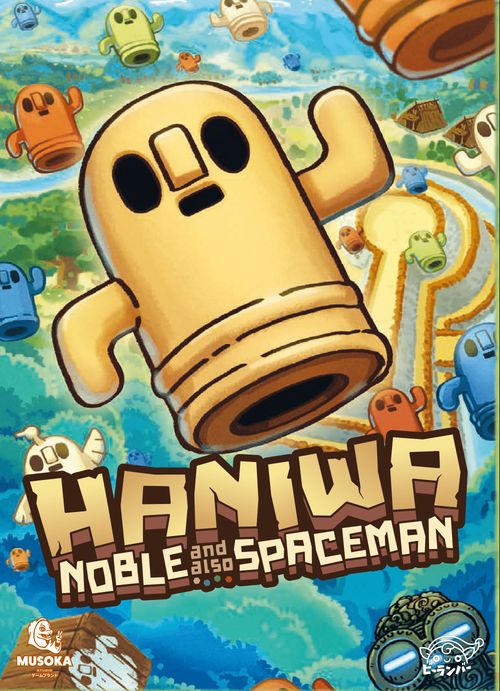
HANIWA
HANIWA Rulebook
Table of Contents
Table of Contents
Overview
Once upon a time, during the Kofun period, two Haniwa crafters faced off at a Gozoku festival to determine which one was the more skilled crafter.
The crafters (players) split up into two areas and gave gifts to the four Gozoku by placing the Haniwa on their areas' grids alternately.
Once three tiles of Haniwa were given to all four Gozoku, the Haniwa power of each column was compared. And the crafter with more power receives a "reward" from the Gozoku in that column.
Each Gozoku has a "Happiness dice", and its pips represent the victory point you receive from the Gozoku. Each time Gozoku receives a Haniwa of his/her favorite color, he/she feels better, and the die roll increases. But if they feel too good, they may eat/drink too much, so be careful.
Also, if you made an "8" power with four horizontal Haniwa, you will receive bonus victory points from the DOGU. It's a big score that can't be ignored, so let's aim for it.
GOAL OF THE GAME: The player with the highest score after adding up the points from the Happiness dice, Dogū tiles, Kofun tiles and Smile bonuses wins the game.
Components
- 36 Haniwa Tiles (12 variations, 3 each). Haniwa Power 1/2/3.
- 4 Haniwa Colors (Red/Green/Yellow/Blue).
- 4 Gozoku Tiles.
- 6 Dogu Tiles.
- Kofun Tiles (6 are used in setup).
- 4 Happiness Dice.
Preparing the Game
Prepare both players' areas by placing all components. These Gozoku and Dogu will be the guides for cells of a grid of each player's area.
- Place the Gozoku tiles and the dice on the center of the table. Place the identically coloured Happiness dice next to each Gozoku, roll the dice and the result is the starting score for the game for that column. If you wish, you can also start the game with all the abundance dice on 1. Players are divided into two areas, separated by a Gozoku-s row.
- Place 3 Dogu tiles in each area face down (their eyes are not shining). This side up.
- Place all 6 Kofun tiles as shown in the image below. This is a bonus you can receive when the die roll exceeds 6.
- Shuffle all Haniwa tiles to two piles. Choose any pile when you draw Haniwa tile. If one is empty, draw from the other.
- Determine the first player by rock-paper-scissors or any other way.
- Each player draws 4 Haniwa Tiles from any deck and puts them into his/her hand. At this time, you may retry this action again once. In that case, all four tiles in your hand are shuffled, and draw 4 tiles again to your hand.
Turn Workflow
Turn start, then the turn steps in order:
- Turn Start: 0 Discard 1 and Draw 1 (once in turn, up to 2 times in each game), then 1 Put a Haniwa tile to your Area, then 2 Check the Dice, then 3 Check your Dogu, then 4 Draw a Haniwa, then 5 Turn End.
0 Discard 1 and Draw 1
You can discard a Haniwa face down and draw a new Haniwa from any deck. This may be done once on each turn and up to twice throughout the game.
1 Put a Haniwa tile to your Area
Select a Haniwa from your hand and place it in your area. You can place it anywhere as long as it is vacant. There are no color restrictions.
If the Haniwa you placed is the same color as the Gozoku in the row, a "Happiness Dice" check will be performed.
Only the first player may place the Haniwa face down once during the game. It will be turned up at end of the game and check for Dice and Dogu.
2 Happiness Dice check
Each Gozoku has a "Happiness dice" and pips of them are the victory point you receive from the Gozoku. This will change when you place Haniwa of the same color as the Gozoku. This must be done. The number that increases is equal to the power of Haniwa placed.
When a red Haniwa is placed in a row with a red Gozoku, the die will increase. In this case, the power of the Haniwa is "2", so the die also increases "2".
If you put Power "3" Haniwa when the die is "5", it goes around and becomes "2"!
However, if the die roll exceeds "6", the die will be circled and count again from "1" due to overeating or overdrinking.
After the die roll exceeds, the player chooses and takes a Kofun tile from the Kofun tile stock as a reward for taking care of Gozoku.
A Kofun tile gives you 1 victory point each. If it is not in the area, you can't take any. Also, it has a special effect. See description under Kofun Power.
This ability can make your hand stronger or make your opponent unsure of how many HANIWAs are left in the game.
Note: Bonus victory points of the Kofun are guaranteed whether or not these effects are applied.
Kofun Power
Kofun tiles have a special effect that is used up. This special effect can enhance the action of placing the Haniwa tile up to once on each turn. Instead of placing a Haniwa from your hand, you can play a Haniwa from your hand and a Kofun tile that you have not yet used, one on top of the other, with the Horse side up.
This tile is treated as a power "2" Haniwa of its Kofun's color, and the dice and Dogu are dealt with as usual.
The "brown" Haniwa has no color and has no effect on the dice.
Also, do not tell your opponent what Haniwa you put in this time. The face-down Haniwa tile below the Kofun tile will not be used to calculate powers at the end of the game.
3 Dogu Check
After checking the dice, if four Haniwa tiles are in your row, start Dogu Check.
If their total power is "8", activate a Dogu in the row. (Face up)
The more Dogu you activated, the more victory points you will receive. One for 2pts, two for 4pts, and three for 8pts.
The Curse of the DOGU: If four Haniwas' total power is higher than "8", you will be Cursed by the DOGU. Take a DOGU from the row without activating it. This DOGU has a penalty. At the end of the game, it will overshadow the GOZOKU and its Reward Dice, nullifying the score. Each cursed DOGU disables one GOZOKU that you win. The Nullify starting with the highest die number, not the total score with the smile bonus.
4 Draw a Haniwa
Draw a Haniwa from any deck and add to your hand. If a deck is empty, draw from the other.
5 Turn End
Pass the turn to the next player. If both areas' 12 grids are filled with Haniwa tiles, the game ends.
End of the Game
When both areas are filled with 12 Haniwa tiles, the game ends. If there is Haniwa put face down, face it up and check dice and Dogu.
After that, compare each column in both areas and the winning side will receive a die in that column.
Comparing each Column
In each Column, the following order of priority is used to determine which side wins.
- Sum all Haniwa power in each column. Sum the power of Haniwas in each column. The player with the higher power in the column gets a die from Gozoku in that column.
- Example 1: Since the total values are 7 and 5, Player A wins in this example.
- See the power of Haniwa match the color of Gozoku. Example 2: Since the total was the same 7, compare only the "blue" Haniwa power that matches Gozoku in this column.
- See how many tiles match the Gozoku. If all powers were the same, see how many tiles match the Gozoku in that Column. Example 3: Since the powers were all the same, here we compare how many yellow Haniwa tiles there are.
If all were the same, no one will get the reward in the column.
Smile Bonus
In the winning column, if you have 3 Haniwas match the Gozoku, turn the Gozoku tile into a Smiling Face. You will get 2 bonus points from that smiling Gozoku. (Check out for an example in column 4.)
Sum all points of Dice, Dogu, Kofun, and Smile Bonus. The player with the higher total score is the winner. If the scores were the same, the player with more activated Dogus will win. If even that is the same, the first player wins.
End of Game Example
Example (page 10): the table shows the score of each player per colour column.
| Example | Green | Blue | Yellow | Red | Dogu | Kofun | TOTAL |
|---|---|---|---|---|---|---|---|
| Player A | 2 pt | 6→0 | 1 pt | 2 pt | 3 pt | 8 pt | |
| Player B | 3+2 | 8 pt | 2 pt | 15 pt |
Player B wins.
Example (page 11): the diagram shows the end-of-game comparison of the four columns, with the printed hypothesis: "In this example, we have made the hypothesis that the 4 rolls of the Happiness dice at the start of the game gave 1 for each colour."
- Player A: column 1 PWR 7 (WIN), column 2 PWR 3 (WIN), column 3 2 Tiles (WIN), column 4 PWR 3 (LOSE).
- Player B: column 1 PWR 5 (LOSE), column 2 PWR 2 (LOSE), column 3 1 Tile (LOSE), column 4 PWR 7 (WIN).
Summary
Turn Flow: Discard 1, draw 1 if you would. Face down, once on each turn, up to twice in the game.
- Put a Haniwa tile to your Area. This action can be enhanced with a Kofun. Only the first player may place it face down once during the game. If a Haniwa you placed has the same color as the Gozoku in the column, check "Happiness Dice".
- Checking Dice. The number on the die is the victory point you get for that column. It goes up when matched colored Haniwa is placed in that column. This must be done. It goes up equal to the power of the placed Haniwa. If you exceed the die, you can take any Kofun tile from stock.
- Dogu Check. If four Haniwas' total power is equal to "8", you'll get the bonus. If it is higher than "8", you will be Cursed.
- Draw a Haniwa. Draw a Haniwa tile from any remaining pile.
- Pass turn to the next player. If both areas' 12 grids are filled, the game will end.
Bonuses: Dogu-Bonus 2 pt / 4 pt / 8 pt. Kofun Bonus 1 pt. Smile Bonus 2 pt.
Kofun Power: If you have a Kofun tile, you can put a Haniwa tile from your hand with overwriting it by the Kofun.
The Curse of the DOGU: Take a DOGU from the row without activating it. This DOGU has a penalty. At the end of the game, it will overshadow the GOZOKU and its Reward Dice, nullifying the score. Each cursed DOGU disables one GOZOKU (and its die). The Nullify starting with the highest die number, not the total score with the smile bonus.
Comparing Each Column:
- Sum all power in the column.
- See the power of Haniwa match the color of Gozoku.
- See how many tiles match the Gozoku.