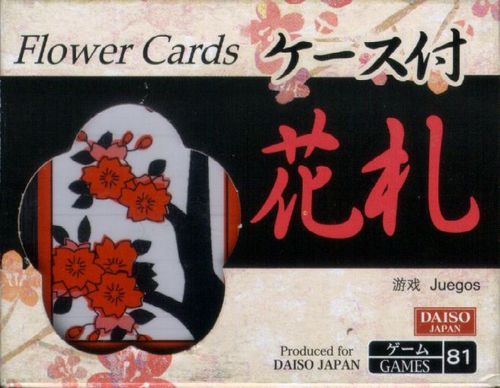
Hanafuda
Hanafuda Rulebook
Table of Contents
Table of Contents
Understanding the Hanafuda Deck
Before learning how to play Koi-Koi, let's take a moment to learn about The Months & Flowers, The Categories, The Sets, and A Few Points to Note.
The Months & Flowers
Your Hanafuda deck consists of 48 unique cards in 12 suits of 4 cards each. Each suit represents a month of the year and its associated flower.
For example, the September month art shows the associated flower Chrysanthemum, and the September cards are the four cards of that suit.
The Categories
Hanafuda cards are broken down into four distinct categories:
- BRIGHTS ・Hikari (光)・5 Cards — Highly auspicious poetic images of such significance that they shine in relation to the other cards.
- SEEDS ・Tane (種)・9 Cards — Poetically linked seasonal pairings, such as flower + bird, insect, or animal. They tell the story of each month through its poetic motifs.
- SCROLLS ・Tanzaku (短冊)・10 Cards — Slips of paper for writing poetry, sometimes tied to trees during poetry gatherings. There are 3 varieties: red, blue, and red with writing.
- DREGS ・Kasu (カス)・24 Cards — Seasonal flowers and grasses. They form the scenery for each month, melting into the background – in much the same way that dregs fade to the bottom of a saké barrel.
The Sets
In Koi-Koi, players make sets (yaku) out of various combinations of cards from different months. These are most often based on the categories, but some might be surprising. Please see the reference sheet for a full list.
Each set entry on the reference sheet shows:
- a quick reference of the main category for the set;
- an example of the cards required for the set;
- the specific cards required to complete the set — for example, "3 Red Scrolls With Writing" for the RED SCROLLS / Akatan (赤短) set;
- the set name in translation, transliteration, and Japanese;
- the points earned by making the set playing Koi-Koi (5 points, in the Red Scrolls example);
- a "plus" icon. For sets with this icon, you score 1 point per ANY additional card of that set's category: Brights, Seeds, Scrolls, or Dregs.
Sets can be collected / made in any order. In the Red Scrolls example, an extra Blue Scroll would be worth 1 additional point.
A Few Points to Note
We'd like to point out a few cases that may confuse new players.
Seeds cards each depict a flower paired with a bird, insect, or animal – except for May and September, which show a bridge and a saké cup instead.
Even though the Lightning card looks powerful, it is considered a Dregs card. However, this unique card has its own optional rule "Wild Lightning!" (See the Tsuiki Addendum.)
The RED SCROLLS and RED & BLUE SCROLLS sets require Red Scrolls with Writing. Blank Red Scrolls may still be used for the additional point bonuses, but not the base sets.
Understanding Koi-Koi
The objective of Koi-Koi is to score the most points after 12 games. In each game, you'll be collecting cards in order to be the first player to earn points for a variety of different set types (yaku).
The leading player can also call "Koi-koi!" in order to push their luck to score another set and try for a big score bonus.
Setting Up Koi-Koi
Before starting each game, you follow three steps:
- Determine the Dealer
- Deal (Game Setup)
- Quick Victory / Bad Deal Check
1. Determine the Dealer
Koi-Koi uses the concept of a dealer (oya) and a player (ko) throughout the 12-game series.
- Shuffle all 48 Hanafuda cards and create a deck.
- Each player cuts the deck to reveal a card. The player who reveals the card from the earliest month becomes the dealer for the initial game. If tied, repeat until a dealer is determined.
For example, a player revealing JANUARY • Pine becomes the DEALER (oya) over a player revealing JUNE • Peony, who is the PLAYER (ko).
After the initial game, the winner becomes the dealer for the next game.
2. Deal (Game Setup)
- The dealer shuffles the deck and then deals 2 cards at a time to the player [face-down], common area (ba) [face-up], and themselves [face-down] until they've dealt 8 cards to each location [24 total].
- They then place the remaining cards in a deck next to the common area [face-down].
Before looking at their cards, the player may choose to swap their hand with the dealer's hand.
Use a piece of paper to track your score game-over-game.
The table layout is: the player's hand, the player's scoring area, the common area (ba) with the deck beside it, the dealer's scoring area, and the dealer's hand.
3. Quick Victory / Bad Deal Check
Before beginning play, the player and dealer each look at their individual hands for a QUICK VICTORY and then the common area for a BAD DEAL.
If either opponent has 4 cards of the same month (teshi) — for example, all 4 cards from May • Iris — OR if either has 2 cards from 4 different months (kuttsuki), it is a QUICK VICTORY and they score 6 points. That player becomes the new dealer and sets up the next game in the series.
If both opponents have either condition, both are awarded 6 points. In this instance, follow the Determine the Dealer steps to start the next game.
THEN, the same check is made on the common area. If either condition is met (teshi or kuttsuki), it is a BAD DEAL, in which case the current dealer shuffles and re-deals for the same game.
Playing Koi-Koi
A Koi-Koi competition between two players is usually the culmination of points from a series of 12 games. For shorter play, try a series of 6 games.
Playing 1 Game of Koi-Koi
After setup, the dealer always goes first.
In each game, you are racing to be the first to complete a scoring set of cards. Each round, the opponents take a turn playing a card from their hand to the table, followed by revealing a card from the deck.
In both steps, they hope to "capture" cards of the same month from the common area and, along with the revealed card, add them to their scoring area. (For example: a July match — captured! A December match — captured!)
Taking Your Turn
Proceed through the following steps in order.
1. Play a Card from Your Hand
Reveal a card from your hand and place it on the table.
- If the card you played is of the same month as any card in the common area, place that card and the matched "captured" card from the common area into your scoring area.
- If the card does NOT match any month in the common area, then add it to the common area. You do not move any cards to your scoring area.
The common area may have more than 8 cards.
2. Reveal a Card from the Deck
Flip a card from the top of the deck into the common area.
- If the card you flipped is of the same month as any other card in the common area, place that card and the matched "captured" card into your scoring area. Card playing is over; proceed to Step 3.
- If the card does NOT match any month in the common area, then it stays in the common area. Card playing is over; proceed to Step 3.
We recommend sorting your cards in your scoring area based on potential sets, so you can easily see if you've scored. (See reference sheet.)
Special Cases When Capturing (Both Step 1 and Step 2)
If there are 2 cards from the same month in the common area, you may choose the most advantageous card to capture.
If there are 3 cards from the same month in the common area and you play or flip the 4th card of the month, you capture all 4 cards.
Keep your potential sets in mind when you capture extra cards. (See reference sheet.)
3. Check for a Scoring Set
At the end of your turn, check to see if you have scored a set. (See reference sheet.) Sets are combinations of cards based on similar elements. For example, the "Seeds."
With a good capture, it is possible to complete multiple sets at the same time or a set with bonus points.
If you have made a set(s), you can either end the game there by calling "Shōbu!" ("Game!") becoming the winner and gaining those points, OR you can call "Koi-koi!" ("Come on!") and keep playing to get another set.
If you are able to complete the additional set, you score those total points (from all sets) and potentially get a BIG SCORE.
HOWEVER, this is risky because if your opponent can finish just one set before you finish your next set, they'll win, double their points, and end the game!
"Koi-koi!" may be called only once per game. If the "koi-koi" is countered by the opponent completing a single set, then the game immediately ends.
Game End and Scoring
The game ends when either opponent has completed a set(s) and called "Shōbu!" or either player has completed a set after "Koi-koi!" has been called.
The person who completed the set scores, and their opponent gets zero points (even if they previously had a completed set).
Big Score
If the winning set(s) total 7 or more points in a single game, you double the points!
Example: the player completes an original set, "blue scrolls," worth 5 points, then calls "Koi-Koi!" and completes a second set, "three brights," worth 5 points. 5 pts + 5 pts = 10 pts; big score x2 = 20 pts total!
If neither opponent is able to make a set, or a second set if they called "Koi-koi!", before playing all their cards, the game is a draw (zero points) and the opposite player becomes the dealer.
Setting the Next Dealer
The winner becomes the next dealer. Collect all the cards and Deal (Game Setup) the next game.
Final Scoring
The match is over after the 12th game ends. Sum up the points from all 12 games.
The final winner is the player with the most points!
Here we have the final score between Nancy and Bruno. Looks like Nancy has edged out the victory after 12 games:
| Game | Nancy | Bruno |
|---|---|---|
| 1 | 6 | — |
| 2 | — | 3 |
| 3 | — | 26 |
| 4 | 14 | — |
| 5 | — | — |
| 6 | 6 | — |
| 7 | 16 | — |
| 8 | 5 | — |
| 9 | — | 1 |
Take note that in each round only one person should score unless neither player completes a set (Game 5) or both players score 6 points with a Quick Victory (Game 10).
Set Reference Sheet
Months
- JANUARY • Pine
- FEBRUARY • Plum Blossom
- MARCH • Cherry Blossom
- APRIL • Wisteria
- MAY • Iris
- JUNE • Peony
- JULY • Bush Clover
- AUGUST • Silver Grass
- SEPTEMBER • Chrysanthemum
- OCTOBER • Maple
- NOVEMBER • Willow
- DECEMBER • Paulownia
Category marks used on the sheet: Brights, Seeds, Scrolls.
Brights Sets
| Set | Japanese | Points | Cards required |
|---|---|---|---|
| FIVE BRIGHTS | Gokō (五光) | 10 | ALL 5 Brights |
| FOUR BRIGHTS | Shikō (四光) | 8 | 4 Brights, Excluding November Bright |
| RAINY FOUR BRIGHTS | Ame-Shikō (雨四光) | 7 | November Bright Plus ANY 3 Brights |
| THREE BRIGHTS | Sankō (三光) | 5 | ANY 3 Brights, Excl. November Bright |
Scrolls Sets
| Set | Japanese | Points | Cards required | Plus bonus |
|---|---|---|---|---|
| RED SCROLLS & BLUE SCROLLS | Akatan・Aotan (赤短・青短) | 10 | 3 Red Scrolls With Writing & 3 Blue Scrolls | plus |
| RED SCROLLS | Akatan (赤短) | 5 | 3 Red Scrolls With Writing | plus |
| BLUE SCROLLS | Aotan (青短) | 5 | 3 Blue Scrolls | plus |
| SCROLLS | Tanzaku (短冊) | 1 | ANY 5 Scrolls | plus |
Seeds Sets
| Set | Japanese | Points | Cards required | Plus bonus |
|---|---|---|---|---|
| SEEDS | Tane (タネ) | 1 | ANY 5 Seeds | plus |
| BOAR, DEER, BUTTERFLY | Ino-shika-chō (猪鹿蝶) | 5 | Boar, Deer and Butterfly cards | plus |
Dregs Sets
| Set | Japanese | Points | Cards required | Plus bonus |
|---|---|---|---|---|
| DREGS | Kasu (カス) | 1 | ANY 10 Dregs | plus |
For sets with the "plus" icon, you score 1 additional point per ANY card of that category: Brights, Seeds, Scrolls, or Dregs.