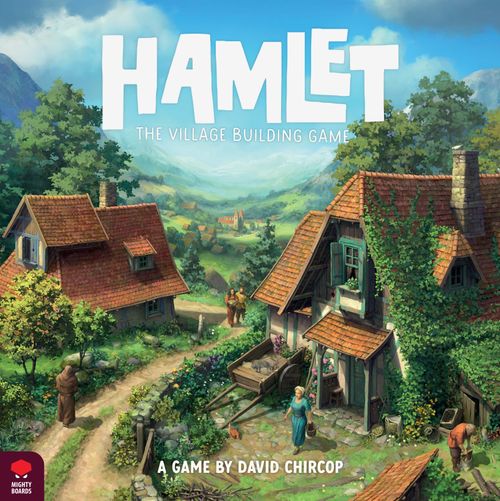
Hamlet: The Village Building Game
Hamlet: The Village Building Game Rulebook
Table of Contents
Table of Contents
Objective
Hamlet is a competitive village building game. In British English, a "hamlet" usually refers to a small village without a Church. Thus, a game of Hamlet ends when the players complete the Church, and what was once a fledgling village has become a bustling town. Although everyone is building the same village, the winner of the game is the player who earns the most Points by being the biggest contributor to the growth of the village.
You will score points in many ways such as making Church Deliveries, constructing buildings, selling at the market, building roads, refining materials, gaining Milestones and Awards, and connecting a strong delivery network. All of these will contribute to you being the biggest benefactor by the end of the game!
Player Components
- 32 Refined material tokens — 8 of each colour / 2 of each type per player
- 24 Player markers — 6 of each colour
- 24 Flags — 6 of each colour
- 16 Villagers — 4 of each colour
- 20 Roads — 5 of each colour
- 24 Donkeys — 6 of each colour
General Components
- 18 Raw material tokens — 6 of each of the 3 Raw materials: Wood, Stone, Wheat
- 1 Starting Player token
- 30 Gold coins — 23 of the 1 Gold coins, 7 of the 5 Gold coins
- 6 Flat Church tiles
- 9 Milestone & Award tiles
- 12 Market Sale tiles
- 32 Building tiles
- 1 Scoreboard
- 1 Canvas bag
Kickstarter Bonus Content
This copy of Hamlet: Founders Deluxe edition comes with a number of additional optional components.
Here are some guidelines for using them:
The Tile Chits. These are an alternate way of shuffling tiles in the bag. If you do not like having your building tiles shuffled in the bag, you may use these chits as a substitute. Since there are two Pond tiles, if you would draw one of the Pond chits, randomly choose one of the tiles.
The 3D Cardboard Church. This is an optional 3D Church that is used to add flavour to the game. Whenever you complete a Church Delivery, place one of the Church pieces onto the board and watch as you slowly complete the construction of the Church. This copy also comes with a flat version of the 3D Church, making for a more travel friendly experience. Finally, there is also an extra tile with an alternate illustration.
Setup
For a 1-player game, read the included Solo Game leaflet.
-
Give each player all the components of their colour. (The diagram shows setup for 2 players).
- 8 Refined materials: 2 of each of the 4 materials (Timber, Flour, Milk, Brick). These tokens are marked with the regular Refined version on the top side (black) and the High Quality version on the bottom side (white).
- 5 roads
- 6 player markers
- 6 Flags
- 6 Donkeys
- 4 Villagers
-
Place the Church in the centre of the table. In a 3-4 player game, use the 3-4p side. Start with one part of the 3D Church already placed on the table. In a 1-2 player game, use the 1-2p side. Start with two parts of the 3D Church already placed on the table.
-
Each player places 1 Villager and 1 Donkey of their colour onto the Church tile.
-
Place the Woodcutter, Quarry, Farm, Market and Town Hall adjacent to the Church so that their road segments match up with any of the road segments of the Church. If it's your first play, follow the setup diagram shown here. In a 2-player game, use the 2p side of the Market. Otherwise, use the 3p-4p side. This is now the play area.
-
Place 2 Wood, 2 Stone, and 2 Wheat on the Woodcutter, Quarry, and Farm respectively.
-
Fill the bag with the starting building tiles. The starting tiles have a bag icon above their names on the back of each tile.
-
Sort the rest of the building tiles into 4 piles of 4 based on their unlock type, printed above the names on the back of each tile — Timber, Milk, Brick, and Flour. The box insert comes with slots to have these 4 piles pre-sorted.
-
Place the Scoreboard beside the play area. Place 1 of each player marker on the empty area beside the 1 space.
-
Draw 4 building tiles from the bag. Place 1 tile each above the 0 Gold, 1 Gold, 2 Gold, and 3 Gold slots on top of the Scoreboard.
-
Randomly determine the starting player and give them the starting player token.
-
Give each player 3 Gold.
- In a 4-player game, players 3 & 4 receive an additional 1 Gold.
- In a 2 or 3-player games, the last player receives an additional 1 Gold.
-
Place the Awards and Milestones where everyone can see them.
-
Split the Market Sale tiles into 3 piles based on their tier (shown by the number written on their back).
- In a 4-player game, randomly remove one of the tier-2 tiles and one of the tier-3 tiles.
You are ready to start your game of Hamlet.
General Concepts
Tile Anatomy
In Hamlet, you will be growing a village by placing tiles on the board next to each other. Each tile represents a specific building. A tile in your personal supply or above the Scoreboard represents the building's blueprint. When you lay it on the board, it becomes the building itself.
Each tile shows its tile name, its construction reward, its construction cost, and its building action.
Tile Segments
The edges of each tile are made up of one or more equal-length segments. Segments are always separated by a small clearing. A segment can be one of 3 different types: Road, Forest, and Mountain. These segments come into play when building and traversing the village.
Adjacency
Whenever you place a building tile, it is considered adjacent if at least one full segment of the tile is touching one full segment of another tile. Mountain and Forest segments can always touch each other, but road segments can only touch other road segments.
Raw, Refined & High Quality Materials
-
Raw materials are the most basic type of resource and can be used by anyone. Raw materials are not limited. If you run out of tokens, use an appropriate substitute. The Raw materials are Wood, Wheat, and Stone.
-
Refined materials are created by processing Raw materials. They are made by a specific player and have an icon on top and bottom showing the material's type and quality. When you make a Refined material, use the black side of the marker. The Refined materials are Flour, Milk, Brick, and Timber.
-
High Quality materials are Refined materials that are produced by the player who owns the appropriate Award. For example, Carpenters always make High Quality Timber instead of Refined Timber. When you produce a High Quality material, use the white side of the marker instead of the black side. When consumed, the player who made them will receive double the rewards indicated on the Refinery.
Refined and High Quality materials are limited. Each player has 2 of each material and cannot make more if both tokens are already in the village. When consumed, they are returned to the player who made them and can be refined again.
Ownership
Any building tiles (blueprints) and Gold in your personal supply are yours, but buildings and materials on the board are owned by all players. Everyone can freely use all the materials on the building tiles – even ones in another player's colour – and activate all buildings in the village. Landmarks (buildings with the Flag icon on them) will grant Points only to the player whose Flag marker is on them, but apart from these exceptions, everything is shared in Hamlet.
Gold
Gold is a resource used to purchase various things in Hamlet and is also worth a small amount of Points at the end of the game. Each player's personal Gold supply is kept public for all players to see. You can only use your own Gold.
Roads
Roads in Hamlet are used to indicate where your workers (Villagers or Donkeys) can go, and to where resources can be transported. You will often construct buildings that are not immediately accessible (no printed road connected to another tile). Those tiles can later be connected through either another building tile's printed road, or by building a road between two tiles. Buildings cannot be activated if they cannot be accessed by your workers, and they usually cannot be scored at the end of the game. Road markers are limited. Once you build all of them, you may not build any more. When you build a road, everybody can use it, but only you will score Points for it at the end of the game.
Villagers & Donkeys
There are two types of workers in Hamlet:
-
Villagers perform actions around the village. They can activate buildings to perform their actions and they can also construct buildings and roads. Villagers move quickly in the village and can get to any accessible tile in a single turn as long as there is a road that leads there. Villagers are represented by meeples. You start with 1 Villager on the board, and you can have up to a total of 4 during the game.
-
Donkeys are used to transport materials to the Villagers. Donkeys move slowly and can each only move to an adjacent tile once per turn. You start with 1 Donkey on the board, and you can have up to a total of 6 during the game.
Consuming & Transporting Materials
You will be required to consume materials to perform Villager actions. Whenever you consume materials, they either need to be on the same or an adjacent tile as your Villager, or you will need to have Donkeys in place to transport the materials from their current location to wherever your Villager is taking the action. Materials are transported and consumed one by one in any order.
Transporting Materials
The village's robust transport system is always able to move any material one space from its location to an adjacent tile, connected by a road. To transport materials farther, you will need the help of your Donkeys**.** If the materials land on a tile with one of your Donkeys on it, the Donkey aids in the transport of the material, moving the material once more to an adjacent tile connected by a road. If there is another one of your Donkeys on the next tile, the material can move once more. This keeps going until it lands on the tile where the action is taking place.
If you cannot transport all of the required materials to the tile where the action is being taken, then you may not perform the action. You cannot transport any materials you will not immediately consume.
Consuming Materials
Almost all actions taken by your Villagers require materials to be consumed. Whenever you consume a material after transporting it, remove it from the board. Raw materials are returned to a common supply, while Refined and High Quality materials are returned to the player who produced them.
- When a Refined material is consumed, the player who produced it immediately gains the reward indicated on the Refinery. If a player consumes their own Refined material, they get the rewards themselves.
- When a High Quality material is used, the player who produced it immediately gains twice the indicated reward.
- When a Raw material is consumed, no special reward is given to any player.
Example: The Yellow Villager wants to build the Lumbermill next to the Church. (1) The Stone on the Quarry can be transported since it is directly adjacent to your Villager. (2) The Stone on the Barn can be transported since moving it to the Quarry lands it on your Donkey, allowing you to move it again to the Church. (3) Finally, the Brick on the Stonemason can also be delivered as it can be moved first to the Donkey on the Barn, then to the Donkey on the Quarry (remember you can use roads built by other players). The Lumbermill can be built!
If the Yellow Villager wanted to make a "3 Milk / Brick" Church delivery instead, they would not be able to. The Milk on the Dairy Farm cannot be moved to the Church, as there isn't a Donkey on the adjacent Barn. Meanwhile, the Milk on the Cow Conservatory cannot be moved to the Church as there is only a Donkey owned by another player on the Stonemason (remember, you can only use your own workers).
Milestones & Awards
Hamlet has two types of objectives to compete for:
- Milestones are granted to players during the game for being first to achieve something. They give the player Points or an ability to use during the game.
- Awards are granted at the end of the game for being the best in a certain category.
Whenever you earn a Milestone, take it and place it in front of you. Points from Milestones will be scored at the end of the game. However, if the Milestone gives you an ability, gain the ability immediately. Awards will be given out during final scoring.
The Awards
- Chaplain — Most Church deliveries by the end of the game. 5 Points.
- Landscaper — Most Landmark buildings at the end of the game. 4 Points.
- Sacristan — Second most Church deliveries by the end of the game. 3 Points.
- Merchant — Most sales at the Market. 4 Points.
The Milestones
- Carpenter — 1st Refinery. All Timber you generate is High Quality.
- Mason — 1st Refinery. All Brick you generate is High Quality.
- Herder — 1st Refinery. All Milk you generate is High Quality.
- Miller — 1st Refinery. All Flour you generate is High Quality.
- Planner — 1st Bridge/Path. 1 Point per bridge/path.
Game Structure
A game of Hamlet consists of an indefinite number of rounds. Beginning with the starting player, each player takes one turn each round. Continue taking turns until the Church is completed, triggering the end of the game. Once a player completes the Church, players continue until the player sitting to the right of the starting player has completed their turn. Then proceed to the End Game Scoring.
Turn Flow
During your turn you may perform these actions in any order:
- Move Donkeys: Once per turn, you may move each of your available Donkeys by up to 1 tile.
- Villager action: Take an action with each of your available Villagers.
Move Donkeys
You may move each of your Donkeys once to any adjacent tile connected by a road. You may only take the Move Donkeys action once per turn.
Villager Action
Each of your Villagers may perform a maximum of one action per turn.
A Villager can take any of the following actions:
- Activate a building tile on the board.
- Construct a building adjacent to an existing building.
- Build a road to connect two building tiles.
Whenever you perform a Villager action, move the Villager to the building tile where you will perform the action. The Villager can move to any building as long as the villager can follow a road that leads there. If a building is not connected by a road, then no worker can move to it.
Lay the Villager down on its side to show that it has taken its action this turn.
Most actions require you to have materials transported to the building tile where the action takes place or to have Gold available in your supply. If you cannot transport all the required materials or lack the Gold, you cannot take the action.
Villager Actions
1. Activate a Building
To activate a building, you must place your Villager on the building tile which you would like to activate. Each building has a different action. The starting buildings are detailed here, and additional buildings can be found in the Building Glossary at the end of this rulebook.
A. Producers
The Raw materials displayed in teal squares are produced in these buildings.
Use a Producer
- Check for empty material slots on the tile. If all slots are occupied, you cannot take this action.
- Fill all the empty material slots on the tile by taking the corresponding Raw material from the supply and placing 1 on each slot.
- Gain the rewards listed on the tile for working there once, irrespective of how many slots you have filled up.
B. Refineries
Refineries are used to convert Raw materials into the Refined materials displayed on the tile's material slots. Whenever you build the first Refinery of each of the 4 Refined materials (Flour, Milk, Brick, Timber), add the entire corresponding stack of blueprint into the bag and shuffle it.
Use a Refinery
- Check for empty material slots on the tile. If all slots are occupied, you cannot take this action.
- Transport the required Raw materials to the Refinery and consume them. If the required materials cannot be transported to the tile, you cannot take this action. If a refinery has more than one action material slot, you may fill either just one or both in one action.
- Take a corresponding Refined material from your supply and place it black side up on the tile. If you don't have the Refined material token in your supply, you cannot take this action.
- If you have an appropriate Milestone for creating High Quality materials, flip the Refined material token white side up.
- You or other players can now use this material for other actions. Refining materials does not immediately give any rewards. The rewards are gained by the player who refined the material when it is consumed.
C. Town Hall
Placing a Villager on the Town Hall allows you to take both actions available on this tile – purchasing a blueprint and hiring new workers in that order.
Purchase a Blueprint
- If you already have 3 blueprints in your personal supply, you cannot take this action.
- Choose one of the 4 blueprints displayed above the Scoreboard. The leftmost tile is free. If you choose the second tile, place 1 Gold on the leftmost tile. If you choose the third tile, place 1 Gold each on the first and second tile, and so on.
- Add the blueprint and any Gold on it to your personal supply. You now own a blueprint of the building.
- Slide the remaining tiles above the Scoreboard to the left.
- Draw a new tile from the bag and place it on the rightmost spot so that there are 4 tiles available again. If there are ever fewer than 4 tiles, replenish the display immediately.
And/or Hire Workers
- You may hire as many workers as you can afford in a single action.
- The first additional Villager that you hire costs 5 Gold, the second costs 7 Gold, and the third costs 9 Gold. You may not have more than a total of 4 Villagers, including the one you start with.
- Donkeys cost 3 Gold each. You may not have more than a total of 6 Donkeys, including the one that you start with.
- After paying their costs, take any hired workers from your personal supply. Place newly hired Villagers on the Church lying down – you may use them next turn. Place newly hired Donkeys on any building tile that is accessible to the Church by a road – you may use these immediately.
Example: (1) You activate the Town Hall and purchase a blueprint. You have 10 Gold in your supply. You need the second tile so you (2) first place 1 Gold on the leftmost tile, (3) then take the second tile which has 2 Gold on it already. You now have 11 Gold. (4) You slide the tiles leftwards and (5) draw a new tile from the bag. Place that new tile in the 3 Gold slot. You now decide to hire workers: one Donkey and one Villager. Since you have 2 Villagers on the board already, the Villager costs 7 Gold and the Donkey costs 3 Gold. You pay the total of 10 Gold, (6) place the new Villager on the Church laid on their side, and (7) place the Donkey on the Farm which is connected to the Church by a road.
D. Market
The Market is one of the most important buildings as it allows for both the purchase and sale of materials. At the Market, you can do two things: Make a Sale at the Market, and make a Free Market purchase.
Make a Sale at the Market
- Choose a Market Sale tile that you would like to fulfil.
- Transport all required materials to the Market tile.
- Consume all the required materials, and immediately grant Refined and High Quality materials' rewards to the player of their colour.
- Take the chosen Market Sale tile and place it in front of you. Receive the tile's rewards (Points and/or Gold) immediately.
- If there are still Sale tiles in the draw pile, refresh the Market Sale tiles queue so that there are always 3 available. If there are no more Sale tiles, leave the slots empty.
You may not use the Free Market purchase (see below) while making a Sale at the Market.
Free Market Purchase
Whenever your worker needs to consume materials, you may use a Free Market purchase to get the required materials from the Market.
- Purchasing from the Market is not an action and does not require you to place a Villager on the Market. The costs of the materials are displayed on the Market tile. You may obtain as many materials as you can afford from the Market.
- In order to use a purchased material, you must be able to transport it from the Market to the Villager that is taking the current action (either by being adjacent or connected with Donkeys). The Market always has an infinite supply of materials. The materials are not created physically during a Free Market purchase. Purchased Refined materials do not belong to any player and reward no Gold or Points. You may not purchase High Quality materials.
You may not purchase materials from the Market to make a Sale at the Market.
E. Church
By making a Church delivery, you build one part of the Church. The Church is a massive project that requires multiple deliveries to complete, each indicated by a delivery slot. The required materials and Point rewards are different for each slot. Deliveries can be fulfilled in any order, and the Church is considered complete when all delivery slots are filled.
Delivering to the Church
- Transport the required materials to the Church one by one, in any order, and consume them. Grant any rewards for Refined and High Quality materials immediately as soon as you transport them. You may use Gold obtained this way for Free Market purchase within the same delivery.
- Place one of your player markers on the delivery slot to indicate that you are the one who completed it.
- Score the Points awarded by the Church delivery slot immediately.
Whenever you see a "/" sign, it can be treated as "or" which allows for a combination of the listed resources. For example, 3 Milk/Brick means a total of 3 resources that are a combination of either Milk or Brick.
Begging
When times are tough, you can beg at the Church to gain 1 Gold. This action is only available when the 3 starting Producers (Farm, Woodcutter, and Quarry) are full and it is impossible to work there.
2. Construct a Building
- Place your Villager on a tile that has at least one free segment.
- Choose a blueprint from your personal supply that you would like to build.
- Make sure the blueprint can be connected to the tile your Villager is standing on, following adjacency rules (see Adjacency). At least 1 valid segment needs to be adjacent without any segment breaking adjacency rules.
- Transport the required materials to the Villager who is building the tile, one by one, in any order, and consume them. Players gain any rewards for Refined and High Quality materials immediately as soon as you consume them. You may use Gold obtained this way for a Free Market purchase within the same building construction.
- Place the building tile adjacent to the tile your Villager is standing on, following adjacency rules.
- Gain the Construction rewards indicated on the building you just placed.
- Take a Milestone: If still available, take the Milestone matching the Refined material listed on the Construction reward (with a white arrow). If this Milestone has been taken by another player already, you may not take it from them.
- Add tiles to the Bag: Whenever you build the first Refinery of each of the 4 Refined materials (Flour, Milk, Brick, Timber), add the entire corresponding stack of blueprint tiles into the bag and shuffle it.
Landmarks
Landmarks have a Flag icon next to their name on the yellow banner. This means that the player who built these Landmarks must mark them, so that they can score Points from them at the end of the game. Whenever you construct a building with a Flag icon, place one of your Flag markers on it. Flags are not limited. If you run out, use a suitable proxy. Landmarks need to be connected by a road to the Church to be scored at the end of the game, unless stated otherwise on the tile.
3. Build a Road
Sometimes it will be impossible to connect a building using only the road segments on the tiles. In these cases, you will need to build roads to connect the buildings to the network in order for workers to be able to move onto those tiles.
To build a road, your Villager must be on one of the two tiles you would like to connect. You may not build a road if the two tiles are already directly connected to each other.
Two Types of Roads
- Bridges (Mountain-to-Mountain): Bridges connect two touching Mountain segments. They require 2 Wood to build.
- Paths (Forest-to-Forest): Paths connect two touching Forest segments. They require 2 Stone to build.
Touching Forest-Mountain segments represent Cliffs. These cannot be connected with a road.
Build a Road
- Transport the Raw materials to the tile where your Villager is.
- Place one of your road markers onto the intersection of the two tiles. Use the same road marker whether it is a Path or a Bridge.
- The two tiles are now considered connected by a road.
- If still available, take the Planner Milestone tile. If this Milestone has been taken by another player already, you may not take it from them.
Note: Building a road does not give you immediate rewards, but it will score you Points at the end of the game (see End Game Scoring).
Example: The top road is illegal because the Barn and the Lumber Mill are already connected with the printed road. The bottom road is illegal because you may not build roads on Cliffs.
End of Turn
When you have used all of the workers that you wish to activate, your turn is over and the player to your left goes next.
Completing the Church
Once all of the Church deliveries are completed, your hamlet is no longer a hamlet – it has now grown into a town! The game is also very close to the end. Complete the current round so that every player will have played the same number of turns (until the player sitting to the right of the starting player has completed their turn). Then proceed to End Game Scoring.
End Game Scoring
Awards
Hand out the Awards to the players. In case of a tie, the Points are shared, rounded down. If there is a tie for the most Church deliveries, the tied players claim the Chaplain and Sacristan and split the Points between them, rounding down.
Landmark Scoring
Go through the Landmarks and grant their owners Points as listed. Remember that Landmarks need to be connected to the road network to be scored at the end of the game, unless explicitly stated otherwise on the tile itself.
Bridge and Path Scoring
Score 1 Point for each road you have built during the game. If you have the Planner Milestone, score an additional Point for each road.
Longest Road
Find the largest continuous series of building tiles connected by only roads of your colour or roads printed on the tile. You cannot use the Church. Score 2 Points for each building tile in this series.
Gold
Score 1 Point for every 3 remaining Gold you have.
Scoring example:
Red has built three roads: two from the Quarry, connecting to the Stonemason and to the Barn; and another connecting the Pond to the Dairy Farm – they score 3 Points, 1 for each road. Yellow has built two roads from the Cow Conservatory: one connected to the Stonemason, and the other to the Farrier. They score 2 Points.
At the end of the game, if these are the longest uninterrupted connections each player can find: Red will score 12 Points - they have a path starting from the Pond, then onto the Dairy Farm, moving into the Barn, Quarry, and Stonemason, and finally ending on the Farrier. Meanwhile, Yellow will score 10 Points - they have a path starting from the Farrier, going into the Cow Conservatory, then Stonemason, Dairy Farm, and finally the Barn.
However, Yellow will score an additional 5 Points from the Farrier – which gives them 1 Point for each tile in the longest road. Red scores 3 Points for connecting their Pond with a Bridge.
Your Little Hamlet Is Now a Town!
The player with the most Points is the winner and will be remembered throughout history as the founder of the new town. Name it, take a photo of it, share it on social media with #MyHamlet, and cherish it – the next one you build will be very different. In the case of a tie, the player with the most Church deliveries wins. If there's still a tie, the player with the most Market Sale tiles wins. If there's still a tie, fill pint glasses with milk (or a milk alternative), and the first player to finish their glass wins.
Building Glossary
Producers
Barn: If the Barn is not full, fill it up with any combination of Raw materials (Wheat, Stone and Wood) and gain 2 Points. Do not gain any Gold.
Farm: If the Farm is not full, fill it up with Wheat and gain 2 Gold.
Quarry: If the Quarry is not full, fill it up with Stone and gain 2 Gold.
Woodcutter: If the Woodcutter is not full, fill it up with Wood and gain 2 Gold.
Refineries
Cow Conservatory: If the Cow Conservatory is not full, you may refine 1 Wheat into 1 Milk for each empty slot. For each Wheat you refined, place a Milk on its black side on each empty slot (or on its white side if you are the Herder). When any player consumes the Milk, gain 1 Gold and 1 Point (or 2 Gold and 2 Points if you are the Herder). If both slots are empty, you may refine 2 Milk in one action, provided that 2 Wheat are available.
Dairy Farm: If the Dairy Farm is not full, you may refine 1 Wheat into 1 Milk. Place a Milk on its black side on the empty slot (or on its white side if you are the Herder). When any player consumes the Milk, gain 1 Gold and 1 Point (or 2 Gold and 2 Points if you are the Herder).
Flour Mill: If the Flour Mill is not full, you may refine 1 Wheat into 1 Flour. Place a Flour on its black side on the empty slot (or on its white side if you are the Miller). When any player consumes the Flour, gain 1 Gold and 1 Point (or 2 Gold and 2 Points if you are the Miller).
Lumbermill: If the Lumbermill is not full, you may refine 1 Wood into 1 Timber for each empty slot. For each Timber you refined, place a Timber on its black side on each empty slot (or on its white side if you are the Carpenter). When any player consumes Timber, gain 1 Gold and 1 Point (or 2 Gold and 2 Points if you are the Carpenter). If both slots are empty, you may refine 2 Timber in one action, provided that 2 Wood are available.
Master Stonemason: If the Master Stonemason is not full, you may refine 1 Stone into 1 Brick for each empty slot. For each Brick you refined, place a Brick on its black side on each empty slot (or on its white side if you are the Mason). When any player consumes the Brick, gain 1 Gold and 1 Point (or 2 Gold and 2 Points if you are the Mason). If both slots are empty, you may refine 2 Brick in one action, provided that 2 Stone are available.
Sawmill: If the Sawmill is not full, you may refine 1 Wood into 1 Timber. Place a Timber on its black side on the empty slot (or on its white side if you are the Carpenter). When any player consumes the Timber, gain 1 Gold and 1 Point (or 2 Gold and 2 Points if you are the Carpenter).
Stonemason: If the Stonemason is not full, you may refine 1 Stone into 1 Brick. Place a Brick on its black side on the empty slot (or on its white side if you are the Mason). When any player consumes the Brick, gain 1 Gold and 1 Point (or 2 Gold and 2 Points if you are the Mason).
Windmill: If the Windmill is not full, you may refine 1 Wheat into 1 Flour for each empty slot. For each Flour you refined, place a Flour marker on its black side on each empty slot (or on its white side if you are the Miller). When any player consumes the Flour, gain 1 Gold and 1 Point (or 2 Gold and 2 Points if you are the Miller). If both slots are empty, you may refine 2 Flour in one action, provided that 2 Wheat are available.
Landmarks
Farrier: When scoring your longest road at the end of the game, score 3 Points for each tile instead of 2.
Monument: Score 2 Points for each matching segment. The Monument has a total of 9 segments: 3 Forest, 3 Mountain, and 3 road segments.
Outpost: Count the number of building tiles on the shortest way from this Outpost to the Church. Score 1 Point for each tile. Include both the Outpost and the Church when counting tiles.
Pond: As long as the Pond is connected by a road, score 3 Points.
Shrine: Score 2 Points for each Church delivery you've successfully completed.
Small Mountain Range (& Large Mountain Range): Score 1 (or 2) Points for each segment connected to another Mountain segment. Mountain Ranges do not need to have a road connection (such as a Bridge) in order to be counted at the end of the game.
Small Woodland (& Large Woodland): Score 1 (or 2) Points for each segment connected to another Forest segment. Woodlands do not need to have a road connection (such as a Path) in order to be counted at the end of the game.
Square: Score 3 Points for each connected road segment. Do not score any Points for any player-built roads (such as Bridges or Paths) or any other matching segments (such as Forest-to-Forest segments).
Stables: Score 2 Points for each Donkey you own.
Tavern: Score 1 Point for each 1 Gold you still have at the end of the game, up to a maximum of 8 Points. You still also score end of game Gold Points as normal.
Tradepost: Score 1 Point for each Market Sale you have completed. You still also score end of game Market Sale Points.
Warehouse: Score 1 Point for each Bridge or Path you have built. You still score end of game Bridge or Path Points, as well as longest road Points.