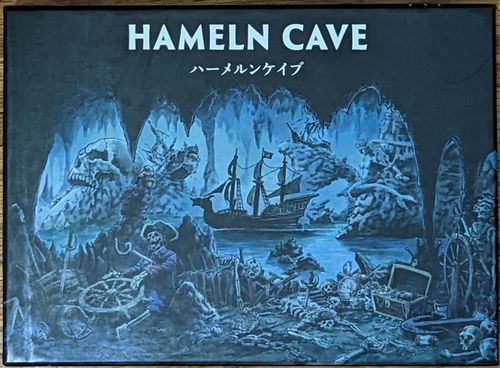
HAMELN CAVE
HAMELN CAVE Rulebook
Table of Contents
Table of Contents
Contents
- 3 cave boards: This is a map of the cave that is the stage of the game. Use three boards side by side vertically.
- a. Level - Refer to it when preparing the cave boards, depending on the level you are trying to challenge. If you want to challenge level 1, use the surface marked I.
- b. Play area - When you play a card from your hand, the place to put it is shown on the board.
- c. Round track - Track markers around the edge of the cave boards to manage the rounds in the game.
- d. Rockfall icon - Shown on the round 3 and 5 track markers.
- e. Cave collapse line - Two purple color lines, corresponding to round tracks 3 and 5, respectively.
- f. Starting space
- g. Goal space
- h. Reef mass (picture of rocks)
- i. Ghost mass (picture of the ghost pattern)
- 6 character cards: These cards show the character that the player is in charge of.
- a. Character name
- b. Character skills - Shows special effects granted during the game.
- c. Skill icon - Character skills are shown briefly.
- 27 playing cards: These are the cards that will go into the player's hand. Each card is marked with colors, numbers, and patterns. (There are 3 colors; brown, blue, and green numbered 1-9), and the same card does not exist twice. Patterns are distributed as follows: 1-3 ghost, 4-5 saber, 6-8 steering wheel, and 9 mermaid.
- 1 Call Card: A card that affects the ghost ship.
Game Preparation
- Players sit facing each other. Decide on a level (difficulty) to challenge and place the cave boards vertically in the center of the table with the side corresponding to the level facing up. (If you are playing for the first time, we recommend starting from level 1.)
- Each player chooses one of the character cards and places it in front of themselves. (If you are playing for the first time, it is recommended to select "Rick" or "Aria".) If necessary, use the back of an unused character as a quick reference for card patterns. Put any remaining unused character cards back in the box.
- Take out the twenty-one playing cards (numbers 3-9 in all three suits) and shuffle them well. Deal each player 9 cards. (Do not show your hand to your partner.) Cards that are not dealt to players are placed face down in a row near the cave board. The place where these cards are placed is called the "Surplus Area". (At this time, there are 3 cards in the Surplus Area.)
- Shuffle the six 1-2 playing cards and place them face up in a row near the Surplus Area. In addition, place the Call Card face up on the far right (**the rulebook says to the far left, but see translator note in 2-4-1 as to why it should be on the far right). The place where these cards are placed is called the "Ghost Area".
- Place the Ghost Track Card face up near the Ghost Area. Place a track marker on the space marked the "S" on the ghost track.
- Place the ship piece on the start square of the cave board. Also, place a track marker on the "1" space located on the edge of the cave board.
- Each player will place a summary card in front of them, if needed.
Game Flow
This game progresses by repeating the "1. Hand Exchange Phase", "2. Action Phase", "3. Ghost Phase", and "4. Preparing for the Next Round". These phases are collectively called a "round".
The game ends when the Action Phase of the fifth round ends, or when one or more of the end conditions are met. See Ending the Game for termination conditions.
1. Hand Exchange Phase
In the hand exchange phase, you select and exchange one card in your hand. Each player is free to choose the card to give to their partner, turn it face down, and put it out into the play area. After that, you will receive the card that your partner put out in the play area and add it to your hand.
2. Action Phase
In the action phase, you perform a procedure called a trick, multiple times. In each trick, the lead player at that time leads (plays the first card of the trick) and the other player follows (plays the second card of the trick). Based on the colors and numbers of the two cards issued by each player, one player wins the trick and the effect is applied by the combination of patterns. The action phase ends when any player wins a total of four tricks.
2-1. Lead -> 2-2. Follow -> 2-3. Trick winner determination -> 2-4. Applying the effect
2-1. Lead
The lead player chooses any card from their hand and plays it face up into the play area.
*About the lead player - In the first trick of each round, the player on the side of the round track where the track marker is placed becomes the lead player. For subsequent tricks, the winner of the previous trick will be the lead player for the next trick.
2-2. Follow
The following player chooses a card from their hand and plays it face up into the play area. If you have one, you must play a card from your hand of the same color as the card played by the lead player (must follow). You can choose any number you like. If you don't have a card that matches the lead color, you can play any card.
2-3. Trick winner determination
After both players have played a card, the winner of the trick is determined.
- a. If the two cards have the same color, the player with the highest numbered card wins the trick. (Example: Lead plays Blue 3 and Follow plays Blue 8. Follow wins the trick.)
- b. If the two cards have different colors, the player who leads this trick wins the trick. (Example: Lead plays Blue 3 and Follow plays Brown 8. Lead wins the trick.)
The winner of the trick puts the two cards from this trick in a pile face up in front of themselves. This is so that you can see which player has won how many times during this round.
2-4. Applying the effect
After the trick winner is determined, various effects will occur depending on the combination of the patterns of the two cards used in the trick. There are three main effects: "Advance the ship", "Defeat the ghost", and "Reveal the face-down card".
- If you use a combination that is not included in the following (such as "Steering Wheel" x "Mermaid") as a trick, the effect will not occur.
2-4-1. Advance the ship
You can advance the ship piece on the cave board. If there is no square in the destination of the ship piece, you cannot move the ship piece. The different patterns that can move the ship are as follows:
- "Steering Wheel" x "Steering Wheel": Advance the ship piece by one square in the direction of the winner of the trick.
- "Steering Wheel" x "Ghost": Advance the ship piece by one square in the direction of the winner of the trick. After that, add one card from the left end of the Ghost Area to the Surplus Area face up. *TRANSLATOR NOTE: THE RULEBOOK SHOWS THE CALL CARD ON THE LEFT DURING SETUP. HOWEVER, IN THE PICTURED EXAMPLE HERE (AND THROUGHOUT THE REST OF THE RULEBOOK) IT SHOWS IT ON THE RIGHT. IT SEEMS LIKE BEING ON THE RIGHT IS THE CORRECT SETUP.
- "Ghost" x "Ghost": Advance the ship piece by one square in the direction of the winner of the trick. After that, add two cards from the left end of the Ghost Area to the Surplus Area face up.
- See also "3-1. When a Call Card is added during the Ghost Phase".
- "Mermaid" x "Mermaid": Advance the ship piece by one square in the straight direction.
2-4-2. Type of mass
- Reef mass: Ship pieces cannot enter this square. (As a result of the trick, if the destination of the ship piece is a reef mass, the ship piece cannot be moved.)
- Ghost mass: When a ship piece enters this square, immediately add one card from the left end of the Ghost Area to the Surplus Area face up.
2-4-3. Defeat the ghost
"Ghost" x "Saber": Move one "Ghost" from this trick to the right end of the Ghost Area.
2-4-4. Reveal the face down card
"Saber" x "Saber": The winner of the trick chooses one of the face-down cards in the Surplus Area and reveals it (turns it face up). After that, apply this effect below depending on the revealed card.* If there are no face down cards in the Surplus Area, this effect will not occur.
- "Steering Wheel": Advance the ship piece by one square in the direction of the winner of the trick.
- "Mermaid": Advance the ship piece by one square in the straight direction.
- "Ghost": Move the released "Ghost" to the right end of the Ghost Area.
- "Saber": Select one from the face down cards and publish it. Then apply the effect of the revealed card.* If there are no face down cards in the Surplus Area, this effect will not occur.
3. Ghost Phase
In the Ghost Phase, the number shown in the space with the track marker on the ghost track is added from the cards on the left end of the Ghost Area to the Surplus Area. (Example in the rulebook shows the track marker on the second space which has a 3 on it so three cards are added from the left side of the Ghost Area to the Surplus Area.)
3-1. When the Call Card is added
When the "Call Card" in the Ghost Area is added to the Surplus Area due to the application of effects in the Ghost Phase or Action Phase, the ghost mass, etc., the track marker on the ghost track is advanced to the next space. Immediately after that, move the "Call Card" from the Surplus Area to the right end of the Ghost Area.
4. Preparing for the Next Round
4-1. Advance the track marker on the round track to the next number. At this time, if the track marker advances to the number with the rockfall icon, "cave collapse" will occur. If the ship piece is not passed the cave collapse line of the same color as the number on which the marker is placed, the game will end immediately.
4-2. Collect cards other than those placed in the Ghost Area (cards used for tricks, cards in the Surplus Area, remaining hands) and shuffle. Then deal 9 cards face down to each player and place the remaining cards face down on the Surplus Area. (The number of cards in the Surplus Area is equal to the number of "ghosts" currently added.)
4-3. Move to 1. Hand Exchange Phase of the next round.
End of Game
Victory Condition
The game ends immediately when the following conditions are met, and the player wins.
- The ship piece has entered a Goal Space on the cave board.
Defeat Condition
If any of the following conditions are met, the game will end immediately and the player will be defeated.
- The action phase of the fifth round is over.
- When the cave collapses, the ship piece does not pass through the cave collapse line.
- There are no more "Ghost" cards in the Ghost Area. (The only card in the Ghost Area is the "Call Card".)
- The track marker has advanced to the space marked DEAD on the ghost track.
*If the victory and defeat conditions are met at the same time, the player wins.
Communication Restrictions
Players are subject to the following communication restrictions from the time their hand is dealt to the end of the action phase of that round.
- Do not consult with your partner regarding the strategy. ("I want you to use a specific card for a trick", "I want you to win a trick", etc.)
- Do not give information about your hand (colors, numbers, patterns, etc.) to your partner.
- You cannot make your own guess about the partner's hand or the face-down card in the Surplus Area. You may accidentally give the information in your hand to your partner.
Character Skills
Depending on the character card you choose in the game preparation, you can get special effects that will give you an advantage in certain situations. You don't have to use the skill. The notation "you" in the skill text refers to the player who has the character card at hand. Keep in mind that your partner cannot use your character card skills.
Characters
- Henry: When you advance the ship piece with "Ghost" x "Ghost", you can advance the ship piece by one square in the straight direction.
- Aria: You can check the card given to you by your opponent during the Hand Exchange Phase, and then select and hand over a card. * It is not possible to check the card played by your partner and give that card back to them. You must hand them a different card.
- Rick: When you reveal a face-down card, from winning a trick with "Saber" x "Saber", you can reveal up to two cards. (Apply the effect of one of them).
- Charlotte: When you advance a ship piece with a card containing a brown "Steering Wheel", you may advance the ship piece in the direction of your opponent.
- Clyde: Before moving on to the Ghost Phase, when you win four tricks, you can do one additional trick.
- Rion: When you advance the ship piece with the same number "Steering Wheel" x "Steering Wheel", you can advance the ship piece by one square in the straight direction. (Example: You lead Blue 7 and your partner plays Green 7)
Supplement
- You can always check the contents of the cards that have already been played in previous tricks.
- When applying an effect, even if the card combination is different in color, the effect will be applied according to the combination of patterns.
- When advancing a ship piece by the effect of "Steering Wheel" x "Ghost" or "Ghost" x "Ghost", even if there is no space in the direction of travel or there is a reef mass and the ship piece cannot be moved, you still add a ghost from the Ghost Area to the Surplus Area.
- If a "Saber" card is revealed as the face down card in the Surplus Area due to the effect of "Saber" x "Saber", reveal an additional card. If another "Saber" is revealed, reveal an additional card. Continue until there are no more face down cards or you reveal a non "Saber" card.
- The number of cards added from the Ghost Area to the Surplus Area during the Ghost Phase refers to the number shown in the space where the track marker was placed on the ghost track card at the beginning of the Ghost Phase.