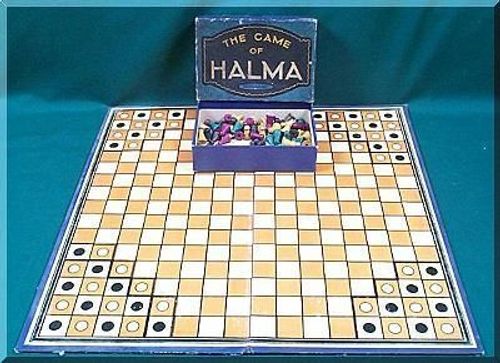
Halma
Halma Rulebook
Table of Contents
Table of Contents
Board
The square game-board is divided into a suitable number of light and dark checks or squares, alternately arranged, and in the present instance two hundred and fifty-sixty in number, or sixteen squares, ranging longitudinally and transversely and also along the longest diagonals of the square. (The printed figure reads "two hundred and fifty-sixty" as in the patent; the same sentence gives the board as sixteen squares.)
At two or more opposite corners of the board a certain number of the small squares or checks have an indicated separation from the other checks toward the middle of the board. This indication may be made as by the heavy black lines, the space within which lines being considered as yards. To increase the capacity of more or less of such yards, still further outwardly-extended lines may be employed, so that with the use of one board for different phases of the game the yards may either be considered to embrace a smaller number of checks, as thirteen, separated by the inner lines, or the greater number of checks, as nineteen, separated by the outermost lines.
The area and boundary of the yards may be indicated in other ways than by the separating lines. For instance, the yard-checks may be formed by tints easily distinguishable from those of the checks outside of the yard.
Pieces
Sets of men or movable pieces are to be provided, the sets to be of different colors or the men thereof of different forms, or having other distinguishing features.
Setting Up
Placing the board so that a nineteen-square yard is at one side of each player, one player fills his yard with nineteen black pieces and the other his yard with nineteen white pieces.
Object of the Game
By alternate moves each player endeavors to get his pieces out of his own inclosure and pack them in the other. Whichever packs his pieces first wins the game. It requires from sixty to eighty moves on each side to accomplish it.
Permitted Moves
The permitted moves are only two:
- First, a step. A piece is moved into either of the eight adjoining squares, provided it be empty.
- Second, a hop. A piece jumps over a piece of either color, standing in either adjoining square, into an empty square. It repeats the jump with the same piece, as part of one and the same move, in any direction, as often as the disposition of the pieces renders it possible and advantageous.
It must be observed that a hop cannot carry a piece an odd number of squares. Each hop must move it two squares, and hence to a square corresponding in tint with the one from which it started. This test will detect the error when a player has inadvertently taken a false jump.
Phases of Play
The game of halma naturally divides itself into three parts.
First: the Gambit
The "gambit" is the first part, by which the pieces are got out of the yard. It is of course important to get the nineteen pieces out as soon as possible and run them as rapidly as possible in a diagonal direction across the board. Care should be taken not to allow laggards to be separated by too great an interval from the main body, nor to allow the advance scouts to block the way. The most rapid progress is made when the pieces are so scattered that a little foresight will provide "ladders," down which long hops can be made, sometimes advancing a piece ten or twelve squares at one move.
These ladders should of course be constructed to help yourself and not your adversary, who is on the lookout to avail himself of your ladders when he can, just as you try to avail yourself of his.
Second: the Melee
The "melee" begins earlier or later, according to the gambit adopted by the two players, when the thirty-eight pieces, meeting near the center of the board, struggle to get past each other. Sometimes the crowd is so compact that the easiest way to get by is to go round. Arrange, whenever possible, whether in the gambit or in the fight, the ladders in such manner that a number of pieces can easily be brought down the same ladder.
Third: the Packing
The "packing" of the pieces is the third part. This must be kept in view, indeed, from a very early period in the melee. It is in this part that the caution not to allow the scouts to block the way is particularly needed. The moment you have entered a piece within the opposite yard you should begin to make, by "steps," if necessary, that inclosure a honeycomb of ladders into which you can run the rest of the pieces. A few steps with the first pieces that enter will often save double the number on the last who come in. Remember, also, in this packing the importance of arranging each ladder to accommodate as many pieces as possible.
Four Players and Partner Play
In the game by four players each has but thirteen pieces and the smaller yards are used. Each person may play for himself, substantially as described for two players.
The opposite players may play as partners. It then being the desire of the playing partners to exchange places as rapidly as possible, hence aiding each other. Or, the adjacent players at each side of the board may play as partners.
It is of course understood that all the time during the game the pieces are to be retained on the board, jumping being to facilitate progress only.
Claim
The herein-described gaming set, combining with two or more sets of several men each, each set of different colors, a player's board having its surface divided into squares and having a group of several of said squares in two or more opposite corners of said board, having an indicated separation from the other squares thereon, substantially as set forth.