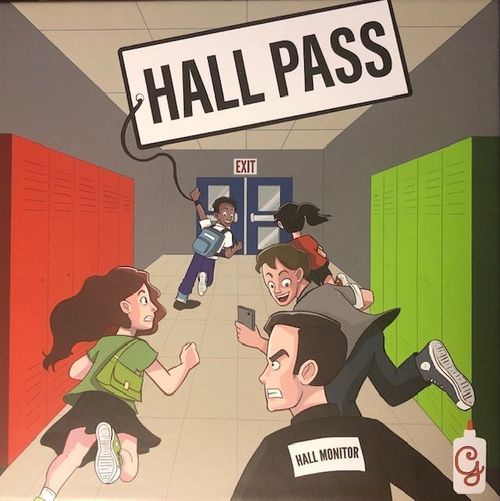
Hall Pass
Hall Pass Rulebook
Table of Contents
Table of Contents
Object of the Game
Be the first to escape from school! The game ends and the winner is declared when one player successfully moves all of their game pieces to their getaway car.
Setup
Each player chooses a side/color and lines up their 7 pieces in the matching boxes on their side of the board. These boxes are your home classrooms. Pieces can be arranged in any order to start the game. Do not reveal the numbers on the bottom of your pieces to other players.
Scoring
The only way to escape to your getaway car is through any classroom other than your own. Note that in order to escape you must move at least 1 space past any opponent's classroom. Once a piece has escaped, it is placed on the corner of the board by its matching getaway car and is not to be brought back into play.
Start of the Game
Whoever has gone the longest without telling a lie goes first. Or whoever wants to go first can go. Or flip a coin. Turns move clockwise around the board.
On Your Turn
You have 2 options. Pick 1.
- Move any one of your pieces that is not in detention in any direction in a straight line (forward, backward, left, right) as many spaces as you want.
- Release a piece that is currently in detention back into any of your open home classroom spaces.
Rules of Moving
- You are allowed to move any number of spaces in a straight line. If another piece is in the hallway and in your path, your piece knocks the opponent's piece to their detention and your piece STOPS in that same space.
- You are not allowed to knock out or pass through any piece that is currently sitting in its own classroom. Pieces in this position block other players from escaping school through that exit.
Hall Pass
The number on the bottom of each game piece is its "Hall Pass", which dictates how many spaces that piece can "legally" move on any given turn. Moving a different number of spaces (higher or lower) from what the Hall Pass indicates is allowed as long as you don't get caught!
Example 1: If the piece's Hall Pass is a '5' and no other piece is in your path, then the only legal move is 5 spaces. Moving 1, 2, 3, 4, 6, or 7 spaces is risky.
Example 2: If the piece's Hall Pass is a '5' and there is another piece directly in your path and 3 spaces away, then only a move of 3 to knock out and replace the other piece is legal. Moving more spaces is not allowed because you must STOP on the space of the piece you knock out. Moving fewer than 3 spaces is allowed but is risky.
Calling to See a Hall Pass
After any move, any player can choose to call to see their competitor's Hall Pass if they suspect a bluff was made. The caller may do so by politely asking to see the Hall Pass or something a bit less P.C. Just make it clear that you think your competitor is full of 'it'. Once a call is made, the caller may pick up the piece and look at the Hall Pass or the player who was called can show it.
If the Hall Pass is Valid
(the player called into question made a legal move), then:
- The move stands.
- The player who was questioned gets to send any 1 of the caller's pieces (except any that have already escaped school) into detention for being a tattle-tale. Any piece sent to detention for being a tattle-tale must stay in detention through the player's next turn even if it means they do not have a move, in which case their turn is skipped. Pieces sent to detention for any other reason do not have to wait a turn to be used.
If the Hall Pass is Invalid
(the player called into question made an illegal move), then:
- The piece that moved illegally is sent to detention.
- If any piece was knocked to detention it returns to its space in the hallway.
- As a reward for being an excellent hall monitor, the caller can move any of their own pieces from anywhere (including from detention) into ANY open space in the hallway without using a turn.
Once the next player has taken their turn, the previous move stands even if they are later discovered to have bluffed.
Modifications for a 3 Player Game
Setup
Each player picks a side and color as usual. The pieces of the unclaimed side/color (the ghost player) are all placed in their detention to start the game.
Gameplay
You are still allowed to escape out any side except your own. Turns rotate around the board as usual, skipping the ghost player.
Each player has the option to use their turn to move a ghost player's piece instead of their own. However, this option is limited solely to releasing a ghost piece from detention into the ghost player's home classroom. Once a ghost piece is moved to its classroom space it must remain in that space for the rest of the game.
Modifications for a 2 Player Game
Setup
Players select sides/colors as usual. (Opposite sides are suggested but using adjacent sides can also be done.) The pieces of the two sides not being used begin the game in detention.
Gameplay
The gameplay rules are the same as the 3 player rules described above except there are two ghost players.
Gameplay FAQs
Can I check the numbers of my own pieces at any time during the game?
Yes of course. If you can remember where all your pieces are for the whole game then you are probably too smart for this game.
Can I move within my own classroom to try to block another player from escaping?
Yes, but the same rules apply as regular moves. If the space you intend to block is 3 spaces away then you need to have a Hall Pass of exactly '3' in order to do so, or you need to bluff.
So if I make it into another player's classroom then I've escaped?
No. You need to move at least one space past the classroom to escape school. So if the classroom is 3 spaces away then you need a piece of 4, 5, 6 or 7 to be able to escape (legally). It is okay to land in the classroom of another player but beware that you can be knocked out as if you were in the hallway. An opponent may move within their classroom to knock you out but may not knock you out by releasing a piece from detention.
What happens if an opponent inadvertently (or advertently) exposes, knocks over, or looks at your piece's Hall Pass?
Shame on them! That's dirty play. You should be well aware that the only time an opponent can look at your Hall Pass is when they have made an official call to see it. The first time a player does this a warning is given, followed by losing their turn each time after. If this happens to you, you have the right to swap that piece with any of your other pieces, including any that have already escaped from school. If this happens immediately after your move and you were bluffing, your opponents can't call you on it. If you accidentally expose your own piece, that's on you.
The rules say pieces sent to detention for being a tattle-tale must remain in detention through my next turn, but how do I remember that?
Up to you. One method is to leave that piece in the grass next to your detention when it is first sent there, and then move it into detention after your next turn so you know it is available to be put back into play.
If I have multiple pieces in detention can I mix them up or shuffle them around?
Yes, and you should. A savvy opponent might remember they just caught your '3' piece and know where you placed it.
If someone correctly calls my bluff, do I have to show the Hall Pass or can I just move the piece to detention?
You do not have to show it, but the opponent who calls you out has the right to pick it up and look at it if you haven't yet moved it to detention. So you better grab it before they do.
Is there a time limit to make my move?
Officially, no. But players who take too long suck the fun out of the game. Feel free to make passive aggressive remarks or be downright rude to someone who is taking too long.
Are we allowed to coach each other?
Definitely! Table talk is encouraged. Feel free to give advice or collude together against the person in the lead so you can catch up. Just don't be surprised when your ally abruptly changes course and betrays you.