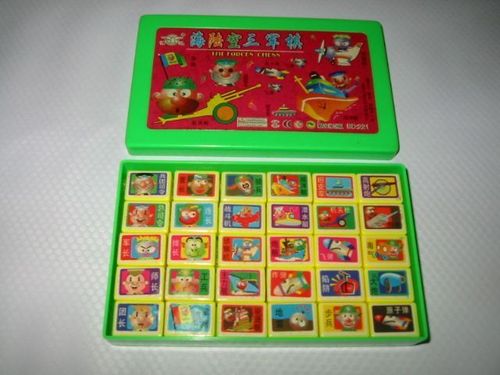
Hai Lu Kong Zhan Qi
Hai Lu Kong Zhan Qi Rulebook
Table of Contents
Table of Contents
Pieces
The land and naval pieces in power order (1 is the best):
| Rank | Land Force | Count | Naval Force | Count |
|---|---|---|---|---|
| 1 | Commander-in-Chief | 1 | ||
| 2 | Army Group Commander | 1 | ||
| 3 | Division Commander | 2 | Battleship | 2 |
| 4 | Brigade Commander | 2 | Cruiser | 2 |
| 5 | Regiment Commander | 2 | Gunboat | 2 |
Suitable alternate translations of the ranks may be: 1. Marshal, 2. General, 3. Colonel, 4. Major, 5. Captain, 6. Lieutenant, 7. 2nd Lieutenant, 8. Sergeant.
The weapon pieces in the game:
| Weapon | Count |
|---|---|
| Fighter Plane | 1 |
| Recon Plane | 1 |
| Anti-aircraft Gun | 2 |
| Artillery | 2 |
| Missile | 2 |
| Landmine | 2 |
| Flag | 1 |
Map
Translation of the indications on the game board.
- Running crosswise down the middle of the board: "Political Boundary/Territory Line."
- In the 4 corners of the board with an aircraft symbol: "Airport".
- At the long board edges, 4 red semi-circles: "Army Post". The board long edge "Army Posts" are apparently not used.
- On each end of the board, 8 red semi-circles: "Army Post".
- On each end of the board, 4 red semi-circles: "Cannon Placement".
- On each end of the board, 2 red semi-circles: "Navy Placement".
- On each end of the board, 2 red semi-circles in green circles: "Port".
- On one end of the board, "Product of the Flying Horse Factory."
Translation of the Rules
This is a translation of the rules provided on the game board.
Navies rest on green circles and travel on the yellow lines which connect them.
Armies rest on yellow circles and travel on single red lines.
Each turn you move a distance from one circle to an adjacent circle. The physical length of the rendered line is not important for this rule.
The black dots are stopping points for aircraft. They travel on black dotted lines. Aircraft may fly any distance in a turn so long as they only travel on only the same line. They may fly back and forth on this line.
Double red lines may be used by navies to come onto land. Once navies are on land they may enter the city and capture the enemy flag. Navies may fight on yellow circles.
Cannons and battleships may attack over red arrows.
The flag may be placed in any red semi-circle.
Armies and navies are placed on semi-circles at the start of the game.
The black dashed lines are railways. An army using the railway may move 1 or 2 spaces, but cannot overtake any pawns in front of them.
The red dashed lines are high speed air routes reserved solely for planes retreating after attacking the enemy.
If there is no artillery or battleship in the area, planes may use these lines to retreat even without attacking.
Additional Rules
The translation's notes on the rules above. Some are derived from Kevin Lee, a frequent player of the game, and some from inference.
The wooden pieces are thick and instead of being displayed so that the opponent can see them, are placed on edge and only revealed when in battle or when overflown by the Recon Plane.
Player turns alternate from player to player and each player may only move one piece on his turn.
Artillery may move using red lines.
Normally, pieces are taken as in chess with the attacking piece moving to the space occupied by another piece and if it has a higher rank, defeating it and removing it from the game. If it has a lower rank, the attacking piece is removed. Ties are resolved by having the piece which attacks defeat the other.
The Gunboat can attack armies which are on the rail bridge (the small connecting area between two rail lines), having the rank equivalent of a Regiment Commander. The Battleship and Cruiser are not allowed to attack armies on the rail bridge.
The Battleship and the Cruiser (and not any other naval units) may use a port to land on the enemy's shore and use the double red lines to advance. They may try to fight, in this way, enemy armies and take the flag. If a Battleship or Cruiser lands, it may use rail movement as well.
The Flag must be set up in the city (the extreme end of the board) on one of the three red semi-circles there. The other two semi-circles are available for army placements.
The Flag and the Landmine may never move.
When an army runs into a Landmine, both the army and the Landmine are destroyed and removed from the game.
The Fighter Plane can destroy a Landmine without being itself destroyed.
In the air, the Fighter Plane is more powerful than the Recon Plane. Should Fighter Plane meet Fighter Plane, the one which attacks wins. Should Recon Plane meet Recon Plane, neither one is destroyed and both must move out of the space.
The Fighter Plane may attack a land or sea piece which is on the black line on which it is flying.
The long red lines at the edge of the board are for special use of planes if they need to return to their home board side in a hurry. In one move the plane which can reach the red line travels all the way back to the connected airport.
The board long edge "Army Posts" are apparently not used.
Missiles may move in the same way as other army pieces on red lines or one space along a black line. They may not move into the airport or onto the flag.
When a missile strikes or is struck, it too is removed from the game. Missiles may attack planes.
Artillery and Battleships may attack over red arrows. This remote firing, if it works, harms the defender only.
Rewritten Rules
The translation's rewritten version of the rules above.
Set-up
The wooden pieces are thick and instead of being displayed so that the opponent can see them, are placed on edge and only revealed when in battle or when overflown by the Recon Plane.
The Flag must be set up in the city (the extreme end of the board) on one of the three red semi-circles there. The other two semi-circles are available for army placements.
Armies and weapons are placed on yellow circles containing red semi-circles on the player's half of the board.
Navies are placed on green circles containing red semi-circles on the player's half of the board.
Sequence of Play
Players alternate turns. A turn consists of moving one piece and possible combat resolution created thereby.
Movement
Armies rest on yellow circles and travel on single red lines. They move from circle to adjacent circle. The physical length of the rendered line is not important for this rule.
The black dashed lines are railways. An army using the railway may move 1 or 2 spaces, but cannot overtake any pawns in front of them.
Artillery may move using red lines.
Navies rest on green circles and travel on the yellow lines which connect them. They move from circle to adjacent circle. The physical length of the rendered line is not important for this rule.
The Battleship and the Cruiser (and not any other naval units) may use a port to land on the enemy's shore and use the double red lines to advance. Such navies may fight on yellow circles, enemy armies and even take the flag.
If a Battleship or Cruiser lands, it may use rail movement as well.
The black dots are stopping points for aircraft. They travel on black dotted lines. Aircraft may fly any distance in a turn so long as they only travel on only the same line. They may fly back and forth on this line.
The red dashed lines are high speed air routes reserved solely for planes retreating after attacking the enemy. In one move the plane which can reach the red line travels all the way back to the connected airport.
If there is no artillery or battleship in the area, planes may use these lines to retreat even without attacking.
Missiles may move in the same way as other army pieces on red lines or one space along a black line. They may not move into the airport or onto the flag.
The Flag and the Landmine may never move.
Combat
Normally, pieces are taken as in chess with the attacking piece moving to the space occupied by another piece and if it has a higher rank, defeating it and removing it from the game. If it has a lower rank, the attacking piece is removed. Ties are resolved by having the piece which attacks defeat the other.
The Gunboat can attack armies which are on the rail bridge (the small connecting area between two rail lines), having the rank equivalent of a Regiment Commander. The Battleship and Cruiser are not allowed to attack armies on the rail bridge.
Artillery and Battleships may attack over red arrows. This remote firing, if it works, harms the defender only.
When an army runs into a Landmine, both the army and the Landmine are destroyed and removed from the game.
The Fighter Plane can destroy a Landmine without being itself destroyed.
In the air, the Fighter Plane is more powerful than the Recon Plane. Should Fighter Plane meet Fighter Plane, the one which attacks wins. Should Recon Plane meet Recon Plane, neither one is destroyed and both must move out of the space.
The Fighter Plane may attack a land or sea piece which is on the black line on which it is flying.
When a missile strikes or is struck, it too is removed from the game. Missiles may attack planes.
Winning the Game
The winner is the player who first captures the other's flag.