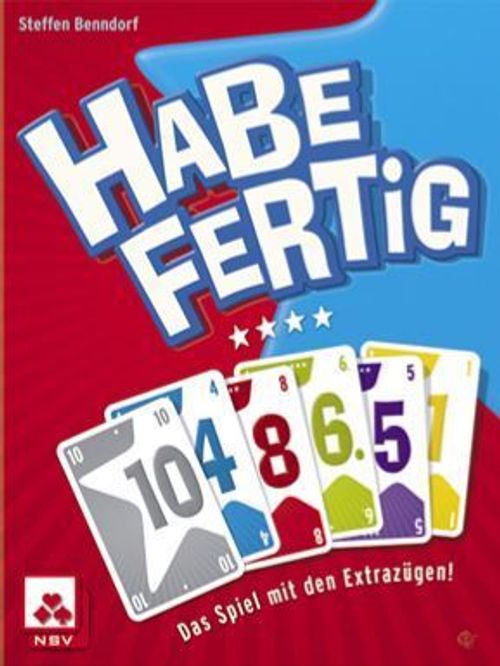
Habe Fertig
Habe Fertig Rulebook
Table of Contents
Table of Contents
Getting started
Shuffle the cards. Each player receives 12 cards. Improve your chances: Each player chooses any 2 of his 12 cards and lays them face down next to him (= hidden cards). The cards stay face down and cannot be looked at until the end of the round. Players hold on to the remaining 10 cards, which make up their hands. From the remaining undealt cards, lay two of them face up next to each other with approximately 15 cm space between them. These two cards make up the two open discard piles. The last cards are put into a draw pile laid face down between the two open discard piles.
Through the course of the game, players discard their cards on one of the two open discard piles, and never anywhere else.
Layout: discard pile – draw pile – discard pile.
Order of play
The player to the left of the dealer begins, with play continuing in turns in a clockwise direction. On your turn, if you want to, you can play one card on one of the open discard piles. When you play a card, you can choose either option A or B.
► If you can't or don't want to play a card, say "pass". You then have to pick up the top card from the draw pile and add it to your hand. Your turn is over and you can't discard any cards. The next player now takes his turn.
A) Play a card in the gap
Play a colour that does not match either of the open discard piles. Also, it must lie in the "gap"; that is to say, the number must lie between the two numbers of the two open discard piles. Lay the card on either of the two open discard piles and call out: "gap!"
By playing a card in the gap (important: the colour can't match either of the two open discard piles), you immediately get another turn. With your new turn, you have to play another card according to option A or B (or pass and pick up a card from the draw pile).
Example: The two open discard piles show a red 4 and blue 9. A card has to be played that is neither red nor blue and that is a 5, 6, 7 or 8. Ben plays a yellow 6 in the gap and gets to take another turn.
Note: If possible, you can continue to play cards in each new gap (created by the card that you've just played), card after card, each time extending your turn.
B) Play a card of the same colour or same number
Play a card that has either the same colour or same number as one of the open discard piles, laying it on the discard pile that it matches.
Example: Any yellow card, or any 6 card can be played on the yellow 6 discard pile. Any blue card, or any 9 card can be played on the blue 9 discard pile. Ben plays colour on colour (blue on blue). Then his turn is over.
Note: The 8 card lies between the 6 and 9, but to get another turn (according to option A), the colour has to be different from both of the open discard piles.
Note: If you play colour on colour, or number on number, you don't get an extra turn. Your turn is over and the player to your left starts his turn.
No gap
If there is no gap when you start your turn (the same applies at the start of a round), you have to turn over the top card of the draw pile and lay it face up on either one of the two open discard piles (this is good for you, since it increases your chances of getting a big gap). You then begin your turn as you normally would and play a card according to option A or B (or pass and pick up a card from the draw pile).
Note: If there still isn't a gap after turning over and playing a card from the draw pile, take your turn as you normally would, even though there is no gap. You have to play either colour on colour, or number on number (or pass, drawing a card from the draw pile).
Example: Linus has just finished his turn and now it's Emma's turn. The open discard piles show a 5 and a 4: no gap. Emma turns over the top card from the draw pile and lays it on one of the two open discard piles of her choice. She then continues her turn as normal.
Play then continues with each player taking turns in a clockwise direction. If the draw pile runs out during a round, leave only the top card from each open discard pile where it is and shuffle the rest to form a new draw pile.
Another example: Anne takes advantage of the big gap (grey 10, red 3) and first plays the blue 7 in the gap. She immediately gets another turn. Now she plays the grey 4 in the new gap and gets yet another turn. Now she plays the red 6 in the gap and gets to play again. Then she plays colour on colour (red on red). Now it's the next player's turn. Anne only left him with a very small gap (2–4). A perfect turn!
End of a round & the game
A round is over as soon as someone lays his last card on one of the open discard piles. This player (and only this player!) receives plus points! He turns over both his hidden cards that he chose and laid face down at the beginning of the game. Each star counts as a plus point.
Example: Linus ends the round. He turns over both his hidden cards that he chose and laid face down at the beginning of the game. Both cards have a total of 6 stars, which he notes down as plus points.
The other players receive minus points for each card that they still have in their hands according to the total number of stars (no plus or minus points are awarded for their hidden cards).
Example: Anne still has four cards in her hand with a total of 7 stars. She must record 7 minus points.
All plus and minus points are recorded. After adding up and recording all the points, the player to the left of the last dealer is the new dealer; he shuffles all the cards and gives each player 12 cards each. Now the next round can begin. The game preparation and the order of play stay the same as before.
4 rounds are played for a two- or four-player game, and 3 rounds for a three-player game. Whoever has the best score (after adding up both plus and minus points) at the end of the game wins.