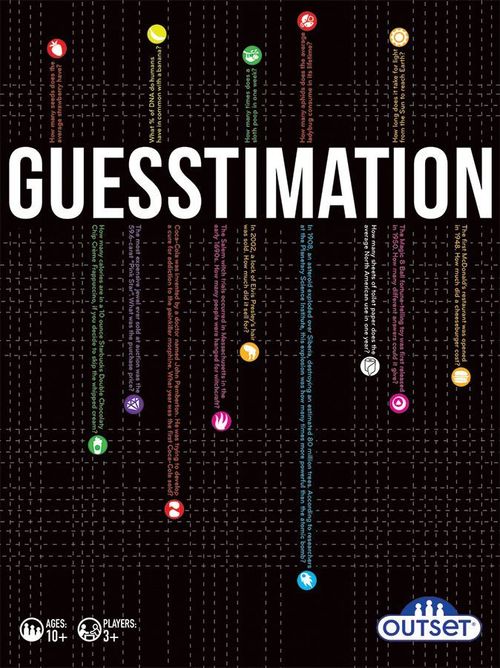
Guesstimation
Guesstimation Rulebook
Table of Contents
Table of Contents
Game Contents
- 300 cards (1,800 amazing questions)
- 1 Game Board
- 6 Pencils
- 1 Answer Pad
- 6 Playing Pieces
- 1 Dueling Chip
- 1 Die
Set Up
- Set up the board by placing the Card Box and Dueling Chip on the marked locations on the board.
- Provide each player with a pencil, colored playing piece and sheet from the answer pad.
- Place all playing pieces on the "Start" position.
Playing the Game
- Each card has six questions on the front with answers on the back. One card is used per round. Take a card from the box and pass it around to familiarize the group with the format.
- To start, each player rolls the die to determine the first Round Leader of the game (highest roll wins). The Round Leader is the person who reads the question for that round. Each person takes turn as the Round Leader, moving in a clockwise direction.
- The Round Leader then rolls the die to determine which question they will read. Next, they draw a card and read the corresponding question being careful to guard the answers on the back. For example, if the Round Leader rolls a five, they will read question five on the card. "Duel" questions are highlighted in green, see "DUELS" below for more information.
- Once the question has been read, each player including the Round Leader, secretly records their guess on their own answer sheet.
- Next, each player verbalizes their written guess, starting with the player to the left of the Round Leader, moving in a clockwise direction.
- The Round Leader then reads the answer on the back of the card and the group determines which player has the closest guess. (NOTE: It does not matter if the closest guess is higher or lower than the actual answer.)
- Once the winner has been determined, that player moves ahead according to the Scoring Rules (see page 3). In the event of a tie, both players move ahead.
Duels
One-on-One Duel
Guesstimation includes a Dueling Chip, which is used to initiate a One-on-One duel. This duel is designed to add an element of risk and reward to game play. The player who has earned the chip has an opportunity to gain extra spaces on the board by challenging another player to a duel.
Gaining Possession of the Dueling Chip
Each card has two types of questions – chip possession and standard. Chip possession questions are highlighted in green. Non-highlighted questions are standard.
The Dueling Chip is up for grabs every time a chip possession question is selected. Simply put, win a round on a question highlighted in green and you win the Dueling Chip. There is at least one chip possession question on every card, which is always question 4. Therefore, any time a 4 is rolled the Dueling Chip is up for grabs. However, there are a few cards that have as many as three chip possession questions. It is the Round Leaders' responsibility to inform the group when a chip possession question has been selected.
When can the Dueling Chip be used?
Once a player has won the Dueling Chip, they can use it on any standard question. However, if another chip possession question is rolled before the player uses the Dueling Chip, they will have to win the round to keep it. This rule applies even if you won the Dueling Chip on the previous round and did not have the opportunity to use it. That is just the luck of the die!
How to use the Dueling Chip: How much of a risk-taker are you?
The player in possession of the Dueling Chip (a.k.a. the Dueler) can declare a duel at any time after a standard question has been read. Once a duel has been declared, that player decides who they are going to challenge. The challenged player must accept.
Next, the Dueler determines the amount of risk/reward attached to the duel by announcing a wager that is between 1 and 3 spaces. The winner of the round moves ahead the amount of the wager, while the loser moves back the same amount. A wager cannot be changed once it has been announced. If the Dueler forgets to make the wager, it automatically defaults to 2 spaces. (Example: If the wager is 3, the winner would advance 3 spaces, while the loser moves back 3 spaces. As you can see, strategic use of the Dueling Chip can often help win the game or bring a player back to the pack.)
During a Duel, only the guesses of the two competing players count for the round. However, the remaining players also record a guess and if their answer is identical to the real answer (including decimal), they move ahead 3 spaces. In the rare event of a tie during a duel, the highest roll of the die wins. A player who loses a duel cannot go back any further than the "Start" position. Once a Duel has taken place, the chip is returned to the storage spot on the game board.
Scoring Rules
- The winner of a standard round moves ahead 2 spaces.
- The winner of a One-on-One Duel moves ahead the amount of the wager (1-3 spaces).
- The loser of a One-on-One Duel moves back the amount of the wager (1-3 spaces).
- A player who guesses the exact answer (including decimal) moves ahead 1 extra space. This also applies to the winner of a duel.
Winning the Game
The first person to land on the Finish space is crowned the Guesstimation champion. In the event that more than one player crosses the finish line on the same round, the tied players answer one final question and the winner of that question wins the game.
Other
Units of Measurement
Questions requiring units of measurement are written in both U.S. and Metric terms. For example: In feet (meters), how tall is Mount Everest? To avoid confusion, it's important that all players write their answer in the same unit of measurement. Therefore, it is necessary for the group to choose the unit of measurement before any guesses are written.
Ties
In the event of a tie each player moves ahead accordingly. Ties can occur when the closest guesses are identical OR they are an equal distance from the actual answer. For example, if the actual answer is 5, and one player guesses 4 and the other 6, this will result in a tie, as both players are an equal distance from the actual answer.
Note
Guesstimation is for entertainment purposes only. North America refers to the U.S. and Canada only. Money related questions are in U.S. currency. Unless otherwise specified, all answers are written using the latest data available at the time of research.