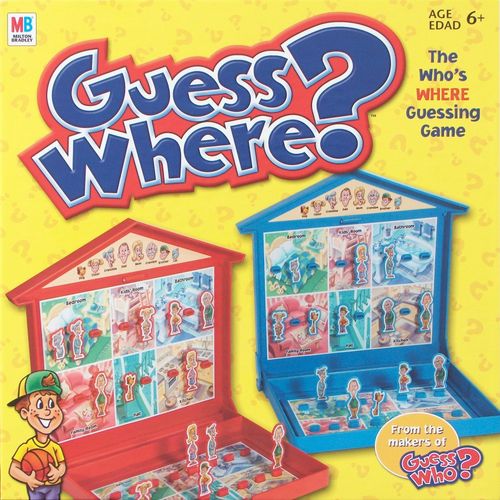
Guess Where?
Guess Where? Rulebook
Table of Contents
Table of Contents
Object
Guess where your opponent's family members are, before your opponent guesses where yours are.
Contents
- 2 Fold-up plastic houses
- 32 Family member pieces (16 red, 16 blue)
- Label sheets
The First Time You Play
Remove the game parts from their plastic bags, and discard the bags.
Label the houses: Each house has a Guess Where? label, a family label, a large top label (label B) and a smaller bottom label (label A). The labels are the same for each house.
For each house, carefully apply the labels as shown in Figure 1.
Figure 1: Carefully apply the 4 labels to each house as shown. The figure shows the back of the house with the Guess Where? label on the roof, and the front of the house with the family label above the top board, label B on the upper panel and label A on the bottom board.
Get Ready
Figure 2 shows a house set up and ready to play. Refer to it as you set up your game.
The family members: The 8 family members in each house are the two grandparents, the two parents, a sister and brother, a dog and a cat.
There are two of each family member: one with a peg, which you'll use for hiding the family member on the top board; and one with a tab on the bottom, which you'll use to track your guesses on the bottom board.
-
Choose a house and all 16 of the matching-color family members. Place the house in front of you in the open position. Your opponent does the same. Sit facing your opponent, so that neither one of you can peek inside the other's house.
-
Decide how many family members you'll use in your game. (You may want to start with only four or five, and work your way up to the ultimate challenge of using all 8.) When using less than all 8 family members, also decide which ones you'll use; both players must use the same family members. Place any unused family members in the tray.
-
Now you and your opponent each take your pegged family members, and hide them on your top board by fitting the pegs in the holes. Some rooms may have two or three family members (as long as there's a hole for each one); other rooms may have none.
-
Place your tabbed family members beside your house. Your opponent does the same with his or hers.
Figure 2: You and your opponent are each hiding all 8 family members. Here's how you set up your house. The figure labels the tray (for your unused family members), your tabbed family members, and your hidden pegged family members, and shows the Mom with peg and the Mom with tab.
How To Play
The younger player goes first. You and your opponent then take turns asking questions.
On Your Turn
Ask your opponent any "yes" or "no" question about where his or her family members are. Your questions can be general or specific; they can be about one or more family members, and about specific rooms or entire floors (upstairs in the bedroom, the kids' room or the bathroom, or downstairs in the family room, the hall or the kitchen). Here are some examples:
-
"Are there any pets downstairs?"
-
"Is either one of the kids in the family room?"
-
"Is Mom upstairs?"
-
"Is there a guy in the bedroom?"
-
"Is the cat in the hall?"
-
If the answer to your question is "yes," then you get to ask another question! Keep asking questions until you get a "no" answer.
-
If the answer is "no," then your turn is over, and your opponent now gets to ask a question.
Tracking your guesses: While you're getting clues as to where your opponent's family members are or aren't hiding, fit the tabbed family members in the groove on your bottom board. Place them in the side groove, the top or bottom groove, between rooms—whatever works best for you! Figures 3 and 4 show examples of tracking your guesses.
Once you discover exactly where a family member is, fit its tab into the hole in that room, as shown in Figure 5.
Figure 3: "Are both kids in the same room downstairs?" "Yes." You place the kids together in a side groove downstairs.
Figure 4: "Are the kids in the family room?" "No." You place the kids between the other two downstairs rooms, the hall and the kitchen. You're getting closer!
Figure 5: "Are the kids in the hall?" "No." Now you know they're in the kitchen (probably getting a snack)! Fit each kid into a kitchen hole.
How to Win
Keep taking turns asking questions and placing family members along the groove and in rooms, until you know (or think you know) where everyone is. After getting a "yes" answer, you may make a final guess as to where everyone is. If you're right, you win! If you're wrong, you lose and your opponent automatically wins.
You can add some fun to the game by describing what each family member is doing. For example:
- "Mom's giving the dog a bath."
- "Dad's in the kitchen cooking dinner (uh-oh!)"
- "Grandma and Grandpa just stopped by. They're taking their coats off in the hall."
Games for Younger Players
Here are some ways you can vary the game rules for younger players or beginners:
- Use only the upstairs or the downstairs.
- Vary the number of family members. For example, if an adult is playing with a young child, the adult may have to find all 8 family members, while the child only needs to find three or four.
Storing Your Game
When you're done playing, store the family members loosely in the bottom board of their houses, then snap the houses shut and place them (with these rules, of course) back in the box.