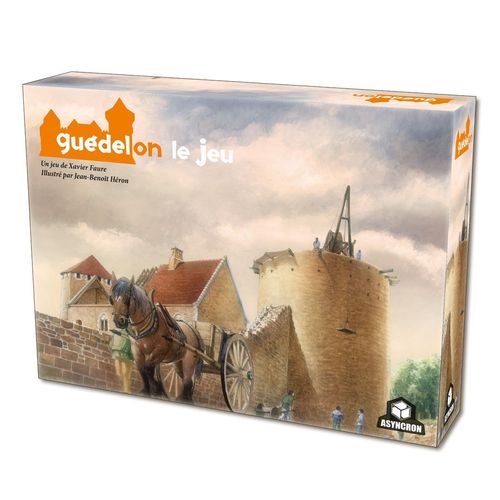
Guédelon: Le Jeu
Guédelon: Le Jeu Rulebook
Table of Contents
Table of Contents
Contents
- 1 game board
- 4 individual player boards
- 1 course of the apprentice tile
- 22 floor tiles
- 27 material tokens (9 wood, 9 stone, 9 clay)
- 5 rope tokens
- 6 mortar tokens
- 1 time counter piece
- 45 event cards
- 5 Cart tiles (to assemble as a cart)
- 9 wooden Visitor pawns
- 4 wooden Worker pawns
- 8 slider pegs
- 1 canvas bag
- 1 rulebook
0 Setting Up
Numbers refer to the illustration in the French rulebook.
- Place the game board in the centre of the table.
- Place the Time counter token on its starting location. The number on each space indicates the current year, counted as if you were in the 13th century!
- Place 9 Wood tokens in the Forest (reserve).
- Place the 6 Mortar tokens and 5 Rope tokens next to the board (reserve).
- Place the Cart figurine in the Stables (9).
- Place the 9 Visitor pawns in the bag and place the bag next to the board.
- Place the 9 Clay tokens near the Clay pit (reserve).
- Place the 9 Stone tokens side near the Quarry (reserve).
- Each player takes a player board, two slider pegs and the Worker pawn of their colour and symbol. See example to the right with the green player.
- Each player places their Worker pawn in the Castle courtyard location.
- For the first game, select the Event cards numbered 1 to 18. Shuffle these cards face down to form the event deck and place it on the game board.
- Place the (orange) Floor tiles to cover the castle buildings as shown, starting from number 0 at each.
1 Purpose of the Game
Players must complete the construction of the castle of Guédelon before the 18th round (year 1245) to win the game. Before beginning, designate a First Player (e.g. the one who visited Guédelon - or failing that, another castle - most recently). This player will remain the first player throughout the game.
2 Materials
The building materials are presented as two-sided material tokens that have different illustrations and shapes.
- The Front represents the raw material: stone from the quarry, freshly cut wood from the forest, or clay extracted from the clay pit.
- The Back is the finished product: cut stones, wood beams and tiles.
The materials can be transported in either the workers own wheelbarrows or in the cart. It is possible to drop them off in any location.
3 Individual Player Boards
Each player has 2 slider pegs on their individual player board to keep track of their experience level and number tools. These start in varying positions depending on the number of players in the game.
Example: In a 4-player game, a slider peg is placed on the "1" level of experience and the other on the level "3" tooling.
Indication of the starting position of the cursor according to the number of players in the game. Symbol and colour of the player. Experience level. Tools Level. Wheelbarrow.
3.1 Experience Level
A player's Experience level determines the maximum number of material tokens (clay, stone or wood) that player will be able to extract or shape (into cut stone, wood beams, or tiles), or to use for constructing the castle during each turn.
The experience level can only grow during the game, thanks to the Master Builder (Master Builder 7.1, page 5).
3.2 Toolbar
A player's tool bar indicates the number of available tools that may increase the efficiency of actions: Each point of tools spent during an action increases the number of material tokens produced, extracted or shaped by this action by 1.
Exception: Tools does not increase the production of ropes nor mortar.
Used tool points can be regained by visiting the Blacksmith (Blacksmith 7.8, page 6) or Pillory (7.3 Pillory, page 5).
Example: Xavier is in the active player and his experience and tools cursors to "3" both. He can extract 3 stones thanks to his experience and possibly 1, 2 or 3 more thanks to his available tools. He decides to spend 2 tools to extract 2 additional stones for a total of 5 and lower his toolbar to level "1".
3.3 The Wheelbarrow
Each worker always has an individual wheelbarrow (shown on the individual player board) which can carry up to 3 material tokens. Loading and / or unloading can be done at any time during a player's turn and as many times as wanted, these are optional and free actions.
4 The Cart
The cart can be used to transport up to 6 material tokens. The Cart figure starts the game at the Stables (7.9 stables, page 6). During turn, a player can take an action to use the cart. This can be done before or after the worker action as a voluntary action.
The player can either:
- load the cart by placing up to 6 material tokens present in the location where the cart is located, or
- unload the cart by placing material tokens present thereon in the location where it is located, or
- move the cart to an adjacent location along a cart path. Nothing blocks the movement of the cart, and the cart does not block the movement of workers or visitors.
The cart can carry up to 6 tokens material of all kinds.
Example: The cart can carry 2 Stones, 2 Wood beams, 1 Mortar, and 1 Rope.
5 Game Round
The game round is divided into 4 phases:
- Advance Time counter piece.
- Draw an Event card.
- Player action turns.
- Move Visitor pawns.
5.1 Advance the Time Counter Piece
At the beginning of each round, the first player advances the Time counter piece one space. If the Time counter piece lands on a space with a bag symbol, the first player draws a Visitor pawn from the bag and places it lying down on the Belvedere (Belvedere 7.2, page 5).
5.2 Draw an Event Card
The first player draws an Event card and announces the effect of the card. The effect is applied, as appropriate, either immediately or for the entire round.
Note: It is possible that a card effect cannot be applied and is thus omitted.
Then the card is discarded, that is to say it is put face up next to the game board to form the Event discard pile.
5.3 Player Actions
Beginning with the First Player and then clockwise, each player takes a mandatory action and any optional actions.
The actions consist of:
-
Move Worker pawn (required). The player removes their Worker pawn from the game board, and then places it on any other location on the game board marked with a symbol (7 Places, page 5).
The player may then either:
- benefit from the effect of the location, if there are no visitor(s) present at the location,
- initiate any visitors at the location.
Moving the worker pawn is mandatory: A Worker cannot stay in the same location as occupied previously.
Exception: A player may not move his Worker pawn to the Master Builder if another player's Worker pawn is already there (7.1 Project Manager, page 5).
-
Use the wheelbarrow (optional). The player can load and unload their cart at both the departure and arrival locations during the movement of their Worker pawn. (3.3 wheelbarrow, page 3).
-
Use the Cart (optional). The player can also, before or after moving their Worker, move, load, or unload the cart. If they decide to move the cart, it can only go to an adjacent location following the paths marked with a symbol wheel (4 cart, page 3).
Exception: A player who is at the Stables can perform multiple actions with the cart (7.9 stables, page 6).
5.4 Visitors Move
When all the players have taken their turns, proceed to the visitor movement, if any Visitors are present (6.3 Displacement of visitors, page 5).
6 Visitors
6.1 Arrival of Visitors
Even if they slow down the construction work, visitors are one of the reasons for the Guédelon project. You need to take care of them by giving them the best information. Visitors of 3 different colours arrive regularly, according to the year and the progress of the construction.
A visitor pawn is drawn from the bag and placed lying down on the Belvedere (Belvedere 7.2, page 5) whenever:
- the Time counter piece lands on a box with a visitor symbol,
- a player puts a Mortar token at the foot of a building.
Several Visitor pawns can arrive in the same turn and may be in the same location.
6.2 Initiate Visitors
Visitors have two states: "Uninitiated" (lying down) and "Initiated" (upright).
When visitors arrive at Guédelon, they are placed at the Belvedere in their "uninitiated" state. Before they can leave the Castle, they must have been initiated by the workers.
To initiate a visitor, it is sufficient for a worker to go to the location of the visitor. The visitor is then initiated by placing it in an upright position. Initiated visitors can leave the castle when they reach the end of their journey. Otherwise they will have to stay at the Castle until a worker comes and initiates them. If several visitors are present in a location where a worker goes, they are all initiated at the same time.
A Worker who goes to a location with visitors may only initiate visitors, workers cannot benefit from the effect of such locations, while there are any visitors present. On the other hand, workers may carry out the cart action and also load and unload a wheelbarrow. This also applies to the Castle: If any visitors are present, we cannot build it, a Worker cannot build!
Note: A player therefore has no interest in going to a place where the only visitors are already initiated. The worker cannot use the effect of the location or initiate any visitors as they are already initiated.
6.3 Displacement of Visitors
At the end of each round, each visitor is moved to the neighbouring location following the route of its colour.
There are 3 routes: Yellow, orange, and red. All three routes end at the Castle. Example to the left: Moving the yellow Visitor this pin to the blacksmith (8) towards the stables (9) able ivant not yellow.
Source note: the example caption is garbled in the translated PDF and is transcribed as printed; the French rulebook's illustration should be consulted.
Initiated visitors (standing pawns) located at the Chateau are placed in the bag again when they need to be moved. Their visit to Guédelon is finished. Uninitiated visitors (pawns lying down) located at the Chateau remains there as long as they are not initiated, thus preventing any construction work!
7 Locations
7.1 Master Builder
This is the only place where there can be only one Worker pawn.
Workers who goes there: moves their slider peg one space to the right on their experience level track.
7.2 The Belvedere
This is the location where visitors start the visit.
When a visitor pawn is drawn from the bag, place it lying down on the Belvedere location.
The Belvedere gives no effect to a worker who goes there. On the other hand, the worker can initiate all visitors who are present there.
7.3 The Pillory
This location is used to entertain visitors.
A worker who goes there:
- moves the slider peg one space to the right on the toolbar, and
- immediately move one Visitor pawn of their choice to the next location on the appropriate route (6 visitors, page 4). An initiated visitor located at the Castle, is returned to the bag.
7.4 Stone Quarry, Forest, Clay Pit
Stone – Wood – Clay
These are used to produce raw materials (stone, wood and clay).
A worker who goes there:
- can produce as many items as indicated by the experience level plus (possibly) all or part of their level of tools; in this case, the tool cursor is adjusted to take into account any points spent (3.2 Rigging, page 3).
The player takes the corresponding number of tokens in the reserve and deposits them with the raw material side visible on the location.
Note: These materials are waiting to be transported to the corresponding workshop (Stone mason, Carpenter or Tilery).
7.5 Workshops: Stonemason, Carpenter, Tilery
Cut stones – Wood beams – Tiles
These locations are used to transform raw materials into finished products (cut stones, wood beams, and tiles).
A worker who goes there:
- can transform as many tokens as indicated by the level of experience plus (possibly) all or part of their level of tools; in this case, the tool cursor is adjusted to take into account any points spent (3.2 Rigging, page 3).
The player turns the number of corresponding tokens present on this location upside down to the finished side (cut stones, wooden beams, or tiles).
Example: Sabine has an experience level of "3", a standard tool of "3" and 2 wood chips on her wheelbarrow. She moves her workman to the Carpenter to do this job. There are already 4 wood chips present. She unloads the 2 wood chips from her wheelbarrow. There are 6 wood chips ready to be processed. She then performs the trade of Carpenter and transforms the 6 Wood tokens into 6 wooden beam tokens (experience level of "3" + level of tools of "3") by turning them upside down. She moves down her tool cursor to the "0" level. She can then load up to 3 wooden beam tokens on her wheelbarrow.
7.6 Mason
The Mason makes the mortar that is essential to begin construction of a building.
A Worker which goes to the Mason can only produce a single mortar token (whatever their level of experience and tools).
Gain a mortar token, and place it at the location or load it onto the wheelbarrow or the cart, if it is present at the mason's location.
A Mortar token is considered to take up one space on a wheelbarrow or the cart. When it is transported to the Castle, it is automatically placed at the foot of a building of the player's choice (7.10 Castle, page 6).
It is mandatory that a Mortar token is placed at the foot of a building before construction of floors starts.
7.7 Ropewalk
Rope is essential for building up high.
A Worker who visits the Ropewalk can only produce a single Rope token (whatever their level of experience and tools).
Gain a Rope token and place it at the location or load it onto the wheelbarrow or the cart, if it is present at the Ropewalk location.
The rope is essential when constructing the castle from floor 1 to floor 4.
A Rope token is considered to take up one space on a wheelbarrow or the cart. When it is transported to the Castle, it is automatically placed on a Rope space near the Thread wheel crane.
Example: Carolina wants to put a building tile on the 3rd floor of the Chapel tower. There are 3 ropes on the Thread wheel crane, thus she can do it. On the other hand, she also wanted to put a building tile on level 4 of the Master tower, but cannot do it because it would take one more rope.
7.8 Blacksmith
The blacksmith manufactures and sharpens the tools.
A worker who goes there:
- set the tools cursor at level "3".
7.9 Stables
A Worker can take 3 actions with the cart instead of one.
Note: this is the only benefit of the stables, but sometimes it is indispensable to be on time.
7.10 The Castle
The Castle is made up of:
- six buildings,
- a courtyard, for storing finished products,
- a thread wheel crane.
Each building has at its base a location to be filled by a mortar token. Each building is composed of 3 to 5 Floor building tiles. On each floor building tile is indicated which finished products and how many are needed for the construction.
A new Visitor pawn is drawn from the bag whenever a mortar token is placed in front of a building.
A Worker who visits the Castle:
- can take as many Finished Product tokens (present in the castle courtyard or in the wheelbarrow) as their experience level plus (possibly) its level of tools and place them on the corresponding spaces of one or more Floor building tiles of their choice. Used tool points are spent as usual.
- it is necessary to place a corresponding type of finished product token on each floor tile starting from floor 0 (the ground floor) and climbing up the floors. In the same building, you must complete a floor before you start putting finished product tokens on a higher floor.
- some floor tiles have a space with a double finished product symbol (C0, D3, E1 and F3). It is up to the players to decide which of the finished products they will use (but it is the active player who has the last word).
- to be able to put finished product tokens on a floor tile, it takes at least as many Rope tokens near the Thread wheel crane as indicated on the floor tile on which one want to build.
- once all spaces on a floor tile are filled, return the finished product tokens to their Reserves and discard the floor tile to reveal the portion of the castle built.
- any Rope token(s) remain on the .
Several buildings can be built simultaneously, but beware of shortage of materials.
Example: A Mortar token was placed at the foot of the building and the ground floor was built (the floor tile A0 was discarded and returned to the game box). Two floors remain to be constructed (Floor tiles A1 and A2). It takes 1 cut stone token present in the court of the Castle and 1 Rope token at the Thread wheel crane to build the first floor. It further takes 1 Tile token present in the court of the Castle and 2 Rope tokens at the Thread wheel crane to build the second floor.
Completion of a building: A building is completed when all the floor tiles that cover this building have been removed.
8 Game End
The players win the game if they manage to construct all the buildings of the Castle before the end of the 18th round (year 1245).
If construction is not completed at the end of the 18th round (year 1245), the part is lost. However, players can continue to see how many extra turns they need complete the construction. They will be able to compare their performances and try to break their own record.
9 Example of a Game Turn
Example of a round of game for a party to three players:
Source note: the numbered steps of this example are garbled in the translated PDF (the text is out of order and partly unreadable). They are transcribed as printed; the French rulebook's illustrated example is the reference.
- Tachometer pawn ahead of box "1234" where there is a symbol "Bag", this which results in to make arrive a pawn Visitor in. This e st dug in the bag, it's a pawn Red visitor. He is sitting lying on the belvedere.
- is an event card drawn. This is the map "Alchemy". Its effect is: "The player who goes to the work of Master places its maximum marker tools (in addition to the experience). "
- The black player, who is the first player moves his pawn on the Master Builder of work, moves its experiment slider one position to the right and, thanks to the map "Alchemy", raises his tooling level to 3.
- Action 4 of the cart: it moves the cart carrying stones from one place 2 until the stonemason.
- The blue player moves his pawn Worker at the Carpenter where are 3 woods. He transforms them into beams by turning over the 3 counters whose side Wood is visible from the Beam side.
- Action 6 of the cart: it unloads the 2 stones at the stonemason.
- The green player moves his pawn ier exercise takes place at the stonemason, discharge 2 stones and transforms his wheelbarrow 4 gemstones found there in 4 stones carved with his experience of 2 + 2 tools.
- What the cart: it loads the 4 cut stones on the cart.
- black Visitor pin is moved following the steps of color, which leads to the career.
10 Difficulty
You can increase the difficulty by replacing 9 of the Event cards numbered 1 - 18 (easy) with a series of 9 Event cards numbered 19 - 27 (intermediate) or 28 - 36 (difficult). You can also replace the series of 9 Event cards with the special Guédelon series 37 - 45.
Source note: only the standard Event cards 1 - 18 are listed in section 13 of this document. The card texts for 19 - 45 are not printed in this rulebook.
11 Solo and Duo Modes
11.1 How the Apprentice Works
When setting up, choose a Worker pawn among the pieces that are not used. This Worker pawn will be the apprentice Worker. Place it on the Belvedere.
The apprentice Worker may advance one or two locations per turn, following one of the colourful visitor trails of your choice. Place a slider peg on the colour the pawn is following to remember the colour of the selected route.
Example left: the apprentice Worker will follow the yellow route.
The Worker apprentice cannot change colour unless it arrives at the Castle location 10. It is moved from there to the Belvedere and will start a new colourful journey at the player's choice at its next action.
The apprentice Worker takes Worker actions in the same way that other Workers do.
The apprentice Worker can meet visitors during its movement. If there is a visitor on the same location, the apprentice Worker can only initiate the visitor, and cannot benefit from the effect of the location. The apprentice Worker can take actions with the cart as well as loading and unloading the wheelbarrow.
11.2 Specifically for Duo Mode
Each player uses a single player board with and the Worker pawn in the corresponding colour.
A third player board is used to manage the apprentice Worker pawn who takes turns after those of the two players (11.1 Operation Apprentice, page 8).
11.3 Specifically for Solo Mode
The player plays with two Worker pawns sharing the same individual player board. The tools, experience and the wheelbarrow are therefore common to the two Worker pawns.
The player decides at every turn, in what order the two Worker pawns takes turns.
A second tray is used to manage the apprentice Worker pawn, who takes turns after those of the player (11.1 Operation Apprentice, page 8).
12 The Mill (Expansion)
The Mill is an additional challenge.
12.1 Content
- 1 Mill tile front and back
- 1 rule leaflet
12.2 Setting Up
Put the Mill tile on the game board covering the mill outline, with the orange side of the Mill tile visible.
12.3 Rules
To build the Mill, players will have to ship two wooden beam tokens and a cut stone token to the mill location and place them on the Mill tile exactly as when constructing a floor of the castle. There is no need for Mortar or Rope.
As soon as the two wooden beam tokens and the cut stone token are placed on the tile:
- Put the three tokens back into their respective reserves,
- Flip the Mill tile, such that the mill side is facing up.
- Draw a new visitor and put him down on the Belvedere.
From now on, visitors will take the path leading to the mill, between the Forest and the Tilery, instead of going directly from one to the other.
13 Card Manifest
Standard Event deck:
- Alchemy. A worker who goes to the Master Builder increases their toolbar to 3 (in addition to the experience gained), or the apprentice increases their experience by 1.
- Souvenir shop. Guédelon the game just arrived in the shop. Morale is at its highest. Each worker increases their toolbar by 2, or the apprentice increases their toolbar to 3.
- Rope maker. The Rope maker replaces worn ropes with new ones. Add a reserve chord token on the Thread wheel crane.
- Spring sweetness. The workers who produce stone or wood this turn produce one more token.
- Flash of Genius. A worker who goes to the Master Builder this turn increases their experience level by 2, or the apprentice increases the experience level by 1.
- Great shape. The last worker in the turn plays twice and also moves the cart 2 times or the apprentice plays twice.
- Trainee. One of the workmen can perform twice the action of the place where he goes, except at the Master Builder. Note: The Cart action can be taken only once.
- My precious. A treasure has been discovered in the clay pit. The first worker who goes to the clay well this turn produces two additional clay tokens.
- Fairy. A good fairy places two material tokens in a production location of your choice (stones in the stone quarry, forest wood, or clay in the clay pit).
- Agile horse. A worker can perform an additional action with the cart before taking their action.