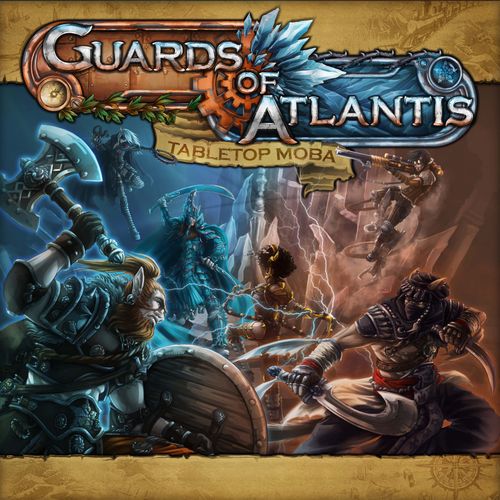
Guards of Atlantis: Tabletop MOBA
Guards of Atlantis: Tabletop MOBA Rulebook
Table of Contents
Table of Contents
Heroes
Wasp leapt through the steam cloud at the witch, electricity trailing behind her, her features both noble and savage. Raising her ceremonial blade, she was about to fall on the elf, when she was abruptly jerked to the side and crashed onto the elvenstone of the Titan fortress.
The mage lowered his hand, exerted by the concentration required to move a fast target. The barbarian was still laughing. – When will you humans ever learn? – he said with a thick accent. – No way you can best an elder race. – His last word trailed off, as he slumped to the ground.
- Forrrtunately the humans arrrent alone, yes? – Tigerclaw whispered behind him, as he took his purse.
Swift, Wasp and Tigerclaw prepared for another push.
Arien the Spellsword
Arien's sword is deadly and his spells let you teleport, slow your enemies and move them around. This versatile hero is a great pick for your very first game.
Brogan the Barbarian
The mighty barbarian has the highest defense value in the game. Mastering his playstyle is not an easy task though, since he has the lowest movement and initiative.
Dodger the Aspiring Witch
Dodger is deadly, but fragile. This is the price for long-range attacks and the ability to destroy multiple minions with a single spell.
Wuk and Hanu the Ape-Men
Wuk and Hanu are a special case. They don't use items and their combined power level is equal to that of a single hero, allowing you to play the game with an odd number of players. If you are an experienced player, controlling both ape-men at the same time can be an interesting challenge.
Ignatia the Rune-sorceress
Ignatia and Sabina are the expansion characters and not included in the base game.
Her attacks are extremely powerful, but can be easily thwarted. Pick the right moment to unleash maximum devastation.
Wasp, Envoy of the Queen
An aggressive and robust character, Wasp can deliver a painful sting and help your team maintain a relentless advance. These qualities make her a great pick for your very first game.
Min the Alchemist
Min is good at defeating enemies and avoiding retaliation. His attacks are lethal and the tricks up his sleeve allow you to escape from harm's way, or, failing that, cheat death.
Swift the Sniper
Her extremely long range, exotic mobility skills and the lack of a basic attack make her a unique, but a very challenging hero.
Tigerclaw the Outlaw
Tigerclaw's exceptional agility make him extremely difficult to corner. His skills allow him to steal coins off enemy heroes, backstab them (with a ballista, given enough coins) or dodge even the most powerful attacks. He is not invincible though, so make sure that no attacks actually connect.
Sabina the Commander
Ignatia and Sabina are the expansion characters and not included in the base game.
The Commander excels at leading and defeating minions. Yet she needs to reach maximum level to become effective against heroes.
Setup
If you have an odd number of players, use Wuk and Hanu the heroic duo, whose combined power level is equal to that of a single regular Hero.
Pick a Hero
Players divide themselves into two equal teams. Teams in the game represent the main factions of the Guards of Atlantis universe - Titans (The forces of Magic) and Atlanteans (The power of Technology).
Players take turns to pick Heroes. The team which picked their Hero first gains control of the Initiative Token (see the Initiative description in "playing the game" section).
Take starting cards
Each player collects their hero's Tier I cards and place the rest of their cards aside – they will not be needed until leveling up.
Place Heroes
Place each player's Hero figure on any of the available spawn points in the corresponding Throne Zone. The order of placement is irrelevant.
If there are no empty spawn points available, place your Hero in any space adjacent to a spawn point.
Place Minions
Place all Minion miniatures on the spaces marked with appropriate Minion icon in the middle (dark green) Zone of the board.
Ignore the icons in the other Zones. They will be used for moving the Minions later.
For the 2-6 player board, the middle zone should have one heavy, one ranged, and four melee Minions per team.
On the 4-10 player board, the two middle zones should each have one heavy, one ranged, and two melee Minions per team.
Place coins and tokens
Place all coins and tokens near the game board within easy reach for all players.
Optional rules for picking Heroes
Draft
Randomly split all the available Heroes equally between two teams. Each team collectively picks a single Hero and passes the remaining to the opposing team.
Repeat the process until each player has a hero to play.
Limited
Instead of picking Heroes as normal, players from opposing teams take turns to ban a Hero, until the number of remaining heroes is equal to the number of players.
Players then take turns to pick from the remaining heroes.
Captain's mode
Pick two players to be Captains.
Deal each player a hero randomly.
Captains take turns to pick a player for their team (Wuk and Hanu must be picked together).
Playing the Game
Game round consists of 4 turns
Turn structure
Play a card
Each player must play one card, face down. As long as you have cards left in your hand and your Hero is on the game board, you must play a card each turn.
Once each player has played a card, the cards are revealed. The cards are then resolved in the order of Initiative. Played and discarded cards should be visible to the opposing team.
The card with the highest Initiative is resolved first. If two or more Heroes have the same Initiative value, the order is determined by the Initiative Token.
Resolve one action
Choose and resolve one of the actions depicted on the card (see Hero card anatomy below).
When it's your Initiative, choose one (and only one) of the available actions (see Actions section below) to resolve.
Once the action is resolved, the next player, whose card has the second highest Initiative, gets to resolve an action, continuing down the line, until all players have resolved their card.
Once every player has resolved an action from his or her card, the game turn ends. Heroes defeated in the previous round return to play at the end of Turn 1.
The round ends
- Minion combat is resolved – if your minions are outnumbered by the opposing team's minions, remove one minion of your choice. This may push the Lane (See Pushing the lane section).
- Players retrieve all their cards (return both played or discarded cards back to their hand).
- Players may spend coins to level-up. (See Leveling section).
- Any tokens are removed from the board.
The round ends after four turns, even if players have cards left in their hands.
Hero card anatomy
A Hero card shows the following elements: Initiative, Card Name, Tier, Secondary actions, Primary actions icon, Card text, Card type, and Keywords.
Initiative Priority Token
If two or more players from the same team are tied for Initiative, they may choose the order in which to resolve their actions. Do not flip the token.
If two or more players from opposing teams are tied for Initiative, the team controlling the Initiative token chooses one of their players tied for Initiative to resolve his action.
After that player resolves an action, flip the Initiative token immediately. The opposing team gains control of it.
The Initiative Token is double-sided. It may be flipped more than once during a single turn.
Actions
Some cards have mandatory movement as part of the card's text. This is not considered to be regular movement and you must move as far as the card dictates. You may not resolve an action, unless you can perform this mandatory movement.
When a card has an effect that moves other heroes, however, move the target as far as possible. If you can not complete this movement you can still resolve the action.
You may not use a card without a Movement icon (such as Steam Jump) to Fast Travel.
A Zone is a section of the game board, comprised of spaces of the similar color and texture.
If the only card left in your hand is a Hold card, you are virtually defenseless.
The area of effect of the ongoing skill with radius is determined by the heroe's current position.
Action: Movement - Regular
A Hero may move up to the number of spaces indicated on the Move icon of the card.
Heroes may not move into spaces occupied by other units, or into impassable spaces (such as mountain spaces). Heroes may move onto water spaces.
Player may opt not to move the Hero when resolving a regular movement action.
Action: Movement - Fast travel
Instead of resolving a Regular Movement, Heroes may fast travel.
A fast traveling Hero may move from his or her current space, to any other space of the same or adjacent Zone, provided that neither Zone contains enemy units.
Hold card
A Hold card has no Initiative or Defense values.
It comes into effect as soon as it is revealed and indicates that you are skipping the current turn.
This card can be used when you are expecting an attack and want to keep more cards in your hand to defend with.
Hold card may never be discarded, though some effects may force you to play it.
Action: Skill
The text of a card with the "Skill" card type comes into effect when you use the Skill.
Skills (and Attacks) often have Range or Radius which determine their Range or Area of effect.
Single target effects have Range, while multiple target effects (Area effects) have Radius.
Cards with the Ongoing keyword indicate this action's effect lasts for the entire round.
Action: Attack
The text of a card with the "Attack" card type comes into effect when you use it to attack.
A hero may target either minions or heroes with an attack action. A minion targeted by an attack is defeated instantly and removed from the board. A hero attacked has an opportunity to defend (see Defense section below). You may attack friendly minions but you will not gain any coins if you defeat them.
Attacks can be Melee (may only target adjacent spaces), Ranged or Area Attacks (may only target enemies within Range or Area of effect).
Some Attacks (and Skills) may use the in a straight line keyword in the card text. A move of 1 space, a Skill or an Attack with Range of 1 is considered to be in a straight line. Melee and radius-based Skills and Attacks are unaffected by any straight line/non-straight line restrictions.
Attack value may be modified by the presence of friendly Minions (see Minion section).
Melee Attacks have the same effective range as "Range 1" Attacks. Ranged Attacks, however, can have their range upgraded through level-ups, while Melee Attacks will only ever target adjacent enemies.
Range and Radius are almost the same, except range-effects are affecting single target, while radius(area)-effects can affect multiple targets.
Reaction: Defense
The text of a card with the "Defense" card type comes into effect when you use it for defense.
Defense works differently from the other actions. You may never resolve a Defense reaction from a card you have played. Instead, it can only be used when you are attacked, and only by discarding that card from your hand.
If the Defense value of the card is higher or equal to the Attack value of the attacker (including all modifiers), the defender survives the attack.
If you have no cards left in your hand or if your only remaining card is a Hold card, you are automatically defeated by any Attack.
If the Defense value of the card is lower:
- defender is defeated and removed from the board;
- defeated Hero loses half of his coins, rounded up;
- the attacker gains twice the defeated Hero's level in coins;
- defeated Hero retrieves all his cards, except the red card, which is placed on the Turn 1 slot of the player mat;
- defeated Hero returns to the board at the end of Turn 1 of the following round.
If you are defeated before you had a chance to resolve a card, it is discarded without resolving.
Minion Combat
There is one Lane on a 2-6 players board and two Lanes on a 6+ players board. Minion combat is resolved in each lane separately.
If a team's minion spawn point is occupied, that team must place the minion on any adjacent empty space.
This can happen in the middle of the round - as soon as any Hero defeats the last Minion in the Zone, or at the end of the round - as a result of Minion Combat.
Minions vs Heroes
Minions are mindless servants of the ancient powers, sent to assist Heroes in destroying the opponent's Throne.
Players do not control minions and minions will not actively attack players. Instead, friendly Minions will raise the Defense of nearby friendly Heroes and lower the Defense of nearby enemy Heroes (see Minion types on the next page for more details).
Minions vs Minions
Minion combat is resolved at the end of every round.
Minions are evenly matched and cannot gain an upper hand over opposing Minions without outnumbering them.
Minion combat results in a tie if both teams have the same number of minions in a lane (see Lane description in Pushing the Lane below).
If one team's Minions outnumber the other team's Minions in a lane, the outnumbered side must remove one of their Minions of their choice.
This may eventually cause a lane to be pushed.
Pushing the Lane
The sequence of Zones forming a path from one Throne to the other is called a Lane.
If at any point in the game a team loses all their Minions in a lane, place the previously removed Minions of both teams and those remaining on the board on the corresponding spawning points one Zone closer to the losing side's Throne.
This is called "Pushing the lane".
Winning the Game
If the lane is pushed into the opposing team's Throne, your team wins the game.
Minion Types
Melee Minion
Common grunt, only effective at close quarters. The most numerous Minion type.
- +1 Defense to adjacent friendly Heroes
- -1 Defense to adjacent enemy Heroes.
Enemy melee Minion is worth 2 coins when defeated.
Ranged Minion
Threatens enemies in a certain Radius, but provides no defensive bonus to friendlies.
- -1 Defense to all enemies in the Radius of 2 spaces around the Ranged Minion.
Enemy Ranged Minion is worth 2 coins when defeated.
Heavy Minion
A bigger and badder version of a melee Minion. Extremely hard to kill.
- +1 Defense to adjacent friendly Heroes
- -1 Defense to adjacent enemy Heroes.
May not be swapped, moved, defeated or removed, unless it's the last Minion of his faction remaining in a lane.
Enemy Heavy Minion is worth 4 coins when defeated.
Leveling
You may buy multiple level-ups during a single round, provided you have enough coins.
Items never affect values listed in the card's text, only those depicted on the icons.
For example, obtaining the Boots of Speed does not increase the mandatory Movement on the "Hit and Run" or "Mad Dash" cards.
Getting the War Talons, however, will increase the Attack value of both of these cards and the Basic Attack of the corresponding Hero by +1.
Wuk & Hanu
Wuk & Hanu are treated as two completely separate characters who can be played either by two players, or by a single player, using a hand of 10 cards and playing 2 cards (one for each apeman) per turn.
They collect coins and level-up individually. Wuk and Hanu don't use items, have a smaller selection of cards, don't have an ultimate and their maximum level is capped at 6.
Level-up
Every Hero starts at level 1. At the end of each round you may level up your hero by paying the required amount of coins. Coins are gained by defeating enemy Heroes and Minions, or by using certain Skills.
When you level up, you replace a card of a lower tier with one of the next tier and obtain an item.
Level-up cost: 2nd level costs 2 coins, 3rd level costs 3 coins, 4th level costs 4 coins, and so on.
Cards
Every card occupies one of five Color Slots. When you level-up, your new card must replace an old card in the same Slot.
You must upgrade all your cards to tier II before you may gain any tier III cards.
There are two cards for each color slot per tier to choose from. The card you didn't choose, will provide you with an item (see items section below).
Items
On the bottom of every tier II and III card there's an "item" section. You obtain an item from the cards you didn't choose to take into your hand when leveling-up.
After you obtain an item, it increases the value of the parameter with the matching icon on every card you play by one. (Such as +1 Initiative).
Attach the item to the player mat, so that only the Item section is visible (to all players!).
Ultimate
Once you upgrade all your cards to Tier III, the next time you level up you gain the Ultimate card instead of upgrading an existing card and gaining an item.
The Ultimate is a special Tier IV card which provides your Hero with a powerful bonus that is always in effect. Place it face-up near your player mat.
Tower Rush Variant
Overview
This variant introduces an alternative victory condition. In addition to going for the enemy's throne, the teams will strive to destroy fortifications of the opposing faction.
Although most games of Guards of Atlantis fall in under 90 minutes play time, a few games may escalate into epic clashes where both teams push the lane back and forth until one team finally manages to use their ultimates to tip the scale into their favor.
While (quoting Brogan the Barbarian) crushing your enemies, seeing them driven before you and destroying their throne is the best thing in life, sometimes you simply do not have time for a longer game.
This is when you use a Tower Rush variant.
Tower Tokens
Any time a lane is pushed by your team, claim a Tower Token. Flip this token to your faction's side. Once claimed, you never lose Tower Tokens.
Your team wins the game if you claim a set number of Tower Tokens or if you capture the enemy Throne, as per regular rules. Players must agree on the number of Tower Tokens necessary to win the game during the setup.
The smaller the number of towers needed to win, the shorter the game length. We recommend 2-3 Tower Tokens for a 2-6 players map and 5-6 for a 6+ players map.
Summary
Setup
- Each player picks a hero and collects the Tier I cards for that hero.
- Place all Minion miniatures on the spaces marked with corresponding Minion icon in the middle Zone of the board (dark green for the 2-6 player board).
- Place coins and tokens within easy reach of all players.
Sequence of Play
Each round consists of 4 game turns.
Turn ends after each player has resolved an action, has no cards to play or played the hold card.
Each turn:
-
Play Cards face down
-
Reveal Cards
-
Resolve actions in order of Initiative
-
Return Heroes defeated in the previous round to play at the end of Turn 1
-
Resolve Minion Combat
-
Retrieve cards
-
Level-up
-
Remove Tokens
Round ends.
Actions
Movement - Regular
A Hero may move up to the number of spaces indicated on the Movement icon.
Movement - Fast travel
Instead of resolving a Regular Movement, move from the current space to any other space of the same or adjacent Zone, provided that neither Zone contains enemy units.
Skill
The text of a card with the Skill card type comes into effect.
Attack
Defeat minions. Defeat heroes, unless they Defend. The text of a card with the Attack card type comes into effect.
Defense reaction
Discard a card with Defense value higher or equal to the value of the Attack to avoid being defeated. The text of a card with the Defense card type comes into effect.
Hold card
Do nothing this turn. Can only be played; cannot be discarded.
Minion Types
Melee Minion — +1 Defense to adjacent friendly Heroes, -1 Defense to adjacent enemy Heroes.
Ranged Minion — -1 Defense to all enemies in the Radius of 2 spaces around the Ranged Minion.
Heavy Minion — +1 Defense to adjacent friendly Heroes, -1 Defense to adjacent enemy Heroes. May not be swapped, moved, defeated or removed, unless it's the last Minion of his faction remaining in a lane.
Earning Coins
Defeat Melee Minion or Defeat Ranged Minion: 2 coins.
Defeat Heavy Minion: 4 coins.
Defeat an enemy Hero: His Level x2 coins.
When you are defeated, lose half of your coins (rounded up).
Level-up Cost
2nd level: 2 coins. 3rd level: 3 coins. 4th level: 4 coins. Etc.
Initiative Token
When the initiative is tied between players from different teams:
- One player from the team controlling the token resolves his action
- Flip the token to the other side
- Repeat until no one is tied for initiative
When the initiative is tied between players from the same team:
- One player resolves his action
- Do NOT flip the token
- Repeat until no one is tied for initiative
Winning the Game
When there are no enemy minions left in a lane, the lane is pushed one zone closer to the enemy throne.
If a lane is pushed into the enemy throne, your team wins the game.
Component List
1 rulebook, 1 two-sided game board, 10 player mats, 8 hero selection cards, 146 action cards, 9 hero miniatures, 8 melee minion miniatures, 4 ranged minion miniatures, 4 heavy minion miniatures, 28 colored bases, 1 initiative token, 5 magma tokens, 4 mine tokens, 66 coin tokens.