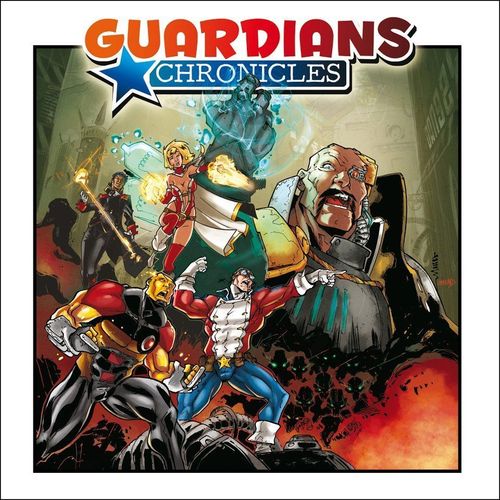
Guardians' Chronicles
Guardians' Chronicles Rulebook
Table of Contents
Table of Contents
The Threat of Doktor Skarov
Goal of the Game
One player plays Doktor Skarov and his Villains, and handles the various traps in the base. Each other player plays one of the Superheroes in LIBERTY PATROL.
Components
- 4 Superhero miniatures
- 5 Supervillain miniatures
- 30 Robot miniatures
- 1 Damsel in Distress miniature
- 16 ID cards
- 48 Power cards
- 4 Initiative cards
- 20 Event cards
- 20 Wound cards
- Guardians' Chronicles news articles
- 9 double-sided gameboard tiles
- 9 cards describing the gameboard tiles
- Some Bonus/Penalty tokens
- Some Damage tokens
- Some Resolution tokens
- 4 Activation tokens
- 9 Door tokens and 5 Airlock tokens
- 5 Combat dice
- 5 Power dice
- 6 Value Check dice
Contents
- Hero figures: Each player's character is represented on the gameboard by a figure.
- Two-sided gameboard tiles: The gameboard tiles fit together to make up Doktor Skarov's base. They provide traps and objectives for the Heroes.
- ID cards: These cards summarize all the information necessary to play the Superhero (or the Villain).
- Two-sided cards describing the gameboard tiles: Each card describes how the associated tile works.
- Power cards: Each Hero has his own set of power cards which he will use to set up his strategy, and use super powers and special abilities.
- Resolution tokens: These tokens are put on the appropriate gameboard tiles and their use depends on the situation.
- Door tokens and Airlock tokens: These tokens are used to link two adjacent gameboard tiles and show the path for the Heroes to reach the Objectives.
- Initiative cards: These cards keep track of the order in which the Heroes are activated.
- Combat dice: You use them to attack.
- Power dice: Use these dice whenever the character's Attack value receives a bonus.
- Value Check dice: Use these dice to make a Value Check.
- Villain figures: Each character controlled by Doktor Skarov is represented by its own figure on the board.
Game Elements
ID Cards
The ID cards present the various values for each Hero, Doktor Skarov and his Minions, as well as their special power.
Each ID card shows the following values:
- Speed: The Speed value indicates the number of Areas a character can cross during a move.
- Attack: The Attack value indicates the number of Combat dice you will roll when Attacking.
- Defense: The Defense value indicates the number of successes an opponent's Attack roll needs in order to deal Damage to the character. In order for an Attack to succeed, the result of the Attack roll must be equal to or higher than a target's Defense value. A successful Attack roll inflicts 1 Damage token to the target.
- Mental: Mental lets you avoid Traps, resolve Objectives, and carry out Special Actions. Mental is usually used in a Value Check. Note: Only Heroes have this ability.
- Number of Actions: The number indicates the number of actions that the character can carry out when activated. Note: This value is only specified for Villains, because Heroes always have 3 Actions.
- Health: The Health value indicates the character's resilience. Every time a character is hit, one Damage token is added to their ID card.
- Heroes' Health: At the end of each turn, Heroes must assess their health. If you have at least as many Damage tokens on your ID card as your Hero's health, your hero is wounded: Discard a number of Damage tokens equal to your Health value, and take a Wound card into your Hand. Any leftover Damage tokens remain on your ID card, even if you have enough for another Wound card. Once you have three Wound cards in your Hand, your Hero is knocked out, and removed from the game.
- Villains' Health: Whenever a Villain takes as many Damage tokens as his Health value, he is immediately knocked out and removed from the game.
- Power: A character's power is always active as long as the character is in play.
There are three types of Villains:
- Acolytes: When an Acolyte is activated, all the figures associated with this ID card can be activated.
- Lieutenants: All lieutenants are unique. They have high Health values.
- Master Villain: Doktor Skarov, the bad guy.
Power Cards (Heroes)
Each member of LIBERTY PATROL has his own set of Power cards. They can be used two ways: for the Secret Technique modifier or for the Special Power. Anytime you play a Power card, indicate which way you are going to use it.
- Place it to the left of the Hero's ID card in order to use the Special Power. When the card is placed to the left, only the Special Power is active.
- Place it to the right of the Hero's ID card in order to use the Secret Technique modifiers, instead. When the card is placed to the right, only the Secret Technique is active.
Note: Some cards only have a Secret Technique; some only have a Special Power. Make sure you put each type on the appropriate side.
Every turn, choose one or two cards to play. A Hero must play at least one card per turn. At the end of the turn, put the cards you played in your discard pile. On the following turn, you will have fewer Power cards in your hand to choose from.
If, at the start of a turn, you have no Power cards in your Hand (Wound cards don't count), you must take all the Power and Wound cards from your discard pile back into your Hand.
Secret Technique
Secret Techniques modify the hero's statistics. The chosen modifiers apply throughout the turn.
- Speed Modifier: Your Speed value is increased or decreased by the indicated modifier.
- Attack Modifier: When making an Attack roll, roll as many Power dice as the bonus value. Or remove as many Combat dice as the penalty value.
- Defense Modifier: Your Defense value is increased or decreased by the indicated modifier.
- Mental Modifier: Your Mental value is increased or decreased by the indicated modifier.
Special Powers
The Special Power remains active as long as the card is in play. If the words Action or Unique Action are mentioned before the power's description, the Power is only activated when the Hero spends an Action during the Activation phase:
- ACTION: Spend one of your three Actions to use the Power as described. You may use the power as many times as your Actions permit.
- UNIQUE ACTION: Spend one of your three Actions to use the Power as described, but no more than once per turn.
Make sure you take into account the order in which the Heroes are activated! Your Ally's Power may require you to do something first in order to enable it!
Next to the card's name, a symbol tells you what kind of Special Power it is:
- Movement: The Special Power affects how a Hero, his Allies, or his Enemies move.
- Attack: The Special Power either improves a Hero's attacks for the turn, or lets him attack under special conditions (ex: ranged attacks).
- Defense: The Special Power either improves a Hero's or his Allies' Defense, or lets him respond to an attack.
- Mental: The Special Power modifies the success requirements of Value Checks.
- Coordination: The Special Power affects a Hero's allies.
- Weakness: This card has a negative effect on a character and/or the team, but lets you heal your Hero.
The "Weakness" Card
Every Superhero has a weakness, a moment of doubt, or a character flaw that may hinder the efforts of the Hero or his Allies. This is reflected by a Weakness card (it is classified as a Power card, and governed by their rules). It can only be used as a Special Power (to the left of the Hero's ID card) and it has a negative effect on the character and/or his Allies. An Ally's weakness can only be covered by team play.
Because new power cards are drawn only after ALL of the cards in your hand have been played, the Weakness card eventually has to be played! On the other hand, the "Weakness" card enables you to heal as many Damage points as your Health value.
Rookie and Veteran (Heroes)
Before becoming a Hero, each character had some kind of career. A Hero lives, fights and sometimes dies ... but above all, a Hero evolves, trains, grows stronger. This aspect of our Heroes' lives is reflected in a Rookie/Veteran system. If you choose to play in Rookie mode, the game will be more difficult. On the other hand, if you play in Veteran mode, your Hero should repeatedly make the front page of the Guardians' Chronicles.
Each member of LIBERTY PATROL has two Rookie and two Veteran Power cards, and one Rookie and one Veteran ID card. You can identify them by the style of the Power description area, and by the card back.
- Rookie: when you play a campaign, you can begin with your Hero's Rookie ID card. Replace two Power cards with the two Rookie cards. At the end of an adventure, you may replace one of your Rookie cards with one of the original cards you removed previously. When you've replaced your two Rookie cards with the two original cards, take your Hero's Normal ID card.
- Veteran: once you've become a Normal Hero, you add a random Veteran card to your Hand at the end of an adventure. When you've added your two Veteran cards, take your Veteran ID card.
This system lets you watch your Hero evolve over four adventures. Feel free however to adjust these rules and come up with different situations to evolve your Heroes.
Rookie and Veteran cards also enable you to balance scenario difficulty if you do not have the recommended number of Heroes. Feel free to play four Rookie Heroes in an easy scenario, and Veteran ones on a more difficult scenario with fewer than four players.
Event Cards (Doktor Skarov)
Event cards are used a little differently than Power cards. They can be used two ways: for the Secret Technique modifier or for the Event. Anytime you play an Event card, indicate which way you are going to use it.
- Place it to the right of the Villain's ID card in order to use the Secret Technique modifiers during the Strategy phase. When placed to the right of the card, only the Secret Technique is active.
- In order to use the card as an Event, when Doktor Skarov activates a Villain, he discards the card during Resolution of the activation.
No more than one card can be played as an Event during a character's Activation.
Note: An Event does not have to be associated with the activated Villain. EXAMPLE: you can Activate a Kinoichi and use the Kamikaze Event card to sacrifice a Robot.
At the end of the turn, cards played as Secret Techniques are put into Doktor Skarov's discard pile. When the Event draw pile is empty and Doktor Skarov needs to draw, shuffle the discards into a new draw pile.
Secret Techniques
The chosen modifiers apply throughout the turn.
- Action Modifier: The activated Villain's number of Actions is increased or decreased by the indicated modifier.
- Speed Modifier: Your Speed value is increased or decreased by the indicated modifier.
- Attack Modifier: When making an Attack roll, roll as many Power dice as the bonus value. Or remove as many Combat dice as the penalty value.
- Defense Modifier: Your Defense value is increased or decreased by the indicated modifier.
Events
The effects of an Event card played during a Villain's activation are applied immediately. Discard the card at the end of Activation. If an Event modifies a rule, every character linked to the activated ID card is affected by this modification.
EXAMPLE: Doktor Skarov activates the Gynoids and plays Photon Beam. Every Gynoid rolls Power Dice instead of Combat Dice for the turn.
Gameboard Tiles
Gameboard tiles have a room on each side. You can pick a scenario and arrange the tiles as indicated, or create your own mission.
Each tile comprises Areas made up of Spaces, and may also include Reinforcement Spaces, Traps, and/or an Objective.
Characters stand on Spaces with a bright colored dot:
- Blue for a normal Space.
- Green for a Hero's starting Space.
- Orange for a Space where interaction with the environment is possible.
- Purple for a space that allows Doktor Skarov to activate one of the tiles in his base.
An Area comprises several Spaces and its boundaries are indicated by walls and white lines. When a Character moves, it moves from area to area, and in the final Area of its move, stands on any unoccupied Space.
Acolytes appear on Reinforcement Spaces. Each Reinforcement Space states the number of Heroes required in the game in order for it to be active. Example: In a 2 player game, use the "1+" and "2+" spaces, but not "3+".
Acolytes can attack from the Reinforcement space where they start. An Acolyte can't return to its Reinforcement space after leaving it. Characters outside a reinforcement square can neither enter it nor in any way prevent an Acolyte from appearing on it.
Each gameboard tile is associated with a card that explains the way it works, and indicates which tokens are required to use it.
Value Check symbols
The diamond's color indicates which statistic to check. The number inside shows the number of dice to throw. A second symbol indicates that the player should add the number of Heroes inside the base to the dice result.
Character Actions
When you activate a character, you get Actions that you can use in any order to move, attack, use a power, or make a Value Check. Unless otherwise indicated, the same Action can be done several times in the same turn.
When it is their turn to play, Heroes have 3 Actions each. Villains have a number of Actions that is indicated on their ID card, and which can be increased by Event cards.
Moving
You can use a Move Action to:
- Move through as many adjacent Areas as the character's Speed value. Example: Sgt Freedom has Speed 2, he can move 2 Areas for 1 action. He moves to any Space in the destination Area.
- Place yourself in any unoccupied Space of your current Area. Example: Sgt Freedom can spend 1 Action to move to any Space in his Area.
- Exit the area you are in if an opponent is also in it. In this case, the Move Action ends in an adjacent area even if you exceed the character's Speed value. Example: Because there is an enemy in his Area, Sgt Freedom needs 1 Action to exit his Area.
The Movement Rules
- You can only pass through an area if there are no enemies in it. If you enter an Area occupied by at least one enemy character, you must stop and your Move is over. Example: Sgt Freedom can spend 1 Action to move to the adjacent Area, but he has to stop there because there is an enemy in that Area.
- If all the spaces in an Area are occupied by Allies, you cannot stop there, but you can go through. However, if at least one of the spaces is occupied by an opponent, you cannot pass through the Area. Example: All the spaces in the Area have enemies in them, so Sgt Freedom cannot go through. On the other hand, the Android can because it has no enemies in the Area. It can end its move in any Space in the destination Area.
- You can place a figure on any unoccupied Space in the final Area. Positions of other figures have no relevance.
- Doors open and close automatically for Doktor Skarov's Villains, but they interrupt Hero movement.
Attacking
An Attack Action lets you either:
- Make a melee attack. Your character can make a combat roll against a target in an adjacent space (even if the two of you are not in the same Area). Two characters in adjacent spaces are only considered adjacent if there is no wall or closed door obstructing a straight line between the centers of the spaces. If this line is unobstructed, you may make a Combat Roll.
- Make a ranged attack. If a power allows it, your active character can make a ranged attack. You must have a line of sight to the target with no enemy in the way. Line of sight is determined by drawing an imaginary straight line from the center of the active character's space to the center of the target's space. If no wall or closed door or enemy obstructs the line of sight, you may make a combat roll. Allies do not block line of sight.
Resolving the Attack
Determine the result of your Attack by rolling as many Combat dice as your Attack value. If you are using a Power card for its Secret Technique, add a number of Special Dice equal to the Attack Bonus. If the Attack modifier is negative, subtract that number of Combat dice.
Roll all the dice simultaneously and add up the successes. Add 1 success for any POW result and reroll the die.
If the number of successes is equal to or higher than the target's Defense value, the attack succeeds and deals 1 Damage to the target. The target puts a Damage token on its ID card.
If the Attack does not eliminate the target, the attacker can push the target back into an adjacent space.
EXAMPLE: Super Nova attacks with 4 Combat and 2 Special dice. She gets 0, 0, 1, 1, POW and 2 = 5. She rerolls the POW and gets a 1, 5+1 = 6. Her Attack roll result is 6 and is equal to Chi's Defense, so Chi is dealt 1 damage. Unfortunately for Chi, she had already been dealt 2 damage and this 3rd damage eliminates her (since her Health value is 3).
Damage and Wound Cards
- At the end of the turn: If you have at least as many Damage tokens on your ID card as your Hero's health, your Hero is wounded: Discard a number of Damage tokens equal to your Health value, and take a Wound card into your Hand. Any leftover Damage tokens remain on your ID card, even if you have enough for another Wound card.
- Once you have three Wound cards in your Hand, your Hero is knocked out, and removed from the game.
- Whenever a Villain has as many Damage tokens on its ID card as its Health value, the Villain is immediately eliminated from the board.
Wound Cards
At the end of each turn, if you have damage greater than or equal to your Health, it turns into a Wound card. A Wound card is played like a Power card. During each Strategy phase, you must always play a Power card, even if it's a Wound. You cannot play two Wound cards at the same time. You can play a Wound card from your hand, if you have one.
Remember, three Wound cards in your Hand eliminates your Hero! If at any time you have 3 Wound cards in Hand, your Hero is overcome by his Wounds and removed from the game.
Making a Value Check
A Value Check is sometimes required for a Hero to achieve a goal, open Doors or avoid a trap. Usually, you must be on an orange space in order for a Value Check to apply. The Value Check you must perform is explained on the card corresponding to the gameboard tile.
The Value Check on the tile depicts a diamond with the target value in it. To its left, it shows how many 8-sided dice you need to roll. To the right, it may also tell you to add the number of Heroes in the game to your roll. You succeed if your total is less than or equal to the target value.
If you succeed, the card will describe what happens.
If you fail, put a -1 token on the gameboard tile: The task becomes slightly easier. The next time any Hero (even the same one) tries the task, subtract 1 from his result. After enough failures, there can be enough -1 tokens to cause an automatic success, but a Hero must still spend an Action to succeed automatically.
Note: An Attack Value Check can be made from a distance, provided there is a clear line of sight to the target, and a Power lets you make a ranged attack.
Example: Sgt Freedom attempts to stop the Missiles. He spends 1 Action to move to an orange space. The difficulty is 4 dice (Base) +3 (number of Heroes). He spends 1 action to roll 4 dice, gets 0, 0, 1, and 2, to which he adds 3 = 6. His Mental value is 3 +1 = 4 (bonus from the Secret Technique). The check failed BUT he puts a -1 token on the tile so the difficulty is now effectively 4 dice +2. With his last action, he attempts the Check again and rolls 4 dice, gets 0, 0, 1, and 1, to which he adds 2 = 4. It's a success, he disarms a missile! One down, three to go...
Doors
In order to open a door, your Hero must:
- be in the space in front of the door.
- choose between an Attack or Mental Value Check. If your Hero uses a Power that allows ranged attacks, an Attack Value Check may be attempted from a distance provided he has a clear line of sight to the space in front of the door.
- attempt the appropriate Value Check.
If you succeed, flip the Door token to its "open" side. If you fail, put a -1 token on the Door, reducing the difficulty of the task for future attempts.
Open Doors
When a door is open, Spaces on the other side become adjacent. Doors automatically open for and close behind moving Villains and do not block their movement. A Villain cannot attack through a closed door. He may decide to spend an Action to jam it open in order to attack a Hero on the other side, but then the door remains jammed open for the rest of the game.
Use the Action Provided by a Power
Using a Special Power that has the word ACTION or UNIQUE ACTION before it requires that your Hero spend one of his three Actions. UNIQUE ACTIONS can be used only once per turn.
Caution: Some Powers help Allies and must be played from a team perspective. Heroes must therefore plan together how they are going to play out the turn.
Note: Special Powers that don't have ACTION or UNIQUE Action in front of their name have a permanent effect as long as the Power card is in play. You do not need to spend an Action for them and they are active throughout the turn, even if the Hero has not yet been activated.
Example of a Hero's Turn
It is GoldenBoy's turn to play. He spends 1 Action to move 2 Areas and ends up next to the Android.
He spends another Action to attack it. He rolls 2 Combat dice (-1 die because of the Android's power) + 2 Power dice (thanks to his Special Technique) and gets 5. The android's defense value is 4. It is destroyed.
GoldenBoy uses his permanent Power which enables him to move to an adjacent Space when he makes a successful attack and positions himself in front of the door.
GoldenBoy uses his last Action to try to break down the door. The difficulty of the Attack check on the door is 5. He rolls 5 Check dice and gets 4. His Attack value is 5 (a base 3 +2 thanks to his Special Technique), so the check is successful and the door is now open.
It is now Doktor Skarov's turn to activate one of his Villains.
Setup
One player plays Doktor Skarov and opposes the other players. That player controls Doktor Skarov, his Villains, as well as the various traps in the base. That player sets the character ID card and Initiative cards of the Doktor and his Villains in front of him.
Each other player chooses one LIBERTY PATROL member, sets the character's ID card and Initiative card before him.
They each roll a Combat die to determine their Personal Mission for the game. If they roll a special result (POW), they reroll the die and need to carry out one of these two Personal Missions during the game.
Doktor Skarov builds his base as indicated in the scenario booklet, or he can create his own scenario. If the player wants to create his own scenario, the number of tiles depends on the desired difficulty and duration for the game.
Doktor Skarov then places the Door counters wherever he wants to set the path the Heroes will have to take to carry out their chosen Objectives. Make sure all the gameboard tiles can be entered.
Doktor Skarov chooses a number of Minions, depending on the number of Heroes he faces, then places them on each tile that has at least one Reinforcement Space.
Doktor Skarov then sets up the various appropriate tokens on each gameboard tile of his base, as indicated on the description cards.
Doktor Skarov places a Lieutenant in each Objective room. If there are any Lieutenants left to set up, he can place them anywhere he wants in the base.
Last of all, Doktor Skarov places his figure on the "Control Room" tile.
When the base is ready, Doktor Skarov draws as many Event cards as there are Heroes. Heroes take all their Power cards in Hand. Heroes start the game in the green spaces of the Entry tile.
Quick Set-Up
- X = Number of Heroes
- Doktor Skarov starts the game with X Event cards in hand.
- Put his figure on the appropriate space in the Control Room tile.
- Place Minions on each Reinforcement square. The number of Minions depends on the number (X) of Heroes.
- Add the Lieutenants (maximum of one per tile, minimum of one per Objective tile).
Game Turn
A game turn is made up of the following phases:
- Strategy (simultaneous)
- Activation (one player after the other)
- End of turn
1. Strategy
Note: The strategy phase is simultaneous for both Doktor Skarov and the Heroes, but resolution will be one player after the other during the Activation phase.
Strategy of LIBERTY PATROL
Each Hero plays 1 or 2 Power cards. Then all the Heroes decide their Activation order together.
Each Hero chooses a Secret Technique and/or a Special Power. They don't have to talk it over but it is usually better if they do. They then put the appropriate cards to the right or the left of their ID card depending on their use. Once the Power cards are placed, they remain in place until the end of the turn.
Remember: Each Power card may be used one of two ways:
- The Secret Technique: Play the card to the right of your ID card to modify your Hero's values.
- The Special Power: Play the card to the left of your ID card to use its special power, instead.
Note: Each Power card you play can be used for its Secret Technique or for its Special Power, but not both at the same time.
Once the cards have been set on the table, the Heroes secretly choose the order in which the Heroes are activated by stacking their initiative cards face-down. The top card of the stack represents the Hero who will play first in the following Activation phase.
Note: Doktor Skarov can hear and observe everything the Heroes do during this phase before preparing his own Initiative stack. It is only natural because this is his lair, and there are microphones and cameras everywhere.
It is up to the Heroes to proceed smartly and keep Doktor Skarov from guessing their true intent. They can even use misinformation to lead him astray. For example, they can play their Power cards face-down until the Activation phase.
Strategy of Doktor Skarov
He can play as many cards as there are Heroes. At the same time as the Heroes, Doktor Skarov can use one or more Event cards to increase the Values of one or more of his characters by placing them to the right of their ID cards. He doesn't have to play them all; it's all a matter of strategy.
In addition, when Doktor Skarov eliminates a Hero, the number of Event cards he can play drops by one.
Just like the Heroes, he can choose to put his cards face-down so as not to reveal any clues.
Heroes decide when they are ready, and they don't have to reveal their cards to do that. At that point, Doktor Skarov can modify the way his cards are arranged one last time before announcing the Activation phase.
2. Activation
Heroes and Doktor Skarov reveal their Power and Event cards. Then the Heroes flip the top card of their Initiative stack and activate the corresponding Hero.
Every time a Hero is revealed, he gets a maximum of 3 Actions which can be used to:
- Move.
- Attack.
- Make a Value Check.
- Use a Special Power.
Unused Actions are lost.
Once the first Hero has finished his Activation, it is Doktor Skarov's turn. He chooses a Villain, puts an Activation token on the corresponding ID card, and then uses some or all of the Villain's Actions to:
- Move.
- Attack.
Note: ID cards with the keyword Minions are associated with several figures. When activated, you can use all the figures associated with the card.
At any time during the Activation of an ID card, Doktor Skarov can play an Event from his Hand and trigger its effect. This Event doesn't have to be tied to the activated Villain.
Once the first Villain's Activation is over, it is LIBERTY PATROL's turn to play again. The Heroes turn up the second card of the Initiative stack and activate that Hero. Doktor Skarov then activates a Villain that hasn't yet received an Activation token. And so on until the Initiative stack is empty, and as many Villains as Heroes have been activated.
Doktor Skarov always activates as many Villains as there are Heroes. Eliminated Heroes decrease the number of Villains that can be activated. If Doktor Skarov has fewer Villains in play than Heroes, the remaining Initiative tokens are used to draw Event cards.
Activate Doktor Skarov
If the objectives have been met, and the door to the Control Room has been opened, Doktor Skarov himself can be activated like any other Villain. He can exit the room or wait there and prepare for the final showdown.
3. End of Turn
The End of Turn consists of three phases:
Room Activation
Each purple Space in the Control Room corresponds to a room in the base (see Scenario Booklet for examples). If the door to the Control Room is not yet open, Doktor Skarov can be placed on any purple Space of the Control Room in order to activate the corresponding room in his base. Refer to the room's card in order to see its effects.
Objectives
Objectives that haven't been neutralized by the LIBERTY PATROL are resolved as indicated on their description card.
Cards and Wounds
The Heroes and Doktor Skarov discard the cards they played during the Strategy phase. Doktor Skarov draws 2 Event cards.
If the number of Damage tokens on your Hero's card is equal to or higher than his Health value, discard a number of Damage tokens equal to his Health value, and draw one Wound card into your Hand. A Hero cannot draw more than one Wound card per turn.
A Hero that has no more Power cards in Hand picks up all the cards in his discard pile.
Note: Although you play a Wound like a Power card, it is not considered a Power card. So a player who has only Wound cards in his hand must pick up all the cards in his discard pile.
A Hero that has 3 Wound cards in hand is eliminated, and Doktor Skarov adds the article about the Hero's downfall to the front page of the GUARDIANS' CHRONICLES.
End of the Game
Final Showdown
When every objective has been neutralized and/or met, the Final Showdown begins. Heroes can now open the door to the Control Room.
As soon as this door is opened, Doktor Skarov can no longer activate rooms at the end of the turn.
- The showdown ends when all the Heroes are defeated or Doktor Skarov gets away.
- During the Final Showdown, but not before then, whenever Doktor Skarov eliminates a Hero he can spend 1 Action during his activation to make an emergency exit from the base to safety. He earns the news article that tells of his victory against LIBERTY PATROL.
- The game ends when the Heroes beat Doktor Skarov. The surviving Villains escape the base or surrender, and the Heroes earn the news article describing the arrest of Doktor Skarov.
The Showdown has taken place, whether the Heroes neutralized Skarov or let him get away, and their actions have made it to the public. The front page of the Guardians' Chronicles is ready to go to press.
The Guardians' Chronicles
- When an objective is neutralized by the LIBERTY PATROL, or met by Doktor Skarov, the corresponding article is added to the front page of the GUARDIANS' CHRONICLES with the appropriate side face-up.
- At the end of the game, if a Hero has carried out his Personal Mission without being knocked out, reporters add the praising article in the right column of the front page.
- When a Hero is knocked out, reporters add the shaming article in the right column of the front page.
- At the end of the game, if there's space left between the various articles, you can insert ads to bring the newspaper to life.
- Depending on the outcome of the Final Showdown, add an article that tells of Doktor Skarov's arrest or escape.
Once the game is concluded, compare the articles in favor of each side. Refer to the example and insert the designated headline. It could look favorably upon the Heroes, if they were particularly efficacious, or it could show that Doktor Skarov is a threat to be taken seriously!