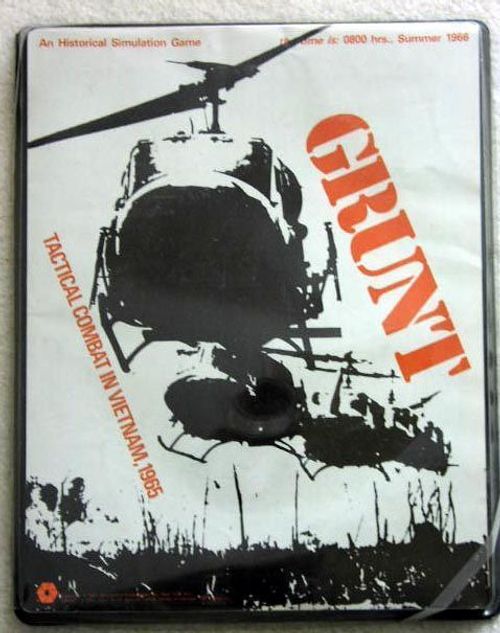
Grunt: Tactical Combat in Vietnam, 1965
Grunt: Tactical Combat in Vietnam, 1965 Rulebook
Table of Contents
Table of Contents
- General Course of Play
- Terrain
- The Playing Pieces
- Counter Key
- Sequence of Play
- Movement of Units
- Combat
- Setting Up the Game
- Arriving by Helicopter
- The Solitaire Game
- Basic Two-Player Game
- Probe
- Pinning
- Victory Conditions
- The Standard Game
- Changes and Modifications to the Basic Rules
- Additions
- Optional Rules
- Air Strikes
- Deployment Options
- Chain of Command: Orders from Higher Headquarters
- Situation One
- Situation One (Alternate)
- Situation Two
- Situation Three
- Order of Battle Chart
General Course of Play
The mapboard shows a typical coastal area of central South Vietnam: several small villages intermixed with forests, streams and rice paddies. A hexagon grid system has been superimposed over the map to enable the players to determine movement, positioning, and firing ranges of their units. Each Player maneuvers his units and fires their weapons at the units of the Enemy Player. The Player controlling the disposition and movement of the Viet Cong, the Peasants, the Caches and the Dummy counters is called the NLF Player (National Liberation Front). The Player controlling the disposition and movement of the United States infantry units, ARVN Intelligence and Ranger Teams is called the U.S. Player. At the start of the game the NLF units are turned face down on the map. The U.S. Player must explore this array of face-down counters in order to engage the NLF. The NLF must skillfully deploy and manipulate his combat units and dummy counters in order to avoid being caught in a situation where the U.S. Player can bring to bear his superior fire-power. The game is won by accumulating more Game Points than one's opponent. Game Points are gained by firing upon Enemy units and destroying enemy equipment (see Combat Results Tables). All games are ten Game Turns in duration (see Sequence of Play). Players should keep in mind that the type of conflict being simulated in the game is not successfully waged by employing "sledgehammer" frontal assault tactics. Due to the way the point system is weighted, the U.S. Player must be especially judicious in his initial placement (i.e. arrival by helicopter) and in the type of operation he conducts. The NLF Player is advised to use hit-and-run tactics and trickery in order to extract a high cost from the U.S. Player.
The Game is subdivided into three sets of rules: the Basic Game; the Standard Game and the Standard Game with Optional Rules added. Players should experience the Basic Game first and then escalate through the ascending levels of complexity until they find a "rules-mix" with which they are most comfortable.
Terrain
There are seven different types of hexes representing terrain found on the mapboard that, to varying degrees, affect the play of the game:
- Forest – thick dense stands of trees with heavy undergrowth;
- Treeline – forest bordering on clear or covered terrain;
- Broken – varies from rough ground overgrown with brush to grassland;
- Open – cultivated (rice paddies both flooded and drained);
- Buildings – groups of hooches;
- Rivers or streams;
- Road-"berm"/Dikes – Dike-like raised areas in open terrain along which the roads are found.
The Playing Pieces
The playing pieces used in the game simulate the various military units, civilian groups, objects and markers that effect a typical military operation; e.g. an arms cache counter represents crates of weapons. A good portion of the counters represent nothing and are used by the NLF Player to confuse the U.S. Player. The combat units and civilian counters have more than one characteristic and get most of the attention. A more complete description of each counter follows:
The first page of the printed rules shows example counters for the combat unit types: Headquarters; Viet Cong Leader; American Infantry; Viet Cong Militia; American Mortar Personnel; and Viet Cong Hard-core Guerrilla.
Counter Key
The printed counter key lists the following playing pieces (icons are identified here by their captions):
- South Vietnamese Rangers (ARVN)
- South Vietnamese Intelligence Platoon
- American Forward Observer
- Medical Aid Team
- Artillery Center of Impact
- U.S. Ammo Supply
- Administrative Records
- Radio Equipment
- Rice Cache
- Antipersonnel Traps
- Improved Position
- Pinned Marker
- Casualty
- Sniper
- Porters
- Peasants
- Ambush
- Arms Cache
- Ammunition Cache
- Dummy Counter
Sequence of Play
Grunt is played in complete turns called Game Turns. Each Game Turn is composed of two Player Turns (U.S. and NLF). Each Player Turn is composed of two Phases: a Movement Phase and a Combat Phase. Each Player executes his turn in strict order according to the following outline:
U.S. Player Turn
- Movement Phase: U.S. Player moves his units.
- Combat Phase: U.S. Player fires his weapons and determines results.
NLF Player Turn
- Movement Phase: NLF Player moves his units.
- Combat Phase: NLF Player fires his weapons and determines results.
Completion of Game Turn: Players record the passage of one complete Game Turn. There are ten Game Turns in a Complete Game.
Movement of Units
Each unit has a Movement Allowance of six Movement Points. Units are moved from hexagon to hexagon, expending one movement point from their allowance for each hexagon they are moved into (regardless of the type of unit may be moved or the kind of terrain). No unit may exceed its Movement Allowance in a single Movement Phase. In any given Movement Phase a player may move as many or as few of his units, in any direction or combination of directions, expending as much or as little of a given unit's Movement Allowance as he desires. The NLF Player may move his dummy counters as if they were regular units. Ammo; Arms, Rice, Radio, Records, Booby-Trap and Peasant counters have NO MOVEMENT ALLOWANCE. Units may move through Friendly units but they may not stop on top of Friendly units. Units may not move through enemy units. Units may move adjacent to enemy units without being required to stop or fight. In certain circumstances (see Combat 3.5) units may move onto enemy cache units. Once a unit has been moved (and the player's hand withdrawn from the counter) it may not be moved any further in that Movement Phase. Movement points may not be accrued from Phase to Phase or transferred from unit to unit. No more than one unit may be placed on a given hex at the same time.
Combat
During the Combat Phase of the Player Turn, Players may fire their weapons at enemy units. The firepower of a given combat unit is represented by its Attack Strength. The units being fired upon are protected from the effects of fire, according to the type of terrain they are in. The defending units, themselves, do not possess any intrinsic defensive value; the protection afforded by the terrain in the hex being fired into is called the Defense Strength. Combat is resolved by comparing the total Attack Strength of the firing units against the Defense Strength of the hex into which they are firing. The comparison is stated as a
The comparison is stated as a probability ratio (odds): Attacking Strength to Defense Strength. These odds are simplified and rounded off to conform to those found on the Combat Results Table. Odds which simplify unevenly are rounded off in favor of the defending units. For example, odds of "11 to 3" are rounded off to "3 to 1." Odds are calculated in this manner for each separate attack being made. For each attack, a die is rolled by the Attacking Player and the result line indicated by the die-number is read from the Combat Results Table under the appropriate odds heading. The result is applied immediately, before going on to resolve any other combat.
Ground combat units have a fire range of eight hexes. That is, they may use their Attack Strength against any target which is within an eight hex radius of their position.
Terrain has the Defense Strength listed below:
- Open hex: one point
- Building hex: two points
- Broken terrain hex: two points
- Treeline or Forest hex: three points
Units may not fire through hexes which contain (a) other units, enemy or friendly; (b) buildings; (c) forests; (d) road-berm. Units may ALWAYS fire into an immediately adjacent hex regardless of what type of terrain it contains. Units on roads defend as if on broken terrain.
Notice that the Points Combat Results Table (which is the table used in the Basic and Standard games) aside from indicating what effect enemy fire has upon a target, indicates the number of game points scored by the attacking player for obtaining that result. Players should keep a running record of the points they obtain since this is the method by which the "victor" is determined.
Only units which are face-up may be fired upon. A given unit may not be subjected to more than one attack per Attacking Player Turn. No attacking unit may fire more than once per Combat Phase. NLF units which are face-down may fire, but in doing so are turned face-up.
More than one unit may direct its fire upon the same hex: the Attack Strengths of all the firing units are totaled into one combined Attack point-value and the Combat Results Table is used once to determine the effect of that combined attack.
Units are never forced to fire; attacking is a voluntary act. Defending units, however, have no choice as to whether or not they will receive fire.
If the defending unit is a Sniper and the Combat Results Table calls for points to be scored by the attacker, then the Sniper unit is destroyed in addition to that result.
"Caches" do not obstruct fire. A cache may be destroyed in the following manner: move the attacking unit onto the cache and stop. Do not move or fire the attacking unit in the next full Player Turn. At the end of that full Player Turn of sitting on the cache, the cache is automatically destroyed (or captured, if the Player so wishes). The unit may move and fire normally in the Player Turn after the cache is destroyed (or captured). If the Player decides to capture the cache, the capturing unit "carries" the cache along with it. If fired upon, the unit must drop the cache (and subsequently go through the capturing process again if it wishes to pick it up again). Units carrying caches may not fire. The cache may only be dropped as response to enemy fire.
Setting Up the Game
The NLF Player places and positions all his counters (including Peasants) FACE DOWN on the playing map. The U.S. Player may not examine any of these face-down counters without first going through a discovery procedure ("Probing" in the Basic Game; "Searching" in the Standard Game). The NLF Player may re-examine face-down units at any time. The U.S. Player's units are used FACE UP on the map. After the NLF Player has placed all his units and dummy counters on the map, the game commences with the U.S. units arriving on the map by helicopter. The quantities and types of units in play in a given game are listed in the Order-of-Battle charts. Players should use the Basic Game Order of Battle and rules for the first few games. Note: No units (of either side) may be initially placed (or landed by 'copter) WITHIN FOUR HEXES OF THE MAP EDGES.
Arriving by Helicopter
The helicopters in the game are not represented by actual helicopter counters. They are represented by the ability to place-on and lift-off units from the map. Each helicopter may carry either one squad-sized combat unit or two Headquarters, Forward Observer, or Medical units. Helicopters land and unload and lift-off again, all in the same Movement Phase. Helicopters do not trace their path of approach to the landing zone: simply place the units they are delivering directly on the hex in which they are landing. In two-Player games, VC Hard-Core Guerrilla units may fire at the helicopters as they are landing: Helicopters (and the units in them) defend with a strength of ½ point regardless of the terrain in which they are landing. The NLF Player fires at the helicopters during the U.S. Player's Movement Phase. Helicopters must land the initial units in a continuous chain of hexes. No more than one helicopter-load of units may land or take-off in a given hex in a given Player Turn. Units may not move or fire in the Player Turn in which they arrive by helicopter (exception: in the Solitaire Game they MAY move in the arrival turn). Helicopters may only land/lift-off from open or broken-terrain hexes. In the Basic and Standard Games, the U.S. Player has enough helicopter capacity to land or lift a single Company.
The Solitaire Game
Place all NLF, Peasant, and Dummy counters face-down on the map. Shuffle them around until they are thoroughly intermixed; then place one counter per hexagon in any sort of pattern, scattering them over the map. Place one counter in each building hex. Do not examine any of the counters. Land the American forces and move them in the turn of landing as much as desired within the six-hex per Movement Phase limitation, stopping each American unit as it comes adjacent to an upside-down counter. After moving all the American units, turn over any and all upside-down counters to which they are adjacent. American units may not fire at NLF units during the U.S. Combat Phase immediately following the Movement Phase in which they were turned face-up. The American unit(s) which discovers an NLF unit may not move away until the NLF unit is destroyed. NLF units which are turned face-up MUST fire at the most vulnerable American unit (or the closest if two or more targets are equally vulnerable). NLF units may not be moved even after being turned face up.
Basic Two-Player Game
The Two-Player Game proceeds exactly as the Solitaire Game with the following modifications:
a. The NLF Player may set up and move as he so desires. b. Peasants may not be moved and may not be placed in forest hexes. Up to two peasant counters may be placed in treeline hexes. c. The NLF may fire his units as desired. Firing units must be face-up or be turned face-up as they are fired. d. American units may not move in the Player Turn in which they land. e. NLF Hardcore units may fire at helicopters as they land. This fire takes place during the U.S. Player's Movement Phase. Such NLF units are not turned face-up due to being fired. f. The Americans discover NLF units using the Probe technique (see below). Both the Solitaire and the Basic Two-Player Game are ten Game Turns long.
Probe
In the Two-Player Basic Game, the U.S. Player discovers NLF units by announcing a Probe of any (or all) suspected Enemy occupied hexes to which the U.S. player has units adjacent. Probing takes place after the U.S. Movement Phase and before the Combat Phase. U.S. units MAY NOT fire into a hex which was probed in the Movement Phase of that Player Turn. Once turned face-up, a unit may not be turned face-down again. Only one U.S. unit is necessary to probe a given hex, and only one hex per Player Turn may be probed by a given unit. Should the U.S. Player uncover an Anti-Personnel Trap in a Probe, the units involved immediately undergo an attack at "3 to 1" odds (regardless of Terrain). Anti-Personnel Traps are also referred to as "Booby-Traps."
Pinning
Units which are fired upon are often pinned as a result of that fire. When such a result is called for by the Combat Results Table, place a Pinned Marker on the unit(s) in question.
Units which have been pinned may not move or fire in their ensuing Player Turn. Remove the Pinned Marker at the end of the pinned units' Player Turn. Helicopters are not pinned but units being landed by them are.
Victory Conditions
The game is won on points. Players are awarded points when certain results occur on the Combat Results Table and (in the case of the U.S.) by destroying or capturing enemy supply and materiel caches. Players should keep a running total of the points they receive. At the end of ten complete Game-Turns the Player with the most points may declare himself the winner. If both Players have an equal number of points, then both may declare "victory."
If the U.S. Headquarters (i.e. the Company Commander) unit is destroyed, the U.S. Player may not declare himself the victor since (symbolically at least) he is no longer capable of declaring anything. In this eventuality, the NLF Player may declare himself the "victor" no matter how many or how few points he has accrued.
The Standard Game
The Standard Game is an extension of the Basic Game which incorporates additional rules attempting greater realism, but without hindering the easy flow of "playability." The rules of the Basic Game should be carried forward incorporating the changes, expansions and additions as noted in the following set of rules.
Changes and Modifications to the Basic Rules
- Range and Line-of-Sight: The maximum range of fire is still eight hexes. Players must, however, more carefully calculate the line-of-sight through which their fire courses. First, determine whether a target hex is within the eight-hex range; then (except in the most obvious cases) use a straight-edge (such as a ruler) to determine through which hexes the line-of-sight passes; place the ruler along the line described by the center-points of the firing hex and the target hex: if at any point along the way, the straight-edge cuts through a hex containing buildings, forests, treeline or berm or units, then the path of potential fire is stopped at that hex (i.e. the line-of-sight is obstructed). A broken terrain hex obstructs fire if it is four or more hexes from the firing unit and in the line-of-sight. Broken Terrain hexes closer than four hexes to the firing unit limit the maximum range of that unit's fire to four hexes. If all the intervening hexes are open-terrain then the line-of-sight is not obstructed. For example, a unit in a treeline hex could fire at a unit in broken terrain if all the hexes in between were open terrain. Rivers have no effect on the line-of-sight. Units capable of fire may always fire into adjacent hexes.
The Defense Strength of terrain is not altered from that of the Basic Game.
-
Stacking (more than one Friendly unit per hex): Units may be stacked as many to a hex as the Player wishes. The number of units in a hex does not increase or diminish the Defense Strength of that hex. Units landing or lifting off in helicopters are still subject to the stacking limits of the Basic Game. Combat results apply to all units in a hex.
-
Hiding: The NLF Player may turn face down (again) any of his combat units which do not fire in that Player Turn and which are not in open or broken terrain hexes into which the U.S. units have a line-of-sight.
-
Landing Tactics: The U.S. Player need not land all his units in one continuous line. Landings may be divided into separate groups of contiguous units as long as no group is less than a platoon (four squads).
Search
The Probe rule is no longer used to locate hidden units; rather the American player may move on top of overturned units; after the American player has finished moving, the NLF player informs the American if he has moved on top of any combat units. If the American has, he moves back to the hex from which he entered the occupied hex. In those hexes not occupied by combat units, the American may uncover the units by expending three Movement Points from that Player Turn's Allowance; if they wish to destroy or capture a cache, they must spend another Player Turn in the hex in a pinned position.
Booby-Traps
If the U.S. Player moves on top of a booby trap, the units involved undergo a "3-to-1" attack immediately. The NLF Player must tell the U.S. player that his units have landed in a Booby Trap IMMEDIATELY. The U.S. unit does not expend the three movement point cost in order to uncover a Booby Trap in his next Movement Phase. Units may not fire while on Booby Traps. Units receive casualties (or lose points) from Booby Traps as called for by the Combat Results Table, but they do not suffer the pinning effect. If, for some odd reason, the U.S. player should leave units on a booby trap, they suffer the effects again (and the NLF Player remarks upon the aptness of the name of the trap). NLF units never suffer the effects of their own Booby Traps. Caches stacked with Booby Traps are destroyed and the points for them awarded upon the trap being sprung for the first time. The Booby Trap is never "used-up" and affects any U.S. unit that dares to enter it again. Face down peasants or NLF units may not be placed in Booby Traps, although the NLF may move through them. Face-up NLF units may stack on a Booby Trap.
When using the Optional Casualty Combat Results system, U.S. units which incur casualties on Booby Traps may move off the Booby Trap but may not take the casualties with them. Only Medical units may remove casualties (and suffer the effects of the Booby Trap in order to do so).
Additions
In addition to the above modifications, these new rules are introduced:
Fire Restriction
Units may only fire or move in the same turn; never both.
Terrain Restrictions
Movement into forest or tree-line hexes costs three Movement Points; movement into broken terrain costs two Movement Points; movement across a river hex side costs one additional Movement Point (in addition to any other costs). Movement into open terrain, buildings, or along roads costs one Movement Point per hex.
Porters
Some NLF Orders-of-Battle make provision for porters. These units may move onto caches, radio and records in one turn and move off with one of these other units in their next turn. It costs three Movement Points for a porter to load and to unload his burden. Porters are removed from the board (destroyed) as soon as the Americans fire at them; they may be captured by the Americans simply by moving a unit on top of them.
Interrogation
When ARVN units come across peasants they may stop to interrogate them. Peasants under interrogation may not be moved. At the end of the next complete turn after the civilians have been under interrogation by the ARVN counters, a die is rolled and the results determined and acted upon. (See Interrogation Results Table)
Only one "interrogation-roll" is permitted per Game Turn. Only one NLF unit of a given type may be "exposed" per game. The ARVN counter must be stacked with an American unit of any type for the interrogation to be effective.
If you interrogate a porter, you may roll the die twice and use both results. Units uncovered by interrogation may not be moved by the NLF Player.
Command Control
(NLF only) NLF units have to depend on voice signals and whistles or horns (or whatever). NLF units may only move if they are within five hexes in open or broken terrain (or within three hexes in forest terrain) of a leader counter. The leader counters must be used to move troops. Snipers need no leader units. Units do not need leaders to fire.
Civilians
U.S. units may not cause the NLF Player to turn a Vietnamese counter over (except through "Search") unless it is within the U.S. unit's line-of-sight in open terrain. If the counter is a dummy counter turn it over and remove it from the game. If the counter contains people (either civilians or NLF), the NLF Player tells the U.S. Player this fact, but does not further identify the counter as to whether it contains civilians of NLF. The U.S. unit can fire on the unidentified unit, and try to pin it, but if they hit civilians they give points to the NLF. If the NLF hit civilians in the course of fighting, they give points to the U.S. Player. In general, NLF Player may move all upside-down counters (except civilians) all over the place.
Variable Orders-of-Battle
Various scenarios are provided on the initial Order-of-Battle Charts; they vary in initial strength for the NLF, and in initial deployment for the Americans. Since various mixes of strengths and time-of-commitment will quite naturally yield different results in terms of points, Game Points are given to the other player, when you choose your Order-of-Battle or plan-of-commitment, to serve as a balancing weight. If the American wishes to commit more troops, he must write down the commitment order, and place it in a visible place, although the contents may be hidden. To cover his activities, he may pretend to write down orders every turn, and place them in a pile. If the order is written on Game Turn One, the troops land on Game Turn Four, with a similar delay occurring for orders written in later Game Turns.
Optional Rules
These rules are additions which lend a still more realistic tenor to the game, but which, to some degree, reduce playability.
Strengthened Defense
All units which remain stationary for one Player Turn have their defense strength doubled; e.g. if an American unit in forest terrain does not move on Game Turn Four, and is attacked by the NLF in their Player Turn, it defends with a strength of six rather than three. This rule applies to pinned units, as well as unpinned units.
Move and Fire
a) Units with three movement points or more remaining in their Allowance may stop and fire in the same Player Turn.
b) Units may expend up to two units-of-fire per Combat Phase (see Ammunition Supply); they may expend these units-of-fire into a single hex, thus effectively doubling their attack strength, or they may apply each of the two units of fire to two targets (which targets may be separated from each other by no more than one intervening hex).
Ammunition and Supply
a) Each U.S. unit has six units-of-fire (this requires record-keeping), each NLF unit has four units-of-fire. A unit may fire one or two (doubling their attack strength) per Combat Phase. Once you are "out of ammo" you can no longer fire, although NLF units reaching an ammo cache may resupply (it takes three Movement Points to do this upon reaching a cache. Caches have an "unlimited" ammo supply. The U.S. may drop a supply counter which carrys 24 units of fire. Each unit must move to it to be supplied, alternatively, a combat unit may carry it, as they carry enemy caches; in either case it costs the combat unit three Movement Points to resupply. The 'copter carrying the ammo may be shot down as it flys in.
b) Reconnaissance-by-fire may be done by the American Player. In this technique, the player may choose any hex he wishes and fire into it. The NLF Player then notifies the American if there are any people (NLF, porters, civilians) in the hex. If there are not, the American simply looses the unit(s) of fire. If there are people, they are revealed and the effect of the fire is resolved.
Casualty Combat Results Table
a) When using the Casualty Combat Results Table (as opposed to the Points Combat Results Table) casualty counters appear on the board whenever casualties are inflicted. When a U.S. unit incurs casualties, the unit must not move until a medic unit arrives and removes ALL of the casualties. NLF units must carry their dead and wounded with them, or else lose additional points (this also applies to U.S. casualties who fell into Enemy hands). (See the points schedule.)
Units that incur casualties are pinned for two Player Turns following the incurrence of the casualty, unless the unit was within three hexes of the company commander or a medic unit, in which case the unit is pinned for only one Player Turn.
b) When units are stacked, each unit in the stack receives the casualties called for on the table.
c) No unit may take more than six casualties; after six, remove unit from board. (This requires record-keeping.)
d) Abandoned casualties cause an additional point loss. American units are considered lost if they are left on a booby trap counter; if not airlifted out, or if not accompanied by a medical unit at the end of the game. NLF units are considered abandoned if, they have been picked up by an American medical unit, and not recovered by an NLF unit before the end of the game.
Ambush
The NLF Player may place an ambush counter upside down anywhere in the line-of-sight of an NLF fire-unit which has remained stationary (but not pinned) for one Player Turn. If the American Player moves onto this ambush counter, the NLF player adds "two" to his die roll number, though only one unit of fire is expended.
Landings
a) Americans landing may split up into groups, although no less than one platoon (a leader and four squads) may land in one contiguous group.
b) Units may only be picked up or deposited by helicopter in open or broken terrain.
c) NLF units may fire over intervening units or buildings when firing at helicopters which are landing/taking-off; however, they may only fire at the landing hex, and not the "approach" of the "helicopter" as it comes onto the map.
Artillery
The artillery Forward Observer (F.O.) attached to the company has, on call, fire support of one artillery battery 8,000 meters from the company area of operations. Artillery may not perform two missions at the same time, such as "registering-fire" and "indirect-fire."
Adjustment Phase
The American Player rolls the die to determine on what turn the F.O. may enter the game and "fire for effect."
| Die Roll | Combat Phase |
|---|---|
| 1 – 2 | next Game Turn |
| 3 – 4 | two Game Turns away |
| 5 – 6 | three Game Turns Away |
Fire Effect
In the combat portion of the turn indicated on the Adjustment Phase Table, the Allied Player places his Center-of-Impact counter on the map in line-of-sight of the F.O.
[Scan note: the printed impact-pattern diagram and its caption below are on this page; the heading they belong to is not visible in the scan, so none is supplied here.]
Each of the six guns in the battery attack a hex; each gun has an attack strength of six points.
Combat is resolved in the usual manner. The line-of-sight of an F.O. extends indefinitely through open terrain. The line-of-sight of an F.O. is restricted to normal firing ranges and limitations if at any point it passes through broken, forest, building, berm, or treeline hexes.
The artillery rounds (105mm) attack all personnel in the hex, enemy, friendly, civilian; however, they do not attack materiel (i.e., counters which do not represent people).
The F.O. may call down fire even if the F.O. is pinned.
Lifting and Shifting of Fires
The U.S. Player may change his Center-of-Impact up to four hexes in any direction during the same Combat Phase of his Player Turn: this, in effect gives the U.S. Player TWO Centers-of-Impact during that Phase over which to distribute the fire of his six guns.
Subsequent Fire Missions
Once the Allied Player has executed a fire mission, he may change his Center-of-Impact in subsequent Player Turns, up to 20 hexes in any direction without the Adjustment Phase penalty. In the Combat Phase of his turn, he simply moves his Center-of-Impact marker. However, the new Center-of-Impact must be in the F.O.'s line-of-sight. If the shift is more than 20 hexes, he must consult the Adjustment Phase Table again.
The American may never place his Center-of-Impact within six hexes of friendly troops which are in clear or broken terrain or within four hexes of friendly troops in forests.
If the F.O. is with the forward-most unit or ahead of the forward-most unit, the U.S. Player may move his Center-of-Impact to within four hexes of friendly units in open or broken terrain and within two hexes of any friendly troops in forest terrain.
Unobserved Fire
If the F.O. or other U.S. unit cannot observe the spot where the Center-of-Impact marker is placed, he must roll the die twice to determine real Center-of-Impact. The first die-roll indicates range error: if the number on the die is "even" move the Center-of-Impact marker north of the intended target by that many hexes. The second die-roll determines deflection error. Move the Center-of-Impact counter east (if the number is even) by that many hexes, west if the number is odd. This final position of the marker is your real Center-of-Impact. If doubt arises as to which of two possible hexes is true-east, west, north or south, roll the die to settle the argument. The impact pattern is the same as in Observed Fire. If you shift fire, and the Center-of-Impact counter is still unobserved, you must repeat the Unobserved Fire Procedure.
If shifting observed fire in the same Combat Phase and the second placement of the Center-of-Impact counter cannot be observed, you must use the Unobserved Fire Procedure. (You might end up where you started!)
Fields of Fire
When an infantry unit fires its weapons it creates a field of fire or "kill zone" that extends out to the maximum range of the weapons. In the game, if a unit is firing at another unit, all the hexes in line with the firing unit and the target and up to the maximum effective range for the terrain involved must be considered under fire as well.
MAXIMUM EFFECTIVE RANGE IN HEXES PER TERRAIN: 8/clear; 4/broken; 1/forest.
Example: A U.S. squad fires from a treeline hex at a VC squad that is four hexes away. There is also a VC unit six hexes away and in line with both the U.S. unit and the first VC unit: the second VC unit is in the "kill zone" of the firing unit and must undergo attack. If the second unit had been a U.S. unit it would have to undergo attack as well.
When a unit has fired on another unit and established a field of fire, the "kill zone" persists into the Enemy Player's Movement Phase. Any unit that wishes to move through a unit's field of fire must stop and undergo attack; if the Combat Results Table shows "no effect," it may continue on its way. This applies for friendly as well as enemy fields of fire. A player may establish a field of fire in his fire turn in order to deny the enemy free passage through that particular area during the enemy's Movement Phase of his turn, (suppressive fire).
For maximum realism there should be a further zone that extends beyond the maximum effective range of weapons by one half the distance. In other words, weapons-fire can be considered to be able to cause casualties up to twelve hexes in open terrain, six hexes in broken terrain and two hexes in forest terrain. The effect on any unit caught in these extra zones is ½ of the firing unit's Attack Strength. This getting in each other's line of fire is a major concern of the company's leaders.
Air Strikes
Air strikes are attacks on known or suspected enemy positions by U.S. Air Force fighter-bombers. These attacks are coordinated by the C.O. and the F.O. on the ground and an Air Force FAC airborne in the area. There are two types of air support:
Pre-Planned Air Strike
The U.S. Player marks down on a piece of paper on what Game Turn he wants an air strike to take place, it must then take place on that turn or be cancelled. If he wants to use the preplanned air strike during his first Player Turn as a preparation on the landing zone he must mark down the impact-area. The strike takes place before he lands his troops.
On-Call Air Strike
When the U.S. Player is notified that he has an air strike he makes a secret die roll, the number indicates the number of Game Turns he must wait until the strike will take place. The strike must take place on that turn or be cancelled.
Air Strike Procedure
In the turn that the air strike takes place, the U.S. Player points out eight hexes to be attacked. These hexes must be in contact with each other on at least two sides, (i.e. each hex must be adjacent to at least two other strike-hexes). The U.S. Player then rolls the die four times (once for each bomb run). Each hex in the impact area is attacked with a strength of "9" for each die-roll. If a hex is occupied, the terrain determines that unit's defense. All material in a hex under air attack is considered destroyed if a "KIA" is rolled; if the material is ammunition, it is exploded and is scored immediately (due to secondary explosions); all other material is scored only if US units pass through the hex on a follow-up sweep.
No part of the impact area may be within four hexes of a friendly unit if the unit is in open, broken, building or treeline hexes and six hexes in a forest. If a stream passes between all the friendly units and the impact area, the strike may be made within three hexes of a friendly unit no matter what the terrain the unit is in.
Suppressive Fire from Lift Helicopters and Escort Gunships
When the lift helicopters are making their final approach to the assault landing zone, the door gunners and the gunships begin firing into suspected enemy firing points. During the landing move of the U.S. Player's turn, he may fire on any open, broken, building or treeline hex within line-of-sight and eight hexes of the landing units. The helicopters fire on the target hexes with a fire strength of three points each. This is fairly "pinpoint" fire and only the target hexes are affected. Helicopters may not fire through other landing helicopters nor into forest hexes.
When a helicopter lands to pick up wounded or land additional U.S. ammunition, it receives the fire support of two "Huey Cobra" gunships, each with an Attack Strength of five. They are considered subject to the same fire considerations given in 10.1. When landing ammunition or picking up wounded with this rule, the helicopter spends one turn on the ground. It lands on one turn and takes off on the next, thus permitting the NLF to fire at it three times: once during landing, once during the NLF Player-Turn in which the 'copter is "on the ground," and once as it lifts off.
Body Count
When using the Artillery and/or the Air Strike rule, the U.S. player does not automatically receive the points for casualties against the NLF or destroying caches (by Air Strike only): however, the NLF automatically receives the points if peasants take casualties.
In casualties inflicted from all forms of action by the U.S., including ground fire, the U.S. must pass a unit over the destroyed cache (destroyed caches may not be moved by porters) or the NLF casualties in order to receive the points for the damage inflicted; this is not the same as getting points for abandoned casualties, which must be picked up by medical units to gain these points. As any NLF units may carry casualties (though they may fire while so burdened), it can be seen that the U.S. Player will at times have difficulty proving losses inflicted.
Victory Conditions: Variable
As we all know, victory is not as straightforward and clearly defined as some would like it. Winning by five points is obviously not as satisfactory as winning by 255 points. Here is how to distinguish the levels of "victory":
"Reported Victory" One Player scores between 100% and 150% of the enemy's points. Result — victory is reported in press; Company Commander, whether American or NLF, improves his image slightly.
"Notable Success" One Player scores between 150% and 200% of the enemy's points. Result — enemy withdraws orderly; Company Commander is commended, may receive citation.
"Turning Point" One Player scores over 200% of the enemy's points. Result — turning point in war is announced to press; Company Commander receives medal, may be promoted.
Variable Order-of-Battle
Various Orders-of-Battle are provided for the Player's greater edification. Each Player in effect can choose their own "game plan"; however, Players are warned against following their natural instincts and choosing the strongest Order-of-Battle, as this may give enough points to the enemy to lose you the game. Moreover, the more you have on the board the more points you are capable of losing.
Following the Orders-of-Battle are four experimental situations; the U.S. may take any of these and attempt to follow the orders to the best of his ability; the games are scored in the usual fashion, but the U.S. Player has the additional satisfaction of completing his orders. In any event, the Players should not reveal each other's set-up until the end of the game, when the points for these things are added in to the points received for casualty-causation. If players wish, the game may be extended, but this must be agreed upon before play starts. No game may be longer than 80 turns.
NLF Order of Battle Chart
Each Order-of-Battle represents the type and quantity of NLF units in the area being assaulted by the U.S. troops, in a given game set-up. The headings at the tops of the Order-of-Battle columns, identify what sort of general setting or situation the NLF units are in. The numbers in the columns give the exact quantities of specific types of units or counters to be deployed by the NLF Player. In addition, the choice of a given Order-of-Battle requires that the U.S. Player be awarded a certain number of Game Points above and beyond any that he may "earn" in the course of the game. Note: If the NLF Player uses the "Day-to-Day" set up and the U.S. Player does not discover and declare this fact by the end of the fourth U.S. Player Turn, then the U.S. Player loses the game. If he wrongly declares some other set-up to be "Day-to-Day" then he also loses.
Deployment Options
-
Assault: Land entire company on Game Turn One. Award NLF 75 points.
-
Bait: Land one platoon in first Game Turn; remainder of company on call. NLF receive 10 Game Points for initial platoon; 40 additional Game Points if remainder of company is committed.
-
Ground Drive: All U.S. units enter on roads. Use same entry options as described in Assault and Bait: If entire company is committed in a Ground Assault on Game Turn One, award NLF 50 Game Points. If platoon is used as Bait, award NLF 10 points for platoon and 30 additional Game Points if remainder is committed.
-
Reinforcement Option: In all of the first three options, an additional company may be called in. Award NLF 100 Game Points if this option is exercised. Reinforcing company may not arrive in first Game Turn.
-
Air-Strike Option: In all of the above, Air Strikes may be called in as per the Air Strike rules. Each strike used awards the NLF 15 Game Points.
Using the Deployment Options
The U.S. Player does not have to announce his intentions in advance. Once he calls in reinforcements (either the remainder of the first company or by the entire second company) they must appear. Reinforcements arriving by helicopter appear three U.S. Movement Phases after the Movement Phase in which they are called. The U.S. Player must secretly write down the call for reinforcements and show the order to the NLF Player when the reinforcements arrive. Such orders should be kept in plain view (face-down) until such time as they are shown to the NLF. The U.S. Player may write fake orders each turn to prevent the NLF from knowing exactly what is happening. Dummy orders should be plainly marked as such in order to avoid confusion and recriminations. Reinforcements arriving by ground-travel appear on the third U.S. Movement Phase after the Movement Phase in which they are called. The U.S. Player must indicate on the order-slip which road the ground reinforcements will enter on and from which direction.
Chain of Command: Orders from Higher Headquarters
The four sets of "orders" and mission outlines which follow, are to be employed in place of the Standard Deployment Options. Each of the games under these orders is ten Game Turns in duration. Notice that in some of the orders changes have been made to the Order-of-Battle. The U.S. Player may decide to use a random method of selecting his orders or he may choose a set. In any case, the orders he is operating under should not be revealed to the NLF Player until the end of the game. To select orders at random (which is more realistic) the U.S. Player should write the names or the orders on four separate slips of paper and select one, keeping it face down but in view of the NLF Player after it has been read by the U.S. This rule should be used with the Casualty CRT.
Situation One
Search and Destroy No. One
The mission of the company is to patrol the area of the Game Map in search of enemy personnel, equipment and supplies. This mission is to gather intelligence and to disrupt the enemy lines of communications, and supply. If more than light enemy activity is encountered, the commander is only to engage the enemy to insure the safety of his men.
All enemy suspects, prisoners and intelligence materiel are to be collected and prepared for evacuation. That which cannot be collected is to be destroyed.
The company will have attached one ARVN recon platoon; this unit is to be utilized to the fullest for gathering information on the enemy's activities.
The commander is to press vigorously toward the completion of his mission; however casualties are to be avoided with equal concern.
The company will have fire support from one artillery battery; two artillery Forward Observer parties will be attached to the company to coordinate these fires.
There will be no air support.
The mission will be evaluated at the end of one hour; i.e. game ends after ten turns.
The company has been assigned enough "sorties" to lift half the company plus attached elements in the initial lift; the lift ships will return to the Battalion pick up zone and lift the remainder of the company by the Fourth Game Turn's movement portion.
Award NLF 80 Game Points for this situation.
NLF Player receives 30 points for each U.S. WIA and 60 points for each U.S. KIA.
Situation One (Alternate)
Search and Destroy No. Two
Intelligence has determined that the enemy has collected records of critical importance to his war effort in the area covered by the map.
The company is to air assault into this area and uncover and capture these records caches. Due to the importance put onto these records by Division, every effort must be made to secure them. The commander is to avoid unnecessary risks; however, he should vigorously engage the enemy if he feels it will lead to the successful completion of his mission.
The company will have attached one ARVN recon platoon.
The company will have artillery fire support and will have two artillery Forward Observer parties attached to coordinate these fires.
The company has been allocated two air strikes "on call" to be used by the commander as required.
The company has been assigned enough sorties to lift half the company plus attached elements in the initial lift, the lift ships will return to the Battalion pick up zone and lift the remainder of the company by the movement portion of the Fourth Game Turn. The mission will be evaluated at the end of one hour (i.e., the game ends after ten turns).
Award the NLF 65 Game Points for this situation.
NLF Player receives 15 points for U.S. WIA and 30 points for KIA.
U.S. Player receives 100 points for evacuating NLF records.
Situation Two
Secure Landing Zone
The mission of the company is to air assault into the area of the map and secure the landing zone prescribed by battalion. This area is to be cleared of all enemy units that could interdict the establishment of this airhead for future operations. This is a key part of a larger operation; its successful completion is to be achieved at all costs.
One ARVN Ranger company will be attached. The ARVN Rangers may land directly on forest hexes.
The company will have on call artillery fire support and will have attached two FO parties to coordinate.
There will be an airstrike on the landing zone to be coordinated by the company commander before the assault.
The company has been allocated enough sorties to lift one half of the assigned troops, the remainder will land during the movement portion of the Fourth Player Turn. The second lift will carry enough extra ammunition for 48 fire-turns, (i.e., 48 units of fire in two Ammo Supply units).
The mission must be completed in one hour (i.e., the game ends after ten turns).
Award the NLF 70 Game Points for this situation.
NLF Player receives 10 points for each WIA and 20 for each KIA. U.S. Player receives only half the usual points for enemy caches.
Situation Three
Eagle Flight
The company is on ramp alert along side the eagle flight lift ships, on call to support ARVN Ranger units operating in the brigade area of operations.
The ARVN Ranger is landed anywhere on the playing map (in forest hexes they can use the "rappel" technique to exit the helicopter); when this unit becomes engaged or uncovers either physically or through interrogation any enemy material caches other than rice, the company may be committed and will arrive on the movement portion of the Second Player Turn after they are called.
The company has attached two FO parties to coordinate artillery fire support.
There are enough lift ships to transport the entire company.
[Scan note: a stray overprinted fragment ("mission will be evalu one hour after") sits above the next sentence in the scan; it is a printing artifact and is not transcribed.]
The mission will be evaluated one hour after the company has been committed, (i.e., the game ends after ten turns).
Award the NLF 90 Game Points for this situation.
Order of Battle Chart
| Basic Game | Mobile Base Camp | Mobile Training Camp | Day-to-Day | Supply Depot | Inf. Company | NLF Held Area | |
|---|---|---|---|---|---|---|---|
| Peasants | 10 | 12 | 12 | 12 | 12 | 12 | 12 |
| Rice | 3 | 4 | 8 | 8 | 8 | 6 | 6 |
| Records | 1 | 2 | 2 | — | 1 | — |
| Units | Basic Game | Standard Game: Company | Standard Game: Platoon |
|---|---|---|---|
| Infantry Squad | 12 | 12 | 4 |
| Mortar Squad | — | 2 | — |
| ARVN Intelligence Team | — | 1 | — |
| Medical Team | — | 3 | 1 |
| Forward Observer | — | 2 | — |
| Company Commander | 1 | 1 | — |