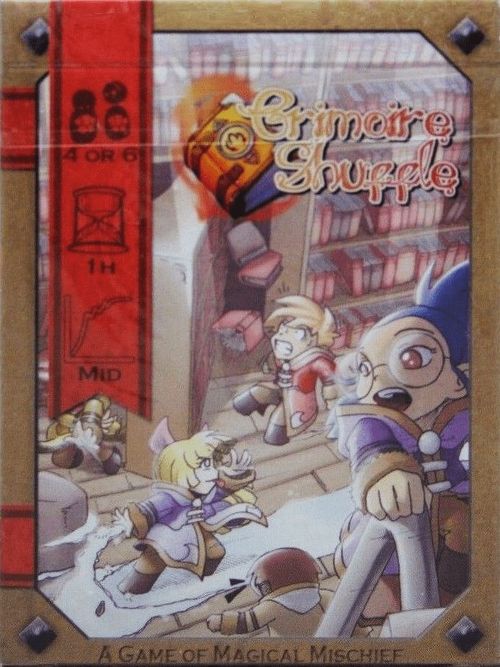
Grimoire Shuffle
Grimoire Shuffle Rulebook
Table of Contents
Table of Contents
Materials
- A 20-card Library Deck. These cards are double-sided to look like rooms of the library.
- 24 Grimoire Cards
- 4 Special Room Cards (Cold Room, Burned Room, Swamp Room, and Overgrown Room)
- 6 Player Badges
- 2 Leader Badges (Red team & Blue team)
- 6 player pawns or standups
Setting Up
Determine who will be on which of the two teams. Seat yourselves at the table so that teammates alternate seating. (See illustration below)
Leave the four special rooms off to the side for now. Shuffle the remaining library deck, then create a 3-by-5 game board by laying out cards (make the board 4-by-5 if there are 6 players instead of 4).
Place each player pawn at one of the short ends of the board (the one with fewer cards), such that each team has its own edge. Shuffle the Grimoire Cards to form a deck. Now you are ready to play!
Badges
There are two kinds of 'badges' in the game. These are purely informational cards that have reminder text on them. Player badges show which players own which pawns and which direction they are currently heading. Leader badges show which players are currently their teams' leaders.
The Blue Leader badge carries this reminder text:
- Give a book to each player on your team.
- Give a book to the leader of the opposing team.
- Place the remaining book face-down on this badge.
Advanced: If playing with Advanced Rules, reveal the book placed on this leader at the start of turns. Everyone on your team gets to use the 'leader' effect of that book!
First Turn
Give the Red Leader Badge to the player on the red team who most recently visited a library. Then randomly select one of the two players seated next to that player to have the Blue Leader badge. These players will be their respective teams' leaders during the first turn of the game.
Deal Grimoire cards to each team's leader. In a 4-player game, they get 3 cards. If there are 6 players, give them 4 cards. Players should orient their player badges to show which way they are currently headed in the library.
Grimoire Cards
Each Grimoire Card describes a series of steps that the player will execute on their turn. For example, the Earth Grimoire Card allows the player to flip a room, move up to 3 spaces, flip another room, and move 2 more spaces. A player who possesses this Grimoire Card must execute all of these steps in this order on his turn.
Rounds
A round takes place in two phases. In the first phase (Distribution), the team leader will distribute his Grimoire Cards. After this, each player will take one turn, going clockwise around the table and finally ending with the leftmost team leader.
1 - Distribution
Each team leader picks up the stack of Grimoire Cards that he or she has been dealt, and then selects one Grimoire Card to give to each of his teammates. After this, he selects one Grimoire Card to give to the opposing team leader. Place these Grimoire Cards face-down on top of the recipients' player badges. The remaining Grimoire Card he places face-down on top of his own leader badge. There should be exactly one Grimoire Card face-down on each badge at the end of Distribution.
Example: Red (the Blue Team Leader, fancy that) places the Earth Grimoire Card on his teammate's player badge, and Crystal on the opposing leader's player badge. The one remaining Grimoire in his hand is placed face-down on his own leader badge. The opposing leader places the Fire Grimoire Card on Red's player badge.
2 - Turns
The two leader badges will always be held by adjacent-seated players. The player to the left of the leftmost leader takes the first turn, and turns pass to the left (clockwise).
On a player's turn, he reveals the Grimoire Card he has received and executes all of the instructions on the card in order. Once he has completed these steps, he puts the card face-down underneath his team's leader badge.
If a player ends his turn at the far end of the board, he places his current Grimoire Card to the side of the table as a trophy. He then takes the top two cards of the Grimoire Deck and chooses one to keep and one to place on the bottom of the deck.
The new Grimoire Card goes beneath his team's leader badge as normal. He then changes the orientation of his player card to show that he is now heading back the other direction.
Given the starting positions above, this diagram shows how the leader badges move around the table each round. The right-hand leader is always the one to pass his leader badge, and he 'leapfrogs' over the player to his left when passing. Except for the very first right-hand leader, a player will hold his team's leader badge for 2 rounds before passing it.
End of Round
Once all players have finished executing the instructions on their Grimoire Cards, the round ends. Discard the Grimoire Card placed on the leader badge to the bottom of the deck, and draw a new Grimoire to replace it.
At this point, each leader badge should have the same number of Grimoires on it that it did at the beginning of the round.
The right-hand leader passes his leader badge and all cards on it to the next teammate to the left ("leapfrogging" the opposing team leader). If the game has not ended at this point, a new round begins.
Game End
The game proceeds until one team possesses a number of Trophy Grimoires equal to the number of players (so 4 in a 4-player game and 6 in a 6-player game). Not every player needs to collect a trophy to win—it is possible for one player to collect multiple trophies, as score is kept across the entire team.
If both teams complete this goal in the same round, a sudden elimination begins. The next team to collect a Grimoire Card during sudden elimination immediately wins the game.
Grimoire Actions
Move up to X spaces - Each movement must bring the apprentice to an adjacent, unoccupied space, and the apprentice must not pass through a wall. You can always choose to move less than the Grimoire instructs, including a movement of zero spaces. See the next page for some examples of movement.
Place a Special Room - A Special Room goes on top of any existing room. A Grimoire that places a Special Room may have some effect on apprentices already in the room. Otherwise, do nothing to the apprentices already in the room—they will continue to stand where they did when the room was first placed. If you need to place a Special Room that is already in the library, pick up that Special Room first (leaving apprentices in the same spaces in the room underneath) and place it as instructed.
Move any number of spaces in a straight line - Move the apprentice any number of spaces. All of these movements must be in the same direction. Players must stop at a wall when moving like this.
Rotate a Room - Rotate the selected room 180 degrees. Any apprentices in the room move with the room.
Move through a wall - The movement must be through a wall—you cannot choose normal movement instead.
Ignoring Walls - You can move as though there were no walls. Normal movement is still allowed.
Flip a Room - Move all apprentices off of the room, then pick up and flip over the room card. Rotate it as you wish, then replace it into the library. You may place all apprentices that were on that room back into the room in any arrangement you wish.
Teleport a player - Teleportation ignores all walls and obstacles, but you cannot teleport into a blocked space (such as the Overgrown Room or another player's pawn).
Switch places with another player - Pick up both apprentices and place each one down in the space the other previously occupied.
Rows - Spaces that do not carry an apprentice closer to or further from his destination are considered to be part of the same row. (Imagine facing your destination. Stepping sideways left or right keeps you in the same row.)
If a Grimoire Card contradicts these rules, follow the instructions on the Grimoire instead of the rulebook.
Board Edges
Each far edge of the board (the edges with fewer cards, where players start out) acts like one large space that is connected to all spaces on that edge. A player moving an apprentice can move that apprentice onto or off of an adjacent far edge, provided that edge is not blocked by walls (unless you can move through walls by a Grimoire effect, in which case you could move off any far edge of the board).
Leaders (Optional)
Once you've played the basic game a few times, you might be ready for an even deeper puzzle-solving competition. Leaders add the depth of multiple Grimoire interactions to Grimoire Shuffle.
Your head librarians have made a bet over which team of apprentices is the quickest. In order to hedge that bet, they utilize some spells of their own in order to turn the odds in their favor.
As more experienced casters, the Leaders are able to cast the more powerful spells in each Grimoire that will affect the entire library.
Each Grimoire Card has a LEADER effect in the bottom right corner of the card. If you are playing with LEADER effects, these will be activated between Distribution and Turns.
After Distribution is complete, both team leaders flip over the Grimoire Cards that were placed face-down on their Leader Badges and read the LEADER effects out loud. Those effects are active for the rest of the round.
Grimoire Cards on Leader Badges do not ever make use of the normal Grimoire effects printed on their Grimoire Cards (the ones apprentices use).
Optional Effects
A Grimoire or Leader effect is only optional if it contains the word 'may'.
When a Grimoire effect allows you to move 'up to' a number of spaces, you can choose to move zero spaces, if you wish.
Movement
The source rulebook refers to "examples of movement" on a following page. Those examples are not included in the rules PDF from the Minigame Library, which contains only pages 4 through 8 of the rules; the examples are therefore not transcribed here.