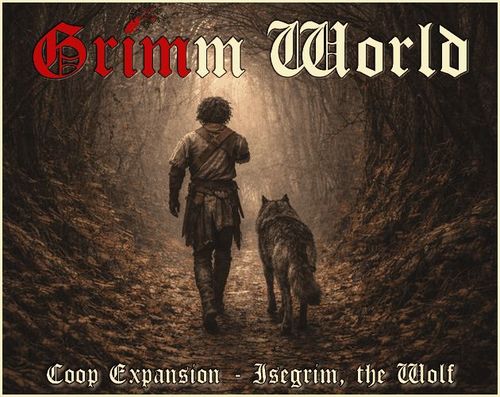
Grimm World: Isegrim the Wolf
Grimm World: Isegrim the Wolf Rulebook
Table of Contents
Table of Contents
1 Adaptions of the Rules
When this rulebook refers to the character, it is referring to Marta, Jakob, etc.
When this rulebook refers to Isegrim, it refers to the wolf.
When this rulebook refers to a game character, it is referring to the character and Isegrim.
1.1 Game Material
This expansion only contains Lost Pages cards. To play with this expansion, sort the cards into the Lost Pages deck.
You will also need a game figure for Isegrim.
1.1.1 Character Card for Isegrim
Isegrim's Character Card is very similar to the Character Cards, but they have a few small differences, which is why the cards are explained in more detail below.
Figure 1 – Isegrim's Character Cards
The following information can be found on Isegrim's character card:
- Isegrim: Name, temperament and image of the wolf.
- Combat Value: This value is used in the Adventure Mode and indicates how dangerous Isegrim is. The Adventure Mode will be introduced at a later date and is not yet available.
- Exploration Ability: Isegrim can use this ability during the Exploration Phase of the game.
- Combat Skills: Some Action Cards have a star (★) symbol. When such a card is played, the corresponding action on the Character Card is performed.
- Feeding: The Feeding Card (see chapter 1.1.3) is placed below the Character Card and indicates how much Isegrim has already been eaten.
- Temperament: The Temperament Card (see chapter 1.1.4) is placed above the Character Card and indicates how the animal's nature and character are developing.
- Skills: These are Isegrim's skills.
- Status Values: Isegrim's 9 status values are shown on the right-hand side of the card. These are the same as the character's status values but are only used in combat. During the Exploration Phase, the character's status values are used for checks, but can be improved by playing Isegrim's Action Cards.
- Carrying Value: If Isegrim loses all his health points, the character can carry the wolf with him until he finds provisions for his healing (see chapter 1.6).
- Skills: If the wolf learns any other skills, these are placed above his Character Card.
1.1.2 Action Cards for Isegrim
Isegrim receives Action Cards during the course of the game, which can be contributed to checks during Exploration or played as actions and reactions during Combat.
Figure 2 – Isegrim's Action Card
The Action Cards have a 'wolf' symbol under the grey area. This allows the Action Cards to be distinguished from those of the character.
1.1.3 Feeding Card
Figure 3 – Feeding Card (front and back)
The Feeding Card is placed underneath Isegrim and records how much Isegrim has already eaten. In the Rest Phase of the game, the player can discard provisions from the Storage Card (the Encounter Card is placed back under the Encounter Check) and heal Isegrim's life points in return. For each provision discarded in this way, the wolf heals damage equal to its Regeneration value (shown as an icon on the card). For each damage healed, the player takes one of Isegrim's discarded Action Cards, which is under his Damage Card, back into his hand. In addition, the Feeding Card is increased by 1, up to a maximum of 4. The value of the Feeding Card is referred to during the game.
1.1.4 Temperament Card
Figure 4 – Temperament Card (front and back)
The Temperament Card is placed above Isegrim and defines Isegrim's education. Based on its value, the wolf develops into a good-natured or bloodthirsty animal. Whenever the wolf goes hunting, kills someone in combat, trains with the character or helps with checks, the card is turned in one direction or the other, similar to the Alignment. Whenever the wolf grows, reference is made to the current value of the Temperament Card.
1.1.5 Damage Card
Figure 5 – Damage Card for the Wolf Cub
The Damage Card is the same as the one of the characters. This card lists the special rules that must be followed if Isegrim has all the Action Cards below the Damage Card. The Damage Card is part of the Lost Pages Deck, and the player is informed when the Damage Card is drawn and placed.
1.2 Setup
To use this expansion in the game, simply start a new campaign. Thanks to the new Y001d map, the storyline of Isegrim is automatically started as soon as the character enters a mountain space (G) on a Region Card for the first time.
1.3 Exploration
Isegrim and the character always travel together across the Region Cards. Thus, they always represent only one character and cannot separate.
During exploration, the character's status values are always used for checks, never Isegrim's status values. Isegrim's Action Cards, on the other hand, may be contributed to checks in the same way as the character's Action Cards. They are also discarded as damage afterwards.
If damage is caused by an encounter, the character and Isegrim always receive both this damage. What exactly happens when a game character's HP drops to 0 is explained in detail in chapter 1.5.
Isegrim can grow from a puppy to a full-grown wolf in the game if the character always feeds him well. During the Rest Phase, the character can feed Isegrim provisions. Isegrim heals damage equal to its Regeneration value (shown as an icon on the card) for each provision it eats. In addition, the Feeding Card is used to mark how much food Isegrim has already eaten.
1.3.1 A Unit
Unlike other people, creatures or animals that can join the character during the course of the game, Isegrim counts as part of the character. He always moves with the character across the game world. He rides a carriage with the character and can teleport with him using magic or magical items, even if humans, creatures or animals are excluded. Isegrim is an exception to this rule.
1.4 Combat
Compared to fighting with just the character, there are slight adjustments when Isegrim is included. These changes are described in the following subchapters.
1.4.1 Setup
During the step Figure Placement (see Rb. 8.1.2.2), Isegrim must be placed in a space adjacent to the character. Isegrim may also not be placed in a space where an enemy is placed.
1.4.2 The Combat Round
At the beginning of the character phase, it is decided whether Isegrim or the character takes his turn first. Only when one of the two has finished his turn is it the turn of the other game character.
Enemies always act on the game character closest to them. To determine which game character is closest to the enemy, the range is determined. If the distance to the character and to Isegrim is the same, the enemy always chooses the game character that has a higher priority due to the Decision Compass.
In Figure 6, enemy 01 executes Action Line 2. He receives 3 movement points and moves towards one of the game characters. Since the character and Isegrim are equidistant, the Decision Compass of the Conflict Card is checked. The character is on the left above the enemy and Isegrim is on the right above. The compass has a priority of 1 on the left and 3 on the right, so the enemy will move towards the character. First one field to the left (priority 1), then 2 fields upwards (priority 2) and then he performs an attack.
Figure 6 – Prioritization of the enemy
Spaces occupied by a game character block the line of sight to spaces behind them for enemies, but not for other game characters.
For the escape condition, both game characters must reach one of the escape spaces. If there is only one space to flee, one game character must stand in this space and the other in an adjacent space. If one of the game characters is defeated, you place its piece on the corresponding space. The defeated game character does not block the line of sight, and the enemies and the other game character can enter that space and also end their turn there. The other game character can no longer escape from combat because he would not leave the other behind. The character still has the option to carry the wolf and thus escape from combat. If the character moves into the defeated Isegrim's space, he can discard an action card to perform the 'Re-Equip' action (see Rb. 8.2.1.1). While re-equipping, he can pick up Isegrim (his card is placed as an item under the Character Card or Storage Card) and escape the combat with him.
If a game character is defeated, the other game character can still win the combat. After the combat ends and the corresponding entry of the Conflict Card has been resolved, the corresponding 'A game character is defeated' entry (see chapter 1.5) is resolved.
A combat is not considered lost until both game characters have 0 HP.
1.5 A Game Character is Defeated
Depending on which phase of the game one or both of the game characters lose all Hit Points, the game proceeds differently. This is explained below:
- Both game characters lose all HP during the Exploration: Lose 1 Chapter (Y030) and heal both game characters completely.
- Both game characters lose all HP during Combat: Resolve the corresponding entry on the Conflict Card, and if the resolution states that the character heals a certain amount of hit points, then Isegrim heals himself by the same number of hit points.
- The character loses all HP during the Exploration: Lose 1 Chapter (Y030) and heal both game characters completely. Isegrim guards the injured character and waits for him to recover.
- The character loses all HP during Combat, but the combat was still won: After the corresponding entry for the victory on the Conflict Card has been resolved, it is treated as if the character had lost all HP during the Exploration Phase, i.e. lose 1 chapter (Y030) and heal both game characters completely. Isegrim guards the injured character after the combat and waits for him to recover.
- Isegrim loses all HP during Exploration or during Combat, but the combat was still won: This case is handled differently depending on the evolution stage Isegrim. The exact procedure is described on the wolf's Damage Card.
1.6 To Carry a Wolf
Isegrim can be carried as a cub or young wolf. He can be picked up or put down during the Rest Phase. During a combat, if Isegrim is adjacent to the character, he can be picked up or put down with a Re-Equip action. If Isegrim is carried, he cannot play cards to boost a check and he cannot attack during combat. If the character loses all HP during a combat, he drops Isegrim. Place the wolf in an adjacent space and in the next Character Phase it can act normally if it still has HP.
When the wolf is carried, all cards attached to Isegrim (e.g. Feeding Card, Temperament Card, etc.) are placed in the same orientation under Isegrim's Damage Card.
1.7 Saving and Loading
At the end of each round, the game state can be saved. The cards for Isegrim are placed in the pile after the character's cards. The cards must be stacked in the following order:
-
- Isegrim's Character Card
- 1.1. Acquired Skills
- 1.2. Temperament Card
- 1.3. Feeding Card (with a value of 1-4)
- 1.4. Action Cards
- 1.5. Isegrim's Damage Card
- 1.6. Action Cards that are discarded as damage
- 1.7. Feeding Card (with a value of 0)
If Isegrim is being carried at the time of saving, the wolf is placed under the Character Card or the Storage Card accordingly. The Temperament Card and the Feeding Card with the current value are placed on Isegrim's Damage Card. If Isegrim has not yet been fed, the Feeding Card is placed below the Damage Card.
1.8 Adventure Mode
Per the printed text, Adventure Mode is not yet available in this release.
The following things are changed in Adventure Mode:
- Isegrim gives bonuses or penalties as indicated on his Character Card, depending on his development stage.
- When calculating the current health points, the Action Cards of both game characters are added together and divided by 2 (rounded up).
- After winning a combat, the character and Isegrim both lose the indicated health points.