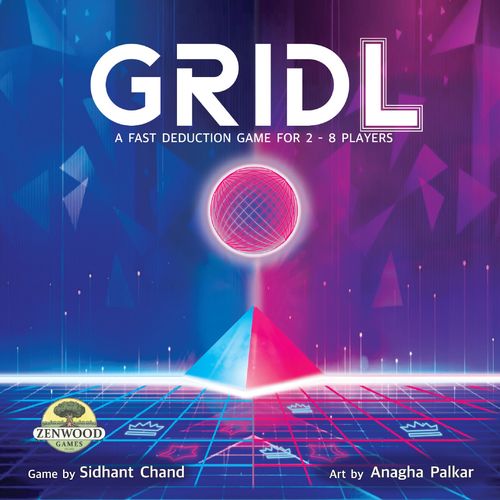
GridL
GridL Rulebook
Table of Contents
Table of Contents
Objective
The game of GridL is played between two teams (or cooperatively if playing less than 4 players). Cluegivers (or the Gridmaster) must successfully convey solutions coded on a 5x5 Grid, to their teammates. The catch - each axis of the grid gets a random generated word, and communication limiters force the Gridmaster to use restricted word clues connecting these two words! Teams hope to either be the first to reach 12 points on the score track, or have more points than the opponent team at the end of 6 turns - to win the game of GridL!
Components
- 85 Word Cards (Navy/Magenta Side)
- 1 Grid Board
- 12 X-Tokens / Power Tokens (Double Sided)
- 4 Player Tokens (Blue/Pink Side)
- 2 Block Cards
- 25 Solution Cards
Setup
- Place the Grid (Board) at the center of the table.
- Take all the 85 Word Cards and shuffle them well. Make sure all the faces are of a single color! (For your initial game, we suggest the Magenta-side of the word cards for play. You can use the Navy-side for more challenging games!) Once done, keep the stack of Word Cards beside the Grid Board.
- Shuffle the 25 Solution cards and place them facedown beside the Grid Board.
- If playing with 4 or more players, form two teams of equal team-members as much as possible. Each team collects two player tokens. They choose either Pink or Blue as their team color, and flip both their player tokens to the side representing their team color. For 2-3 players, check the alternate rules at the Variants section.
- Stack all the 12 X-Tokens (with X side up) and place them beside the Grid Board. Now you are ready to play the game.
- Decide which team goes first. That team starts at 0 points, and the team that goes second starts at 1 point. The respective player tokens are placed accordingly, as shown in the setup image.
Concepts
The Grid (Board): The Grid consists of 5 x 5 = 25 coordinates. It has 5 rows (numbered 1,2,3,4,5) and 5 columns (named A,B,C,D,E) So the intersection of each row and column has a unique coordinate, i.e, A1, B4, D2 etc. On the outer edges, two are used as axes to give words, and two edges contain a continuous score track numbered 1 - 12.
Word Cards: Each Word Card has 4 words; 2 on each side. The Magenta side has easier words, whereas Navy side has challenging words! Word Cards are tucked under the Grid to reveal a single word.
Solution Cards: Each Solution Card corresponds to the Grid on the table. The coordinates marked on it represent the range of solutions that will give the team 1, 2 or 3 points, if chosen correctly. In the game, teams are trying to guess these coordinates without knowing the contents of the card!
Every Solution card is UNIQUE! It has 1 KEY coordinate printed prominently on the card which grants 3 points if guessed. The card also has several peripheral coordinates that grant 1 or 2 points if guessed instead. Any coordinate beyond this solution range grants no points to the team, so teams must be careful when guessing the solution.
Player Tokens: One player token is used by teammates to guess solution coordinates on the grid, while the other is used as a counter to track their team's score.
X-Tokens / Power Tokens: Once a turn ends and correct solution is revealed, the X-tokens are used to cover the key solution coordinate on the Grid, reminding players that this solution won't appear in the future. Power Tokens are used in an advanced variant of the game, explained later.
(Block Cards: Instead of tucking the word cards beneath the board, you may alternatively keep the word cards oriented near the axis and use the Block cards to cover up the word not in use.)
Gameplay
In a turn, one team actively plays GridL in guessing the solutions. That team is called the guessing team, and the other team is called the passive team.
- The team that starts, chooses one teammate as Gridmaster for this turn.
- First, the passive team picks the top Word card from the word card deck, and chooses one of the two words to be used by the guessing team for this turn. Passive team may discuss among all teammates before finalizing the word. Then, they tuck the word card either on the Row or Column axis, only revealing their chosen word. This becomes the first word.
- Next, the guessing team picks the next top Word card from the deck and chooses one of the two words similarly. They may also discuss among themselves (excluding the Gridmaster, who may just shake or nod her head) and tuck the card beneath the other axis respectively.
- The Grid Board will now have one word on each of its row and column axes.
- Now, the Gridmaster picks a Solution Card from the top of the Solutions deck and secretly examines it. She must remain completely silent and cannot express or communicate in any way the contents of the Solution card just yet.
- Once she is done examining, the Gridmaster finally must give a clue to her other teammate(s), with the goal of helping them choose the key solution coordinate on the grid board, as per the solution card! The clue must be a noun or a phrase, which can be described by each of the two words, in the respective scale (Low-Medium-High) as denoted by the Key coordinate. Detailed rules around giving clues, along with examples, are mentioned later in the rulebook.
- Additionally, the clue must adhere to the following conditions:
- It must be within 1 – 5 words, and portray a single context
- It must neither be the exact words as present on the grid axes, nor a synonym or antonym of the words themselves
- It must not be a number or any value that hints towards a numeric coordinate on the Grid
- Once Gridmaster gives the clue, the remaining teammate(s) must try to connect it with both the words present on the axes, thinking which specific coordinate is being hinted at. They may discuss among each other into guessing the Key coordinate. The Gridmaster must not help, speak or express anything during this phase!
- To guess, the teammate(s) must unaniomously come to a conclusion, and use their player token to place it on one empty coordinate on the Grid, denoting their choice. Once placed they cannot change their decision!
To score, the respective player token is simply moved ahead that many spaces ahead, on the score track.
- The player token used for guessing is returned back to the team. The two word cards are removed from under the Grid and discarded back into the box.
- Irrespective of what the team guessed, one X-token is picked from the supply and placed on the KEY coordinate on the Grid, marking it as over. The Solution card is then discarded to the box.
Once this is done, the current turn is over. The passive team now becomes the guessing team, who takes the same sequence of steps as described. In subsequent turns, the guessing teams must choose a different Gridmaster than the one who played earlier.
End Game
The game goes on turn after turn, with teams alternating as guessing and passive teams, till the endgame is triggered. There are two possibilities:
- A: Any one team reaches (or crosses) 12 points at the end of their turn - That team is immediately declared the winner of GridL!
- B: No team is able to reach 12 points, and both teams have taken 6 turns each - Both teams check their respective scores. The team with the highest score, wins! In case of a tie, the team that didn't start the game, wins!
Tip: How to Give Clues in GridL?
Giving clues as the Gridmaster is the heart of the game GridL! Clues can be very abstract, as there is no limit to your imagination how you represent the solution in the form of word clues.
Each of the two axes scales from 5 range of degrees, notably: high, medium-high, medium, medium-low, low... while one can intuitively interpret these in any other scale they wish to. Every coordinate on the Grid therefore represents a unique intersection of two degrees of each axis, respectively.
Example: Let's say A1 is the KEY coordinate. The words for this turn are FAT and ICY.
A1 coordinate represents "high" FAT and "low" ICY. Some possible word clues with different interpretations are as follows:
- Lamb Chops (full of fat, served hot)
- A Furnace (since it is pretty huge and is always on fire!)
- The Incredible Hulk (bulky and hot-headed!)
FAT & ICY are interpreted in various ways!
Using this approach, the Gridmaster must try to think of a clue that represents specific degrees on both the words, as per the Solution card. Because of the two-dimensional clue giving nature of the game, some pair of words might pose a unique challenge to think of perfect clues. Do not get disheartened! Play with the spirit of the game - we have seen super weird but really good clues working out for teams.. think of abstract, meta-level, or indirect clues that may hint your teammates to translate into the solution! Like every other game, you get better as you play GridL more! :)
Example: In this case, the Gridmaster needs to give a clue that means "medium" on both CHARMING & DESERTED.
One such clue could be: September Afternoon in a Mall. The essence is that Septembers are neither unpleasant nor super charming.. and during afternoons it's neither full of people nor deserted in a mall.
The clues in the game are completely subjective, dependant on the chemistry and understanding between the teammates - Go crazy, go wild, go vivid when describing clues!
Co-operative Variant: For 2-3 Players
If playing GridL with less than 4 players, everyone works together as a single team. The rules are the same, except:
- The objective of the players is to reach or cross 12 points before 6 turns.
- Only 6 X-tokens are used in the game.
- There is only the guessing team and no passive team. Both words are chosen by the guessing team.
- After a turn is over, the Gridmaster simply changes to a different player and the game continues for 6 turns.
Advanced Variant: Powers (4+ Players)
For a more strategic gameplay, follow these additional rules during SETUP and GAMEPLAY:
Setup
- Instead of stacking all the 12 X-tokens, randomly flip any 8 of them to the other side. These are powers that you can use during the game to gain advantages (or to give your opponent team some disadvantages).
- Display all the 8 power tokens to both teams. Now, starting with the team that goes second, each team picks 1 available power token, turn by turn, and keeps it near them. Do this until all 8 tokens have been picked. So each team will end up with 4 different power tokens.
- From the 4 remaining X-tokens give each team 2 X-tokens. They cannot flip these X-tokens to the power side. So each team will have 4 power tokens and 2 X-tokens respectively to begin the game with.
Gameplay
In a turn, a team may use EXACTLY 1 power token. There are two types:
A: (Denoted by Single Dash) Must be used when you are the guessing team. Teammates can decide to use one of these powers in their turn, ONLY before their Gridmaster says the clue. The Gridmaster may contribute to decision making about the powers only by nodding or shaking her head.
- Team gains 1 additional point if at least the row is correct.
- Team gains 1 additional point if at least the column is correct.
- Gridmaster may reveal the Row of the solution along with the Clue.
- Gridmaster may reveal the Column of the solution along with the Clue.
- Team gains 1 additional point irrespective of the guess.
- Draw 3 cards from the Solution Deck and keep it secret, among your teammates only. These are 3 discarded solutions!
- Teammates gets to guess using two player tokens. Temporarily use the opponent teams' token for this turn. After revealing the solution, score only for one single, best guessed token.
B: (Denoted by Double Dash) Must be used ON the guessing team when you are the passive team. The guessing team should always ask the passive team first if they plan to use any power in this turn. Once the passive team has either used or decided not to use a power, the guessing team may or may not use one of their powers respectively. Post this, passive team must not change their decision!
-
Bet on the opponent guessing team. If they score at least 1 point, you also gain 1 point.
-
Bet on the opponent guessing team. If they do not score at least 1 point, you gain 1 point.
-
If opponent guessing team score only 1 point this turn, then they instead score 0 points!
-
If opponent guessing team score nothing this turn, then they lose 1 point!
-
After opponent Gridmaster has given the clue, your team may also guess the solution and place the player token on your team's choice of coordinate. Then the guessing team chooses as usual (can choose the same coordinate as well). If your team's guess is within the solution range (key or peripheral), you also score 1 point.
-
Once a power is used, the team that used it must flip it to X-token side and keep in their team's X-Token supply.
-
After a guessing team's turn, that team must use one of their own X-tokens in supply to cover and mark on the Grid. If they have no X-Tokens, they MUST flip one of their unused power tokens instead - so plan carefully!