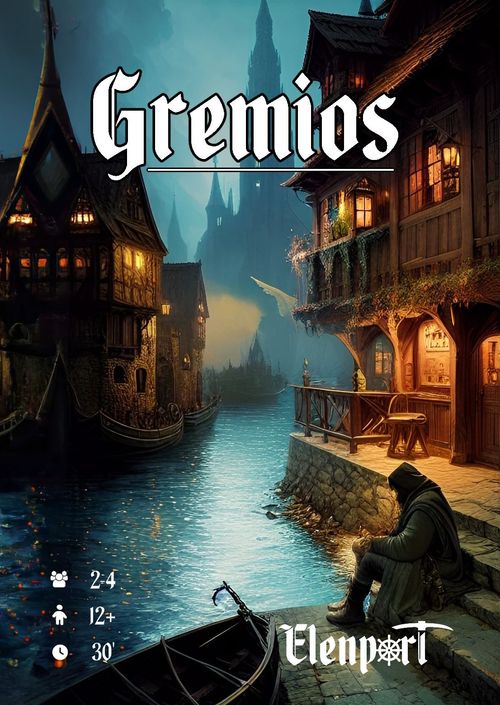
Gremios
Gremios Rulebook
Table of Contents
Table of Contents
Contents
67 cards (63x88mm):
- 12 character cards.
- 10 guild cards + 1 expedition card.
- Event deck.
37 cards (45x68mm):
- Resource decks: treasures, inns and lands.
- Discoverer emblem.
2 dice.
Rulebook.
120 medieval coins in 4 different colours.
Box with a medieval touch.
Card Types
Below you can see the different types of decks, which are easily recognisable by the illustrations on their backs and by their identifying icons.
Game Setup
- Place the expedition card on the table.
- Shuffle the Guild cards and place as many on the table as there are players. Mix the remaining ones with the rest of the event deck cards.
- Shuffle the event deck and set aside three random cards. These cards are added to the discard pile and are reshuffled when the event deck runs out.
- Each player randomly receives two role cards and three coins.
- The player who rolls the highest starts the game; from that point on, play proceeds clockwise. Before the game begins, each player chooses one of their characters, following the same order.
Initial card layout for a 3-player game.
Turn Phases
1. Event Phase
Reveal an event card and, depending on the card type, place it on the board or apply the action it indicates.
Types of event cards:
Guild Foundation
Guild foundation cards contain a small house icon with a number in the upper right corner.
Place the card on the board in its corresponding spot to found that guild.
In the figure above, you can see the foundation of the Quarry (4) guild.
You can find more information in the Guild foundation events section.
Action Event
Action cards contain a lightning bolt icon in the upper right corner.
Apply the action indicated on the card and place it in the discard pile.
In the example, you can see the application and subsequent discard of an action event.
You can find more information about these cards in the Action events section.
Temporary Event (Blockade)
Place the blockade card on the board in its corresponding spot. While it is active, the guilds it affects (indicated by the padlock icon in the upper right) will not generate resources.
A second blockade card of the same type would cause a mutiny in the affected guilds.
A third card would cause a bankruptcy, and all 3 blockade cards are sent to the discard pile.
You can find more information in the Temporary events section.
The mutiny and bankruptcy events caused by blockade accumulation produce the same effect as the action cards of the same name, but on both guilds. You can find more information about these events in the action events section.
2. Roll Phase
- Roll both dice (all rolls must be made using two dice).
- Apply the action of the previous event (if it depended on the roll).
- If a 7 is rolled, deactivate all temporary events, moving them to the discard pile.
- If a 7 is not rolled, give each player as many coins as they have invested in the guild whose number matches the roll (as long as it is not blocked by an event).
Example of coin distribution for a roll of 8. In the first case, the «gold» player receives two coins, and the «silver» player receives one. However, in the second case, nobody receives coins because there is a blocking event.
3. Collection Phase
The player receives one coin for their turn, and one additional coin for each non-destroyed inn. The Action events section explains how inns are destroyed.
Collection phase example: at the start of their turn, the player receives one coin plus one additional coin because they have a non-destroyed inn.
Note that although the current player has already completed the event phase and the roll phase, their actual turn does not begin until this phase. This means that any circumstance affecting the player's collection that occurred during those phases will be taken into account. For example, if a foreign invasion was revealed in the event phase, the player would not collect for inns destroyed by that event in the collection phase.
4. Investment Phase
As long as they have enough coins, players can perform the following investment or purchase actions during their turn:
| Action | Cost | Limit |
|---|---|---|
| Invest in guild | 2 coins (investment + reserve) | 1x/turn |
| Invest in expedition | 2 coins (investment + reserve) | 1x/turn |
| Buy land | 2 coins | No limit |
| Cultivate land | 1 coin | No limit |
| Build inn | 6 coins | No limit |
| Repair inn | 1 coin | No limit |
Note: The game includes 4 reference cards with the different costs and turn phases.
Investing in a Guild
The player may invest once per turn in any available guild; that is, any guild on the board that has capacity for another coin. This action costs two coins, one of which is placed on the guild in one of the circles to indicate the investment and the other goes to the reserve.
Example: the «silver» player invests in the «Farm» guild, so they must pay two coins: one goes to the reserve and the other is placed in the corresponding slot on the guild. Since in this case they have surpassed the «gold» player in number of investments, they use a coin from their reserve to place it in the upper left corner of the guild, indicating they are the top investor. This grants them a victory point, as we will see in the Victory Points section.
Investing in an Expedition
The player may also invest in an expedition once per turn (even if they have already invested in a guild) at a cost of two coins.
This action is similar to the previous one, with the difference that it is not necessary to use a coin to indicate who the top investor is, since the expedition card does not directly grant any victory points.
Example: the «bronze» player pays one coin to the reserve and places another in the corresponding spot on the «Expedition». In the Expeditions section you can find more information about expeditions.
Buying and Cultivating Land
Additionally, the player may buy land by paying two coins or cultivate it by paying one coin per plot. In a single turn, multiple plots can be bought and cultivated.
Example: the «bronze» player pays two coins to the reserve to acquire a plot. Afterwards, they can pay one additional coin to cultivate it, flipping the card.
Building and Repairing Inns
Additionally, the player may also build and repair inns during their turn.
Building an inn costs six coins, and the player must have a plot of land (cultivated or not) on which to build it. If they don't have one, it can be bought in the same turn. When an inn is built, the land is returned to the land deck.
On the other hand, repairing an inn costs one coin.
Example of building an inn: initially, the «gold» player has 8 coins. They also have 1 destroyed inn, 1 cultivated plot and 1 uncultivated plot. They decide to build an inn on the uncultivated plot; so they pay 6 coins and lose that plot, i.e. they return it to the corresponding deck.
Example of repairing an inn: afterwards, they pay 1 additional coin to repair the destroyed inn (by flipping the card).
Victory Points
The game ends when a player obtains 10 victory points. At that moment, that player rises as the most influential person in Elenport.
There are several ways to earn victory points:
- Become the top investor of a guild → +1 victory point.
- Build an inn → +2 victory points.
- Acquire a treasure → +1 or +2 victory points.
- Obtain the discoverer emblem → +1 victory point.
Cards that grant victory points include a seal with one or two ribbons in the upper left corner. One ribbon indicates one victory point and two ribbons indicate two victory points.
Example of cards that grant victory points.
The different ways to earn victory points are detailed below.
1. Top Investor of a Guild
The player who has the most investments in a guild becomes the top investor of that guild. If there is an equal number of investments, the player who invested first always prevails.
If a player becomes the top investor of a guild, they must make sure to indicate it by placing a coin of their colour in the upper left corner (covering the seal), as shown in the figure above. This coin is mandatory and does not represent an additional cost beyond the investment (2 coins), so they can use a coin from their reserve for this purpose.
Note also that the order of investment and therefore coin placement is from left to right and top to bottom.
2. Inns
Each inn grants the player who owns it two victory points, as long as it is not destroyed. Inns are destroyed when the Foreign Invasion event occurs. As mentioned previously, inns can be repaired so that they once again grant victory points.
3. Treasures
Treasures are special resource cards that players can obtain after successfully completing an expedition in which they have invested.
There are three types of treasures:
- Wealth, which does not grant victory points, but the player can exchange it for 3 or 4 coins, as indicated on the card, during their turn.
- Common treasure, which grants one victory point.
- Rare treasure, which grants two victory points.
Types of treasure: common treasure, rare treasure and wealth.
Each player's treasures must be kept hidden and should only be revealed when the game ends, except for wealth treasures, which the player may exchange at any point during their turn for the number of coins indicated in the upper left corner.
In the Expeditions section you can find more information about expeditions.
4. Discoverer Emblem
The discoverer emblem is a special card awarded to the player who has the most treasure cards in their possession (with a minimum of two cards).
Discoverer Emblem card.
A player can take the emblem from another player if they surpass them in number of treasure cards.
Additionally, a player can lose the Discoverer Emblem when exchanging a wealth card for coins. Two cases can be distinguished:
- The Emblem is given to another player if they have more treasure cards than the player who used the wealth card after discarding it (as long as they have a minimum of two treasure cards).
- The Emblem is discarded if there are several players who meet the above condition and have the same number of treasure cards; or if no player has at least two treasure cards.
In the second case, the emblem would go to whichever player breaks the tie or obtains two treasure cards first.
In the Expeditions section you can find more information about expeditions.
Expeditions
Expeditions take place when one of the following situations occurs:
- The «Expedition» event appears.
- All investment slots on the expedition card are filled.
When the expedition sets sail on a player's turn, that player must roll the dice. If the result is 6, 7 or 8, the expedition is considered successful, and all players who invested must take, in order (from left to right and top to bottom), one treasure card for each investment they made.
In the left image the expedition event appears; the expedition takes place even though there are only two investments. In the right image, the «Gold» player invests in the last available slot and the expedition takes place immediately. Note the distribution of treasure cards and the emblem in each case.
On the other hand, if the result is not 6, 7 or 8, the expedition is considered a failure, and no player receives treasure cards.
Finally, regardless of the expedition's outcome, all investments made must be returned to each player's coin reserve.
Event Cards
When the event deck runs out, the discard pile is shuffled including the 3 cards that were randomly removed. Then, 3 cards are again randomly set aside.
Below, all types of event cards are detailed.
1. Guild Foundation Events
Guild foundation events are a great occasion in the city, as they offer new investment opportunities and are essential for the development of Elenport.
When a guild foundation event is revealed from the event deck, the guild is considered active for the rest of the game and is placed on the mat (or on the table) in its corresponding position (see the layout in the image below). There are a total of ten cards, numbered 2 through 6 and 8 through 12.
At the start of the game, as many guilds are placed as there are players. The rest will appear as cards are revealed from the event deck.
Example with all guilds arranged in the correct order.
2. Action Events
Action events define specific occurrences that happen in the city. Once the effect is applied, the card is placed in the discard pile.
Various action event cards.
Note that some action cards depend on the subsequent roll to apply their effect. This is indicated on each card.
The effect of each action card is detailed below.
Good Harvest
With the «Good harvest» event, all players receive one coin for each cultivated plot they own.
Good harvest example: in this case, the player would receive two coins: one for each cultivated plot.
Age of Prosperity
With the «Age of Prosperity» event, all players receive 1 coin, and all active temporary blockade events are moved to the discard pile.
Age of Prosperity example: all players receive 1 coin and temporary events are removed.
Expedition
With the «Expedition» event, a maritime expedition takes place (as long as there is at least one investment). This event also occurs when the fourth investment is made on the expedition card.
In both cases a roll is made that determines the expedition's success/failure:
- The roll is 6, 7, 8 → success.
- The roll is any other number → failure.
If the expedition is successful, all players who invested in the expedition will receive a treasure card. You can find more information and examples of how an expedition is resolved in the Expeditions section.
Bad Harvest
With the «Bad harvest» event, all players lose the cultivation of one of their cultivated plots (if they have any).
Bad harvest example: in this case, the player loses cultivation on one of their cultivated plots.
Bankruptcy
The «Bankruptcy» event causes the guild affected by the next roll to lose all its investments. Therefore, no coins are received from the roll and the top investor's victory point for that guild is lost.
Bankruptcy example: the red player loses two investments and one victory point. The green player loses one investment.
The guild is not removed from the board and the current player could invest in it again.
Mutiny
The «Mutiny» event causes all players who have invested more than once in the guild affected by the next dice roll to lose one investment. With this event, coins can still be collected after the corresponding removal of investments (as long as the guild is not blocked for any other reason).
Mutiny example: the red player loses one investment, but does not lose the victory point. The green player loses nothing since they only had one investment. As long as there was no blocking event preventing it, both players would receive one coin for the roll in their collection phase.
Note that a mutiny event never causes a change in top investor of a guild, regardless of the order in which the remaining coins were originally placed.
Foreign Invasion
The foreign invasion causes half of all players' inns to be destroyed. If they have an odd number of inns, one additional inn is destroyed.
Foreign invasion example: in this case, the player must flip two active inns.
Land Expropriation
The «Land expropriation» causes all players to lose half of their land holdings. If they have an odd number of plots, they lose one additional plot.
Players may choose which plot(s) to discard, choosing between cultivated and uncultivated plots.
Land expropriation example: in this case, the player must discard two plots of their choice.
It is worth mentioning that inns are not affected by Land expropriation, even though having a plot was required to build them.
Tax Collection
The «Tax collection» event causes all players with four or more coins to lose half of them. If they have an odd number of coins, they lose one additional coin.
Tax collection example: in this case, the player had five coins, so they lose three.
3. Temporary Events
Temporary events describe situations that block the normal development of activity and commerce in the city for a certain period, specifically until a 7 is rolled or the Age of Prosperity event card appears.
Various temporary event cards.
The Mine Collapse, Material Shortage, Trade Blockade and Famine events work similarly, but each affects a different group of guilds. This is indicated by a padlock icon in the upper right corner of the card. For example, the Material Shortage event blocks guilds 4 (Quarry) and 10 (Sawmill).
As previously mentioned, these events must be placed in the space between both guilds.
Example of Trade Blockade event placement.
Guilds affected by one or more blockade events stop generating coins for players who have invested.
Example of a blockade: in this case, even if a 5 or 9 is rolled, no player would receive coins, despite having investments, since there is an active blockade event affecting those guilds.
Some characters have special abilities that allow them to receive coins even when blockade events are active. This is explained in more detail in the Roles section.
On the other hand, a second blockade event of the same type; that is, a second Trade Blockade or a second Famine, for example, would cause a mutiny in the affected guilds (if they are already on the board).
Example of a second blockade event: a mutiny occurs in each of the affected guilds. In this case, the first mutiny has no effect, but the second causes the blue player to lose their second investment in the Market.
The accumulation of a third blockade event causes a bankruptcy in the affected guilds (if they were already on the board), meaning all investments in those guilds are lost. The blockade events are sent to the discard pile, but the guilds are not removed from the board.
Example of a third blockade event: all investments made in the affected guilds are lost. The blockade events are sent to the discard pile.
The Plague event causes players to stop receiving coins from their guild investments, except for the Church and the Monastery; that is, while this event is active, only rolls of 2 (Church) and 12 (Monastery) generate coins.
Plague event example: in this situation, a roll of 5 would not generate resources, even though there is no specific blockade event (Trade Blockade). However, a roll of 12 would still generate one coin for the player with the gold coins.
Two-Player Games
Two-player games are similar to 3 or 4-player games, with some differences detailed below.
Game Setup
Instead of placing as many guilds as there are players, 3 guilds must be placed. The rest of the setup remains identical to what is explained in the Game setup section.
Each Player's Turn
The only difference compared to 3 or 4-player games is that each player takes two consecutive turns, except for the starting player, who only has a single turn in the first round.
In each of those turns, all phases described in the Turn phases section are carried out.
Note: Some roles have slightly modified abilities for two-player games. This is indicated on the cards themselves with the abbreviation PvP (player versus player).
Gremios Ultimate Duel
If you love challenges, there is an alternative game mode for experienced player duels in which each player controls two roles simultaneously, increasing the difficulty since it requires collaboration between a player's roles.
You can find more information at Gremios Ultimate Duel.
Roles
Role cards represent the citizens of Elenport. Each role has two different abilities, which you should consider when choosing your strategy to achieve victory.
Below, the abilities and some details of the different roles are explained.
Archbishop
Abilities:
- The Church and Monastery guilds grant them 2 victory points.
- Receives 1 coin each time another player invests in the above guilds or buys land.
Craftsman
Abilities:
- Once per turn, they may buy or sell a treasure for 4 coins.
- They may make their first investment in the Smithy and the Jewellery Shop at no cost; that is, they can place the coin directly from their reserve without paying anything.
Additional notes:
- Treasures sold by the Craftsman work the same way as when exchanging a wealth card for coins; that is, the card is discarded and not mixed with the treasure deck, with the only difference being that it is discarded face down. Additionally, the same rules apply regarding losing the «Discoverer Emblem».
- If the Smithy or Jewellery Shop are affected by a bankruptcy, they may once again make their first investment at no cost.
Doctor
Abilities:
- Receives 1 coin from their reserve when the «Foreign Invasion» event occurs.
- Receives 2 coins when the «Plague» event is deactivated for each guild where they are the top investor; except for the Church and Monastery.
Governor
Abilities:
- Obtains all coins lost from the «Tax Collection» event, both their own and other players' (the latter in their corresponding coin colour).
- At the start of their turn, they reveal two events instead of one, and may apply whichever one is most beneficial during their turn, leaving the other event for the next player's turn.
Additional notes:
- If only one card remains in the event deck at the start of their turn, the Governor may only apply that event.
Innkeeper
Abilities:
- Starts the game with two uncultivated plots available.
- Receives 1 coin from their reserve each time another player builds an inn.
Master Builder
Abilities:
- 1 coin reduction in the inn construction price. Therefore, they can build inns for only 5 coins.
- Once per turn, they may repair 1 destroyed inn at no cost.
Mercenary
Abilities:
- Once during their turn, they may pay one coin to cause a mutiny in a guild of their choice, as long as they have previously invested in it.
- When the Foreign Invasion event occurs, they receive one coin for each inn destroyed belonging to rival players.
Additional notes:
- Mutinies caused by the Mercenary work exactly the same as mutinies produced by the event card or by accumulation of two blockades, and can also affect the Mercenary's own investments.
- Regarding the coins received for inns destroyed by the Foreign Invasion event, it should be noted that they will only receive coins for those destroyed by the most recent event; in other words, they will not receive coins for inns that were previously destroyed.
Peasant
Abilities:
- Can cultivate one of their plots at no cost once per turn. This action can be performed at the same time as the plot purchase.
- If when the Good Harvest event occurs they have more cultivated plots than all other players combined, they receive 1 additional coin per rival player.
Pirate
Abilities:
- Receives all coins lost in failed Expeditions (including their own and all in their coin colour). For example, a failed Expedition with three investments would result in a payment of three coins to the Pirate.
- Can collect from the «Market» and «Port» guilds even when the «Trade Blockade» event is active. However, they are still affected by mutinies and bankruptcies caused by the accumulation of this event.
Additional notes:
- If the expedition fails during the Pirate's turn and they receive coins, they can use them during that turn; however, as a general rule, they can only invest once in an Expedition.
Shopkeeper
Abilities:
- Receives 1 coin from their reserve each time another player invests in the «Farm» or the «Tavern». The investment cost for them in those guilds remains at two coins, as for all other roles.
- At the start of their turn, they receive 1 additional coin for each active «Famine» event.
Stowaway
Abilities:
- If there are no investments in Expedition, they may invest for free, i.e. they can place the coin directly from their reserve. Additionally, each time the Expedition event is revealed, and as long as they have not invested, they may add an investment at no cost before it is resolved.
- If at the start of their turn they have three (4 in two-player mode) or more investments between «Expedition» and «Port», they receive one additional coin. For example, if they had one investment in «Expedition» and two in the «Port», they would collect that additional coin.
Additional notes:
- If the Expedition event is revealed during the Stowaway's turn and they manage to sneak onto the ship using their first ability (having not previously invested), this action does not count as an investment. Therefore, they could invest again in Expedition during their investment phase, and in fact, they would do so for free since it would be empty.
Trader
Abilities:
- Unlike other roles, they may repeat the guild/expedition investment action. This means that in a single turn they could invest twice in a guild and once in an expedition, or invest once in a guild and twice in an expedition, as long as they have enough coins to do so.
- Receives as many coins as investments lost when a mutiny or bankruptcy occurs in a guild where they have invested, including those caused by event accumulation.
FAQ
Are the event and roll phases considered part of the player's turn? How do events that occur in these phases affect them?
In the Turn phases section, the following phases are described as part of the player's turn: 1. Event phase, 2. Roll phase, 3. Collection phase, 4. Investment phase.
However, the player's actual turn does not begin until the collection phase. This means that any circumstance affecting the player's collection that occurred during the event or roll phases will be taken into account. For example, if a foreign invasion was revealed in the event phase, the player would not collect for inns destroyed by that event in the collection phase.
Do guilds generate resources on the rolls used to determine the guild affected by mutiny and bankruptcy, and to determine the success of an expedition event?
Yes, they do generate resources. In the case of mutiny and bankruptcy, they generate resources once the effect is applied, which means they do not actually generate resources in the second case (bankruptcy).
Do guilds generate resources on the roll used to determine the success of an expedition when all 4 investment slots have been filled?
No, in this case they do not generate resources, since the roll was not made during the roll phase.