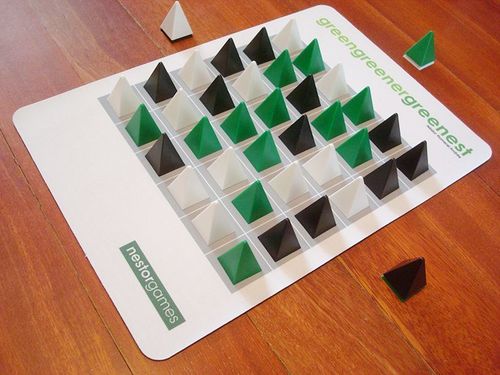
Green (Nestorgames)
Green (Nestorgames) Rulebook
Table of Contents
Table of Contents
Introduction
Green, Greener and Greenest are three games¹ that use the same set of components. Green is a game for 3 players derived from The House Of The Flying Blades and brother game of RED and BLUE, by the same designer, that uses a non-transitive capturing mechanism². Greener is a capturing game for 2 players, where both must capture the same colour. Greenest is a solo puzzle with the same mechanism as Green.
Footnotes:
- Somehow reminiscent of Sid Sackson's Focus (1963) and other games inspired by it.
- Also cleverly implemented in 18 Ghosts, by Michael Rieneck (nestorgames).
- It can be played on any rectangular board with a number of cells divisible by 3.
- Any stacking piece will do. There is a well known gaming system that uses pyramids, but I ignore how many sets you need to play Green.
- You might be tempted to cheat by placing them in such a way that benefits you, but the more random the setup is, the more fun you'll have playing the game.
Material
Depending on the set³, you'd have:
- Basic: a 6 x 6 board, 15 black pyramids, 20 green pyramids, 15 white pyramids.
- Advanced: a 6x9-9x9 board (using one or both pads), 30 black pyramids, 45 green pyramids, 30 white pyramids.
The pyramids are stackable⁴. There are more than needed, in case you lose any. Don't step on them!
Definition
A 'stack' is either one pyramid or several pyramids stacked on top of each other.
Figure: a single green pyramid, and a taller stack made of a white pyramid on top of a black pyramid on top of a green pyramid.
A stack is controlled by the colour of the topmost pyramid. So a 'Black' stack is a stack of any height with a black pyramid on top, and so on...
Setup
Place the board in the middle of the playing surface.
Determine the board size (6x6, 6x9 or 9x9) Randomly fill the board with the same number of pyramids of each colour (black, green and white), one on each cell⁵. Keep the remaining pyramids inside the case.
Each player has an allocated colour (Black, Green or White). Turn order is Black-Green-White. Players sit accordingly. Tournament mode is recommended (see below).
Black takes a black pyramid and a green pyramid from the game case and stacks the black one on top of the green one, placing the stack before her, outside the board. This is to remind players that Black stacks capture Green stacks (by stacking on top of them).
Green does the same with a green pyramid on top of a white pyramid. This means Green captures White.
White does the same with a white pyramid on top of a black pyramid. This means White captures Black.
How to Play
Black starts. Players take turns (Black-Green-White) during the game until all players pass in succession.
On your turn, you must make one capture if possible. Otherwise you pass the turn. Notice that passing the turn doesn't mean that you're out of the game, as further capturing opportunities may arise.
Stacks capture other stacks that are on the same row or column and with no other stacks in between them, by stacking on top of them. Stacks cannot be split.
As mentioned above, Black can only capture Green; Green can only capture White; White can only capture Black.
Figure: a fan of three triangles (white, green and black) showing the capture cycle.
Example: Black stack 'a' can only capture stack 'b'. 'c' can't be captured by 'a' because it's black. 'd' can't be captured by 'a' because it's white. 'f' can't be captured by 'a' because there is a stack in between.
The game ends when all players pass in succession. The player with the highest combined height of controlled stacks wins the game. In case of a tie, the player with the highest stack wins. If the tie persists, play again (except in tournament mode).
Tournament Mode (Recommended)
In tournament mode, three games are played (players rotate colours). Players score as many points as the total heights of their stacks during the 3 games. The highest score wins.
Strategy
- Avoid creating stacks too high, as if captured by an opponent, several points will be lost (unless you have a plan).
- In the following example, Green loses no matter whose turn is it. So it might be better to keep your pieces on the periphery.
Figure: a white, a green and a black pyramid in a row, captioned "Green loses".
- Try to reach places where your stacks aren't threatened, right from the start.
- Try to maximize the number of possible captures on your turn.
- Manage the 'tempo'. Sometimes delaying the capture of a given stack can be a good idea, as that stack can first capture other stacks and grow bigger.
- Running away from a threatening stack in the same direction is not a good idea, as that stack can still capture you from away. Escape orthogonally instead.
Figure: a black stack 'a', a green stack 'b' and two light stacks on a grid, with a red arrow from 'b' towards the upper light stack and a green arrow from 'b' towards the lower one.
Example: avoid capturing in the direction indicated by the red arrow. Go in the direction of the green arrow instead.