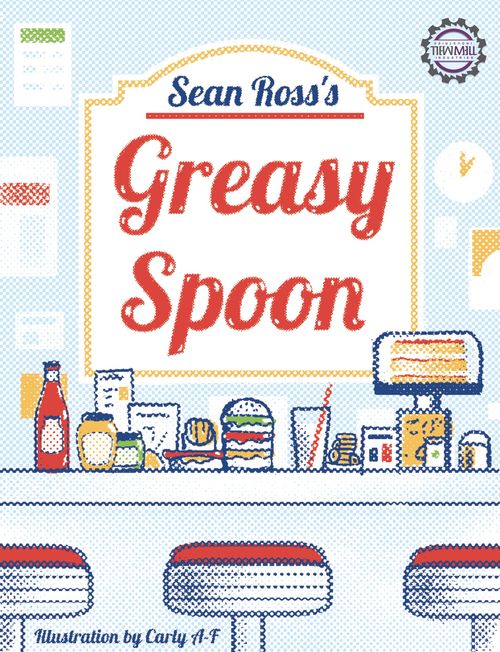
Greasy Spoon
Greasy Spoon Rulebook
Table of Contents
Table of Contents
Game Overview
Game Objective: Shed your entire deck first.
Players: 2
Duration: 20-30 minutes
Equipment: Two 54-card decks, one for each player.
Publisher Note: The card backs for each player's deck should be different so it's easy to tell which deck belongs to which player.
These rules are organized as follows:
- Setup
- Play
- Scoring
- Winning One Game
- Playing a Match
- Winning a Match
Setup
- Players sit across the table from one another.
- Provide each player with their own deck of 54 cards, made up of 3 suits (ketchup, mustard, and relish) with 3 copies of the following ranks, in each suit: (low) 1 2 3 4 5 6 (high).
Play
A game of Greasy Spoon is played over one deal. It consists of the following:
- Dealing the Cards
- Determining the Starter
- Playing a Deal
- Ending a Deal
Dealing the Cards
- Each player shuffles their own deck and deals a hand of 11 cards, face-down, to themself.
- Each player places the undealt deck in a position where they can reach it. This is the player's draw deck.
Determining the Starter
For the first game, pick a Starter. To determine the Starter in subsequent games, see the section "Playing a Match."
Playing a Deal
Each deal is played over a number of rounds. Each round consists of the following:
- Starting a Round
- Menu Items & Menu Combinations
- Continuing a Round
- Serving a More Expensive Dish
- Passing
- Drawing Cards
- Ending a Round
- Starting the Next Round
Starting a Round
The Starter leads the first round by playing a card combination, which is called serving a dish, face up in front of themself. Each player has their own card pile, which is called the service area, on which they play all their orders. Don't mix card piles between players.
This first dish begins the Starter's service area for the round. The Starter serves all subsequent dishes into this area. The other player will serve their dishes into their own service area.
Menu Items & Menu Combinations
There are two kinds of card combinations or dishes: Menu Items and Menu Combinations.
There are three categories of Menu Items: Drinks, Sides, and Mains.
Each category corresponds to the number of cards in the Menu Item. When a category has more than one Menu Item in it, the later Menu Items are higher ranked or more expensive than the earlier ones. The following table lists all the possible Menu Items:
MENU ITEMS
| Menu Item | Description | Example |
|---|---|---|
| Drinks | ||
| Soda | One card played by itself | Ketchup 2 |
| Sides | ||
| Rings | Two cards of consecutive rank | Mustard 3 - Relish 4 |
| Fries | Two cards of the same rank | Ketchup 6 - Relish 6 |
| Fancy Rings | Two cards of consecutive rank and the same suit | Mustard 5 - Mustard 6 |
| Fancy Fries | Two cards of the same rank and the same suit | Ketchup 1 - Ketchup 1 |
| Mains |
In general, each category has consecutively ranked cards being weaker than sets of cards with the same rank, and cards with the same suit are stronger than cards with different suits.
There are two types of Menu Combinations. Both types have one menu item from Mains and then one menu item from Drinks (if it is a Combo 1) or Sides (if it is a Combo 2).
MENU COMBINATIONS
| Combo Type | Description | Example |
|---|---|---|
| Combo 1 | 1 Main & 1 Drink | A Hotdog & Soda: Mustard 4 - Ketchup 5 - Relish 6 & Mustard 2 |
| Combo 2 | 1 Main & 1 Side | A Cheeseburger & Fries: Ketchup 5 - Ketchup 5 - Relish 5 & Mustard 1 - Relish 1 |
Always ANNOUNCE your dishes as you serve them!
Continuing a Round
After a player leads a combination (serves a dish), play proceeds clockwise with each player either:
- Serving a more expensive dish or
- Passing
Serving a More Expensive Dish
You can only serve a more expensive dish of the same type that was previously served.
Higher-Ranking Menu Items
If your opponent served a dish with a Menu Item, then you can only serve a Menu Item from the same category. It must either be:
- The same type of Menu Item but with higher ranking cards or
- Any of the more expensive items in the same category.
Explicitly: You can beat Rings with higher ranking Rings or with any serving of Fries, Fancy Rings, or Fancy Fries. Similarly, you can beat Fries with higher-ranking Fries or any serving of Fancy Rings or Fancy Fries. You can beat Fancy Rings with higher-ranking Fancy Rings or any Fancy Fries. And, finally, you can only beat Fancy Fries with higher ranking Fancy Fries.
This works the same for Mains. You can beat Hotdogs with higher-ranking Hotdogs or any Cheeseburger, Fancy Dog or Fancy Burger. You can beat Cheeseburgers with higher-ranking Cheeseburgers or any Fancy Dog or Fancy Burger. You can beat Fancy Dogs with higher ranking Fancy Dogs or any Fancy Burger. But you can only beat Fancy Burgers with higher ranking Fancy Burgers.
You can beat a Drink only with a higher-ranking Drink.
You CANNOT beat a Menu Item by serving a Menu Item from a different category.
You CANNOT beat a Menu Item by serving a Menu Combination.
Higher-Ranking Menu Combinations
If your opponent served a Menu Combination, then you can only serve a Menu Combination of the same type. So, if your opponent served a Combo 1, then you can only serve a higher ranking Combo 1; if your opponent served a Combo 2, then you can only serve a higher ranking Combo 2.
You CANNOT beat a Combo 1 by playing a Combo 2.
To serve a higher-ranking Combo 1, you must either:
- Beat the Main portion of the combo (in which case it does not matter which Drink you serve) or
- Match the Main portion, but then you must serve a higher-ranking Drink.
Example: If your opponent serves a Fancy Dog (Relish 1 - Relish 2 - Relish 3) and a Drink (Mustard 5), then to beat this you would either need to serve:
- A higher ranking Fancy Dog (Mustard 2 - Mustard 3 - Mustard 4 or higher) and any Drink (from 1 to 6) OR
- Any Fancy Burger and any Drink OR
- The same rank of Fancy Dog (Ketchup 1 - Ketchup 2 - Ketchup 3) but with a higher ranking Drink (Relish 6).
Serving a higher ranking Combo 2 works in the same way: You must either:
- Beat the Main portion (in which case it does not matter which Side you serve) or
- Match the Main portion, but then you must serve a higher ranking Side.
Example: If your opponent served a Fancy Dog (Relish 1 - Relish 2 - Relish 3) and Fancy Rings (Ketchup 4 - Ketchup 5), then to beat this you would either need to serve:
- A higher ranking Fancy Dog (Ketchup 2 - Ketchup 3 - Ketchup 4 or higher) and any Side (from Rings to Fancy Fries) OR
- Any Fancy Burger and any Side OR
- The same rank of Fancy Dog (Mustard 1 - Mustard 2 - Mustard 3) but with a higher ranking Side (Fancy Rings Relish 5 - Relish 6 or any Fancy Fries).
Passing
If you cannot or are unwilling to serve a higher-ranking dish, you must pass (say "Order up!"). If you pass, the round ends.
Backburner
If you pass, you may set aside up to 3 cards. The set aside cards form a pile separate from your draw deck, which is called your backburner.
Drawing Cards
Whenever you have fewer than 11 cards in your hand, immediately draw cards from your draw deck until you have 11 cards again or until your draw deck is empty. You always immediately refill your hand to 11 cards, including after serving any dish or after putting any cards into your backburner. Note: You may never have more than 11 cards in your hand.
Whenever the draw pile is empty, you MUST shuffle your backburner cards (if any) to form a new draw pile.
(Optional) If you have cards in your backburner, you MAY always move your backburner pile atop your draw pile and then shuffle this pile to form a new draw deck.
Ending a Round
A round ends as soon as one player passes or one player goes out (in which case, the game also ends).
A player goes out when they have played the last card from their hand and there are no cards remaining in their draw deck.
Starting the Next Round
When the round ends, if the game has not also ended, then whoever served the most expensive dish is the round winner. Players clear their service areas. The round winner starts the next round.
Ending the Deal
The deal ends immediately after one player has gone out.
Winning One Game
If you go out first, you win one game.
Playing a Match
If you would like to play a Best of 3 or Best of 5 match, then after each game, reshuffle your decks, and the new Starter is the player that did not start the previous game.
Winning a Match
If you win two games in a Best of 3, you win the match!
If you win three games in a Best of 5, you win the match!
The Team
- Designer: Sean Ross
- Concept: Elijah Ross
- Writing: Shreesh Bhat, Raymond Gallardo & Sean Ross
- Logo: Carol LaGrow
- Playtesters: Adley, Robert B., Shreesh Bhat, Jonathan Cox, Nahvid Etedali, Daniel Newman, Taylor Reiner, Jake Stanley, Bert Trobaugh, Daniel G. Vieu, Peter Winckles
Greasy Spoon v1.2.1. Last Updated 25/02/2024. Originally Published 14/03/2023.
This work is licensed under a Creative Commons Attribution-NonCommercial-NoDerivatives 4.0 International License.