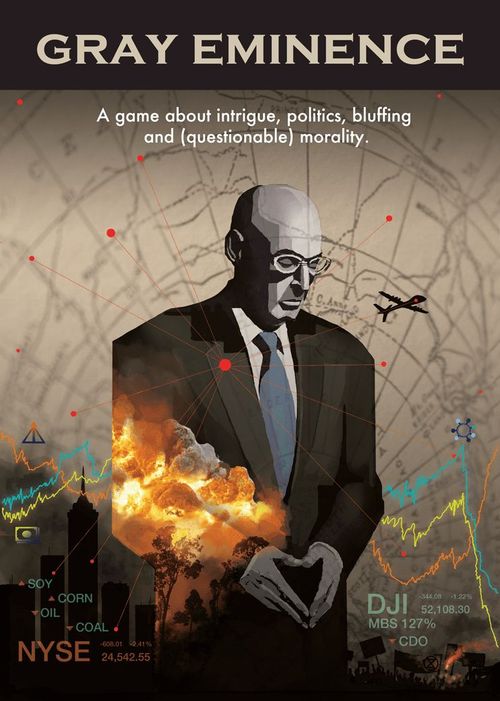
Gray Eminence
Gray Eminence Rulebook
Table of Contents
Table of Contents
- Game Components
- Game Overview
- Glossary
- Game Setup
- Playing the Game
- Round Phases
- 1. Refresh phase (in turn order)
- 2. Event phase (any one player)
- 3. Bidding (players perform together)
- Role Activation after Bidding (in turn order)
- 4. Programming (players perform simultaneously)
- 5. Presidential response (any one player)
- 6. Action phase (in turn order)
- 7. Resolution phase (all players perform together)
- 8. Trading phase (all players perform together)
- 9. Scoring phase (in turn order)
- Winning the Game
- Important things to remember
Game Components
- This 12 page rulebook
- One gameboard
- Six playmats, color coded to player meeples
- Six player meeples used in "visibility track" to show turn order
- 57 Large cards:
- 10 Gray Eminence cards
- 34 Event cards
- 5 Scenario cards
- 8 Escalation cards
- 204 small cards:
- 70 Action cards
- 31 Faction cards
- 36 Secret Objective cards
- 64 Tweet cards
- 3 Reference cards
- 108 wooden cubes representing resources (influence, power & money)
- 6 "Box-of-Secrets" storage chests for your resources during the game
- 5 wooden cylinders used as 'Relationship Markers'
- 1 cardboard Game Turn Marker
- 35 cardboard Victory Point tokens
- 4 cardboard Entity Markers
Game Overview
Players take on the roles of Gray Eminences to steer world politics in their chosen Faction's favor. In each round, an event unfolds that the players must respond to, perhaps aiding or perhaps undermining the resolution of the event.
To do so, they spend resources to vie for position on the world stage to better showcase or hide their actions. Once their positions for the round are set, they plan their actions and commit more resources to their causes. But before resolving the actions, the world reacts to a few of the latest tweets from the US President. Once the dust settles from the tweets, players resolve the actions they had chosen.
And finally, before beginning the next round, and they may freely trade and deal amongst themselves.
At the end of the game, the player with the most VPs from completed objectives and from acquired resources wins the game, securing their Secret Society's place to steer world politics for the decade to come.
Glossary
As Gray Eminence takes place in a cynical world, there is some flavor given to each choice. This rulebook and game components use Bold or Italics to differentiate between aesthetic information and game-relevant information. Italics indicate flavor while bold words are relevant to game play. If a word is both Bold and Italic, then it is both flavor and relevant to game play, such as Gray Eminence. Furthermore, this game considers the singular and plural to be the same, whether that it is the #Lies or #Lie Hashtag.
Gray Eminence does not pretend to observe political correctness or historical accuracy but rather aims to induce discussion about the world we live in. We suggest that all events in the game are plausible and event resolution options are within the range of real-world possibilities. We do not, however, pretend that our event resolution options cover all possible eventualities - If you find that you end up discussing event resolution options we didn't list, that would count as a success in terms of our game design.
Action Cards: Action cards represent the activities of Gray Eminences to gain benefits for Personal Gain or Common Good. Some cards provide both, in which case placement of the card determines which type of effect is used.
Bidding Pool: The Bidding Pool is located on the Power Struggle Board. This is the only source of resources used to resolve Event cards. The Bidding Pool is where players gather resources to be used for common good. Most card types can manipulate the Bidding Pool. Any payment of resources that is not marked with Bidding Pool goes to Common pool.
Box of Secrets: The provided boxes are meant for players to secretly stash their resources during game. Occasionally you might show your resources to another player to brag, intimidate or trade, but most often players want to keep their resource secret. Keep in mind that each player's starting resources are publicly known (printed on the Gray Eminence cards).
Common Good: Action cards and Faction cards are marked to indicate whether the card provides benefits for the player or for the Common Good, which influences the Bidding Pool.
Common Pool: Resources that are not owned by players nor in the Bidding Pool are collectively called the Common Pool. When resources are spent, they are returned to Common Pool.
Escalation: The first time each round that a Relationship Marker reaches Allied or Conflict, place the appropriate Escalation Event card (marked with same flag as the entity reaching Allied or Conflict) on the Additional Event space on the Power Struggle Board with the relevant Allied or Conflict side face-up, replacing any Event card already there. Subsequent Relationship markers that reach chart limits that round are ignored. For your first play or two, you may wish to ignore Escalation Events as you get comfortable with the game - see more from Phase 7.
Events: Event cards describe specific situations or events that can take place. Players can leave their mark in the world by resolving some of these events. Each Event card has two to three resolution options and an unresolved (Unresolved Event) option. Each resolution option lists its cost and effects. The cost is paid from the Bidding Pool at phase 7.
Entity: the Relationship Chart on the Power Struggle Board always has five flags to signify which of the entities are in use. The standard scenario uses the side that has EU, China, Russia, Africa and United Nations flags. Some Scenario cards change some of the entities: use the cardboard Entity tokens to change some flags (and thus entities) to match the scenario. Entities not in play in a scenario have no effect for the game, and those entity specific #hashtags and relationship changes are ignored.
Factions: Factions are corporate interests, ideological foundations and government agencies. Some Gray Eminences have starting Faction cards. Every player is limited to three Factions, and all Factions of a player must be placed at the upper end of playmat at all times. Each Faction card has two states - Refreshed and Exhausted - printed 180 degrees from each other for ease of distinguishing. A Refreshed Faction may be used during Phase 6 for the effect shown on the card. When you use a Faction, flip the card 180 degrees to show it is Exhausted. Exhausted Factions have no effect. During Phase 1, you can pay the cost shown on the Exhausted side to return the Faction to its Refreshed state. Some Factions can only become Refreshed when a certain #Hashtag is revealed from the Tweet deck, as shown on those cards' Exhausted sides.
Gray Eminence: The term Gray Eminence comes from the French Éminence Grise, meaning the power behind the throne. There are two uses of Gray Eminence within these rules. The first is the character or role the player chooses to play; after selection, this definition is rarely used. The second and far more common is a meeple in the Gray Eminence position on the Power Struggle Board. At the end of the game the Gray Eminence with the most Resources gains 1 VP.
#Hashtag: The game uses Hashtags (as Keywords) to assign every Event to one or more categories. As soon as a Tweet card is drawn that contains at least one of the same Hashtags as the Event, no more Tweet cards are drawn. The list of standard game keywords is below. Some Scenarios may change the Hashtag list.
Standard game keywords: #Lie, #Truth, #FakeNews, #Personal, #Domestic, #Regional, #Global, #UN, #NATO, #Oil, #Deal, #Sanction, #Peace, #War, #Terrorism, #Refugees, #Ecology, #Technology.
Influence: "Greasing palms and making threats shouldn't be your primary strategies get your way. You would be surprised by how much you can get done with a solid reputation, access to the country club and an open mind." Influence is one of the main resources in Gray Eminence used in the Bidding Pool and to complete Objectives. At the end of the game, the Gray Eminence with the most Influence gains 1 VP.
In the Public Eye: Being in the limelight cuts both ways: you can more easily direct the people's attention but you're under closer scrutiny. A person in the Public Eye is the first to act in turn order and wins ties in voting.
In the Shadows: "Pay no attention to the man behind the curtain." Being In the Shadows trades going last in Turn order for the ability to blackmail, play more powerful Action cards and benefit from certain Event Resolutions.
Money: Bread. Bones. Cheddar. Dough. Scratch. The green. Money is impersonal but makes the world go round. Money is one of the main resources in Gray Eminence used in the Bidding Pool and to complete Objectives. At the end of the game, the Gray Eminence with the most Money gains 1 VP.
Objectives: Each Gray Eminence has their own visible Public Objectives printed on their card. At the start of the game, each player also draws three Secret Objective cards and keeps two. Every time a player completes a Secret Objective card, the player gets another by drawing two Secret Objective cards and choosing one. Numbers in parentheses on these cards are used only in the Long game. The numbers before parentheses are used in the standard game.
Playmat: Each player takes a playmat matching the color of their player meeple. The Playmat contains spaces for cards played during the game, and has some rules for quick reference.
Personal Gain: Resources personally gained. Each player stores these resources in his Box of Secrets.
Power: "Absolute Power corrupts absolutely." Threats, intimidation or realpolitik. Power is one of the main resources in Gray Eminence used in the Bidding Pool and to complete Objectives. At the end of the game, the Gray Eminence with the most Power gains 1 Victory Point.
Power Struggle Board: The game board for Gray Eminence.
The role of Political movement(s) in Gray Eminence is deliberately left unspecified but still clearly visible. It is certainly known that political movements exert massive influence, have substantial power at their disposal and amass cast amounts of money.
Relationship: Power Struggle Board contains a Relationship Chart, showing the relationships between the USA and various other entities. The different sides of board contain different Relationship Charts - select the side that matches your scenario. Relationships are tracked using Relationship Markers, wooden cylinders marked with a flag at the top. Each entity in the chart can have five states of relationship from Conflict to Allied. Starting positions of each Relationship Marker are defined by the Scenario card.
Resource: Influence, Money, and Power are used in the Bidding Pool and are used (spent) to complete Objectives. Note that the supply is unlimited. If you run out of cubes of a Resource, track additional amounts on paper or use substitutes. For each Resource, the player with the most of that Resource at the end of the game gains 1 VP.
Scenario: The Deluxe version of Gray Eminence comes with five scenarios. Each scenario is defined on a scenario card that shows the setting of the Scenario, which cards to use, and the Common Objective that has to be met or all players lose.
Scenario symbols: Each scenario uses a scenario symbol. Except for the Secret Objective deck, the card decks use Scenario symbols to show which scenario they belong to. The standard cards are most often used in every scenario and most scenarios use only one scenario symbol in addition to the standard. Scenario symbols are: EU X# E2, Ecology X?, Latin America X? and Middle East X?. The Global Scenario has all cards in use and hence does not have its own scenario symbol. The Scenario symbol's first character identifies a deck and the two digits that follow it identify a specific card.
Setting: So why is this game set in the USA? Gray Eminences probably exist in other countries, large and small alike, but in some of those such individuals, if identified, would be banished to gulags, re-education camps or otherwise disposed of. In the USA, the land of free speech, there is ample source material and an atmosphere where Gray Eminences can thrive.
The Gray Eminence personae in this game are not necessarily American or even pro-USA, but the USA is the main game board for these Gray Eminences.
Secret Society: The player picks a Meeple to represent which Secret Society they are the champion of. The Meeple is then used on the board to be placed in the Visibility Track as either Gray Eminence, In the Public Eye or In the Shadows to determine a player's benefits as well as Turn Order for the round. The Secret Society has no game impact but flavour.
The Turn order is determined by the positions on the Visibility track (In the Public Eye, then each Gray Eminence, and then In the Shadows). Turn order is based on results of Phase 2.
Tweet cards: Tweet cards are used in phase 5 to simulate the Presidential Response to any ongoing event. Tweet cards are placed in Tweet card slots on the Power Struggle Board.
Victory Point (VP): VPs are collected throughout the game by completing Objectives and via some Events. The player with the most VPs at the end of the game wins. Victory Points are marked as VP or using Victory Point symbol.
Victory Point marker: Victory Point markers are awarded for completed Public Goals. Completed Secret Objectives are also worth Victory Points, but there is no need to use the markers as you keep the Secret Objective cards until final scoring as reminders.
Visibility Track: The Visibility Track has two functions. The first is to determine Turn Order. The second is to show a Player's Position on the world stage: In the Public Eye, Gray Eminence or In the Shadows.
Voting: Voting in this game plays important role. When players need to agree on something, a simple majority vote is used. Every player must vote on one of the options suggested by players. Abstaining is not allowed. All tied votes are broken by the player in the highest position of Visibility track.
Game Setup
The setup diagram (page 7 of the official rulebook) is a numbered callout picture; the numbers below refer to its callouts. The lettered spots (A to E) are not used in setup; see "Playing the Game".
- Place the Power Struggle Board (0) in the center within reach of all players. Give each player a playmat (1) and corresponding player meeple (2). Leave space for the Unresolved Events (icon) pile (3) and the Resolved Events (4) pile.
- Place starting resources (1 of each) in the Bidding Pool (5).
- Place the player meeples on the visibility track (6) in random order.
- Place the Round Marker on '1st Round' space (7).
- Have each player select the Gray Eminence card they wish to play as. Place the Gray Eminence card in its slot in corner of playmat (8). Take the indicated starting resources (9), and place the starting Faction cards in their slots (10).
- Deal three Secret Objective cards (11) to each player. Players keep two (placing them face down by their playmat (12)), and discard the third.
- Select a Scenario card. For the first game we suggest the EU scenario. Return unused scenario cards to the box. Continue setting up as indicated on the scenario card:
- 7a. Determine how many rounds to play (5 for standard, 8 for long).
- 7b. Shuffle Scenario-specific Tweet cards into the Tweet deck (13).
- 7c. Place the wooden Relationship Markers on the Relationship Chart (14) as dictated by the Scenario. If scenario instructs, place scenario-specific cardboard flags on the relationship chart.
- 7d. Shuffle Scenario-specific Event cards into the Event deck (15).
- 7e. Shuffle Scenario-specific Faction cards into the Faction card deck (16).
- 7f. Shuffle Scenario-specific Action cards into the Action card deck (17).
- Place the rest of resources within easy reach (18) forming the Common Pool.
- Place Victory Point tokens within easy reach (19).
- Note that you will need space for the Event cards in the Event card slot (20) and the Additional event card slot (21). Leave Escalation cards in the box, those are not needed at the beginning of the game.
Playing the Game
The setup diagram has a few extra spots marked with letters instead of numbers. The lettered spots are not used in set up, but rather will be used during the course of the game. Cards can be placed in the lettered spots in phase 4: Programming. The effects of these cards are resolved in phases 6 and 7.
- A: Place an Action card to gain benefits of Common Good area of that card.
- B: Place an Action card to gain benefits of Personal Gain area of that card.
- C: Place an Action card to discard.
- D: Place an optional 4th Action card here. You need to choose whether you gain benefits to Common Good or Personal Gain of that card. You may not choose both.
Power Struggle Board has four Tweet card slots (E). These are used for Tweet cards in phase 5.
Round Phases
1. Refresh phase (in turn order)
Each player draws four Action cards. Any player holding more than eight cards then discards down to eight.
Each player may pay the Refresh cost for any exhausted Factions they control. The Refresh cost is marked at the bottom of the Faction card's exhausted side. Some Faction cards do not have refresh cost and can only be refreshed when a specified action takes place, at which time they refresh immediately.
2. Event phase (any one player)
Draw the next event card from the event deck and read it aloud. This describes the Common Objective of this round. Then place it on Mandatory event slot (20) of the Power Struggle Board.
3. Bidding (players perform together)
Players bid to establish their new turn order on the visibility track. Players secretly choose resources (zero or more) from their Box of Secrets simultaneously and hold them in a closed hand toward the center of the table. When all players are ready, all bids are revealed.
Bidding Resolution steps:
Compare bids to find the highest, 2nd highest and so on, using the following logic. As you find each clear winner, place their bid near the visibility track then continue checking remaining bids.
- Compare total resource amounts ignoring type (e.g. 5 resources beats 4 resources, beats 3 resources, beats 2 resources, beats 1 resource, beats zero resources).
- If tied then compare the multiples of each resource type (e.g. a bid of 2 Influence beats a bid of 1 Power and 1 Money [2 of one resource beats 1 of each]).
- If tied then compare the current Player order on the visibility track (e.g. In the Public Eye beats Gray Eminence (positions 2nd through 4th) beats In the Shadows). All ties are thus resolved.
Clear player markers from the visibility track; then in winning order, each player places their marker on any empty position on the track. There must be a Public Eye and In the Shadows player at the end of this phase. All bids are returned to the Bidding Pool.
In new visibility track turn order, players immediately gain the benefits listed in Step 3 of their playmat (see 'role activation'). Resources are placed in their Box of Secrets.
Example bidding:
- Greg bids 3 Money and 1 Influence (4).
- Wyrm bids 1 Power and 4 Influence (5).
- Tony bids 2 Power and 2 Money (4).
- David bids no resources (0).
- Andrea bids 2 Power and 2 Influence (4).
Winning and placement choice order: Wyrm bid the most resources in total (step 1). Greg bid the most of one resource type (step 2). Tony is tied with Andrea but higher on the visibility track (step 3). David bid lowest so will choose his new position last.
Placement choice order is Wyrm, Greg, Tony, Andrea, then David.
A bid of zero (0) is also acceptable. Remember, where you place your Player meeple determines the turn order, what benefits you gain that round, and your priority in breaking voting ties. Note that the example uses unusually high bids to demonstrate how the tie breakers work. Bids are usually smaller, as the resources used by players are not automatically regenerated or renewed. Placing bids is a tactical choice.
Role Activation after Bidding (in turn order)
There are three roles on the visibility track. Each player activates all of the abilities for their role. Roles are:
In the Public Eye (one player must have selected this position)
This player is first to act because they seek the World's attention, deserved or not.
- Make new connections: Draw a Faction card and play it face up under the top of your playmat with the upper half of the card visible. Playmats only hold 3 cards at one time. If you have 4, discard one. A Faction card can only be discarded when you have more than 3. Some game effects allow Faction cards to be taken from other players; the same rules apply.
- Your plans are exposed: Turn one of your Secret Objective cards face up. The limelight can be challenging.
- Take what's rightfully yours: Gain either 1 Money or 1 Influence from the Common pool.
Gray Eminence (up to three players)
These players hide their intentions with the "appearance" of cooperation. Nothing to see here!
- Prepare for future events: Draw 1 Action card (and discard down to 8 if needed).
- Reap the rewards of your labor: Gain either 1 Money or 1 Influence or 1 Power from the Common pool.
- It pays to be Gray: You can play a fourth Action card for free in the Programming phase.
In the Shadows (one player must have selected this position)
This player plots their secret rise to Eminence by interrupting the plans of others.
- Blackmailing: You have evidence of other gray eminences' behavioral problems. Request an available Faction card from a player (Faction cards given this way retain their current Refreshed/Exhausted status). If they refuse, you choose their penalty: choose a resource type or choose "Secret Objective". If you choose a resource, they must give you two of that resource (or one if they only have one). If you choose "Secret Objective", they privately reveal a Secret Objective card of their choosing to you. If they can't pay then you skulk away empty-handed and make a note to "have words" with your spies.
- Don't mind if I do: Take one resource (1 Money or 1 Influence or 1 Power) from the Bidding Pool.
NOTE: All resources you gain in this phase are placed in your Box of Secrets.
4. Programming (players perform simultaneously)
Prepare to "make your mark on society" through benevolence or Machiavellian means but remain flexible enough to react to those confounding Presidential responses!
Each player makes their plans for the coming Action phase (phase 6). Programming is designed to speed-up game play by allowing all players to simultaneously plan ahead for the Action phase (phase 6). Each player must, if possible, place three or four cards face-down in the various programming slots. (The fourth is free for Gray Eminences, but costs one resource, of any type, for others, paid to the Common Pool). Cards programmed in the slots may be resolved for different purposes in the Action phase. The Programming section on player mats governs player Action card allocation to seek Personal Gain, or Common Good used to resolve Events, in a manner that best suits their Personal Objectives and Secret Objectives.
5. Presidential response (any one player)
Determine the presidential response by drawing and resolving Tweet cards until at least one #hashtag of the Tweet card matches any keywords of the Event card(s) or when all slots on the game board are filled (whichever occurs first). Once the first match occurs, it is assumed that the president is satisfied by his take on the matter at hand. The effects of each Tweet card are applied to Faction cards and the Bidding Pool as each is drawn.
Some tweets allow players to refresh Faction cards. This is clearly written on such Tweet cards.
Optional rule: If any entity/country-specific #hashtags are mentioned more than once in the tweets, players vote to negatively change the relationship of the mentioned relationship by one. Each player may add one resource to the Bidding Pool.
6. Action phase (in turn order)
Players activate (in turn order) the Action cards they programmed in phase 4. Each player usually has three or four Action cards to resolve. These cards can be resolved for purposes other than originally intended. However, Personal Gain cards played to any event and Common Good cards revealed for Personal Gain have no effect when resolved. Players may also select a different programmed card to discard.
That is: players resolve programmed Action cards in any way they choose as long as:
- One is for Personal Gain: reveal when played and place resource gains (if any) in Box of Secrets.
- One is for Common Good: played face-down in a single pile on current Event cards.
- One is discarded: to the Action card discard pile.
The fourth Action card (if programmed) may be played for Common Good (on current Event cards) OR Personal Gain (resolved immediately).
If players cannot, or choose not to, resolve the card for the matching purpose, that card is ignored when revealed or resolved.
You may Exhaust any refreshed Faction cards on your playmat to use that faction. All resource effects of the Faction cards are added to the Bidding Pool from the Common pool.
7. Resolution phase (all players perform together)
Shuffle the Action cards played on the Event card(s) and reveal and resolve them one by one. This includes Relationship Chart changes (see below), Common Good effects and Bidding Pool adjustments (which are taken from or returned to the Common Pool). Personal Gain effects played on Event cards are ignored.
Then check to see if the resources in the Bidding Pool are enough to resolve the Mandatory Event. If there are enough resources (Power, Money or Influence), players must resolve that Event. If there is more than one resolution possible, players Vote on which one to apply. Resource costs are paid to the Common Pool. Any remaining Bidding Pool resources may be used to resolve the Additional event, using the same process. Note, you must resolve the Mandatory event before the Additional event if possible.
Any resources left in the Bidding Pool remain for future rounds.
Resolved Events are placed to the right of the Power Struggle board (4) with a resource of the type used to resolve them on top. This tracks how Events were resolved, which is important for end-game scoring. Unresolved Events are placed on the left side (3).
Exception: Unresolved Events (displaying the unresolved icon) move to the Additional Event slot (21). Any event already there is moved to the Unresolved Events pile (3).
Discard all other used cards to their respective discard piles.
Relationship Chart changes
If a Relationship Marker reaches the Conflict column on the Power Struggle board, immediately play the relevant Conflict card to the Additional event slot, discarding the one already there, if any. If a Relationship Marker reaches the Allied column on the Power Struggle board, immediately add that entity's Allied Event card to the Event deck and reshuffle the Event deck.
Escalation events represent major ruptures in relationships between USA and another entity. The Escalation Events remain until resolved OR until another Additional event replaces them. Resolving Escalation events is done in the same way as standard events, in phase 7.
However, Escalation events have two functions that normal events do not have, and they have only two resolution options other than Unresolved Event:
- Trigger is an effect that takes place immediately when the Escalation event is placed in play. Resolve the trigger effect before continuing.
- Static is continuous change to game rules and/or conditions. This effect applies as long as the Escalation event is in play. The effect ends immediately when the Escalation event is removed from Power Struggle Board.
8. Trading phase (all players perform together)
Negotiations begin with quiet determination, quickly devolving into a cacophony of voices, before finding decorum once more; but only just. People watch and wait, holding their collective breath.
The last action of a round is trading. Anything can be traded: cards (but not Event, Gray Eminence or Escalation cards), VP markers and resources. You can make deals in any combination. All deals are acceptable as long as both players agree to it. Real-life coercion is not allowed. Deals may involve future promises, as agreed by the players. Players must honor these promises to the best of their ability.
OPTIONAL RULE: if all players agree beforehand, deals are enforced only in the current trading phase. Players may promise what they like, but they are free to break those promises as they like as well.
NOTE: Making deals does not use actions except in as far as the deal actually involves performing some actions on a given game round on behalf of another player.
9. Scoring phase (in turn order)
Each player may complete one Public Objective or Secret Objective each round. When you complete a Secret Objective, turn it face up next to your playmat. You then receive a new Secret Objective by drawing two and choosing one (discard the other). When you complete your Public Objective, place the Victory point (VP) tokens it awards on it.
OPTIONAL RULE: When you try to complete a Secret Objective, other players may try to beat you to it by playing more of the Resources of the requested type (if any) and by matching any other conditions. Whoever completes the Objective best keeps it as Victory Points and draws a new Secret Objective immediately.
Winning the Game
At the end of the game, if a common Objective is defined by the Scenario card and it is not met, all players lose.
Otherwise, players add up their Victory Points (VPs) to determine a winner. Additional VPs are awarded for resources as follows: 1 VP for most Money, 1 VP for most Power, 1 VP for most Influence and 1 VP for the most resources in total. Players add VPs from their completed Secret Objective cards and VP tokens. The player with the most VPs wins. If tied, the player who completed the most Objectives wins. If players are still tied, the win goes to the player highest on the visibility track.
Important things to remember
- If a card contradicts a rule, the card takes precedence every time.
- Keep the used Event cards in two piles, one for the resolved events and one for not resolved. This is essential for Objective scoring. Mark the resolved events by placing the type of resource used to resolve the event on top of that pile.
- If a card (most often a Secret Objective) forces a player to prove a condition like "least Influence", the player in question shows Resources in question and then each other player, in player order, has the chance to prove them wrong. No need to show anything more than necessary to prove another player wrong.
- In any place where 'the least' is used, tied for least still counts, but 'the most' means more than anyone else; tied for most is not enough.
- To 'Spend' and 'donate' means you pay the resources from your Box of Secrets to the Common Pool. Whatever you previously put into the bid pool does not count.
- No resource can ever be negative in any pool or player's Box-of-Secrets.
- Resources are not limited. In the rare instance that you run out of any components, please use a suitable substitute.
- Blackmailing can only be inflicted on a Player with a Faction card. If they refuse to comply, the Blackmailer may privately view a Secret Objective card belonging to the victim Player (Victim chooses which one) OR the Blackmailer can demand two resources of one type. The victim must pay if they have them. They are not forced to reveal what they have in their Box of Secrets.
- The Common Objective must be successfully completed or else no one wins.