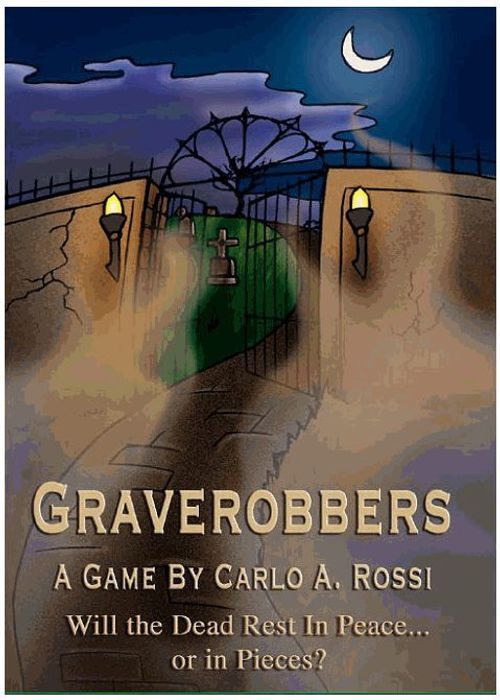
Graverobbers
Graverobbers Rulebook
Table of Contents
Table of Contents
Materials
- 27 Grave Robber cards (with black border) numbered 1 to 3 (nine each)
- 27 Detective cards (with white border) numbered 1 to 3 (thirteen 1, nine 2, five 3)
- 18 Bobby cards (with brown border) numbered 0 to 2 (six each)
- 6 color-coded Player cards – red, blue, green, gray, pink, yellow
- 9 Objective cards with white border
- 9 Objective cards with black border
- 7 Grave cards numbered 1 to 7 (double sided: ransacked Grave / safe Grave)
- 6 Accuse! cards with border in the same color as the Color marker cards – red, blue, green, gray, pink, yellow
- 1 First Player card
If you intend to play multiple hands, you will need to provide your own pencil and paper to keep track of the score.
Aim of the Game
Players represent citizens in Victorian London and must decide where their sympathies lie—is it with the grave robbers and their quest for knowledge or with the bobbies and detectives and the rule of law? Players will be forced to secretly decide where their allegiances lay. Victory is determined by the value of the cards remaining in a player's hand at the end of the game based on whether the grave robbers or police were victorious. The player who has the most points at the end of a game wins. If players play multiple hands, they should determine how many hands they will play before starting and the high scorer at the end of that time is the winner.
Preparation
Place the Grave tiles numbered 1 to 7 in a row, in ascending order with the "undisturbed" sides facing up. This is the cemetery. Every player now chooses a color and takes the appropriate card, placing it in front of him as a reminder for other players. He takes the Accuse! card of the same color and sets it just to the side of the player card. Player and Accuse! cards not used are set back in the box and are not used in play.
The deck of cards (consisting of all (72) of the Bobby, Detective and Grave Robber cards) should be shuffled and dealt out.
- If there are 3 players, each receives 20 cards.
- If there are 4 players, each receives 16 cards.
- If there are 5 players, each receives 14 cards.
- If there are 6 players, each receives 12 cards.
Cards in a player's hand are secret and should not be shown to other players. Cards not dealt out to players are set aside and not used during that game.
Next, shuffle the 18 Objective cards and deal 3 to each player. Each player must now choose two to keep and one to discard. Black-bordered Objectives provide bonus points based on the success of the grave robbers while White-bordered Objectives are bonuses if the police successfully thwart the thieves. (Objective cards are explained in more detail at the end of the rulebook.) Players may keep one white and one black card. You do not have to keep two cards of the same color.
Unselected Objectives are discarded face down and set aside with the other sets of cards not being used this game. A player's Objective cards must be kept concealed until the end of the game.
Finally, a first player must be selected. If players cannot decide, the oldest player becomes the first player and takes the "First Player" card. Play always proceeds clockwise from the First Player.
How to Play
During a turn, a player MUST play either one or two cards from his hand. These cards are played face down or face up, according to the rules explained below.
Cards are placed to one side of a Grave, forming a column (thus there will be 7 Columns of cards, one for each grave) and are placed so that they cover half of the card that was last played on that Grave, so that the value of all cards played face up is always visible.
Bobby, Detective, and Grave Robber cards must be played following these rules:
- The first card played on a Grave is always placed face up next to the selected grave (see picture on previous page).
- If the most recent card on a Grave is face up then the next card on that Grave must be placed face down, and vice versa; if the last card played on a Grave is face down then the next card on that Grave must be placed face up.
- If a player decides to play 2 cards, these cards must be always placed on two different Graves.
Important: A Grave can never have more than 7 cards. When the seventh card is played on a Grave, any face-down cards are revealed immediately and players evaluate if the Grave has been ransacked or saved. (see "Evaluating Graves" section below).
A player must always play one or two cards during a turn.
Playing a Bobby Card as a Spy
During his turn a player may discard 1 Bobby card from his hand to reveal a face down card on any Grave; only face down cards without a card over it can be revealed; players cannot use a Bobby card to reveal a card that has 1 or more card over it. Revealed cards are flipped so that all players may now see it. It is now considered a face-up card.
Example 1: (see figure in the rulebook) a player cannot reveal the face down card in the Grave number 1 discarding a Bobby since another card has been played over it.
Example 2: (see figure in the rulebook) a player may reveal the face down card on Grave 2 by discarding a Bobby; after that card has been revealed he must play 1 card on any Grave (even on Grave 2 if he wants; in this case the card is played face down since the last card has been flipped face up).
If a player discards a Bobby to reveal a card then he MUST play a second card (no less, no more) this turn on a Grave as per the normal rules.
End of Turn and Beginning of a New One
After all players have taken a turn, Grave #1 is rotated 90 degrees. This signals the end of the first turn. After each turn, the appropriate grave is then rotated (Grave #2 for the second turn, etc) Once the grave is rotated, the First player Card should be passed to the next person in a clockwise order.
Evaluating Graves
Immediately after the seventh (and last) card is played on a Grave, all the face down cards are revealed and players determine if the Grave has been ransacked or if it is undisturbed. To do that, the Defense and Robber values are calculated; the Defense value is calculated in this way:
- The value of all Detectives cards (if there are any) are added together;
Next, the value of the bobbies must be added.
- Only as many Bobby Cards are considered as there are detectives in the column. If there are two detectives, two Bobby cards are used. If there are no detectives, then no Bobby cards can be used! The Bobbies nearest to the grave tile are considered first. So if there is only one detective, only the bobby nearest the grave is counted. Excess Bobby cards are ignored.
The total of the detectives and bobbies is the Defense value. The Robber value is easy to determine. It is the sum of all the values of the Grave Robber cards.
If the Defense value is greater or equal than the Robber value, then the Grave is undisturbed (in this case pile all cards under the Grave to show that status). If the Defense value is lower than the Robber value, then the Grave has been ransacked (in this case pile all cards under the Grave and flip it over to the ransacked image to show its status).
After a Grave has been evaluated no more cards can be played on it.
Example 1: (see figure in the rulebook) Grave number 1 must be evaluated. In the picture, all of the cards have been revealed. Since only two Detectives are present, only the two Bobbies closest to the grave are considered (both have a "1" for their value). The remaining Bobby with a "2" is ignored. Thus, the defense value is 4 (2 for the Detectives, plus 1 and 1 for the two Bobbies) while the Robber value is 5 (3+2); the Grave has been plundered!
Example 2: (see figure in the rulebook) Since there are at least two Detectives, both Bobby cards are used. The Defense value is 6 (1+1+2+1+1) while the Robber value is 6 (3+3); ties go to the Defense, so the Grave is undisturbed and the dead may continue to rest in peace.
Playing the Accuse! Card
As soon as a Grave, regardless of what number Grave it is, is ransacked, the Accuse phase is triggered immediately and occurs before any other players take their turns. Accusations begin with the current player and go clockwise around the table until each player has had the chance to make an accusation. A player may choose to play his Accuse! card against an opponent. He does this by putting his Accuse! card next to that player. If, at the end of the game an accused player holds a black-bordered objective card and has fulfilled its requirements, the accused player loses 2 Victory points and the player who played the Accuse! card gains 3 Victory points. On the other hand, if an accused player has NOT fulfilled a black-bordered objective (even if he possesses such a card), he receives 1 victory point for being wrongfully accused. In addition, the person making the wrongful accusation has 1 point subtracted from his point total. More than one player may play an Accuse! card against the same player (and in this case gained or lost points are cumulative), so be careful making your plans too obvious! After all players have had a chance to play the Accuse! card, the next player takes his turn and the round is finished normally with the First player card passed to the player at the left as usual. Unplayed Accuse! cards are removed from the game. If the first player triggered the accuse phase with the first card, he may play a second if he wants, and then pass the turn to the player at his left.
Note: In the rare case in which no Graves at all have been ransacked by the end of the game, then this phase never occurs!
Objective Cards
This kind of black objective is achieved at the end of the game, if the Graves indicated by the card have been ransacked; Victory points that will be awarded for that are indicated at the bottom. If at least 1 of the 2 Graves is undisturbed, then the player gains no victory points.
This kind of white objective is achieved at the end of the game if both Graves indicated by the card were safe and not ransacked. Victory points that will be awarded are indicated at the bottom. If either or both of the listed Graves are ransacked, then the player gains no victory points.
This kind of white objective is achieved if at the end of the game, the Cemetery is undisturbed, i.e. a majority of the Graves in the cemetery are undisturbed/have not been ransacked. The Victory points for this are listed on the bottom of the card.
This kind of black objective is achieved if at the end of the game, the Cemetery is totaled, i.e. if the majority of the Graves in the cemetery have been ransacked. The Victory point value for this is indicated at the bottom of the card.
End of the Game
The game ends after one of the following two conditions have been met:
- After 8 turns if there are 3 or 4 players; at the end of the 6th turn if there are 5 or 6 players
or in the (rare) case that:
- At the end of a turn either 4 Graves are undisturbed OR 4 Graves are ransacked (meaning that the overall fate of the cemetery is irreversible)
In each case, all unevaluated Graves are now evaluated (even if they have less then 7 cards). The graves are checked so that when scoring is done, players know whether they successfully completed their objective cards' requirements.
Ransacked Cemetery
The entire Cemetery is considered Ransacked if at least 4 Graves have been ransacked.
Victory Points
Depending on what happens to the cemetery as a whole, there are two possible scoring systems for figuring out a winner.
- If the Cemetery has been ransacked then every player adds the value of his Grave Robber cards that are still in his hand at the end of the game and subtracts the values of all the Detective cards that also remain in his hand.
- If the Cemetery was not ransacked (hence at least 4 Graves are undisturbed) then every player adds the value of the Detective cards still in his hand at the end of the game and subtracts the values of the Grave Robber cards also remaining in his hand.
After this, a player adds 1 point for every two Bobby cards in his possession (regardless of whether they were trying to help sack the cemetery or save it).
The Objective cards are then resolved and points for successfully achieved cards are added to the total.
Finally, all the points relative to the played Accuse! cards must be summed\subtracted accordingly.
The Player with the most points is the winner. For games of a single hand, if there is a tie, the player with the fewest cards remaining in his hand wins. For games played multiple times, the winner is the player who scored the most points in the final hand. If that is still a tie, then the next player behind the tied players is the winner.
Example: Graves 1, 2, 3, and 7 have been ransacked, thus the entire Cemetery itself is considered ransacked. Alex ended the game with the cards represented in the picture in his hand. His Victory points are determined in the following way: the values of all the Grave Robber cards (3+3) are added (a total of 6). Then subtract the value of the Detective card (-2). So far, Alex has 4 points. Since the Grave number 2 is ransacked he didn't achieve the white-bordered objective, so he gains no points for it. But he did achieve the black-bordered objective (Graves 1 and 2 are ransacked) and he gains 6 points (so now Alex has 10 points). He also takes 1 point for two Bobby cards (the third doesn't count, so we now have 10+1=11 points). Finally, Alex was accused by the Red player of plotting against the Cemetery; since the accusation is true (Alex achieved at least one black-bordered objective), Alex loses 2 points and the Red player receives 3 (so now we are down to 9 points). Alex didn't play his own Accuse card so he doesn't gain or lose any for that and finishes with 9 points.
(Editor's note: the printed example reads "10+1-11"; it is transcribed here as "10+1=11", the evident intent.)
Final Note and a Suggestion
Graverobbers is easy to learn but there are subtle tactics that emerge after a couple of games. Consider playing a hand openly between players so that possible strategies can be explored or playing a couple of turns, stopping, and starting again so that you get the hang of how the system and rules work. If after the first game things seem confusing, try a second one immediately!
Strategy Tip
Balance the cards in your hand. If you know the cemetery will be ransacked, try and dump Detectives onto graves where the outcome is already known. Try not to use too many cards early, and perhaps consider using a second card on your turn only when it will force a grave to be evaluated. That may give you a clue or two about what to do in future turns or what motives other players have.