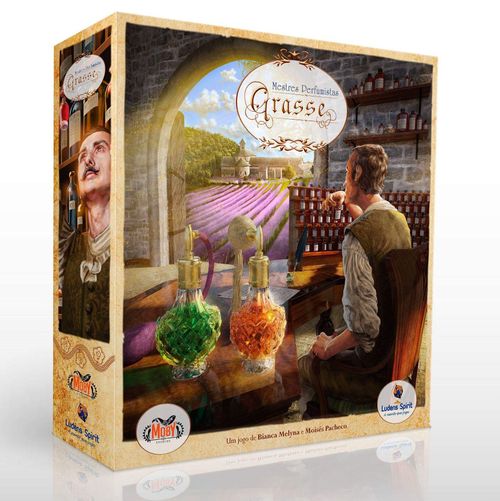
Grasse: Mestres Perfumistas
Grasse: Mestres Perfumistas Rulebook
Table of Contents
Table of Contents
Objective of the Game
In this game, you will take on the role of a master perfumer of the small French town of Grasse, known as the world capital of perfume. To do so, you must collect resources (bases and essences), carry out trades and purchases, produce classic or vanguard perfumes and sell them. All your skills will be rewarded, whether as the most versatile producer, the specialized producer, the best seller, or the best stockist.
Components
- 10 Tiles (locations)
- 4 Screens (player shields)
- 6 Vanguard/Fashion double-sided cards
- 20 Technique cards
- 5 Pawns (one per player color, plus a fifth for 5-player games)
- 6 Factory markers
- 11 Water cubes
- 11 Alcohol cubes
- 15 Contract cards
- 17 Meeples: 4 each in red, blue, yellow, and teal (the four player colors), plus 1 purple meeple (the noble)
- 11 Diluent cubes
- 30 Perfume flasks: 5 each in 6 colors
- 4 Award markers
- 6 Special Client cards
- 11 Fixative cubes
- 32 Small tiles: 8 each in 4 player colors
- 8 Neutral tiles
- 3 Floral Essence cylinders
- 10 Secret Formula cards
- 12 Large tiles: 3 each in 4 player colors
- 3 Fruity Essence cylinders
- 34 Coins: 28 of value 1, 6 of value 5
- 3 Herbal Essence cylinders
- 15 Event cards
- 3 tiles of each of 4 kinds
- 1 Board
- 3 Spice Essence cylinders
- 3 Woody Essence cylinders
- Bag
- First Player marker
Setup
- Place the board in the center of the table.
- Distribute the kits to the players. Each player's kit consists of: 1 screen, 1 pawn, 4 meeples, 3 large tiles, 8 small tiles, 2 "1" coins, 1 water cube, 1 alcohol cube, 1 diluent cube, and 1 fixative cube. Only the cubes and the coins should stay behind the screen.
- According to the number of players, set aside the following location tiles and return them to the game box, since they will not be used in this game:
- 2 players: Grande Usine, Palace, Royal Bank, and Château.
- 3 players: Grande Usine.
- 4 players: no tile is set aside.
- Shuffle the remaining tiles and reveal them on the blank spaces, according to the number of players:
- 2 players: 2 locations
- 3 players: 3 locations
- 4 players: 4 locations
- Then, randomly take 4 tiles from those remaining. Place one on each space numbered I to IV, face down. Reveal the tile on space I.
- In games with 2 or 3 players, the set of bases belonging to the players who are not in the game must go back into the game box.
- Shuffle the double-sided cards and form a pile, leaving the purple face up. Then, reveal a card with the green face up. This way, two cards will be visible: one with a vanguard perfume and one with a fashion perfume.
- Shuffle the technique cards and form a pile. Open 3 cards face up.
- Shuffle the contract cards and form a pile. Open 3 cards face up.
- Place 7 cubes of each type of base and 3 cylinders of each type of essence inside the bag (43 pieces in total). In this setup phase, each space of the production track should randomly receive 3 cubes. Place them starting from here. The one cube left over should be removed from the game.
Game Development
Grasse – Mestres Perfumistas is played over 4 rounds. In each round, every player takes 4 actions, that is, one action per worker.
Worker Allocation
There is a cost to allocate a worker, paid in coins to the bank ($). This cost varies according to the number of players in the game:
- Games with 2 players: 1$ + $ equal to the number of workers already present at the location (including your own workers and the noble, if applicable). If the space is empty, the cost is zero.
- Games with 3 or 4 players: $ equal to the number of workers already present at the location (including your own workers and the noble, if applicable). If the space is empty, the cost is zero.
Important: if a player has no coins and there is no empty space where they could allocate their worker without cost, they must discard it, losing the action. They then receive one coin and perform their movement normally on the resource track. In the following round, they normally recover their discarded worker.
On your turn, you must, in this order:
- Allocate a worker at a location. Carry out its effect (if you wish to).
- Move your pawn 1 to 2 spaces on the resource track.
Movement on the Track
The resource track is the location where players will collect the raw materials needed to produce perfumes. Movement is mandatory and must be carried out always after allocation. The player must move their pawn 1 to 2 spaces forward.
On their first move in the game, pawns enter the track from the left side, from the first available space. When reaching the end of the track, the pawn returns to the beginning.
On this track, two pawns cannot occupy the same space. So, when counting, you should ignore any space that already contains a pawn.
Collecting Resources
All actions that involve resources (collecting, trading and buying) must be carried out by interacting with the resource track, always respecting the following rules:
- Neutral tiles: spaces with gray tiles are considered neutral, meaning players can collect 1 resource without paying anything to the bank when they stop on these spaces.
- Tiles of the player's color: when the player's pawn stops on a space of their own color, the player may take 2 cubes from the corresponding space, instead of 1.
- Tiles of an opponent's color: when a pawn stops on a space of an opponent's color, the pawn's owner must pay 1 coin to the corresponding player in order to collect 1, and only 1, resource. If the player has no coins or does not want to collect the resource, they may occupy the opponent-colored space without paying anything.
All actions involving resources must respect the following rules:
a) In trade actions, the resource(s) are delivered first, before collecting, as in the example. b) The filling of spaces can be done as the player wishes, only respecting the limit of 4 resources (cubes and/or cylinders) per space.
Maintenance
At the end of a round, some things must be done before starting the next one:
- Flip the "vanguard perfume" card of the round that ended and place it, "fashion perfume" side up, over the previous fashion perfume card. Note that the vanguard perfume of one round will always be the fashion perfume of the following round. A new vanguard perfume card must then be revealed.
- During game setup, 4 location tiles were placed on the spaces numbered I to IV. Now, reveal what is on the space corresponding to the new round.
- Determine the first player, giving them the marker. In rounds II, III and IV, the first player will be whoever is furthest behind on the point track. If there is more than one player in this position, consider, among them, the one whose point marker is on top.
Locations and Effects
Now you will get to know the beautiful corners of Grasse and the effect of each of these locations.
Factories
Factories allow you to produce the classic perfume of the corresponding essences. There are 3 factories in total, and each one produces two specific types of perfume, whose combination varies with each game.
The types of perfume are: Spices, Fruity, Herbal, Woody, Floral, Exotic.
- Classic Perfume: produced from the essence cubes shown on the factory.
- Exotic Perfume: produced with 1 additional essence of the corresponding type, plus 2 essences of any different types.
ATTENTION: players can only produce perfumes if there are flasks of that essence remaining in the supply.
To produce, the player must deliver, on the resource track, the resources necessary for production. The player must receive a flask of the perfume produced and the corresponding points. After production, the player must place or move the tile of their color on the production track, indicating that they produced that type of perfume.
Note: only one flask of perfume may be produced per action. During the whole game, the maximum a player can produce of each type of perfume is 5.
The standard scoring for production is as follows:
- Classic perfume: 2 points
- Exotic perfume: 3 points
There are cards that can modify this scoring (contract cards and vanguard/fashion cards), as well as optimize production (technique cards). We will discuss all of them next.
Vanguard/Fashion Cards
Each round, there will be one perfume that is in vanguard and one perfume that is in fashion.
The purple face of the cards represents the vanguard perfumes, which yield a bonus of +1 point when that perfume is produced during that round.
The green face represents the fashion perfume, which will also yield a bonus of 1 point when that perfume is sold during that round. Remember that normally selling does not yield points, only coins, so only the fashion perfume of the round will yield this bonus point.
In setup, two cards were opened: one with the purple face up (vanguard perfume) and one with the green face up (fashion perfume).
As we saw, in the maintenance phase, the current vanguard perfume card must be flipped to the green face and placed over the fashion perfume card that was in effect. So, the vanguard perfume of one round will always be the fashion perfume of the following round. A new vanguard perfume card must then be opened.
Contract Cards
Whenever a player produces a perfume, if they hold a contract card containing the corresponding perfume, they will earn 1 point beyond the normal production score. The exotic perfume does not appear on any contract card.
Each player may hold contract cards of different perfume types only.
Technique Cards
Technique cards represent a technical advance in the production of a perfume. So, when the player produces that perfume, they will not need to deliver the base cube indicated on the card.
Each player may hold technique cards of different perfume types only.
Master Perfumer
Allows you to take two technique and/or contract cards, in any combination. Players are not allowed to have more than one technique card of the same perfume type, and the same applies to contract cards. The player must buy open cards and they must be replenished immediately after each purchase. If the player cannot buy any card because they already own cards of that perfume type, they may discard all the cards available in the purchase row and open new cards until they can make the purchase. The purchased cards must remain visible to the other players, in front of their screen, and have a continuous effect for the entire game.
Bank
The player receives 2 coins from the bank.
City Hall
Allows the trade of one tile of your own color from a location with another tile of any color (including gray), where there is no pawn.
Market
Allows one of the following transactions:
- Trade 2 identical bases for 1 essence;
- Trade 1 essence for 2 identical bases;
- Trade 1 base for another;
- Trade one essence for another;
- Buy 1 any resource for 1 coin.
Perfumery
Allows the sale of one perfume. The flask must be returned to the supply and the player must receive the coins for the sale. The player must place or move their tile on the sales track, indicating that they sold a perfume.
Note: only one flask of perfume may be sold per action. During the whole game, the maximum number of perfumes a player can sell is 5.
For each sale, the player receives:
- Classic perfume: 2 coins
- Exotic perfume: 3 coins
If the perfume sold is the fashion perfume (double-sided card, green side), the player receives 1 point.
Palace
Allows you to move the noble (lilac meeple) to any location on the board. The noble ignores the presence of any workers at the location and performs the corresponding action without paying any cost in coins. It remains at the location where it was placed and counts as a normal worker for the purposes of later allocation cost. When the noble is activated again, it must be moved to another space. At the end of the round, it must be removed from the board.
La Grande Usine
Allows you to produce a perfume of any type (classic or exotic), as long as the resources necessary for its production are delivered.
Royal Bank
The player receives 3 coins from the bank.
Alley (Viela)
Allows the player to move their pawn up to 3 spaces backward on the resource track, collecting the resource(s) from the space where they stop (if they wish and paying the cost, when on an opponent's color).
Alleyway (Beco)
Allows you to choose another player's pawn on the resource track and swap it with your own pawn. In this case, the player who activated this effect may collect the resource(s) corresponding to the space where they stopped (if they wish and pay the cost, when on an opponent's color).
Grand Fair
Allows you to make a move on the resource track and collect the resource(s) corresponding to the space where your pawn stops (if you wish and paying the cost, when on an opponent's color).
Important: after carrying out the effect of City Hall, Alley, Alleyway, or Grand Fair, remember to move your pawn normally.
Château
Allows the sale of a perfume to the nobility. The player must return the flask to the supply and receive the coins for the sale with a bonus of 1 coin. In addition, they must place or move their tile on the sales track, indicating that they sold a perfume.
Enfleurage
Allows the collection of any essence from the resource track without any cost.
Square (Praça)
Allows you to take the golden pawn (temporary collector) and send it to any free space on the resource track, being able to collect, without any cost or bonus, any resource that is on the corresponding space, regardless of the color of the tile. The temporary collector must remain at that space until this action is activated again by a player. The temporary collector counts as if it were a normal pawn while it is on the track, blocking other pawns from accessing that collection space. When the collector is already on the resource track and is activated again, it must be moved to another space. At the end of the round, it must be removed from the board.
Shortcut (Atalho)
Allows the trade of a set of cubes from one space to another. This trade may even be carried out with empty spaces on the track.
End of Game
At the end of round IV, after all players have allocated all their workers, each player may make one production or sale action for free, following turn order. To produce a perfume, you just need to have the necessary resources, and to sell, you just need to have the perfume flask behind your screen, but the player must choose which of these actions they will take. At this moment, the current vanguard and fashion perfume cards are still in effect, and the effect of technique and contract cards held by players also still apply. The perfume produced or sold must be marked on the track. The player will normally receive their points and/or coins, as the case may be.
Then, it is time to check who stood out the most in the four award criteria, assigning the respective scores.
Awards
For the awards, the following criteria are considered:
- Best Seller: covers the players best placed on the sales track.
- Most Versatile Producer: covers the players who produced the most different types of perfumes.
- Specialized Producer: covers the players who produced the most of the same type of perfume.
- Best Stockist: covers the players who have the greatest number of perfumes behind their screen at the end of the game.
To determine the players' placement, you must observe their tiles on the production and sales tracks.
In case of a tie on a criterion, all tied players move down one position (and, eventually, push down whoever is in the position where they land). In games with 2 players, only 1st place should be considered. In games with 3 players, 3rd place should be disregarded.
Worked Example (4 players)
Let's consider that, after a preliminary check, we have the following situation:
- Specialized Producer: 1st: blue, yellow, green (each produced 5 perfumes of the same type). 2nd: red (produced 2 perfumes of the same type).
- Best Seller: 1st: red (sold 4 perfume flasks). 2nd: green (sold 3 perfume flasks). 3rd: yellow (sold 1 perfume flask). Blue did not sell, so it does not compete for this award.
- Most Versatile Producer: 1st: red (produced 5 different types of perfume). 2nd: blue (produced 3 different types of perfume). 3rd: green, yellow (each produced 2 different types of perfume).
- Best Stockist: depends on what each player has behind their screen.
Tie-Breaking Examples
Game with 2 players: Let's consider that, after a preliminary check, we have the following situation:
- Criterion A: tie between yellow and blue.
- Criterion B: blue is in first and yellow in second.
- Criterion C: yellow is in first and blue is in second.
- Criterion D: blue is in first and yellow is in second.
The tied meeples move down and we have the following score:
- Criterion A: blue and yellow score nothing.
- Criterion B: blue earns 5 points and yellow scores nothing.
- Criterion C: yellow earns 5 points and blue scores nothing.
- Criterion D: blue earns 4 points and yellow scores nothing.
Game with 3 players: Let's consider that, after a preliminary check, we have the following situation:
- Criterion A: tie between yellow and blue. Green is right below.
- Criterion B: yellow is in first and blue and green tie in second.
- Criterion C: blue is in first, yellow is in second and green is in third.
- Criterion D: blue is in first and yellow and green tie in second.
The tied meeples move down one level and eventually push down meeples that are there. Then we have the following score:
- Criterion A: blue and yellow each earn 2 points. Green scores nothing.
- Criterion B: yellow earns 5 points. Green and blue score nothing.
- Criterion C: blue earns 5 points, yellow earns 4 and green scores nothing.
- Criterion D: blue earns 4 points. Yellow and green score nothing.
Game with 4 players: Let's consider that, after a preliminary check, we have the following situation:
- Criterion A: tie between yellow and blue. Green is in second and red in third.
- Criterion B: yellow is in first. Blue and green tie in second. Red did not sell perfumes, so it does not compete for this award.
- Criterion C: blue is in first, yellow is in second and green and red are in third.
- Criterion D: blue is in first, yellow and green tie in second and red is in third.
The tied meeples move down one level and eventually push down meeples that are there. Then we have the following score:
- Criterion A: blue and yellow each earn 2 points. Green earns 1 point. Red is expelled and scores nothing.
- Criterion B: yellow earns 5 points. Green and blue each earn 3 points. Red scores nothing because it did not compete for this award.
- Criterion C: blue earns 5 points and yellow earns 4. Green and red are expelled and score nothing.
- Criterion D: blue earns 4 points. Yellow and green each earn 2 points. Red is expelled and scores nothing.
Final Score
All players must lift their screens and add 1 point for every 5 coins. The player with the highest final score is the winner. In case of a tie, count the number of resources remaining; the player with the most wins the game.
Mini Expansion Rules
Mini Expansion I – Events
Setup: Shuffle the event cards and form a pile.
How it works: At the start of each round, from the second round on, the first player must reveal a card.
Most cards have an immediate effect; others have effects that will last for the whole current round. These cards always affect all players.
Maintenance: Open an event card at the start of rounds II, III, IV, before any worker is allocated.
Let's get to know the effects of the cards:
- Every player receives $2.
- Each player, in turn order, may collect 2 bases of their choice, from any space of the resource track.
- During this whole round, all players may sell 2 perfume flasks with a single action at the Perfumery or the Château. It is still necessary to have the flasks available for sale behind your screen. Fashion perfume rules apply normally.
- During this whole round, after moving their pawn, all players may collect 2 resources of their choice from the space where they stop on the resource track. That is, on neutral spaces, players may collect 2 resources instead of 1; on opponents' spaces, players may collect 2 resources by paying only $1 in total; and on spaces of the player's own color, 2 resources may be collected.
- Each player, in turn order, must return 2 bases to the resource track. If they have only one base, they must hand it over and prove they only have one. If they have none, they must prove it. Then, they hand over nothing.
- Each player, in turn order, must return 1 essence to the resource track. If they have no essence, the player must reveal the contents behind their screen, proving they don't have it. Then, they hand over nothing.
- Each player, in turn order, may collect 1 base and 1 essence of their choice, from any space of the resource track.
- During this whole round, after moving their pawn, all players may collect at most 1 resource on the resource track, regardless of the space where they stop (of their own color, an opponent's color, or neutral). When collecting a resource on an opponent's space, the cost of $1, payable to them, is maintained.
- All players must pay $2. If a player has only one coin, they must hand it over and prove they have only one. If they have none, they must prove it. Then, they pay nothing.
- During this round, all players may produce 2 perfume flasks with a single action at any Factory or at La Grande Usine. The resources for the production of each flask are still needed, and all the rules relating to production apply normally.
- Each player, in turn order, may take 1 technique card, among those available. The cards must be replenished as they are purchased.
- Each player, in turn order, may take 1 contract card of their choice, among those available. The cards must be replenished as they are purchased.
- The first player must flip the vanguard card one more time. This will then be the vanguard card that stands for this round.
Variant 1: Open an event card already on the first round of the game. If the card has no effect, open the next card.
Variant 2: Leave the event cards corresponding to each round revealed from the start of the game.
Variant 3: Open 2 event cards instead of 1 per round.
Mini Expansion II – Important Clients
Setup: Shuffle the client cards and open three. They represent the most important clients of Grasse, waiting to buy the finest and most precious perfumes.
How it works: When a player makes a sale (at the Perfumery or the Château) of a type of perfume required by a special client, they earn a coin and an additional point. When this occurs, the respective client card must be discarded.
Maintenance: At the end of each round, the rightmost card is discarded: the client gets bored and leaves! Slide the remaining card(s) to the right and open new cards until there are three open on the table (new clients have arrived!). If there are not enough cards to replenish the row, shuffle the discarded cards, form a new pile, and complete the row of open cards.
Mini Expansion III – Secret Formula Cards
Each player receives a secret formula card at the start of the game. These cards indicate that, at the end of the game, if the player has 4 resources of any color/type plus the two essences indicated on the card, they will receive a bonus of 3 points.
Rules for 5 Players
Consider the same rules as games with 4 players, with the following modifications:
- In setup, open one additional location tile. This way, 5 location tiles will be revealed.
- Place the award tiles for 5 players over the ones printed on the board.
- Each player will place only 2 tiles of their color on the resource track. The third tile should go back into the game box.
- The allocation cost of workers is free if the space is empty. If there are workers there, the cost is the number of workers minus 1. Example: with one worker there is no cost; with two, the cost is one coin; with three, the cost is two coins; and so on.
Solo Mode "Pierre, the Envious"
In the world of Grasse, not everything is flowers. The most celebrated Master Perfumers have to face envy and the not always very honest tactics of their competitors to stand out before their demanding clients.
In solo mode, you will have to use all your technique and talent as a Master Perfumer to prove that you are better than Pierre, the Envious. He became known this way for having the rather disloyal habit of copying the techniques of other famous Master Perfumers. Go to your workshop and prove that you are the best!
Setup
Use the same setup rules for 2-player games, with the following changes:
- Return the first player marker and the screens to the game box, since they will not be needed.
- After drawing the order of the final scoring criteria, the Best Seller and Best Stockist tiles must be turned face down; these criteria will not score.
- For placing the large tiles on the resource track, follow these steps: a. You place on the space you want. b. Pierre places his first tile on the first available space with any essence, and his second tile on the first space with an essence of the vanguard perfume of the round. c. You place your second and third tiles on any available space. d. Pierre places his third tile on the first available space with any essence.
How It Works
The solo game unfolds in almost the same way as other games, but in solo mode, your goal is to score more points than Pierre, the Envious. You always act before Pierre. For each type of action you take, Pierre will have a reaction. Let's get to know them:
| Location | What Pierre does/earns | Priority order | Clarifications |
|---|---|---|---|
| Bank | Receives $1 | – | – |
| Master Perfumer | Takes a contract card or a technique card | • Contract card containing the round's vanguard perfume, or • Contract card containing the round's fashion perfume, or • Technique card containing the round's vanguard perfume, or • Technique card containing the round's fashion perfume, or • First card on the left | Just as in other types of games, a player may never have repeated perfume cards. So, Pierre must also respect this rule. If there are no options available for him to take a card, he does not react. |
| Factories | • Produces a perfume, if he has the necessary resources, or • Sells a perfume, if he has one | • Vanguard perfume, or • Perfume for which he holds a contract card, or • Fashion perfume, or • Perfume of the player's choice | Pierre produces if he has the necessary resources. If not, he must sell a perfume (if he has one). If he can neither produce nor sell, Pierre does not react. He always delivers resources on the spaces with tiles of his own color that are ahead of where his pawn is. If the tiles of his color are complete (with 4 resources), he must place resources on the neutral spaces (gray tiles) that are ahead of his pawn. |
| Perfumery | • Sells a perfume, if he has one, or • Produces a perfume, if he has the necessary resources |
Movement (Resource Track)
The movement of your pawn on the resource track must respect the same movement rules as other types of games (see Movement on the Track). Pierre must also respect the same rules, but, if he reaches it, he must move his pawn to a space containing a tile of his own color. If he cannot reach it, he must prioritize a neutral space. If this is also not possible, he must stop on the space of his opponent, that is, you.
Note: in solo mode, it is possible to use the "Important Clients" and/or "Events" cards, if you wish to.
Collection
To collect a resource (as the effect of a location that determines this), you must follow the same rules as the other types of games (see Movement on the Track). Pierre, on the other hand, must follow the "Other locations" rules expressed in the "Clarifications" column of the table above.
Production, Sales, and Points Tracks
During the game, each time you or Pierre produce or sell a perfume, mark it on the Production or Sales track (as the case may be), the same way you would in another type of game. Also mark the points received on the Points track.
To calculate the score, follow the same rules as 2-player games, remembering that only first place in each criterion scores, and that the "Best Seller" and "Best Stockist" criteria will not be considered in Solo Mode.