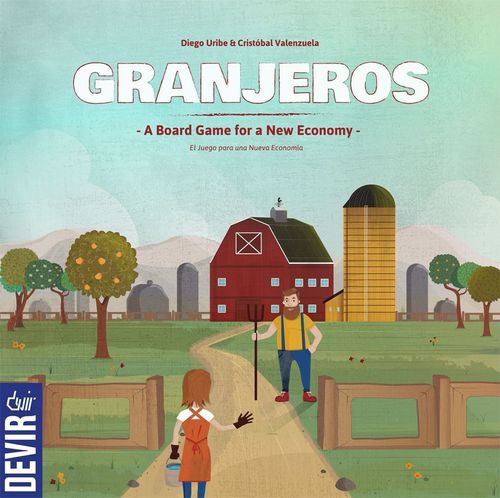
Granjeros
Granjeros Rulebook
Table of Contents
Table of Contents
Components
- 1 Game board
- 36 Land Tiles
- 180 Crop tokens
- 60 Resource tokens
- 5 Exchange cards
- 2 Development cards
- 8 Crop production dice
- 10 Waste tokens
- 30 B Point tokens
- 7 Water buckets
- 30 Trees
- 42 Fences
In boxes like this one you will find additional information not included in the manual. Many of these contain explanations or examples that will help you understand different situations that may arise during the game.
Boxes like this one contain examples of how to apply the rules of the game.
Boxes like this one contain comments and explanations about different aspects and rules of the game.
The trees, water tokens, and harvest dice come with stickers. These should be placed on the appropriate pieces before playing for the first time.
Be careful when placing the crops stickers on the dice. Each of the die's faces should be different.
All fences should be assembled before playing for the first time.
Objective
The objective of the game is to develop your field crops and earn seven B points. The game ends when one or more players obtain seven or more B points. In GRANJEROS, more than one player can win!
Getting Ready to Play
1. Game Board and Game Pieces for Each Player
Pregame preparation
A. Place the game board on a stable surface.
B. Place the 7 water buckets on the well at the center of the board and surround the perimeter with fences.
Given that water is a key natural resource for agriculture, it represents a common good in the game. It is every player's responsibility to make sure the water buckets do not run out. If all buckets run out, players will face a "Total Drought", which will be explained later in the rules.
We recommend that you use a surface that is at least 80x80cm. Each player must have enough space to fit his or her trees and exchange cards.
C. Each player chooses a color and receives all of the trees of the corresponding color. Each player also receives one exchange card and two orchard/barn land tiles.
Starting pieces for each player: 7 Trees, 1 Exchange card, 2 orchard/barn Land Tiles.
The trees represent each player's field crops.
D. The player who most recently visited a farm goes first. If there is a tie, then the youngest player goes first. Throughout the game, the player whose turn it is, is referred to as the "active player".
2. Initial Land Selection
A. The first player chooses where to place one of his orchard tiles. In order to do so, the player must:
I. Place one of his trees on an empty land space on the game board. This becomes the player's first field crop.
II. Place one of his orchard tiles (with the orchard side facing up) on the space, next to the tree.
III. Roll a crop production die to determine which crop will be produced by that field crop. The player must then place the corresponding crop token on the tree.
IV. Fence the entire perimeter of the field crop.
The different hexagons do not give any special advantage, regardless if they are right next to the water well or investment land. It is important, however, to be aware of who your neighbors are!
Land tiles have two sides. During this phase, the orchard side of the land tiles must face upwards.
Only one fence is placed between two hexagons. If there is already a fence on the perimeter of a new field crop, it is not necessary to place another fence.
In this case the blue player is the first to choose where to place his orchard tile. He places his tree and land tile with the orchard side facing upwards, and then throws a crop production die. The player obtains a grape, and therefore places a grape token on his tree. Finally, the player takes five fences and places them around the perimeter.
GRANJEROS is a game that encourages players to collaborate between them. Collaboration mainly occurs between two bordering land spaces. Keep this in mind when choosing spaces to place your tiles.
B. The player on the left side of the first player continues, placing his or her orchard tile on an empty land space of his or her choice, and following steps I through IV.
C. Players continue to allocate one orchard tile at a time until the last player has placed his or her first orchard tile. Then, that last player is the first to choose where to place his or her second orchard tile.
The last player to place his first orchard tile must therefore place both of his orchard tiles in a row.
After the blue, brown, yellow and red players have all placed their first orchard tile, the light-blue player is the last player to place his first tile (1). After following the required steps, he or she immediately places his or her second tile (2).
This means that the first player to place his or her first tile on the game board is the last to choose where to place his or her second tile.
D. The player to the right of the last player (the second to last player) must then choose where to place his or her second orchard tile. Players continue locating their second orchards in this reverse manner, until the first player is the last to place his second orchard tile.
Once the Initial Land Selection round is finished, all players must have two field crops with productive orchards (a "productive orchard" is a fenced land space which contains an orchard tile, a tree and a specific crop on the tree). The image on the left is a board set up for a game with five players.
Game Turn
GRANJEROS is played in successive turns in a clockwise manner. Each turn has two phases. The first phase is the Crop Production Phase, in which everyone participates. The second phase is the Development Phase, in which the active player (the player whose turn it is) makes his or her own choices.
The active player makes his/her decisions during the Development Phase.
In each turn of the game, all players with active field crops of produce crops and receive crop tokens.
During the Development Phase, only the active player can negotiate with other players and evolve his/her tiles.
Summary
-
Crop Production Phase A. Remove a water token. b. Throw the 8 dice. c. Acquire crop tokens. d. Receive waste tokens and lose B points. E. Eliminate waste and crops.
-
Development Phase a. Acquire resources. b. Remove fences. c. Evolve field crops. d. Place crops in investment land. E. Replenish water buckets.
Details
1. Crop Production
A. Remove One Water Bucket
The water buckets in the well represent a common good to all players and are an essential element in the production and harvesting of crops throughout the game. One water bucket must be removed at the beginning of each turn, symbolizing each player's use of this natural resource. Throughout the game, players must work together to preserve adequate levels of water for producing crops, otherwise they will suffer the consequences of a Drought or a Total Drought.
One water bucket is always removed before the dice are thrown. This means that right before throwing the crop production dice, there could be a drought that affects the production of crops.
Drought. If the water bucket supply decreases to 3 water buckets or less, all players face a Drought. During the Drought, land tiles produce crops with greater difficulty. (See sections 1.C. on how to obtain crop tokens and 2.E. on how to replenish water buckets).
Total Drought. If at any moment there are zero water buckets in the well, players face a Total Drought. When there is a Total Drought, the game stops immediately.
All of the players have the option to replace water buckets in the well at the cost of 1 crop token for each water bucket. If by any chance none of the players have crop tokens to replenish water buckets, resource tokens [grain, technology and farmers tokens] can be exchanged for crop tokens at the rate specified in the exchange card.
Once any player acquires five B points, two water buckets will be removed at the beginning of each turn [instead of one] until the end of the game.
B. Throwing the Dice
The game comes with 8 crop production dice. The active player must roll all 8 crop production dice to determine which crops are produced and, therefore, what crop tokens each player receives.
In this example, after rolling the 8 crop production dice, players who have tiles with grape and corn receive crop tokens, because two grapes and two corns were rolled. The number of crop tokens to each player depends on the stage of evolution of the tile for that specific crop.
In the case of the dice results shown above, the blue player, who has an orchard that produces grapes, receives a grape crop token; the red player, who has a barn that produces corn, gets paid 2 corn tokens; the brown player, who has an orchard that produces grapes and one that produces corn, receives one grape token and one corn token.
In this example, players who have grape-producing field crops will be paid twice the amount of grapes, one for each pair of grapes in the dice roll.
During a drought: in this example players who produce grapes will be the only ones who receive a token, given that only triads receive payment.
C. Acquiring Crop Tokens
Players receive crop tokens based on the result of the 8 crop production dice and each player's tiles. The quantity of crop tokens that are paid to each player depends on the tile's assigned crop, its evolution stage, and the quantity of water buckets in the well.
I. If there are between 4 and 7 water buckets in the well [after having removed the bucket at the beginning of the turn]: land tiles will produce crops and players will be paid for every pair (two-of-a-kind) of crops obtained in the dice roll. See examples 1-2-3.
II. If there are 3 or fewer water buckets (drought) in the well [after having removed the bucket at the beginning of the turn]: land tiles will produce crops and players will be paid for every triad (three-of-a-kind) of crops obtained in the dice roll.
D. Receive Waste Tokens and Lose B Points
Waste tokens symbolize the waste generated by the excessive accumulation of resources. The accumulation of waste is an unsustainable consequence that makes victory more difficult for players.
Getting waste tokens. If at any moment a player, after being paid for all of his/her crops, were to have 8 or more crop tokens, he or she will receive only until his/her eight crop token, and receive one waste token.
A player that receives a waste token can choose which crop tokens to keep from the ones he or she receives. He/she must ultimately keep a maximum of 8 crop tokens.
The red player has 6 crop tokens. In this turn, and after rolling the 8 crop production dice, his industry tile and a barn tile produce 5 new crop tokens. The red player then decides which 2 crop tokens to keep, eliminates the rest (as he/she can't have more than 8 crop tokens) and receives 1 waste token.
Losing B points. When a player has accumulated 3 waste tokens, he/she discards all said waste tokens and loses one B point token from his supply of B points. If the player does not have B points yet, he/she only discards the waste tokens.
E. Eliminate Waste and Crops
At the end of the Crop Production Phase, and before the active player moves into the Development Phase of his turn, players may try to remedy the impact of waste accumulation.
Eliminate one waste token. Players can spend two crop tokens of any kind to eliminate one waste token.
Eliminate crop tokens. If a player has received a waste token this turn, he or she can eliminate any number of crop tokens before entering the Development Phase, as a way to avoid future waste tokens.
The red player has just received a waste token. Since his turn is still a few turns away (and he risks receiving additional crop tokens as the dice are rolled at the beginning of each turn), he decides to eliminate a few crop tokens to minimize the possibility of getting another waste token before his turn.
2. Development
During the Development Phase, the active player can negotiate with the rest of the players to form alliances and invest crop tokens as a way to acquire resources that will help him/her to develop his/her field crops and earn B points in order to win the game.
In GRANJEROS negotiation and cooperation are key elements for victory. During his/her turn, the active player should actively dialogue and negotiate at any moment with the rest of the players. The other players can only negotiate with the active player and not amongst themselves.
In his turn, the active player can do any of the following actions:
a. Acquire Resources
Resources are necessary to evolve your field crops. There are three types of resources, which are acquired in exchange for crop tokens.
- Seeds = 1 crop token of any crop. Seeds represent agriculture's basic element.
- Technology = 2 crop tokens of the same kind. Technology represents the productivity enhancements that yield higher production rates.
- Farmers = 2 crop tokens of different kinds. Farmers consist of the human capital which carry out agricultural activity.
In the Exchange Card you will find all of the possible exchanges that can be done in the game. Land tiles, resource tokens, waste tokens, water buckets and fences.
Seeds represent agriculture's basic element; technology represents the productivity enhancements that yield higher production rates; and farmers consist of the human capital which carry out agricultural activity.
Exchanges depend only on whether crops are of the same or different kind, and not on the specific kind of crops per se.
b. Evolution of Field Crops
One of the key decisions players must make in a game of GRANJEROS is how and when to invest resources and evolve their field crops. Evolving the tiles on your field crops is the only way to earn B points and ultimately win the game.
A player benefits in two ways when evolving his field crop. The first benefit is that by evolving field crops a player earns B points. The quantity of B points a player earns depends on the evolution stage of the field crop, and whether the upgrade was done individually or in collaboration with another player (see section 2C on how to remove a fence between neighboring spaces to collaborate). The second benefit is that field crops at a higher stage of evolution are able to produce more crops during the Crop Production Phase.
Besides the two orchards tile with which players start the game, a player should invest in new field crops during the game. Players may acquire a new field crop by paying the cost in crops specified in the exchange card. This new space will be considered an unproductive field crop, until it is upgraded with an orchard land tile. When a player buys a new field crop he/she will put one of his/her tree tokens in a free space (hexagon) on the board and fence the perimeter. Note that an unproductive field crop does not produce crops and does not players any B points.
Later on, and according to the development card info, players can turn this unproductive field crop into an orchard by allocating the specified resources into the field. Note that players need to have the required resources for the upgrade and allocate them on the field crop. When doing so, the field will be activated and the player must roll one crop production die to determine which crop that field will produce for the rest of the game. In the Development Card you can find the benefits of each development stage. In the Exchange Card you can see the resources needed for evolving field crops from one stage to another.
The blue player decides to individually evolve an orchard into a barn. To do this, he exchanges crops for the necessary resources and turns over the land tile over, leaving the barn side face up. In doing so, he immediately receives 1 B point. From this moment on, every time the crop production dice are rolled and crops are produced, the blue player will get paid 2 crop tokens instead of 1 crop token for this field crop.
Once a field crop has been upgraded to a higher level of development a player cannot reverse this decision. Therefore, if you choose to upgrade a barn into a farm, you cannot reverse it or switch the upgrade for an industry.
c. Removing Fences Between Field Crops
Removing a fence between two different players that have adjacent field crops represents an agreement to work together for a mutual benefit. This decision means that, from the moment the agreement is made, both players will share the profits and costs involved in developing adjacent field crops as one mutual field crop.
To remove a fence, both owners must be in agreement and pay the specified cost in crop tokens (3 crop tokens of any crop). The involved players negotiate how much they will each contribute to the cost of removing the fence. This kind of negotiation applies to the costs of all future upgrades in the field as well.
When a fence is removed, whichever of the two field crops is at a lower stage of development is instantly upgraded to match the stage of development of the other field crop (note that this might earn one player B point(s) if he is upgraded in this action). Two joint field crops will share crop earnings and evolve together at the same cost as an individual land field crop! Also, as players evolve these joint field crops, both will earn B points in the same way. This means that two players can win the game (seven B points) at the same time. When managing joint field crops, both players must be in agreement as to how they will pay for resources to develop their shared land. If there is no agreement between them on how to develop their joint field crops, the active player can make the decision, even without the consent of his/her partner, pay for the resources from his supply of crops, invest them in the field crop, and finally, generate the development of both spaces however he/she wishes.
When joint field crops produce crops, the players collaborating on those plots must agree on how they will share crop production. If an agreement is not reached, the player who has received the crops can keep all of it, in the same manner that the other player can refuse shared crops.
Once a fence is removed from two field crops, it cannot be place between them again.
You cannot remove more than one fence per field crop. A field crop can only be paired to one of its bordering field crops for collaboration.
The red and blue players decide to remove a fence between their field crops. They agree that the blue player will provide two grape tokens and the red player will provide one carrot token for a total of three crop tokens required to remove the fence. Subsequently, the fence is removed from the board and the blue player's orchard that produces grapes will automatically be upgraded to a barn matching the level of development of his new partner's field crops. Also, because of this upgrade, the blue player will earn 1 B point for having evolved from an orchard to a barn.
A fence can only be removed between bordering field crops.
d. Placing Crop Tokens on Investment Land
Investment lands represent opportunities to add certain advantages to specific crops. Each investment land triggers a specific exchange advantage. Regardless of who assigned a crop to an investment land or which kind of crop has been assigned, all players take advantage of the benefits of that investment land for that specific crop.
To activate these advantages, the active player must place one of his crop tokens on any of the investment lands in the outer perimeter of the game board. If there is already a crop token occupying an investment that the player wants to activate with a different kind of crop he possesses, he can remove the current token and put his. From then onwards, and until another player changes the token, the benefit from that valuation plot will apply to the newly placed crop token.
Once a crop token is placed on an investment land, any player can take advantage of its benefit immediately and therefore perform exchanges applying the specific benefit for that crop token.
During his turn, the red player places a tomato token on the investment land. He then decides to acquire 3 technology tokens. Thanks to the advantages of this investment land, he must now only spend 3 tomato tokens instead of 6 (as originally specified in the exchange table). The blue player, during his turn, also wishes to acquire one technology token and decides to spend 1 tomato token in order to do so, taking advantage of the benefit of the investment land that is active with the tomato token. Then, on his turn, the yellow player decides to change the crop token assigned to that investment land, eliminating the tomato token and leaving in its place an apple token. Subsequently, the yellow player acquires 2 technology tokens for only 2 apple tokens instead of four.
e. Replenishing Water
During his/her turn, the active player can replenish one or more water tokens by exchanging one crop token (of any crop) for one water token, which is then placed in the water well.
In the case of a Total Drought (see section 1.A), all players can contribute to replenish the water as a way to remove the Total Drought condition.
End of the Game
The game ends when one or more players reach seven B points.
All of the players that have seven or more B points win the game.
7 B points win the game.
Explanation of Field Crops
The stage tables below are icon-based in the printed manual. Investment and benefit values are transcribed from those icons. "Individual" is a single farmer icon in the Profit row; "Joint" is the two-farmer icon, which applies when the field is upgraded collaboratively (see sections 2.B and 2.C and the worked examples on pages 9, 10 and 13).
1. Unproductive Field Crop
This is the basic stage of development of a field crop. It represents the ownership over a field crop but as such, it doesn't have productive capabilities yet. When a new unproductive field crop is acquired, the active player chooses where to place one of his trees among the empty hexagon plots on the board, and then fences the perimeter.
- Investment necessary: 2 crop tokens of the same kind.
- Benefit: Ownership of the field crop.
The blue player has decided to purchase a new unproductive field crop.
2. Orchard
The orchard is the simplest stage of production in GRANJEROS. It is a small-scale operation.
Note that a player must have an unproductive field crop before evolving it to an orchard and placing an orchard tile over it. When the field crop is upgraded to an orchard, the player throws a harvest dice to determine what type of crop is produced by that tile for the rest of the game, and proceeds to place a crop token over his tree.
- Investment needed: 1 Seeds + 1 Farmers.
- Benefit:
- Production: 1 crop token.
- Profit: 0 B points.
The blue player has invested the required resources to turn his unproductive field crop into an orchard. In order to determine what the land will produce, he throws one harvest dice and obtains a tomato. He then puts one of the tomato crop token on his tree. From this moment onwards, the land plot will only produce this crop until the end of the game, regardless of the stage of development.
3. Barn
The barn is an intermediate stage of development in GRANJEROS. It is a medium scale operation that employs greater resources, mainly workers and crops. It can therefore produce more crops than the orchard.
Note that the field crop must be at an orchard development stage in order to be able to evolve into a barn.
- Investment needed: 1 Seeds + 2 Farmers.
- Benefit:
- Production: 2 crop tokens.
- Profit: 1 B point for an individual upgrade (one farmer icon); 1 B point for each player in a joint upgrade (two farmer icons).
It is important to note that the orchard and barn occupy the same land tile (each printed on one a different side of the tile). The same occurs with the industry/farm tiles. This is an environmental-friendly decision, as it reduces the amount of game pieces that need to be manufactured.
4. Farm
The farm is an advanced stage of development in GRANJEROS. It is a large-scale operation based on a balance of human capital, technology, and crops.
Note that the field crop must be at a barn development stage in order to be able to evolve into a farm.
- Investment needed: 1 Seeds + 2 Farmers + 2 Technology.
- Benefit:
- Production: 2 crop tokens.
- Profit: 2 B points for an individual upgrade (one farmer icon); 2 B points for each player in a joint upgrade (two farmer icons).
In previous turns, both the red and blue players agreed to lift the fence between their field crops to make one collaborative barn. During the blue player's turn, they decide to evolve their joint barn into a farm. In order to do this, they agree that the red player will invest a seed token and a farmer token and the blue player will invest a farmer token and 2 technology tokens. Once this occurs, the joint field crop will evolve into a farm and each player will receive 2 B points.
5. Industry
Industry is an advanced stage of development in GRANJEROS. It is a large scale operation which requires intensively on technology as a way to be efficient and profitable.
Note that the land plot must be at a barn development stage in order to be able to evolve into an industry.
- Investment needed: 4 Technology.
- Benefit:
- Production: 3 crop tokens.
- Profit: 1 B point for an individual upgrade (one farmer icon); 2 B points for each player in a joint upgrade (two farmer icons).
An Industry is very effective at producing crops. Therefore, if one or more players have an industry, it is recommended to be careful of your crop production, as it can rapidly be turned into waste by making players accumulate more than 8 crop tokens. Remember that if a player accumulates 3 waste tokens in a field crop, that player loses one B point.
B Enterprises
B Corporations are new a type of enterprises that use the power of the market economy to give concrete solutions to social and environmental problems. In this manner, B Corps compete to be the best companies for the world and not just in the world. They operate under high social, environmental, transparency and corporate standards and take legally binding decisions that must consider not only financial interests of its shareholders, but also long-term interests such as stakeholders, employees, suppliers, customers, and the community in which they are located, as well as the environment.
This kind of company is redefining the meaning of success in business by raising one essential question: What purpose does this company serve for society? In answering this question, financial returns become essential tools for achieving the company's objectives but are not the company's sole reason of existence. Success is not only measured in terms of profits or dividends, but by how the business model balances profit with social and environmental impact in a measurable way.