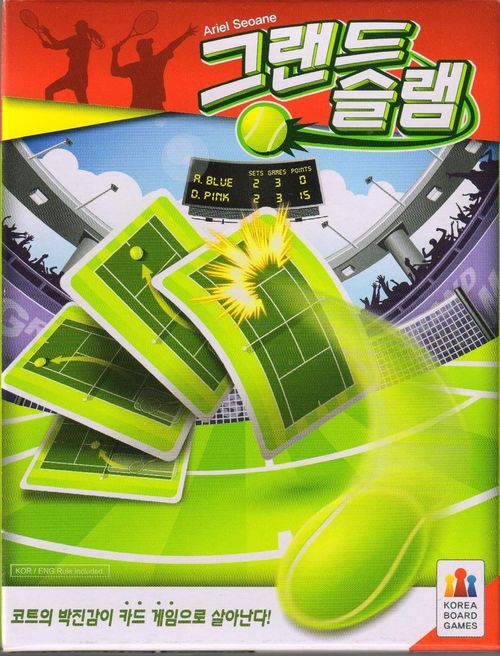
Grand Slam
Grand Slam Rulebook
Table of Contents
Table of Contents
Contents
- A Decks: 24 Playing Cards
- B Decks: 24 Playing Cards
- C Decks: 24 Playing Cards
- D Decks: 24 Playing Cards
- 2 Court Cards
- 9 Ball Tokens
- 1 Rule Book
Set Up
Singles
To start, collect all cards with the same reverse side pattern into four decks. Each deck has the same face cards. Both players take one deck each. Remaining decks are not used (they are used in a doubles match).
Place two court cards in the center of the table making a court.
Set all ball tokens aside where both players can reach them easily.
Both players shuffle their decks, placing them on the table in front of them. Take the top six cards from the deck.
Decide who goes first.
Progress
1. Serving
The serving player plays the top card from his/her deck and places a green ball token on the section of the opponent's court corresponding with that card.
2. Receiving
The receiving player can play a card from his/her hand that matches the opponent's serve. The player then returns the ball token to the opponent's court that corresponds with this card.
2-1. Smashing
After you successfully receive, now you can play "smashing". After playing a receiving card, if you have one more card with the same attack point as your receiving card, play it! These two cards together will turn your shot into a powerful smashing return. Flip the ball token to the red side to show the smashing and place it on the section of the opponent's court that corresponds with the card.
2-2. Receiving the Smashing
You need two corresponding defense cards to receive the smashing. After you receive the opponent's smashing, the second card played will be your offense card. You can play smashing also to return the opponent's smashing if you have a suitable card with the second card. So, you need three suitable cards to receive your opponent's smashing and to smash.
End of Turn
At the end of each turn, you may fill up your hand to a maximum of six cards. If "smashing" is played in this turn, draw two cards from your deck. In a rare case, continuous rally can cause you to run out of cards. When your deck runs out, you cannot draw any more cards.
Off Balance
If you have just one card to receive the opponent's smashing, play it; however, you cannot draw a card when your turn ends. Every time you lose your balance, you lose one card from your hand. It makes it more difficult to play, but you can lose your balance on purpose to play smashing. In any situation, the cards in your hand will decrease.
Diving Receive – as a Last Resort
If you have no cards left to receive, there is one more way to return. Discard one card from your hand and then play a top card from your deck. If that card can receive, place a ball token where this card is shown, then end your turn. You cannot draw a card and cannot play smashing during this turn. A "Diving Receive" can also be used to return your opponent's smashing without using an additional card. Again, in any situation the cards in your hand will decrease.
(Illustration: discard one card from your hand and then play a top card from your deck — success or fail.)
Ace
If a player cannot receive, the offensive player scores. Take a ball token and place it on the left side of the scoring player's court. Both players then shuffle each of their decks. The player who received at the start of the previous game is now the starting server.
Victory
The first player who gets four points will be the winner of the match.
Variation Rules – Play Like a Real Tennis Game
The serving player will change after scoring two points. If the score is 3:3, it goes to "deuce". In a deuce, a player wins by scoring two points more than the opponent. One point more than the opponent is called "advantage". If the opponent gets a point in your advantage, the game returns to deuce.
Doubles
A doubles match needs four players, two players per team. Sit together with your teammate. The rules are the same as a singles match, with these exceptions:
- A. Each player starts with five cards, not six.
- B. Each teammate plays turn by turn. After one player receives the opponent's attack, the other player should return the next opponent's attack.
- C. You cannot use a "Diving Receive".
- D. If you cannot receive during your turn, you may discard one card and your partner may receive the ball instead of you. If nobody can receive, the opposing team gets one point.
Master Rule
After you are familiar with the Original Rules, you can enjoy Grand Slam with the Master Rules. This is a more difficult version, but you can enjoy the game by utilizing a broader range of strategies.
Master Rules vary slightly from Original Rules, as follows:
- During setup, draw your cards, then put down one to four cards face up in front of you. This reveals these cards, allowing the opponent to refer to them during his/her turn.
- The player must play at least two cards per turn – one card from his/her hand, the other from the cards he/she has placed in front of him/herself. If the player doesn't have two cards to play, the player loses that turn. If the player wants to play smashing, the player must use two cards that have the same attack point. Defending the opponent's smashing also requires two cards.
- At the end of each turn, the player refills his/her hand before putting down one to four cards, face side up.
- A player can only play one card from his/her hand per turn. If the player wishes to defend against the opponent's smashing OR play smashing, the player must use the cards face up in front of him/her.
- Players cannot use "Diving Receive"; however, in a doubles match a player's partner can receive the ball instead of the player.
All other rules are the same as an Original Rules game.