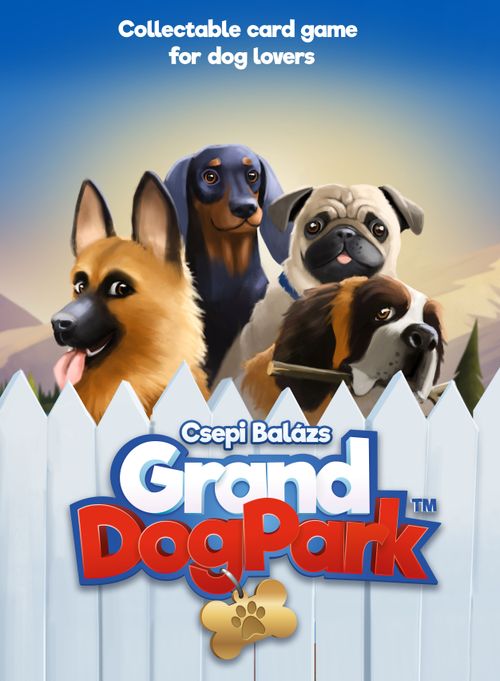
Grand Dog Park
Grand Dog Park Rulebook
Table of Contents
Table of Contents
1. Aim of the Game
The aim is to finish the game with the fewest fleas (points).
2. Setup for 4-6 Players
- Shuffle the dog deck (60 cards) and deal 6 cards to each player (A).
- Place the remaining dog cards face down on the table forming the draw deck (D).
- Flip the top card of the deck face up on the middle of the table (E) as the starting dog of the first pack.
- Place the doggie treats (B) next to the draw pile.
- Skill cards (C) should be visible and reachable for everyone.
3. Components
In the basic set, there are four dog breeds: German Shepherd, Dachshund, Pug, St. Bernard.
- 15 dog cards in each breed (numbered from 1-15)
- 12 doggie treat cards (B)
- 4 skill (trick) cards (C)
- 6 rules sheets (6 languages)
Setup layout key:
- (A) 1-4 player's hand
- (D) dog cards draw deck
- (E) starting card
- (F) discard pile
- (G) dog pack (sequence)
Dog card anatomy (as labelled on the rules sheet): the card number is in the bottom left corner; the number of doggie treats the dog gives is shown on the card; the number of fleas is in the top right corner; the number of shampoos is shown beside the fleas; the picture shows the dog; the pet name is printed at the bottom of the card.
4. Tactical Game Mode
For a more tactical game, place four dog cards face up next to the draw pile before starting to play. When you have to draw a card or cards, choose one of these. Replace the drawn card(s) immediately from the draw deck.
5. Setup for 2-3 Players
In case of 2 or 3 players it is recommended to play with only 3 breeds in order to keep the game dynamic. There are no other modifications.
6. Gameplay
The game consists of several rounds. Before each round, draw a dog card and place it face up on the middle of the table to start a pack (sequence). A round is over when the draw deck runs out.
Rounds consist of runs. A run ends when a player takes the pack of dogs from the middle of the table.
The player who has owned the most dogs in their life starts the first round. Consequent rounds are started by the player who has collected the most fleas in the previous round.
On your turn, take one action, then replenish your hand to 6 cards. There are two types of actions: expanding the pack or starting a new pack. Playing continues with the next player on the left of the current player (clockwise).
7. Player's Actions
A) Expanding the Pack
When you choose to add a new dog to the pack, place a card from your hand either to the left or to the right side of the sequence.
Each card has a number in the bottom left corner (e.g.: 8). You can only place it on the left side if the number is smaller than the leftmost card of the sequence. And place it on the right side if it is bigger than the rightmost card. The numbers in the sequence always increase from left to right. The difference between neighbouring cards can vary. You can't put cards in-between two cards of the sequence, except if a dog's trick allows it.
When you place a dog card, you receive a number of doggie treats indicated on the card (e.g.: 1 treat icon) immediately. The number of treats you own is represented by the treats visible on the treat cards in front of you. There is one doggie treat on one side of a treat card, and two treats on the other. You can have a maximum of four treats by having two cards, both with two treats facing up.
If you want to (or have to) use the dog's special skill to add it to the sequence, give a doggie treat to your dog in return. The dog performs the trick of its breed and you pay one treat, by returning a card with one treat facing up, or by flipping a card with two treats to its other side. The tricks specific to each breed can be found on the skill cards.
You can only trigger one trick on your turn spending one treat. Treats earned by placing card(s) cannot be used in the same turn.
B) Starting a New Pack
When you cannot add a new dog to the pack, you have to take all cards of the sequence and place them face down in front of you. This will be your own pack.
A player who takes the sequence has to start a new pack from the cards in hand, by placing it to the middle.
8. End of a Round and Scoring
The last run starts when the last dog card is drawn from the deck. The round continues until a player takes the sequence from the middle of the table. If you have no cards on your turn, you must take the sequence and the round ends.
At the end of the round, add the remaining cards from your hand to your own pack. Each player sums up the number of fleas indicated in the top right corner of the cards. The number of fleas is reduced by the number of shampoos. The final number of fleas cannot be less than zero. The result is added to the score in the previous rounds. Scores can be recorded on a sheet of paper. Shampoos can only reduce fleas collected in the current round.
9. Starting a New Round
Shuffle all the dog cards, give every player 6 cards and place a card in the middle of the table. Retrieve all treat cards from players. The new round is started by the player who has collected the most fleas in the previous round.
10. End of the Game
The game ends when at the end of a round, a player has scored at least 30 points (added to the number of fleas in previous rounds). The winner is the player who has collected the fewest fleas (points). In case of a tie, players share victory.