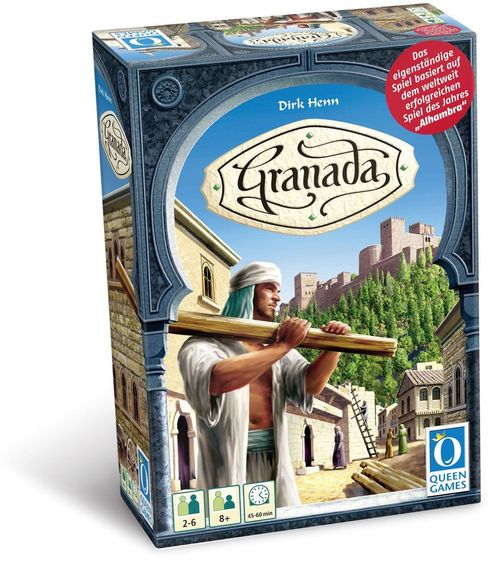
Granada
Granada Rulebook
Table of Contents
Table of Contents
Game Components
- 6 Starting tiles – showing the Alhambra. There is one starting tile for each player in their player color, it is the starting point of their individual city of Granada.
- 6 Scoring markers – in the 6 player colors, used for scoring victory points on the victory point track.
- 1 black marker – used on the game board to indicate which side of the building tiles is placed face up when replenishing them (even numbered or odd numbered price).
- 1 game board – used for placing:
- money
- building tiles
- players' supplies of building tiles
The construction yard - showing four spaces for four building tiles. Each space is allocated to a different currency.
4 spaces for money cards. Space for the face down deck of money cards. Spaces for the black marker. Space for storing a player's supply. There's a separate storing space for each player.
- 3 summary tableaus for scoring
2 summaries for regular scoring. On the front side you can see how many points can be gained in the particular scoring. 1 scoring summary used for simplified scoring (see page 8). The back sides of all cards show in detail which items have to be scored in exact order.
- 108 money cards of four currencies – used for buying the building tiles of the construction yard.
Money cards of four currencies; each card is provided three times, their values ranging from 1 to 9.
- 54 building tiles – showing 9 different types of buildings on their front and back sides. There are 12 buildings of each type, their values ranging from 2 to 13. These building are used to build the city of Granada. There is a different type of building on the front and back of each tile. A colored mark indicates the type of building on the reverse side. If the value shown on one side is an even number, the next higher odd numbered value is shown on the reverse side, and vice versa. There are moats on up to three edges of some tiles; the moats are on the same edges on both sides of the tiles.
Moat. Type of building and purchase price. An even numbered price means there's the next higher odd numbered price on the reverse side. "Front" side with price 2. Colored mark indicating the type of building on the reverse side. The "back" side with the next higher odd numbered price, 3 in this case.
- 2 scoring cards – they are shuffled into the deck of money cards.
- 1 linen bag • 6 "+100"-markers • 1 rules leaflet
The +100 markers are used whenever a player has gained more than 100 victory points and starts their second round on the victory points track.
Object of the Game
Set in Granada in the Middle Ages, the players act as principals and employ construction units in order to increase the city's growth. The player having built the most buildings of a certain type in their city at the right moment – that is when a scoring takes place – gains victory points.
Additionally each player gains victory points for the longest moat in their city. At the end of the game the player with the most victory points is the winner.
Setup
- Each player takes the starting tile and scoring marker of a color of their choice. They place the starting tile on the table in front of themselves, this is the starting point of their individual city of Granada.
- All players place their scoring marker on the „0" space of the victory point track.
- The game board is laid out in the middle of the playing area. All players should have easy access to their supply spaces on the board.
IMPORTANT! Setup for a 2-player-game is explained on page 8 of these rules.
The starting tile is a building tile without any moats. The scoring markers are placed on the „0" space.
- All 54 building tiles are put in the bag which is kept ready for use.
- 4 building tiles are drawn randomly, one after the other, from the bag and placed on the four spaces of the construction yard, numbered 1 to 4. Place the tiles with their even numbered side face up. Then the black marker is placed on its space indicating the odd numbers.
- Place the two summary tableaus for regular scoring beside the game board. You will not need the third tableau, used only for simplified scoring.
- Remove the two scoring cards A and B from the deck of money cards and put them aside, then shuffle the deck of money cards.
- Now each player is dealt their starting capital. For each player, deal one card after the other from the top of the deck of money cards and place the cards face up in front of the player until their total is 20 or more, disregarding the different currencies. Cards are dealt to the next player in the same manner etc. After all players have received their starting capital, they take their money cards in their hand and keep them secret from now on.
- The player with the least number of cards (no matter what their total is) is the starting player. In case of a tie the player with the least total (of all tied players) is the starting player. If there is still a tie, the youngest player of the tied players is the starting player.
- Next draw the top 4 money cards from the deck and place them face up on the designated spaces of the game board.
Note: This way no player will start the game with more than 28 or less than 20 money total.
- Separate the remaining money cards in five piles of a similar level, then shuffle the scoring card „A" into the second pile, the scoring card „B" into the fourth. Stack the piles on top of each other, the fifth pile at the bottom, the fourth on top of it, next is the third pile etc., the first pile being on top of the complete deck. This deck is placed on its designated space of the game board.
Note: This way it is made sure that the scoring cards won't be drawn neither too early nor too late in the game or are drawn in rapid succession.
Sequence of Play
Players take their turns clockwise, beginning with the starting player. The active player (the player who is performing their turn) must decide between three possible actions:
- Collecting money
- Buying a building tile
- Rebuilding your individual city of Granada
In case of buying building tiles, the player must extend their city using these tiles or add them to their personal supply:
- Place one or more building tiles
A detailed explanation of these actions is following now:
Collecting Money
The player may take any one of the money cards on display or more than one of the cards, provided their total does not exceed 5 (disregarding the different currencies).
Example: The player may take both money cards on the left or one of the two cards on the right.
Buying a Building Tile
The player may buy one building tile from the construction yard, paying at least its price (as shown on the tile) in the currency shown next to the tile on the game board. But beware, there is no change!
The money paid is put on a discard pile.
If a player manages to pay the price exactly as required they perform another turn, again deciding between the three possible actions.
As long as a player is performing their turn the building tiles of the construction yard are not replenished, this is done only at the end of their turn.
The player places their newly acquired tile or tiles besides their city (it is installed in their city only at the end of their turn).
Example: Green urgently wants to build a school for his city. The price of the school in the construction yard is 10. Green owns two money cards of the matching color (=currency) and decides to buy the school.
Because his payment does not match the price (he pays 11 instead of 10) his turn ends, he does not receive any change.
Note: This way a player may perform a maximum of 5 actions during their turn – four times paying the matching price and then either collect money or rebuild their city.
Rebuilding Your Individual City of Granada
When rebuilding their city a player has to choose out of three options:
- Extend their city by one building tile taken from their own supply (see building rules page 5).
- Reduce their city by one building tile and place it in their own supply.
- Exchange one building tile from their city for one building tile from their own supply. The new building tile must be placed exactly at the same position as the former one.
After rebuilding the city must still be constructed according to the building rules in all respects. The starting tile must never be rebuilt or removed.
Example: Red buys a building tile and pays the matching amount of money, so it's his turn again.
He decides to buy a further building tile, again he pays the matching amount.
Red has another turn, this time he decides to rebuild his city. He removes one building tile from his city and exchanges it for one from his personal supply.
Finally he extends his city by the tiles he had just bought, trying to place them as best as possible, or he may put one or both in his personal supply on the game board.
His turn is finished now.
End of Turn
Place One or More Building Tiles
The acquired building tile or tiles must be placed at the end of the player's turn. It is up to the player if they extend their own city by the tile (or tiles) or if they add it (or them) to their personal supply. There is no limit of the number of tiles in a player's personal supply.
If a player has acquired more than one building tile they may use them to extend their city or add them to their supply in any order they wish.
When a player wants to extend their city by the tile they may place it with the same side face up which was face up when they bought it. If they want to place it with its reverse side face up they have to pay at least a total of 3 money of any one currency. Only after having paid this amount (again no change!) the player may build the tile with its reverse side (compared to when they bought it face up).
When adding a tile to their personal supply, a player may put it there with any side face up, they don't have to pay any money in order to invert the tile.
Important: Once added to a player's supply or built as part of a city a tile must never be inverted for the rest of the game!
Note: There is no extra turn when paying 3 sharp. If a player wants to invert several tiles they just bought they must pay separately for each tile.
Example: Red bought one Arena and one Library. He wants to extend his city using the reverse side of both tiles. He pays 3 with orange currency cards, flips the Arena tile over, revealing a Hospital. He adds the Hospital to his city.
Then he pays 5 with green currency cards, he cannot pay 3 sharp, and inverts the Library. He adds the District on the reverse side to his city.
Note: Of course you may use money just collected due to an extra turn for payment when inverting a tile.
Building Rules for Granada
When building their own city of Granada players must obey the following rules:
- All buildings must have the same orientation (i. e. all roofs must point upwards).
- The edges of adjacent tiles must be of the same kind. Either there is a moat on both edges or there is no moat on both edges.
- Each added building tile must be "accessible on foot" starting from the starting tile without crossing any moats or leaving the tiles altogether.
- Each added tile must touch at least one other tile edge to edge (i. e. they must not touch only diagonally).
- It is not allowed to create any "holes" (empty spaces surrounded by tiles on all four sides).
The starting tile is a building tile without any moats.
The following tile placements are illegal:
Wrong orientation.
Edge with moat adjacent to edge without moat.
"Pedestrian-Rule" broken: You cannot walk from the starting tile to the Arena without crossing a moat.
Starting tile and placed tile do not touch each other edge to edge.
Placing the Hospital creates an empty space surrounded by tiles on all four sides.
After all acquired tiles have been added to the city or to the player's supply the player's turn is finished.
The money cards are replenished to a total of four.
When the deck of money cards is exhausted, the discard pile is shuffled and used as new draw pile.
Also the building tiles are replenished to a total of four. The position of the black marker indicates if the new tiles are placed with their even numbered price face up or their odd numbered price face up. When the marker is positioned on the odd numbered space, the new tiles are placed with their odd numbered price face up.
If the construction yard has been replenished the black marker is moved to its other space.
Then the next player to the left performs their turn.
Example: Spaces 2 and 4 had been cleared before and are now replenished in order - first space 2, then space 4. The black marker's position is indicating even numbers, so the new tiles are placed with their even numbered price face up. Then the black marker is moved to the position indicating odd numbers.
Scoring
Overall there are 3 scorings during the course of the game. The first two scorings "A" and "B" take place when the corresponding cards are drawn form the deck of money cards. The third and final scoring takes place at the end of the game.
When a scoring card is revealed it is removed from the game and replaced by a money card. Then, before the next player's turn, scoring takes place.
During each scoring players gain victory points for majorities of buildings and for moats of their individual cities.
The players mark all their victory points on the victory point track with their scoring marker.
Victory Points for Moats
Each player gains victory points for their longest continuous moat.
Each edge with a moat being part of a player's longest moat is worth 1 victory point. Moats being side by side, that means moats within a city, do not generate victory points.
This moat is worth 8 victory points when scoring.
This moat is the shorter one and therefore is not considered for scoring.
Moats within a city do not count for victory points.
Note: Only the number of buildings is considered for scoring. The purchase price of buildings is used only as tie-breaker. As a matter of course a player must have built at least 1 of a certain type of building in order to gain any victory points at all.
Victory Points for Majorities of Buildings
Victory points are awarded for each type of building. The player holding the majority of a certain type of building gains victory points depending on the number of buildings of this type within the cities of all players. Majority means that a player must have more buildings of that type in their own city than any other player has in their city.
Scoring "A"
The first scoring ("A") takes place after the scoring card "A" has been revealed.
Only the player holding the majority of a certain type of building gains victory points. The number of victory points they gain is the total number of buildings of this type within the cities of all players. Scoring is done for all 9 different types of buildings one at a time.
In case of a tie the building tile with the highest price serves as a tie-breaker; that player of all tied players owning the tile with the highest price of this type is considered to hold the majority. This tie-breaker is used for all scorings of this game.
Example: Yellow has built 3 Schools, both Red and Green have built 2 Schools. So there are 7 Schools in total. As this is the first scoring ("A") only Yellow gains 7 victory points.
If both Yellow and Red would have built 3 Schools they would have to check who had purchased the School with the highest price.
Scoring "B"
The second scoring ("B") takes place after the scoring card "B" has been revealed.
Now both the player holding the majority of a certain type of building gains victory points and the runner-up.
The player with the majority gains twice as many victory points as there are buildings of this type in the cities of all players.
The runner-up gains as many victory points as there are buildings of this type in the cities of all players. Again scoring is done for all 9 different types of buildings one at a time.
Example: Blue holds the majority with 4 Schools, Green has built 3 Schools by now and Red still has 2 Schools. There is a total of 9 Schools; as this is scoring "B" Blue gains 2 x 9 = 18 victory points and Green gains 1 x 9 = 9 victory points.
Scoring "C"
The third and final scoring takes place at the end of the game, no scoring card is needed. The game ends as soon as the construction yard cannot be replenished anymore (see "End of the game"). Now also the player with the third most buildings of a certain type is entitled to gain victory points.
When doing the final scoring the player with the majority gains thrice as many victory points as there are buildings of this type in the cities of all players.
The runner-up gains twice as many victory points as there are buildings of this type in the cities of all players.
The player with third most buildings gains as many victory points as there are buildings of this type in the cities of all players. As before scoring is done for all 9 different types of buildings one at a time.
Please note: Do not count any buildings in the players' personal supplies when scoring.
Example: Now both Blue and Green have 4 Schools, Red still has no more than 2. There are 10 Schools in total, Blue's most expensive School was for 9, whereas Green paid 12 for his most expensive School. This means that now Green is considered to hold the majority, he gains 3 x 10 = 30 victory points for this third and final scoring. Blue is runner-up and gains 2 x 10 = 20 victory points, finally Red gains 1 x 10 = 10 victory points being third.
End of the Game
After a player has finished their turn, the game ends as soon as the building tiles of the construction yard can not be replenished completely because there are not enough left.
Now, in order from 1 - 4, all tiles remaining in the construction yard are given to the players owning the most amount of money of the corresponding currency, ignoring the price of the tile. In case of a tie the tile in question is not given to any player. A tile received this way must be added to the player's city at once, obeying the building rules, before the next tile is given to the next (or the same) player. These tiles must never be built with their reverse side face up. If a player does not want to add the tile to their city or cannot do so, they may add it to their personal supply.
Note: The spaces of the construction yard are replenished as much as possible.
Note: It may be useful to forfeit adding the tile to one's city if this is only to the benefit of other players.
Now the third and final scoring takes place.
The player with the most victory points after the third scoring is the winner of the game. In case of a tie all tied players are winners.
Special Rules for 2 Players
The usual rules for Granada are used with the following exceptions:
There are three copies of each money card provided, one copy of each is not used and put back in the box. There are only 72 money cards in a 2-player-game.
There is an imaginary third player, let's call him Dirk. Dirk does not build his individual city of Granada (he must not stick to building rules) but he still hoards building tiles. Dirk does not perform any actions or game turns.
At the beginning of the game 6 randomly drawn tiles are put aside for Dirk - and placed in good view of the two players, their even numbered side face up (same way as the initial tiles are placed on the construction yard).
When scoring Dirk gains victory points for majority of buildings, but not for any moats.
Immediately after the first scoring another 6 randomly drawn tiles are added to Dirk's tiles with that side face up as indicated by the black marker.
Even more tiles are added to Dirk's tiles immediately after the second scoring. This time the number of Dirk's new tiles is not necessarily six, but a third of the tiles still inside the bag, rounded down. These tiles are placed with that side face up as indicated by the black marker.
There is only one actual rules change for the two players: Each time they buy a building tile they may not only add it to their city or their personal supply, but they may also donate it to Dirk.
When they do so they place it with the same side face up as when they bought it or they may pay at least 3 of any one currency to turn it over.
Simplified Scoring
When playing with children or in order to learn the game the easy way players may agree upon simplified scoring. With simplified scoring the number of victory points for buildings is fixed.
Scoring for each player's longest moat remains unchanged.
Scoring A
For each type of building the player holding the majority gains 3 victory points.
Scoring B
For each type of building the player holding the majority gains 10 victory points, the runner-up gains 3 victory points.
Scoring C
For each type of building the player holding the majority gains 18 victory points, the runner-up gains 10 victory points and the player with the third most buildings of this type gains 3 victory points.
points in a beginners game (applies to all types of buildings)
| Scoring | A | B | C |
|---|---|---|---|
| 1st Place | 3 | 10 | 18 |
| 2nd Place | – | 3 | 10 |
| 3rd Place | – | – | 3 |
© Copyright 2009 Queen Games, D-53842 Troisdorf, Germany