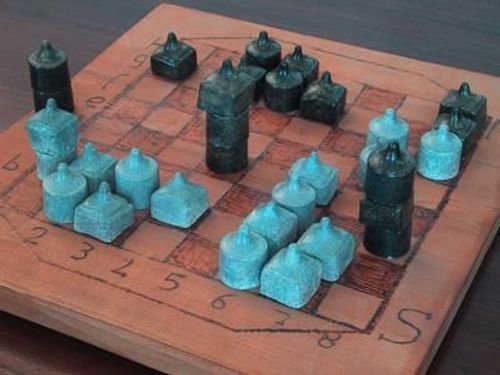
Gounki
Gounki Rulebook
Table of Contents
Table of Contents
Objective
Using strategy and careful thinking, be the first to get through your opponent's lines and place one of your pieces beyond the other side of the board.
Material
- An 8x8 board
- 16 white pieces (8 circles and 8 squares)
- 16 black pieces (8 circles and 8 squares)
Preparation
Each player chooses one colour and places his pieces as illustrated: squares on dark spaces and circles on light ones.
The player with the colour white begins.
[Figure omitted: starting position.]
Game Description
During each turn, players choose a piece and play it according to the rules specific to that piece.
He has the choice to move or to deploy that piece (i.e. separate it into several pieces if it was a compound piece). During that move, he may have the opportunity to stack his own pieces or to capture one of his opponent's pieces.
In any case:
- you cannot move backward, toward your own side,
- you cannot jump over other pieces.
The winner is the first player who places a piece beyond the opposite side of the board.
[Figure omitted: a double circle placed beyond the opposite side of the board, giving White victory.]
Movements
Simple Pieces
Simple circles move one step diagonally, always forward.
Simple squares move one step on the side or forward.
Stacks
During a movement, the player may choose to stack his pieces to form a compound piece. For instance:
- Stacking a square with a square gives a double square.
- Stacking a double circle with a square gives the compound piece circle-circle-square.
Pieces are composed of a maximum of 3 simple pieces.
The stacking order of squares and circles has no impact on the compound piece's movement possibilities.
[Figure omitted: three compound pieces, which are equivalent.]
Movements of Compound Pieces
Important: during a movement, a compound piece is always taken as a whole, like one "big piece". To separate that piece again into 2 or 3 simple pieces, you must deploy it (see below).
- A double circle moves like a simple circle in 1 or 2 steps.
- A double square moves like a simple square in 1 or 2 steps.
- A square-circle moves either like a square, or like a circle.
- A triple circle moves like a simple circle in 1, 2 or 3 steps.
- A triple square moves like a simple square in 1, 2 or 3 steps.
- A square-square-circle moves either as a double square, or as a simple circle.
- A circle-circle-square moves either as a double circle, or as a simple square.
During a movement, a compound piece cannot:
- be split into several pieces,
- change direction,
- jump over other pieces.
[Figure omitted: possible movements of double pieces.]
[Figure omitted: possible movements of triple pieces.]
Deployments
To split a compound piece into 2 or 3 simple pieces, you must deploy it.
To do so, the player takes the compound piece in his hand. He places his hand above a neighbouring space, drops a simple piece on that space, then continues this way until all the simple pieces of the compound piece have been placed (or deployed).
[Figure omitted: some possible deployments before and after.]
Rules concerning the order of deployments and the choice of destination spaces are the following:
- If a compound piece includes both circles and squares, you deploy all circles first, or all squares first. One cannot, for instance, deploy in the order 1-circle, 2-square, 3-circle again.
- The destination space of a simple piece is always chosen according to its normal possible movements: forward diagonal for a circle, on the side or forward for a square.
- If one deploys 2 or 3 circles, he has to deploy them in the same direction: one cannot slalom during deployments. In the same idea, 2 or 3 squares are always deployed in the same direction.
Example 1
Regardless of the real order in which the simple pieces of a circle-circle-square are stacked, the player may deploy:
- Either a square (one step forward or on the side), then two circles (two steps one after the other in the same diagonal).
- Or two circles (two steps one after the other in the same diagonal), then one square (one step forward or on the side).
Remember: keep in mind that these 3 compound pieces are equivalent.
[Figures omitted: possible deployments for a circle-circle-square, starting with the circles and starting with the square.]
Example 2
The figures below illustrate the different ways to deploy a square-square-circle, starting with the squares, or starting with the circles.
[Figures omitted: possible deployments of a square-square-circle, starting with the squares and starting with the circle.]
The deployment of a square-circle works like the deployment of a square-square-circle with only one square (or like the deployment of a circle-circle-square with only one circle).
Triple square and triple circle deployments follow the same principle.
Important Deployment Limits
During a deployment, one cannot:
- Deploy over a space occupied by an opponent's piece.
- Stop the deployment before the piece has been completely deployed.
Note: a winning deployment ends the instant a piece has been placed beyond the opposite side of the board.
Deploying Over Your Own Pieces
You can deploy a compound piece over your own pieces, as long as no piece made up of more than 3 simple pieces has been formed after the deployment is complete.
[Figures omitted: examples of deployments over other pieces, before and after.]
Rebounds
Composed pieces can bounce against the sides of the game board during their movements or deployments. This is not considered as a change of direction.
Rebound principle: if a piece cannot continue its movement because it meets the side of the board, it bounces like a tennis ball against a wall.
[Figures omitted: some possible movements with rebounds, and some possible deployments with rebounds, before and after.]
Captures
When a player moves one of his pieces onto a space which is already occupied by an opponent's piece (simple or compound), that opponent's piece is captured and removed from the game.
You can capture a piece during a movement, but not during a deployment.
If a player captures all his opponent's pieces, he wins the game, but this rarely happens. Be careful, "gluttony is a deadly sin!"
Strategy for Beginners
Before you start to read about strategy, my advice is for you to play a few games to make sure you really understand the rules. That's already done? Great, let's begin!
The fundamental aspect in Gounki is that it is a race. The goal is to be the first to place a piece beyond the other side of the board. Most of the time, you've got to choose position over capture, and play moves that make you quicker than your opponent.
In the Beginning
A good way to start a game is to build triple-mixed-pieces: circle-circle-square or square-square-circle. These are the most powerful pieces of the game because of their speed and flexibility.
The circle-circle-square is a very offensive piece. It can go sideways or forward, and can change its target side in only one move, thus exploiting possible weaknesses without giving the opponent time to organize his defence.
The square-square-circle is mostly defensive in the beginning of the game: when deployed, it can turn into a wall of mutually-defended pieces. On the other hand, because it includes two squares, it can mostly lead straight attacks, which is not very efficient in the beginning when most of the defensive pieces are still in the game.
Triple circles and triple squares are the quickest pieces but they have a lower number of possible movements or deployments, which makes them easier to block for the opponent. It is not advisable to build them at the beginning of a game.
[Figure omitted: in this example, White has taken a very good start. He has built two circle-circle-squares and has moved one of them forward to control the center. Furthermore, he kept a solid square structure for his defence. Black has chosen to build two different triple pieces, which gives him more possibilities. Unfortunately his defence has big holes! He will have to keep his square-square-circle backward to fill in the gaps.]
Capture vs. Speed
Because Gounki is a race, don't waste time in capturing pieces if this does not help you cross the board before your opponent does!
[Figure omitted: it's White's turn to play. He could capture the circle in h5 with g5, then g4 with g2 (with a rebound). But he prefers deploying g2 in g3, f4 and e5. Thus, he builds in e5 a double circle that threatens c7 and g7 at the same time. After that, he can win in 3 moves.]
End of the Game: Some Skillful Moves
Fork
Beware of a circle-circle-square quietly sleeping on a black space in its 3rd line.
[Figure omitted: another example: White could make an exchange by capturing d5 with e5. Black would then recapture with b7.]
Those pieces are identical, aren't they? Actually, that exchange would be bad for White, because the action takes place in the second half of the board. White needs 4 moves to build a circle-circle-square and put it in d5, while 3 moves do the job for Black.
If he makes that exchange, White loses one move, which is the advantage he gained when playing first at the beginning of the game. Rather, he should move c1 onto c2. Now, if Black makes the exchange, this is good for White.
Threatened by the black triple circle, White has moved his circle-circle-square from e4 to d4. Oh no! Now Black can win the game thanks to a fork. Indeed, Black moves d6 to f4. Doing so, he threatens both positions d2 and h2. If White defends on one side, Black takes the other one.
Most of the time, one should not make forks just to capture opponent pieces (again, capturing is not the main issue), but to win the game or to gain decisive advantage.
The circle-circle-square is very good for making forks, especially when placed on a black space. Indeed, the starting position defends white spaces very well, but not black spaces at all.
Winning Deployment
Black to play: he can win with his piece in b4.
[Figure omitted: solution.]
The black bouncing deployment (b4 * a3, b2, a2) creates a fork for the occupation of the a1 position.
Sacrifice
Often, one triple piece is not enough to go through the opponent's defence.
Here, the black defence is just solid enough to prevent White from going through with only one circle-circle-square. White has thus called for some reinforcement.
Be careful, this is a little complicated!
White to play. He has to be quick because the black piece in g4 can win in two moves with the g4 * f3, e2, e1 deployment. The only solution for White is to be quicker.
The sacrifice works for White: he captures b7 with b5, even if Black can recapture with b8. Then White moves his second triple piece from a5 to a6 and wins on the next turn by deploying a6 on the a7 and b8 cases. He wins when he goes off of the board in the c column when he deploys a6 * a7, b8, out.
Handicap
The player with the least experience takes White, which is an advantage. Nevertheless, if the black player wins too often, you can decide to give him a handicap to balance your games.
For instance:
- Black has to reach the other side of the board only in the C, D, E or F columns, or
- White can play two or three times in a row during the first turn.