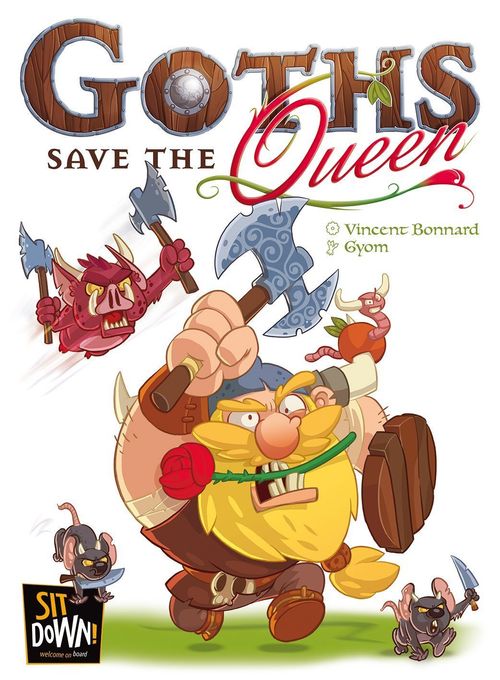
Goths Save The Queen
Goths Save The Queen Rulebook
Table of Contents
Table of Contents
Components
- 6 Terrain cards with a Landscape side (4 plains & 2 forests) and a Barricade side
- 3 Objective cards: one with a Trap side, one with a Plains side, and one with a Queen side
- 16 King cards (8 cards for each king)
- 18 Warchief cards (9 cards for each warchief)
- 2 Catapult cards (1 for each clan)
- 2 Player Aid cards (1 for each clan)
- 6 Goth figurines (3 for each clan) + 6 bases
- 4 Fog of War tokens (variant)
- 1 Initiative token
Goal of the Game
There are two different ways to claim victory:
- Successfully liberate the queen by advancing your army to the Objective card on which she can be found;
- Eliminate the enemy army.
In either case, the game ends immediately.
Setup
Divide yourselves up into two clans with two players each. One clan will play as the Ostrogoths (orange) and the other will play as the Visigoths (yellow). In each clan, one player will be the king, and the other will be the warchief. Take the deck of cards corresponding to your rank and clan. Set up the game as follows:
- Place each clan's Catapult card showing its Inactive side.
- Shuffle the Objective cards then line them up in the center, face-down.
- Each clan faces an identical set of Terrain cards: first a forest, then two plains, in that order toward the center of the table.
- Each clan places its army (comprising 2 of the 3 figurines) on the Forest card on its side of the table.
- Set each clan's third figurine aside for the moment; it will possibly be a reinforcement later.
- The Ostrogoths (orange) take the Initiative token; they will start the game.
No communication is allowed, in any way whatsoever, within the same clan. You cannot even agree on tactics to adopt before the game begins.
A. Issue Orders
I. The Initiative token changes to the other clan
Except on the first turn.
II. The king with initiative chooses a card
- The king with initiative chooses the character he wants to activate. He can choose between: the vulture, the recruiter, the catapult, the barbarian.
- He places the chosen card face-down on the table, so that everyone can clearly see the back of it.
III. The king without initiative chooses a card
He follows the same procedure as the king with initiative (see above).
IV. Each warchief chooses a card
- Each warchief tries to deduce which character his king actually wants to activate, based on the information at his disposal (the two characters visible on the back of his king's card, those visible on the enemy king's card, the configuration of the armies and the terrain...).
- Each warchief chooses one of his cards (depending on the character he thinks his king activated, he can have his choice between several different actions; see "The actions & their order of resolution") and places it in front of him face-down.
It's possible that there are face-up King cards already on the table, in addition to the King card that was just played face-down (see "Neither clan has communicated successfully" and "Only one clan has communicated successfully"). In this situation, the warchief can either play a card that definitely matches one of his clan's face-up King cards, or take a chance by trying to activate the face-down King card.
Anatomy of a King Card
- Front: a reminder of the character this card activates; a reminder of the actions the warchief could perform with this character; a reminder of the bluff depicted on the back of the card; and the character this card activates. Every character has some element in the color of its clan (orange or yellow).
- Back (visible to everyone): depiction of the character and the bluff (two characters are shown), and an illustration of the king of the clan.
B. Resolve of the Orders
When each warchief has placed a card face-down, reveal and resolve all of the King and Warchief cards.
For each clan, independently of the enemy clan, the warchief must take the action he has chosen, only if the order he played corresponds to the character his king chose. Thus, there are three possible situations at this point:
I. Neither clan has communicated successfully
- Each warchief takes his card back into his hand.
- Each king leaves his card face-up on the table. Neither clan can take an action this turn.
If a clan miscommunicates several turns in a row, all of the misguessed cards the king has played remain face-up on the table; add this one to the others.
II. Only one clan has communicated successfully
- The clan that was successful must take its action, after which the warchief takes his card back into his hand, and the king takes all his cards back into his hand.
- The warchief of the clan that miscommunicated takes his card back into his hand.
- The king of the clan that miscommunicated leaves his card face-up on the table. This clan cannot take any action this turn.
If a clan miscommunicates several turns in a row, all of the misguessed cards the king has played remain face-up on the table; add this one to the others.
III. Both clans have communicated successfully
- Each clan can take its action, and they take them in numerical order (see below).
- Everyone takes all their cards back into their hands.
C. The Actions & Their Order of Resolution
IMPORTANT: The clans' actions are never simultaneous! If both clans have selected the same action, the clan with initiative resolves theirs first.
The VULTURE can take one of the two following actions:
- Conduct reconnaissance - The warchief secretly looks at one of the three Objective cards in the center of the table, then returns it face-down. He cannot communicate anything about what he saw, not even to his own king!
- Sabotage the enemy catapult - Flip the enemy Catapult card so its Inactive side is face-up. If the enemy catapult was already inactive, this action has no effect.
The RECRUITER can only take the following action:
- Recruit reinforcements to his army - Add one unit to his army, on the card where the army currently stands. If all three units are already in the army, this action has no effect.
The CATAPULT can take one of the following two actions:
- Load - Flip the Catapult card so its Active side is face-up. If the catapult was already active, this action has no effect.
- Fire - If the enemy army is not on the Barricade side of a card, it loses two of its figurines. If the catapult was inactive, this action has no effect. Flip the Catapult so its Inactive side is face-up.
The BARBARIAN can take one of the following four actions:
- Construct a barricade in his army's current location - Flip the Terrain card so its Barricade side is face-up.
- Advance his army one card toward the Objective cards - You can neither retreat, nor advance onto the Terrain cards in enemy territory. If your army advances onto the Objective cards, the warchief chooses on which Objective card to place his army. Then he reveals that card. If it is the queen, his clan has won the game. If it is the trap, his army loses one unit. The Objective card that is a Plains card cannot have a barricade constructed on it. On a subsequent turn, the army can move (when the Advance order is correctly communicated) to any other Objective card (adjacent or not). An army on an Objective card is not protected from axe-throwing barbarians or catapult fire. Each Objective card can only hold one clan's army at a time.
- Throw an axe at the enemy army - If the enemy army is not protected by a forest or a barricade, it loses one unit; return it to the reserves, from which it can be recruited again later.
- Release rats into the enemy army - If the enemy army is on a barricade, it loses one unit; return it to the reserves, from which it can be recruited again later.
Note: If a clan can execute an action, but it has no effect, it is nonetheless considered successful, and the clan must take its cards back into its hand.
Game Tips
- When you are the king without initiative, pay attention to the card choice made by the enemy king, and adapt your choice of King card accordingly.
- There are two copies of each character in each deck of King cards, but each has a different back. Which one you choose can be an important hint to help your warchief in choosing which card to play.
- The orders are resolved in a very specific order, so anticipating the choices of the enemy king and warchief is very important.
Playing with 2, 3, 6, 7, or 8!
At sitdown-games.com, you can find the rules for playing with 2, 3, 6, 7, or 8 players. You need only one copy of Goths Save the Queen to play with 2 or 3, but in order to play with 6, 7, or 8, you will need a second copy.
Variant: The Fog of War
During the setup, place a face-down Fog of War token (drawn randomly from the four available) on each clan's Terrain card closest to the Objective cards.
When the respective army advances onto the Terrain card with the Fog of War token, reveal the token. Its effect only applies to the army that revealed the token. It remains in effect, wherever the army is, until the token is discarded.
You can use the vulture's Conduct Reconnaissance action to secretly look at your Fog of War token, rather than looking at an Objective card.
If your army is on the same card as the Fog of War token, you can use the barbarian's Construct a Barricade action to do one of the following:
- Construct a barricade as explained in the basic rules.
- Discard the Fog of War token, regardless of your army's position, to end its effect.
Effects of the four Fog of War tokens
- Pea soup - The vulture can no longer conduct reconnaissance.
- Reduced numbers - The recruiter can no longer recruit reinforcements.
- Boar shortage - The catapult is rendered inactive and cannot be activated.
- Gusts - The barbarian can no longer throw axes.
The Game at a Glance
A. Issue Orders
- I. The initiative token changes to the other clan
- II. The king with initiative chooses a card
- III. The king without initiative chooses a card
- IV. Each warchief chooses a card
B. Resolve Orders - Reveal the four cards. There are three possibilities...
- I. Neither clan has communicated successfully: 1. Each warchief takes his card back into his hand. 2. Each king leaves his card face-up on the table.
- II. Only one clan has communicated successfully: 1. The successful clan takes all their cards back into their hands and can resolve their action. 2. The warchief of the unsuccessful clan takes his card back into his hand. 3. The king of the unsuccessful clan leaves his card face-up on the table.
- III. Both clans have communicated successfully: 1. Resolve both actions in numerical order (if equal, the clan with initiative goes first). 2. Everyone takes all their cards back into their hands.