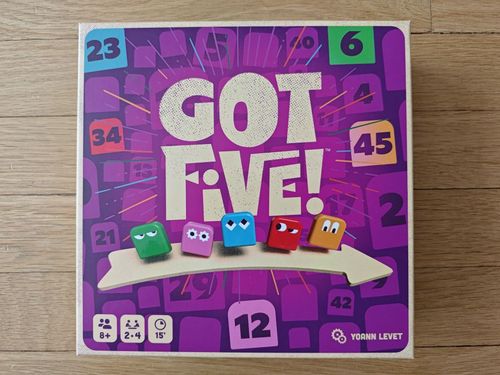
Got Five!
Got Five! Rulebook
Table of Contents
Table of Contents
Goal of the Game
Be the first to correctly guess your 5 hidden numbers, using the clues revealed over the course of the game!
Components
- 60 tiles in 5 colors. Each tile is unique, displaying a number on the front from 1 to 60 and showing 1, 2 or 3 dots.
- 4 stands: each with 5 tile slots and a sorting zone with 6 notches.
- 4 screens
- 4 game boards
- 4 dry-erase markers
Setup
A. Each player takes 1 screen, 1 game board and 1 marker. Place the screen in front of yourself and the board and marker behind your screen so other players can't see them.
Your board shows all 60 tiles in the game, including their color, number and number of dots.
B. Gather the 60 tiles in the center of the playing area and shuffle them face down: they form the supply.
C. Each player takes 1 stand. Place it in front of your screen so the other players can see it. Make sure the arrow is pointing towards your right.
For games of fewer than 4 players, return any unused components to the box.
Each player draws 1 tile of each of the 5 colors at random from the supply, without looking at their numbers. Place them in front of your stand with their numbers facing away from you and towards the other players.
IMPORTANT! Throughout the game, you must never look at the numbers on the 5 tiles on your stand, nor read out the numbers shown on your opponents' tiles.
Now ask 1 of your opponents to place your 5 tiles into the slots on your stand: they must arrange them in ascending order, in the direction of the arrow, placing the smallest number near the minus symbol and the largest number near the plus symbol.
D. Finally, nominate a player to draw 1 tile of each color at random and place them face up near the supply.
Example of 5 tiles placed in order on a stand (view from your opponents' perspective).
Example of setting up a 3-player game: each player (Emma, Adam, Luke) has their screen (A) hiding their game board and marker, their stand (C) with 5 tiles arranged in ascending order, and the 5 face-up tiles drawn near the supply (B and D).
Before starting the game, each player crosses out all the numbers visible on their opponents' tiles on their game board, as well as the numbers on the 5 face-up tiles near the supply.
You're now ready to play!
How to Play
The youngest player starts. Beginning with the starting player and continuing in a clockwise direction, each player plays their turn by carrying out the following 2 actions in order: 1. Reveal a Tile, then 2. Ask for a Clue.
After each action, all players cross out on their board any number that has been revealed and/or any number they can deduce for sure cannot be one of their 5 hidden numbers.
1. Reveal a Tile
Draw 1 face-down tile of a color of your choice from the supply. Flip it face up, announce its number out loud, then place it with the 5 other tiles already face-up near the supply.
2. Ask for a Clue
Select any 1 tile from those face up near the supply (there will always be 6 to choose from). Use it to ask your neighbor for either 1 of the following 2 clues: Sort or Compare.
A. Sort
Ask 1 of the players next to you to sort the tile you have chosen in relation to the 5 tiles on your stand. To do this, your neighbor must place this tile, flat and face up, in 1 of the 6 notches in your sorting zone. They must place the tile so that it fits into the ascending order of the tiles on your stand.
Example: Emma chooses tile 37 and gives it to her neighbor, Adam, who then places it in the notch between tiles 35 and 46 on Emma's stand.
- Each tile placed in this way remains visible to everyone until the end of the game.
- After several rounds of play, if the notch in question already contains 1 or more tiles, place the newest tile below those already there, making sure that all tiles remain visible.
B. Compare
Take the tile you've chosen and hold it above 1 of the 5 tiles on your stand. The colors don't have to match. Ask 1 of the players next to you if the 2 tiles have the same number of dots. Your neighbor must answer your question with a simple "Yes" or "No".
Example: Emma chooses tile 37 and holds it on top of the blue tile on her stand. She asks Luke if these 2 tiles have the same number of dots: Luke compares them and answers "Yes".
Place the tile you have chosen face up between your stand and your screen, in line with the tile it was compared with.
Emma places tile 37 between her stand and her screen, in line with her blue tile.
- Tip: if your neighbor responds with a "No", place the tile at an angle.
- Each tile placed in this way remains visible to everyone until the end of the game.
Your turn is now over, and the player on your left goes next. On your game board, cross out any numbers you think you can rule out according to any deductions you can make.
Use the 5 white boxes at the top of your board to write down the numbers of your 5 tiles as you make your deductions.
Refer to the direction of the arrow to remind yourself to put the numbers in the correct, ascending order.
"Oh no! I made a mistake..."
If you think you've made a mistake at any time during the game, don't worry! You can easily erase what's on your game board and re-do your deductions from square one. All the tiles revealed during the game remain visible to everyone, so it'll take you no time to re-do your deductions and get back into the game!
End of the Game
You have a single chance to announce your 5 numbers and find out whether you've identified them correctly. You can announce your guess at any time during the game, even if it's not your turn.
To do this, shout out "GOT FIVE!". Then one by one and in ascending order, list your guesses for the 5 numbers on your stand.
Your opponents must then confirm whether your guesses are right:
- If you guessed your 5 numbers correctly, you win the game immediately – Congratulations!
- If you made 1 or more mistakes in your guess, you lose the game – What a Shame! Watch from the sidelines to find out who wins!
If all but 1 of the players make a mistake in their guesses, the last player who has not yet made a guess automatically wins the game.