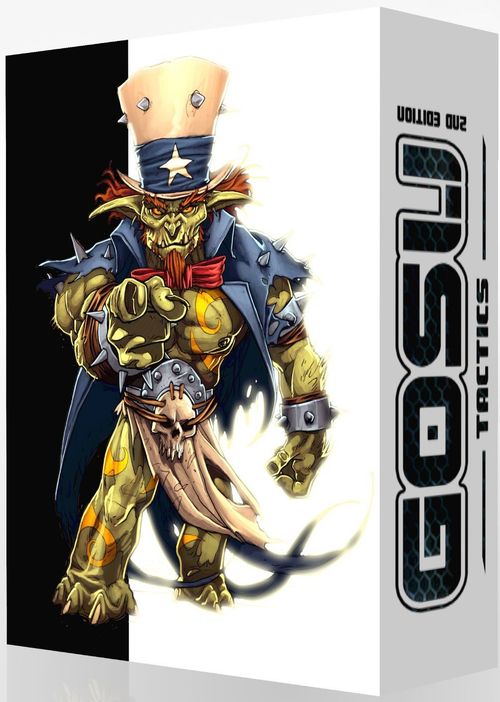
GOSU 2: Tactics
GOSU 2: Tactics Rulebook
Table of Contents
Table of Contents
Game Material
- 85 cards "Cold Foil" (or "glossy") including 75 "Goblin" cards, 9 "Victory Point" cards and 1 "Advantage" card.
- 1 rulebook in English and French.
The 75 Goblin Cards
There are 3 types of cards and 5 clans. The 3 types represent the 3 levels of Goblin in play: either 1, 2 or 3.
The level 1 Goblins are troopers, the Bakutos. There are 45 of them in the game (15 different, all in triplicate). In each group of 3 Bakutos, there is a Bakuto X which is slightly more powerful than the other two and which has a special "link" power.
The level 2 Goblins are seasoned warriors, the Heroes. There are 20 of them in the game (all different).
The level 3 Goblins are the generals, the Ôzekis. There are 10 of them in the game, each one unique.
The level of a Goblin is indicated on the upper right corner of its card.
The 5 Goblin clans are the Ancient Goblins, the Alpha Goblins, the Dark Goblins, the Méka Goblins and the Fire Goblins.
Game Objective
In GOSU: Tactics, each player is a Warlord recruiting Goblins to build his army. At the end of each round, a Great Battle takes place. The player having the strongest army at that moment scores one Victory Point. The first player to earn three victory points wins the game. You may also win the game by fulfilling one of the two instant win conditions.
Game Preparation
Separate the Victory Point cards and the Advantage card from the Goblin cards.
At the beginning of the game, all the Goblin cards are shuffled into a pile placed face down at the center of the table. It is the common draw pile. Next to this pile will be the discard pile, common to all players too. A first player is randomly chosen and takes the Advantage card. Then, each player draws ten (10) cards, looks at them, keeps seven (7) of them to build his starting hand, and discards the three (3) others. All players must discard simultaneously. The player with the Advantage card may now start the game, this is the first turn of the first round.
At the beginning of the game, if a player has no Bakuto (level 1) in the ten (10) cards he just drew, he may discard them all and draw ten (10) new ones from the draw pile. He may do so as long as he has no Bakuto in his hand. Once he gets at least one, he proceeds as normal, discarding three (3) of the ten (10) drawn cards to start the game with seven (7) in hand.
Game Round
During a game round, the players will play in turns, clockwise. When a player cannot play anymore, or decides to stop so as to keep in hand some good cards for the next round, he must pass. Passing is definitive and a player may not play again until the next round. Once a first player has passed, each other player may play only three (3) more turns. A game round ends as soon as all players have either passed or are out of game turns.
Be careful, each player may only take one action during his game turn.
So what actions are actually possible during a game turn?
During your game turn, you may do one of the following three (3) actions:
- Recruit a Goblin by adding its card to your army,
- Mutate a Goblin,
- Pass.
Recruiting a Goblin
The first Goblin you will be able to play must be a Bakuto (level 1). It is the foundation of your army and you will place it on the bottom left of your gaming zone. It will be the first card of your line of level 1 Goblins. This first Goblin is free. You do not have to pay a recruitment cost, whatever his clan. If he has a "come into play" effect, you may activate it before handing the active role to the player on your left (please remember that on your turn, you may do only one action).
From now on, starting on your next active turn, you will be able to recruit either a Hero (level 2) or other Bakutos (level 1).
Whatever their level, Goblins are placed in your army from left to right.
To place other Bakutos (from left to right with a maximum of 5 cards per line), the rule is very simple and applies ONLY to Bakutos (level 1). If the clan of the Goblin you want to recruit is different from those of the other Bakutos already in your army, you must discard 2 cards from your hand to pay the recruitment cost. If there is at least one Bakuto of the same clan, even if it is not next to the newly recruited goblin, then recruitment is free and you do not have to discard anything.
If you recruit five (5) Bakutos from the same clan, it will be completely free. But if you recruit five (5) Bakutos from the five (5) different clans, it will cost you a total of 8 cards (in addition to the 5 recruited goblins!). You will quickly see however that having different Bakutos in your army may be very useful and open more choices for Heroes and Ôzekis (level 2 and 3 respectively).
If the first Bakuto you played is destroyed, and provided that no other card is left in your army, the next Bakuto you will recruit will be considered as if it were the first one and will be free of charge.
If the first Bakuto you played is trapped (we will see what it means a little later), he is then considered as having no clan. But he is still part of your army. So, the next Bakuto you will play will cost you two (2) cards from your hand to recruit, no matter what.
How to recruit a Hero (level 2 Goblin)?
There are two rules to follow to recruit a Hero. Firstly, there can never be more Heroes than Bakutos in your army. Hence, for example, it is not permitted to have two Heroes on the second line with only one Bakuto on the first. Secondly, a Hero can be recruited only if a Bakuto of its own clan is present in your army. This Bakuto does not need to be in the same column as the Hero. It just needs to be on the first line of your army (the Bakutos' line). Thus, if you have, for example, three Bakutos of three different clans in your army, you may recruit up to three Heroes of any combination of these three clans (three of the same clan, one of each, two of one clan and one of the other, ...).
What about the Ôzekis (level 3)?
The rules for playing Ôzekis are very similar to those for Heroes.
First rule is that there may never be more Ôzekis than Heroes in your army.
Second rule is that an Ôzekis (level 3) may be played only if its clan is represented among the Heroes (level 2) AND the Bakutos (level 1) of your army. The placement is still the same, from left to right with a maximum of five (5) cards.
Please note that if during the game a Bakuto, unique member of its clan, is removed from the army, the Heroes and Ôzekis already present will not be destroyed. The two placement rules mentioned above only apply when a card is played. Thereafter, Goblins will live their own lives, often short, but always heroic.
Mutation
As a Warlord, you have incredible powers among which the ability to mutate a Goblin into another Goblin... Do not try it at home, all our Goblins are well-trained professionals!
Some Goblins have a mutation cost printed on their card. It means that they have the ability to mutate into a new Goblin. If no cost is indicated, the Goblin just cannot mutate.
Imagine that you want to get rid of a Goblin that has served its purpose. Some fresh blood could be useful sometimes! If this Goblin has a mutation cost, then your dream may come true! You just need to discard as many cards from your hand as the mutation cost mentioned on the mutating Goblin card. Then you replace it by a new one coming from your hand, of the same level, but not forcefully of the same clan.
Is it possible to mutate a Hero or an Ôzeki into another Hero or another Ôzeki coming from your hand, even though its clan does not exist on the lower levels of your army? Yes indeed! It is a smart way to bring in Heros or Ôzekis of a new clan without having to meet the clan rule of recruitment.
There is only one restriction to mutation: A card may never mutate into the same card as itself (Be careful, level 1 and 1X of the same name are considered as identical). If not, a wormhole opens in the space-time fabric and you end up in an alternate reality where chickens rule the world and enslave you, you will be hatching eggs until the end of your days... In short, it is very dangerous and so, it is absolutely forbidden: No Goblin will mutate into an identical Goblin.
Zombie Mutation
The Dark Goblins have one power of their own: Zombie Mutation. It is indicated by a yellow halo around the mutation symbol. The Zombie mutation works in the same manner as the standard mutation, except that when you replace the mutating Goblin, you may choose a Goblin of the same level either in your hand or in the discard pile! So, the bigger the discard pile is, the more choices you have.
Pass
Passing is definitive for the game round. And as we have seen earlier, when a first player passes, each one of his opponents has only three (3) more turns to play during this round.
The End of the Round and the Ensuing Great Battle
As soon as all players have finished their round, it is time for the Great Battle. Get the popcorn machine ready, things will get tough! So, how to determine the winner of a Great Battle at the end of a round? You just need to add the military strength of all the Goblins in your army, with the exception of the trapped ones. The player having the strongest army (i.e. the highest total) wins the Great Battle and takes a Victory card. A proud owner of three Victory cards wins the game.
In case of a tie during the Great Battle, if one of the players has the Advantage card, he alone wins the Victory Point. If not, then all the tied players take a Victory Point card. And if two (or more) players get their third Victory Point at the same time (meaning none of them has the Advantage card), then they all win the game (this is very very rare, don't worry!).
Small hint for counting your army strength: All Bakutos (level 1) are worth 2 Strength Points, all Heroes (level 2) are worth 3 Strength Points, and all Ôzekis (level 3) are worth 5 Strength Points. To add them up rapidly, count by column as one full column is worth 10 Points, half a column (just a Bakuto and a Hero) is worth 5 Points, and one Bakuto is worth 2 Points. So, the maximum strength of an army is 50 Points (5 columns worth 10 points each).
End of a Round
When a round comes to an end, all the players keep their army as it stands. The player having the Advantage card retains it. If no one has won the game, then a new round may begin.
Starting a New Round
At the beginning of each new round, two things happen in the following order:
- All trapped cards are released.
- Beginning with the player with the Advantage card and going clockwise, all players draw cards until having seven (7) in hands, minus one (1) per Victory Point card they possess. So, if a player has 1 Victory Point, he will draw new cards until having 6 in hand and in the same way, a player with 2 Victory Points will draw until having 5 cards. If a player has more cards in hand than the targeted number, he does not draw new cards nor discard any he has.
- After drawing, if a player has no playable goblin card in hand, whether through recruiting or mutation, nor can proceed to a zombie mutation in his army, he may discard his entire hand and draw that many cards, and may do so as long as he has no possible action to start the round with. Of course, this is not allowed anymore once the first turn of the new round has started.
The Advantage Card, How Does It Work?
At the beginning of the game, the player starting with the Advantage card is chosen randomly. At the beginning of each subsequent round, the player with the Advantage card keeps it and plays first. Only the powers of some Goblins allow a player to gain control of the Advantage card.
At What Time Are the Powers of the Goblins Triggered? And in Which Order?
The powers of the Goblins may be triggered on three (3) different occasions:
Come into play: Symbolized by the come-into-play icon. When a Goblin has one or more powers associated with this icon, the effects are triggered when the card is played, either through normal recruitment process or through the mutation of another Goblin.
Link: Symbolized by the link icon and by 4 symbols on the 4 sides of the card. When a Goblin has one or more powers associated with this icon, the effects are triggered whenever a card of the same clan comes into play either on its right, above it, on its left or below it. If more than one "Link" power is triggered by the new recruit, the player determines in which order he wishes to have them resolved.
Mutation: Symbolized by the mutation icon. When a Goblin has one or more powers associated with this icon, the effects are triggered whenever this Goblin is mutated into another Goblin.
For example, in a single turn, you may trigger four (4) different powers: Mutation + Come into play + 2 links.
Some Important Remarks
There is no maximum number of cards you may have in your hand. Having 15 cards in hand is possible, but it is at your own risks!
A card that is discarded, destroyed or mutated is placed face up onto the discard pile. Players may check the content of the discard pile at any time and as much as they like.
Whenever a power requires a player to draw or reveal cards from the draw pile and the draw pile depletes, the discard pile is immediately shuffled back into the draw pile.
Instant Victory Conditions
If at any time during the game a player has a full army of 15 cards or 9 cards of the same clan (face up), he immediately wins the game.
Let's Now See What the Powers in Play Are
There are 7 types of powers in the game, each one having its own symbol. These powers are available either in 'base' mode or in 'MAX' mode.
Destruction
Destroy a free card: A free card is defined as a card having neither a card above it nor on its right. Please note that during the game, only free cards may be destroyed. We suggest that you destroy your opponent's free cards instead of yours. It's often better.
Swap 2 cards of the same level in the army of your choice: You may perform the swap either in your army or in one of your opponent's. This action helps you protect a free card by moving it at the beginning of a line or, vice versa, make vulnerable one of your opponent's cards. It also allows you to create more powerful "link" combinations.
- Base: Choose a level 1 or 2 free card and destroy it.
- Max: Swap 2 cards of the same level in the army of your choice, then choose a level 1, 2 or 3 free card and destroy it.
Trap
Trap: Some Goblins have the power to trap other Goblins. Once again, it works better on your opponent than on yourself! When trapping a card, just flip it face down. A trapped card does not hold any military strength nor any power of any sort, and it does not belong anymore to any clan either. Hence, this may prevent an opponent to play some cards by removing the key clan representative from his army. A trapped card is automatically released at the beginning of a new round (round, not turn!).
- You may trap a card that is not "free".
- A trapped card may be destroyed if it is "free".
- A trapped card cannot mutate.
- It is possible to play a card above the trapped card as the trapped card still belongs to the army.
- Since a trapped card is clanless, it isn't accounted for an instant victory with 9 goblins belonging to same clan, but it still is considered as a goblin and doesn't prevent a player to win the game if he controls 15 cards in his army.
Release a card: This is the action of flipping over a trapped card to its face up position.
- Base: Choose one card of level 1 or 2 and trap it.
- Max: Choose a card of any level and either trap or release it.
Discard
- Base: The player of your choice must discard one card from his hand.
- Max: All players (you included) must discard half of their cards in hand (rounded down).
Draw
- Base: Draw one card.
- Max: Draw as many cards as the number of clans in your army (therefore, 1 up to 5).
Vision
- Base: Reveal the next 5 cards of the draw pile, take 1 in your hand and discard the other 4.
- Max: Reveal the next 5 cards of the draw pile, take 2 in your hand and discard the other 3.
Return
- Base: Take back from the discard pile 1 card of the same clan as this Goblin.
- Max: Take back from the discard pile 1 card of any clan.
Advantage
Play an extra turn after this one: Thus, you will play one more turn. You may cumulate more than one extra turn.
Important: these extra turns do not count against the limit of 3 turns authorized once a first player has passed.
- Base: Take the Advantage card then play an extra turn after this one.
- Max: The player(s) with the lowest number of Victory Points immediately draws 2 cards. Then, you take the Advantage card and play an extra turn after this one.