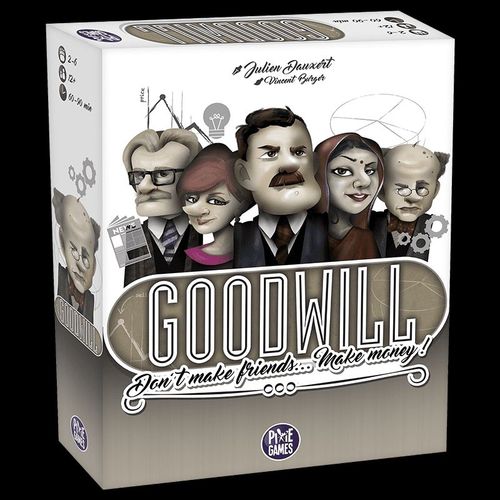
Goodwill
Goodwill Rulebook
Table of Contents
Table of Contents
Contents
- 3 "Company" boards
- 1 "Game turn / Ressources price" board
- 1 "Event" board
- 6 price indicators composed of 2 wheels
- 3 x10 "Share" cards
- 9 "Boss" cards
- 24 "Event" cards
- 21 "Percentage" cards
- 3 "Ressources price" tokens
- 18 "Ressource" tokens (6 of each type)
- 3 "Market Share" markers (one color for each company)
- 1 "Game Turn" marker
- 15 "Gold bars" tiles
- 72 Banknotes (1 to $100)
Setup
- Place the 3 "Company" boards at the centre of the table.
- Place $100 in gold bars on Crimson and Black's safe, and $110 on Amber's. This is the capital of each company. Put the left gold bars aside to make a reserve.
- Place the "Market Share" arrows on each company's scale: 35 % for Black and Crimson; 30 % for Amber. This indicates the market share of each company at the beginning of the game.
- Place randomly a "Ressource" token on each space of the "Company" boards. Put the tokens left aside to make a reserve.
- Place the "Game turn / Ressources price" and "Events" boards nearby.
- Place the 3 "Ressources price" tokens on the '$10' space on the price's scale of the board.
- Place the "Game turn" token on 1953.
- Shuffle the "Percentage" cards, form a deck facedown and place it on the indicated space.
- Shuffle the "Events" cards, and form a deck, facedown and place it on the indicated space.
- Make 4 pairs of cards facedown with a "Percentage" and an "Event" card on each indicated space.
- Shuffle the "Boss" cards and place randomly one face up on each "Company" board.
- Make a deck facedown with the "Boss" cards left and reveal the 3 first cards. They will present the available bosses at the beginning of the game.
- Shuffle the 30 "Share" cards together and deal them, one at a time, to each player in the clockwise direction.
- Special case: In a 4-player game, you must remove 2 share Crimson cards before dealing the shares.
- During the setup, the shares of each company are equally distributed to each player, 5 for each player.
- Each player takes a price indicator composed of 2 wheels. The player will be able to give prices between 0 and 38, and receive $100. Put the remaining Banknotes aside to make the Bank.
You are now ready to play! The players can now look at the informations, one by one, they are allowed to see.
Example: Player 2 (blue) can see informations indicated by the number 2 (blue).
Goal of the Game
In Goodwill you will assume the role of an investor. Throughout the game, you will have the opportunity to invest on 3 different companies which share the same market. The main goal for each company is to choose low cost energies, and upgrade their process to consume the least possible of these energies.
Each player will have access to news about the future, and they will help them in their investing choices. They will get information about the prices of energetic resources, on the discoveries done by their research centers, on the acquisition of market shares or any other surprises about their boss.
After 5 turns, the winner will be the player who has done the best choices for their investment.
Game Turn
A turn in the game represents a year. Each turn is composed of 4 phases which must be applied in the following order:
- Drawing and placing the Events
- Transactions and replacement of the boss
- Revealing "Events"
- End of the year
1 - Drawing and Placing the Events
One of the players draws 4 Events/Percentage pairs and places them on the main board. An Events/Percentage pair will be called an information. These pairs represent the informations available to the players for this year. 3 of these informations will be transformed into events at the end of the turn.
2 - Transactions and Replacement of the Boss
The companies will always be reviewed in the same order, e.g. Amber first, Black second and Crimson third. For each of them, there will be 2 transactions and a possible boss replacement.
I - Transaction
There will be 2 transactions per company per turn.
Each player will do an assessment of a share of the company value. In order to write it down secretly, they will use their price indicator composed of 2 wheels. Each player will place this facedown. When everybody is ready, each assessment is revealed and said aloud.
The player who has set the highest price will buy a share from the player who has set the lowest price. It is compulsory. But which price? It will be an average price between their 2 prices.
Example for Amber company:
- Player 1 gives $10.
- Player 2 gives $12.
- Player 3 gives $14.
- Player 4 gives $16.
Player 1 must sell an Amber company share to player 4 for $13.
Don't forget to do a second transaction (assessment and resolution).
But how can you do the assessment? At the end of the game, each share will cost one tenth of the value in the safe of the company. It means that at the beginning of the game, Black and Crimson shares are worth 100/10 so it is $10 and Amber shares are worth 110/10 so it is $11. According to the information you have access to, you can estimate if this company or the other one will lose or earn money. If you think they will lose some money, choose 8 or 10 at the beginning. If you think they will earn some money you had better choose 12 or 14. At the end of the first turn everything will be clearer.
II - Replacing the Boss
All the players who have a share of the company can promote a new boss, taken from the available bosses.
This player recommends and organizes a vote for the company shareholders. Of course during the debates, you can speak louder than the others in order to get their votes. Each share = 1 vote.
Each shareholder can vote either "yes" or "no" for the suggested new boss. If this "yes" gets 6 votes or more, the boss is replaced in this way:
- Remove the old boss from the board, and put it at the bottom of the boss deck pool.
- Place the new boss card on the boss space of the corresponding company, on the board.
- Draw the top boss card from the deck pool and place it face up with the available bosses.
If "yes" doesn't get 6 votes or more, the replacement is not done.
3 - Revealing "Events"
One player will flip face up the central information, that is to say the 4 percentage cards and the 4 event cards. The lowest percentage card will be removed and placed back in its deck. The same will be done for the attached event card.
The 3 other events will be achieved in the descending order of the attached percentages.
Example: If the 4 percentage cards are: 80 %, 50 %, 25 % and 10 %. The event card attached to the 10 % card will not be played, and as a result the cards (both event and percentage) will be placed back in their respective deck. Firstly, the event attached to the 80 % card will be played, then the event attached to the 50 % card, and finally the event attached to the 25 % card.
On each event card, there are 2 events, the event on the left is placed first and then the event on the right.
There are 7 different types of events detailed in the Appendix.
4 - End of the Year
I - Calculation of the Result
For each company, you must make the following subtraction:
Number of market share - Amount of resource prices - Boss' salary = Result
The number of market shares is a direct reading, and it is between 0 and 100. The price of the resources can be seen on the price scale on the board. The boss' salary can be found on the boss card of the company.
- If the result is < 0, the amount of the result is taken from its capital and given to the bank. If the company cannot pay, it goes bankrupt (see Bankruptcy). Bankrupts are resolved after all the calculations of the results.
- If the result is > 0, the amount of the result must be given by the bank, in gold bars, to the company capital.
- If the result = 0, nothing happens.
Example: Amber has 30% of market shares. Its resources cost $25 (2 x $5 for the petrol and $15 for the workers). Its Boss has a $5 wage. 30 - 25 - 5 = 0; nothing happens.
Black has 35% of market shares. Its resources cost $35 (2 x $10 for the charcoal and $15 for the workers). Its Boss has a $10 wage. 35 - 35 - 10 = -10; Black should pay $10 from its capital.
The Gold bars are two-sided so they can indicate the capitals of the companies.
II - Shuffling the Cards
The event cards are shuffled with the deck of event cards in order to form a unique pile which is placed on the central board. Repeat the same process for the percentage cards.
III - Advancing the Year Marker
This marker is moved forward one space.
End of the Game
The game ends when it is the end of the year 1957.
Score for each player
Amount of their equities portfolio: the value of the share is the value of the company capital divided by 10 (rounded up) + amount of their cash (banknotes). The richest player wins the game.
Example:
- Player 1 has $20 in banknotes + 2 Amber shares + 1 Black share + 3 Crimson shares.
- Player 2 has $10 in banknotes + 2 Amber shares + 4 Black shares + 1 Crimson share.
- Amber capital = $80 -> share value = $8
- Black capital = $110 -> share value = $11
- Crimson capital = $25 -> share value = $3
- Player 1 has: $20 + (2x$8) + (1x$11) + (3x$3) = $56
- Player 2 has: $10 + (2x$8) + (4x$11) + (1x$3) = $73
- Player 2 wins the game.
Appendix: Events in Detail
There are 7 types of events:
a) Price variations for the resources
The symbol of the concerned resource for this event is written on the card, as the price variation is: +5; -5; +10 or -10. For each concerned resource, you must move forward or backward the marker on the price scale of the board, according to the written variation.
Example: If this is written on a card -> Oil +10; and the Oil marker is on the 10 space of the price scale; you must move forward the marker to reach the 20 space.
The maximum price is $25. The minimum price is $0.
The resource price level has an important impact on the results of the depending company at the end of the year.
b) Funding
The symbol of the concerned resource for this event is written on the card. The companies having this/these resources get $10 for each resource. This event has an immediate impact on the company capital.
Example: If a charcoal funding happens, Black should receive $20 in Gold Bars from the bank.
c) Tax
This event is the contrary of the "Funding" event. The symbol of the concerned resource for this event is written on the card. The companies having this/these resources must pay $10 for each resource. This event has an immediate impact on the company capital.
If a company cannot pay the tax (insufficient capital), it goes bankrupt -> see Bankruptcy.
The 3 following events depend on the boss of the companies.
- Innovation symbol: a light bulb.
- Efficiency symbol: gears.
- Advertising symbol: a newspaper.
Each event is attached to a number from 1 to 3. For each of these events the first step is to find to which company they will be applied. To do this, you must refer to the 3 boss cards placed on the board (e.g. the 3 bosses running a company). For each sector (Innovation, Efficiency and Advertising), the bosses have a mark from 0 to 3 (0 meaning the boss doesn't have this ability, 3 meaning the boss excels in it). The bosses who have the ability, and exactly the same number as the one written on the event card, will see their company benefit from the event.
d) Innovation
Transform a resource into another resource.
For each company concerned by the innovation event, you must compare the energy policy of the boss to the resources the company must pay.
For each boss card having at least one light bulb, its energy policy is detailed on the card as a list of lines (each with an arrow). For each line, the resource on the left of the arrow is the resource the boss wants to give up, whereas the resource on the right is the resource the boss wants to use now. The first line is the boss' top priority, the second is its second priority.
- If the company concerned by the innovation event has a resource the boss wants to give up then the resource is replaced by the resource the boss wants to use now.
- If the 1st priority cannot be applied then the 2nd priority is activated.
- If the company concerned by the innovation event only has resources the boss wants to use now, nothing happens.
If a resource change is possible, it must be done.
e) Efficiency
Decreasing the number of used resources.
For each company concerned by the efficiency event:
- If the company has a resource and a copy of this resource, one of the two is deleted; that is to say one of the tokens is removed from the board. (If the 3 resources are identical, one of the 3 is removed.)
- If the company has only one resource or just different resources, nothing happens.
Each company must have at least one resource. (A company cannot have 0 resource.)
f) Advertising
Acquisition of market share.
The company concerned by the advertising event will take 5 % of the market shares of the 2 other companies. It means +10 % for this company and -5 % for the others. These evolutions are modeled by moving the arrow of the company color on the market share scale from 0 % to 100 % on each company board. This event causes changes for all the companies.
The total of the market share of the 3 companies is always equal to 100 %. The market share for a company can vary from 0 % to 100 %.
g) Scandal
The name of the company targeted by a scandal is written on the event scandal card.
Its boss must leave the company. Its card is placed at the bottom of the boss deck pool.
Moreover, it discredits the company and it loses 10 % of the market share. The company gives 5 % to each of the 2 other companies. (10 % to the other if there are only 2 companies left.) If the company only has 5 %, it gives it to the company with the highest market share. This event causes changes for all the companies.
Situation of a Company Bankruptcy
If a company cannot pay (a tax or the annual result) then it goes bankrupt.
- The shares of this company are worth 0 and they are taken back from the players.
- The boss card of this company is placed facedown at the bottom of the boss deck pool.
- The market shares are reallocated fifty-fifty to each remaining company. As the scale is numbered in 5s, if there is a five left it goes to the company which has the highest market share.
Special Situations During the Transactions
Detailed rules to solve these cases:
- If a player no longer has the share and he has chosen the lowest price.
- If several players have chosen the highest price.
- If several players have chosen the lowest price.
- If a player hasn't got enough money and he has chosen the highest price.
The high marketers are the players who have chosen the highest price. The low marketers are the players who have chosen the lowest price among the players who have the concerned share.
The price is always the average price: (value of the high marketer group + value of the low marketer group)/2.
The high marketers who have less cash than the calculated average price are excluded from the transaction and as a result from the high marketer group. (If there is none left in the high marketer group, you must redo the resolution of this transaction regardless of the excluded players.)
The number of transactions is equal to the number of the smallest group among these 2 groups. If a group is more numerous than the other, the players from the smallest group choose the player they are going to do the transaction with. In this case, a player can only be chosen once.
The players who belong neither to the high marketer group nor the low marketer group are just mere spectators.
Example 1:
- Player 1 has chosen a $10 price and they don't have the concerned share.
- Player 2 has chosen a $12 price.
- Player 3 has chosen a $10 price.
- Player 4 has chosen a $16 price.
- Player 5 has chosen a $16 price.
- Player 3 chooses the player they will sell the $13 share to, between player 4 and 5.
Example 2:
- Player 1 has chosen a $10 price.
- Player 2 has chosen a $10 price.
- Player 3 has chosen a $16 price.
- Player 4 has chosen a $16 price.
- Player 5 has chosen a $18 price but they only have $6.
- Player 3 buys a $13 share from player 1.
- Player 4 buys a $13 share from player 2.
Special Case for Advertising
Each company concerned by the advertising event will get 5 % of market shares from the other companies which have at least 5 % of market shares. This means:
If there is only one company concerned by the advertising event, it will get 10 % of market shares. But where will it be taken?
- If the 2 other companies have at least 5 % of market shares, then each of these two companies will lose 5 % of market shares.
- If one of the 2 other companies has 0 % of market shares, the third one will lose 10 % of market shares.
If 2 companies are concerned by the advertising event, then each of these companies will get 5 % of market shares and the third one loses 10 % of market shares.
- If this 3rd company has 0 % of market shares, nothing happens.
- If this 3rd company has 5 % of market shares, then it will give its market shares to the company which has the biggest market shares.
If the 3 companies are concerned by the advertising event, nothing happens.
If there are only 2 companies left:
- If 1 company is concerned, then this company takes 10 % of market shares from the other company.
- If both companies are concerned, nothing happens.
4 Player-games
In a 4-player game, you must remove 2 share Crimson cards before dealing the shares. The majority +1 will be reached for the vote of the boss if 5 votes are given and not 6 as usual. Nothing else changes.
Variants
Length of the Game
According to the time you have, you can choose the number of years you want to play at the beginning of the game. Place the year marker on 1954 for a short game (4 turns) or on 1951 for a longer game (7 turns).
Advanced Player Mode - Dividends
Definition of a dividend: part of the profit given for each share of a company.
It is done during the calculation of the results at the end of the year. 2 conditions must be met in order to have dividends given for a company:
- The result of the year must be >5.
- The boss of the company must have the ability "Gives dividends".
The result is distributed to the players regarding the number of shares of the company they have. There are 10 shares for each company (even for Crimson in a 4-player game), so when having a share you win a tenth of the result of the company.
Only the tens are distributed, the rest (<10) is given to the capital.
Example: if Bobby, who gives dividends, is the Amber boss, and Amber result is +$25 at the end of the year, each shareholder will get $2 for a share of the company. It means that $20 are distributed to the shareholders. The remaining $5 are given to Amber capital.
Variant for Expert Players - Cash Only
At the end of the game, only the cash the players have is counted during the scoring. Dividends are more than important!